
How to Avoid Burnout on a Marketing Team with Clear Roles and Boundaries

A marketing team can hit every deadline and still be running on empty. Learning how to avoid burnout on a high-pressure marketing team starts with looking beyond output: persistent exhaustion, growing detachment or cynicism, and a sense that your work is becoming less effective can all signal a problem. The World Health Organization describes burnout as an occupational phenomenon, not a medical condition.
If you work in or lead a marketing team, you may recognise the pattern: competing priorities, constant requests and little time to reset. Pushing through can seem like the quickest way to keep campaigns moving, but workload and team norms matter too. Clear roles, realistic priorities and communication boundaries can make pressure more manageable.
This article explains how workplace burnout develops, which emotional, behavioural and performance warning signs to look for, and what leaders and teams can change. You’ll find practical ways to clarify ownership, make trade-offs visible, protect breaks and set expectations for incoming work, so the team can deliver sustainably without treating every request as urgent.
Table of Contents
1. What Are the Signs of Burnout at Work?
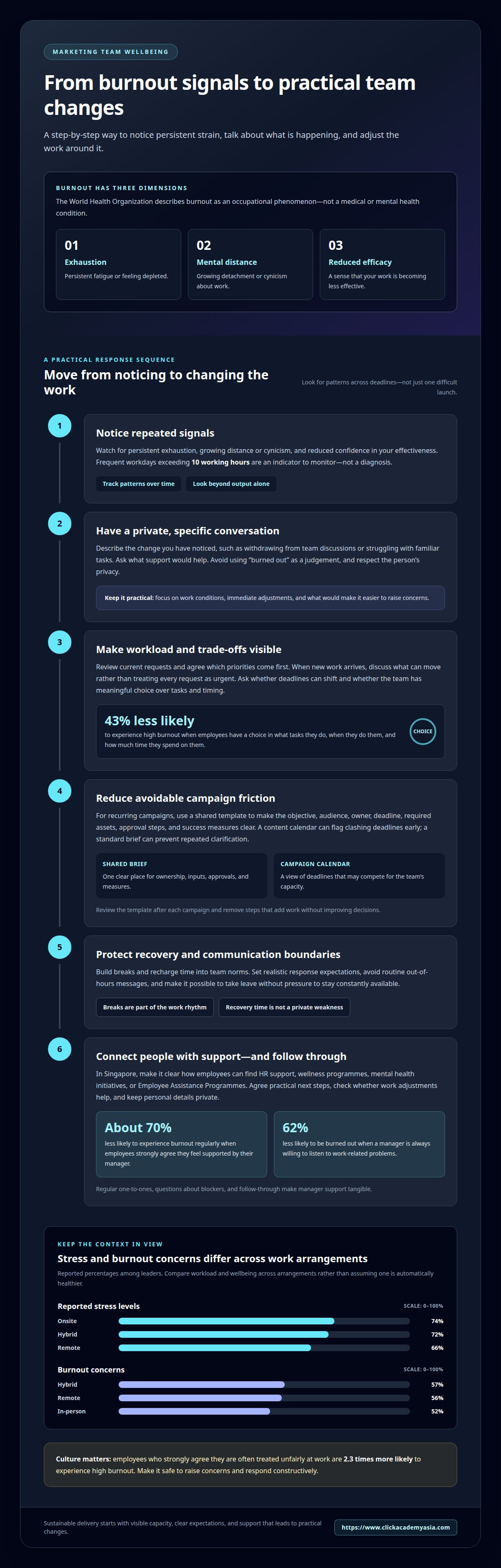
The World Health Organization describes burnout through exhaustion, job-related mental distance or cynicism, and reduced professional efficacy. These signs may appear as persistent fatigue, detachment from campaigns, or difficulty feeling effective despite completing tasks. Track patterns across deadlines, not just one difficult launch. Frequent workdays exceeding 10 working hours are an indicator to monitor when assessing burnout risk.
Work arrangements alone don’t explain stress. Reported stress levels among leaders were 74% for onsite leaders, 72% for hybrid leaders, and 66% for remote leaders. Burnout concerns followed a different pattern: 57% among hybrid leaders, 56% among remote leaders, and 52% among in-person leaders. These figures show why teams should monitor workload and wellbeing across each arrangement, rather than assuming one is automatically healthier.
Burnout also affects creative work. A survey reported that seven in 10 professionals across media, marketing and creative sectors experienced burnout during the preceding 12 months. High-pressure agencies and in-house teams can both face risk, though their pressures may differ. Agencies may balance several client deadlines, while in-house teams may manage internal requests and shifting priorities. Compare the demands, control and support in each team, rather than assuming one setting carries greater risk.
Culture shapes whether people can raise concerns before stress builds. Employees who strongly agree they are often treated unfairly at work are 2.3 times more likely to experience high burnout. Leaders can make wellbeing visible by discussing capacity during campaign planning, responding constructively to concerns, and recognising recovery time as part of sustainable delivery. Connect assignments to organisational purpose too: explain which audience need or business priority each campaign serves. That context helps employees see how their contribution fits broader goals.
Repeatable processes can reduce avoidable pressure without lowering standards. For recurring campaigns, use a shared template that captures the objective, audience, owner, deadline, required assets, approval steps and success measures. A content calendar can flag clashing deadlines early, while a standard brief can prevent repeated clarification. Review the template after each campaign and remove steps that add work without improving decisions. These practical signals help leaders adjust workloads and distinguish a demanding period from a persistent pattern.
2. What Is Workplace Burnout?
The World Health Organization describes burnout as an occupational phenomenon, not a medical or mental health condition. It has three dimensions: exhaustion, job-related mental distance or cynicism, and reduced professional efficacy. This distinction helps leaders discuss working conditions without labelling an employee or making a diagnosis. Keep the response practical: notice changes, ask what is affecting work, and address workplace factors.
Managers can notice possible burnout through changes in behaviour, such as withdrawing from team discussions, growing cynical about campaigns, or struggling to complete familiar tasks. Speak privately, describe the specific change you have noticed, and ask what support would help. Avoid using “burned out” as a judgement. A calm, confidential conversation makes it easier to raise concerns without stigma.
Recovery may take weeks, months or longer, and severe cases can extend beyond a year. Rest and self-care can be part of recovery, while professional help such as counselling or therapy may also be appropriate. Managers should not try to diagnose or treat an employee. Instead, discuss immediate work adjustments and give them space to access suitable support.
In Singapore, employees can ask their HR team about available support, including wellness programmes, mental health initiatives and Employee Assistance Programmes. Make the route clear: explain where to find information, how to access support, and who can discuss workload changes. Employees should not have to share personal details with the whole team to ask for help. Respect privacy while agreeing on practical next steps.
Manager support matters. Employees who strongly agree they feel supported by their manager are about 70% less likely to experience burnout regularly. Employees whose manager is always willing to listen to work-related problems are 62% less likely to be burned out. Leaders can make listening tangible by scheduling regular one-to-ones, asking what is blocking progress, and following through on agreed actions.
Individual support works best alongside organisational changes. Review how requests are assigned, whether deadlines can move, and whether employees have meaningful choice over tasks and timing. Employees are 43% less likely to experience high burnout when they have a choice in what tasks they do, when they do them, and how much time they spend on them. Build recharge time into team norms, including taking leave without pressure to stay constantly available.
A well-being-supportive culture treats capacity as part of planning, not a private weakness. Leaders can model boundaries by setting realistic response expectations and avoiding routine out-of-hours messages. Leaders guiding teams through change can also build relevant capabilities through ClickAcademy Asia Digital Transformation for Leaders training, supporting more sustainable ways of working.
3. Workload, priorities, roles, breaks, and communication boundaries
Evidence-based prevention focuses on work design: set priorities, clarify ownership, protect recovery time, and make workload trade-offs explicit. For employees working 45 or more hours a week, burnout risk is influenced more strongly by how they experience their workload than by hours alone. Leaders should review both capacity and control, not just timesheets. That’s a practical starting point for how to avoid burnout on a high-pressure marketing team.
Start each planning cycle by agreeing on the most important goals. A marketing team might prioritise a product launch and customer retention, then defer lower-impact requests. Name an owner, decision-maker and deadline for each deliverable. Clear roles prevent duplicated work and give team members a route to resolve conflicting instructions without carrying every decision themselves.
Make incoming work visible before accepting it. Use a request form to capture the objective, deadline, required assets, audience, approver and reason for urgency. Assess each request against current priorities. If it must proceed, identify which existing task will move back. This capacity rule makes trade-offs explicit and prevents every new request from quietly becoming an extra deadline.
Separate genuine fire drills from ordinary urgency. A campaign launch affected by a broken landing page may need immediate attention; a late request for a routine social post may not. Define what counts as an urgent interruption and who can approve one. Lock priorities for a set planning cycle, and explain changes when business needs require a pivot. This is a practical way to avoid burnout on a high-pressure marketing team by reducing reactive workload shifts.
Content work benefits from predictable workflows. Use a shared calendar for drafts, reviews, approvals and publishing, so editors can spot deadline clashes early. Standard templates for creative briefs and campaign plans reduce repeated clarification. Marketing automation can handle routine email or social scheduling, while people retain decisions requiring strategy or judgement. Review recurring tasks and remove steps that no longer serve the campaign.
Protect breaks and focused work in the schedule. Leaders can block uninterrupted time for complex planning, set no-meeting periods and encourage lunch away from desks. Set communication expectations too: routine updates can go in shared documents, while urgent issues use an agreed channel. State response windows clearly, so employees aren’t expected to monitor messages constantly.
Finally, rotate work where practical. After an execution-heavy sprint, make time for strategy, customer listening, creative development or process improvement. In one-to-ones, ask which task is taking more capacity than expected and what can be stopped, shifted or simplified. Regular adjustments make boundaries operational instead of leaving employees to manage unsustainable workloads alone.
4. Early emotional, behavioural, physical, and performance warning signs
Look for changes from an employee’s usual pattern, not just one difficult day. Emotional signs can include irritability, anxiety about routine feedback or growing detachment from campaign work. Behavioural shifts may include withdrawing from discussions, avoiding decisions or reacting unusually strongly to edits. Persistent tiredness or difficulty switching off also deserve attention. These observations are prompts for a supportive conversation, not a diagnosis.
Performance changes can be subtle at first. A marketer who usually catches broken links might miss them, or a content lead may struggle to finish familiar briefs. In Marketing Week’s 2025 Career & Salary Survey, 40.3% of surveyed marketers reported feeling ineffective in driving campaign results. That finding highlights why leaders should discuss obstacles and workload, rather than treating every missed target as an individual performance failure.
Separate an outcome from the factors an employee can influence. A campaign’s results may depend on budget, timing, approvals, audience response, and platform changes, not only an employee’s effort. Employees who strongly agree their performance metrics are within their control are 55% less likely to experience burnout frequently. Review whether targets reflect the person’s actual remit, access to resources, and decision-making authority.
Performance pressure can also hide early distress. An employee may keep meeting deadlines by working through breaks, while exhaustion, emotional strain, or frequent mistakes accumulate. DDI’s Global Leadership Forecast 2027 found that 19% of leaders frequently feel used up at the end of the workday. Use regular one-to-ones to ask what feels difficult, what has changed, and which expectations need adjusting.
Burnout can affect confidence as well as output. Employees who very often or always experience burnout at work are 13% less confident in their own performance. Leaders should avoid responding to a temporary dip with tighter monitoring or public criticism. Instead, compare recent work with the employee’s normal pattern, clarify priorities, and agree on a practical support step, such as narrowing the brief or revisiting a deadline.
Team norms shape what employees feel safe to report. If a marketer believes every campaign must be flawless, they may conceal uncertainty until errors surface late. Make expectations specific: define what “ready for review” means, who approves the work and which risks require escalation. When discussing performance, ask about conditions as well as results. This helps distinguish a skills gap from unclear ownership, shifting goals or sustained pressure.
Respond to repeated signs rather than waiting for a crisis. Note observable changes at work, check in privately and agree on a follow-up. If the employee describes ongoing distress, discuss available workplace support and encourage appropriate professional help. A clear response protects their dignity while giving leaders a more reliable view of team capacity and campaign delivery.
5. Marketing burnout symptoms and business impact
Burnout’s impact rarely stays with one person. In a marketing team, exhaustion can slow reviews, weaken collaboration, and delay decisions across shared campaigns. A leader who feels used up is 3.9 times more likely to learn about issues later than they should. That delay can leave team members responding to avoidable problems under even tighter deadlines.
The effects also reach commitment and delivery. A meta-analysis of 16 empirical studies found that workers with higher exhaustion reported lower commitment, with a correlation of r = -.19. The same analysis found a correlation of r = -.22 between exhaustion and reduced ability to perform roles well. These findings point to a practical risk: constant overload can weaken both people’s connection to work and their capacity to deliver it.
Customer experience can suffer too. The meta-analysis found a correlation of r = -.55 between higher exhaustion and lower customer satisfaction. For a marketing team, this may show up as less thoughtful audience research, rushed campaign reviews, or slower responses to customer feedback. Leaders can monitor these work signals alongside campaign outcomes, rather than treating a missed target as an isolated performance issue.
Retention and attendance provide further warning signs. Employees who very often or always experience burnout at work are 63% more likely to take a sick day and 74% more likely to look for another job. Burned-out leaders are also 5.3 times more likely to disengage or leave their jobs. When experienced marketers step away, campaign knowledge and working relationships can leave with them.
Marketing-specific findings make the pressure harder to dismiss. More than 55% of marketers were emotionally exhausted during the previous year, while more than 60% felt undervalued. These experiences can reinforce each other: constant urgency leaves little room for meaningful work, and a lack of recognition makes demanding work feel less worthwhile. Team members may continue producing, while their engagement steadily declines.
Use a shared review to connect well-being signals with business impact. Track recurring delays, rework, missed handovers, absence patterns and workload feedback. Discuss the conditions behind each pattern, such as unclear approvals, conflicting briefs or capacity stretched across launches. Then agree on one change, like reducing concurrent priorities or assigning a clear decision-maker, and review whether delivery becomes more sustainable.
Leaders can strengthen campaign planning skills through [Internal Link: ClickAcademy Asia practical marketing strategy learning]. Treat development as one part of a wider response: stronger skills can improve planning, but they cannot compensate for persistently excessive workload or unclear expectations.
ClickAcademy Asia
ClickAcademy Asia helps marketing professionals and leaders build the skills to plan work clearly and make informed campaign decisions. When pressure stems from unclear strategy, marketing capability gaps or repeated uncertainty about priorities, structured learning can support stronger ways of working. WSQ Digital Marketing Strategy & Planning and WSQ Content Marketing Strategy develop practical skills for setting direction and organising campaigns. WSQ Search Engine Optimization (SEO) and WSQ Search Engine Marketing (SEM) offer focused learning for teams strengthening their channel expertise.
Training can complement clearer roles, realistic expectations and workplace support, but it cannot replace those changes. If you’re considering relevant learning for yourself or your team, [Internal Link: Contact ClickAcademy Asia] to discuss your needs.
Build a more sustainable way of working
The next step in learning how to avoid burnout on a high-pressure marketing team is to make sustainable delivery part of how the team operates. Treat capacity and capability as connected: stronger marketing skills can help people plan and execute with greater confidence, while leaders remain responsible for creating workable conditions.
Choose one practical improvement to carry into the next planning cycle. For example, agree on what a successful campaign requires, then identify the skills that would help the team deliver it with less friction. Use that learning to strengthen professional judgement, not to justify adding more work to already full workloads.
Recap: set clear campaign criteria, identify skills gaps and apply learning without increasing workloads. For Singapore teams, equip your people through WSQ-funded training tracks. Explore training with ClickAcademy Asia and take a considered next step towards a more capable, sustainable marketing team.
Frequently Asked Questions
What Is Workplace Burnout?
Workplace burnout is a work-related phenomenon associated with prolonged occupational stress, as described by the World Health Organization. It can affect how someone feels about work and how effectively they carry out their role. It isn’t simply a demanding week or one disappointing campaign. For example, a marketer who remains drained and detached after a launch may need a conversation about ongoing working conditions.
What Are the Causes of Burnout?
Burnout can develop when work demands persist without enough control, support or recovery. In a marketing team, causes might include taking on extra campaign work without dropping existing tasks, unclear approval ownership or priorities changing after production begins. A useful first step is to map one employee’s recurring responsibilities against available capacity. This can reveal whether pressure comes from workload, process friction, role ambiguity or several factors together.
What Are the Signs of Burnout at Work?
Look for a sustained change in someone’s energy, engagement or ability to manage familiar work. For instance, a previously collaborative colleague may stop contributing ideas, or an experienced analyst may struggle with routine reporting. One missed deadline alone doesn’t establish burnout. Managers can note patterns, ask privately what has changed and discuss whether workload, team interactions or working arrangements are contributing.
How Can High-Performing Teams Burn Out?
High-performing teams can burn out when strong results lead to steadily rising expectations without a corresponding increase in capacity. A dependable campaign manager might become the default owner for urgent launches, stakeholder updates and last-minute revisions. Because work continues to get done, leaders may overlook the strain. Review who repeatedly absorbs unplanned work, and include recognition, workload allocation and recovery in performance discussions instead of rewarding constant availability.
What Are the 5 Stages of Burnout?
Burnout doesn’t always follow five fixed stages, so a staged list shouldn’t be used to diagnose an employee. Some descriptions show a progression from rising pressure to exhaustion and disengagement, but people’s experiences differ. Team leaders should respond to observed changes rather than waiting for someone to reach a particular stage. If distress persists, discuss workplace support and encourage the employee to seek appropriate professional help.
Why Is Burnout Prevention Important for Companies?
Prevention helps companies protect continuity, decision quality and the knowledge teams build through campaigns. When a key marketer becomes unavailable, colleagues may need to reconstruct audience insights, approval history and channel plans while meeting deadlines. Leaders can reduce this vulnerability by sharing documentation, cross-training colleagues and addressing recurring workload bottlenecks. These practices support delivery and make essential campaign knowledge less dependent on one person.
What Are the Early Signs of Burnout in Marketing Professionals?
Early signs may appear in the work before a marketer raises a concern. A strategist may stop challenging weak briefs, a designer may withdraw from creative reviews, or a campaign owner may become unusually anxious about routine feedback. These changes can have other causes, so approach them with curiosity. Ask what has become harder recently and whether responsibilities or expectations need adjusting.
How Can Marketing Teams Manage Workload, Deadlines, and Shifting Priorities?
Use one shared view of active work, with an owner, deadline, approver and priority for each deliverable. When a new request arrives, decide what it replaces or reschedule it; don’t silently add it to the queue. Set a clear route for genuine urgent issues and communicate changes to affected team members. A weekly planning review can surface deadline conflicts before they lead to rushed handovers.



Comments