
Digital Transformation Leadership Skills for Managing Change

Technology alone won’t drive a transformation. Leaders must connect it to business priorities and the people responsible for making change work. Strong digital transformation leadership skills combine strategic judgement, enough technical fluency to ask the right questions, and the ability to guide teams through uncertainty.
These capabilities matter whether you’re a senior executive sponsoring change or a manager turning a new direction into day-to-day practice. Enthusiasm for new tools is not enough: leaders need to set a clear purpose, make informed decisions with data, build trust across teams and sustain innovation as priorities shift. These are practical leadership disciplines, not traits reserved for technology specialists.
This article explains what digital leadership involves and how to strengthen the capabilities behind it. You’ll learn how to assess emerging technologies, use data to support decisions, sustain change through communication and participation, and secure executive backing by linking initiatives to measurable business outcomes. The result is a practical framework for leading transformation with greater clarity, confidence and accountability.
Table of Contents
What Is Digital Leadership?
Digital leadership turns technology choices into a coordinated business strategy. It connects talent, operating models and distributed technologies to outcomes such as faster service or more useful customer experiences. As of 2023, 88% of organisations had achieved or planned to adopt a digital-first business strategy. A digital-first approach treats digital capability as part of how the organisation creates value, not simply an IT upgrade.
Strategy sets a destination for transformation; a roadmap makes the route practical. Start with a business priority, such as reducing delays in customer support. Map the processes, skills and technologies needed to address it, then assign owners, sequence the work and define measures tied to the intended outcome. This keeps investment decisions connected to business goals instead of creating a list of disconnected technology projects.
Talent and operating models determine whether a roadmap moves beyond planning. A retailer introducing online ordering, for example, needs marketing, operations, customer service and technology teams to coordinate fulfilment and customer communication. Leaders clarify decision rights, hand-offs and accountability across these functions. They also identify capability gaps and develop or recruit the skills needed to work with new processes and tools.
Technology strategy must also account for systems and teams spread across functions or locations. Leaders don’t need to engineer every solution, but they should understand how platforms, data flows and integrations affect operations. They can improve IT agility by involving technology specialists early, prioritising work by business value and reviewing dependencies before delivery. This helps leaders assess emerging technologies against existing processes, security needs and strategic goals.
In Singapore, managers should prioritise strategic alignment, data and technology fluency, change leadership and cross-functional collaboration. These capabilities help leaders connect digital initiatives to measurable outcomes while guiding teams through new operating practices. The most effective mix depends on the organisation’s transformation goals. Digital transformation leadership skills are therefore not a fixed technical checklist; they combine business judgement, people leadership and an informed understanding of the technologies shaping the roadmap.
Digital leaders work across technology, business and people rather than treating them as separate concerns. Their role is to align technology with business outcomes while leading with empathy, influence and adaptability. That combination connects organisational priorities with the needs and contributions of people involved in digital work. Leadership means more than selecting or understanding technology: it requires guiding its use in ways that serve organisational goals and adapt to changing circumstances.
A useful test for any digital initiative is whether it supports a core business goal and contributes to a desired outcome. Digital leaders should also anticipate future opportunities, weighing what the organisation may need next alongside current priorities. To assess progress, link initiatives to business outcomes and use measurable KPIs and value-realisation frameworks. These give teams a basis for checking whether work delivers its intended value, rather than judging success only by whether a technology has been introduced. Keeping goals, measures and expected value connected makes digital leadership an ongoing discipline of alignment and assessment.
Flexible Management of Innovation and Emerging Technologies
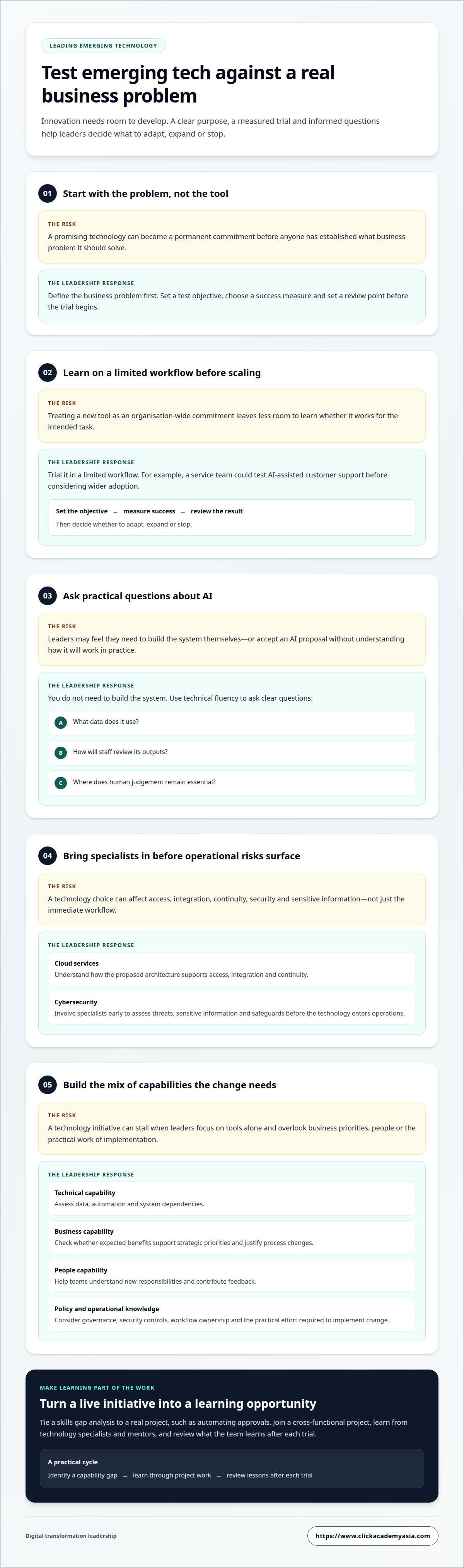
Innovation needs room to develop, but each technology decision should address a defined business problem. For example, a service team could trial AI-assisted customer support in a limited workflow before considering wider adoption. Leaders set the test objective, success measure and review point, then decide whether to adapt, expand or stop. This lets teams learn without treating every promising tool as a permanent commitment.
Technical fluency helps leaders ask useful questions without having to build systems themselves. For an AI proposal, clarify what data it uses, how staff review its outputs and where human judgement remains essential. For cloud services, understand how the proposed architecture supports access, integration and continuity. For cybersecurity, involve specialists early to assess threats, sensitive information and safeguards before the technology enters operations.
A balanced capability portfolio combines technical, business and people-oriented strengths. Technical capability helps leaders assess data, automation and system dependencies. Business capability tests whether expected benefits support strategic priorities and justify changing existing processes. People capability helps teams understand new responsibilities and contribute feedback. Policy and operational knowledge matter too: consider governance, security controls, workflow ownership and the practical effort required to implement a change.
Leaders can develop these capabilities through focused learning and practical work. Start with a skills gap analysis tied to a live business initiative, such as automating approvals. Join a cross-functional project, learn from technology specialists and mentors, and review what the team learns after each trial. This builds a sound basis for decisions and helps leaders adapt as data, AI, cloud and cybersecurity practices evolve.
To assess leadership capability, compare demonstrated strengths with an initiative’s requirements. Use a project scenario to examine how a leader weighs customer or operational benefits against implementation effort, security risk and effects on staff. Invite relevant stakeholders to assess the proposed approach, then identify gaps in technical, business, people, policy and operational capabilities. Connect the resulting development plan to responsibilities in real projects.
A predictive maintenance proposal, for example, calls for more than technical enthusiasm. Leaders need to understand the data required, involve operations teams who will act on alerts, and evaluate how the new workflow affects existing maintenance processes. They should also agree how to review the trial. These steps support adaptable innovation while grounding decisions in business needs and accountable implementation.
Data Analytics and Data-Driven Decision-Making
Data analytics helps leaders turn operational records into decisions instead of treating dashboards as reports to admire. A customer service team, for example, can compare enquiry volumes, response times and resolution patterns to locate bottlenecks. A core digital transformation leadership skill is defining the decision first, then selecting relevant data and agreeing how to assess success. This keeps analysis focused on improving a process or customer outcome.
Data visualisation makes patterns easier to discuss across teams. A chart showing enquiries by channel and time can reveal where demand is building, while a process dashboard can expose delays between hand-offs. Leaders should ask what the visualisation measures, which period it covers and what context could affect its interpretation. Clear labels and consistent definitions help colleagues distinguish a meaningful trend from a misleading comparison.
Scenario modelling adds a forward-looking view to the analysis. A manager considering a change to service hours could compare possible demand patterns and their effects on staffing, response times and workload. What-if models don’t replace judgement; they make assumptions visible. Leaders can test different conditions, examine likely operational effects and identify which outcomes to monitor if the change proceeds.
Data-informed decisions combine evidence with business context. Before acting on a rise in website traffic, for instance, a marketing leader should examine conversion behaviour, campaign sources and customer actions. More visits alone may not indicate commercial success. Teams can agree on a small set of relevant KPIs, review them consistently and use findings to adjust campaigns, processes or resource allocation.
Data literacy means understanding how information is collected, interpreted and applied. Leaders need to recognise data quality issues, such as duplicate customer records or inconsistent definitions of a completed sale. They should also ask whether a dataset represents the customers or operations under discussion. These checks strengthen critical thinking and help teams avoid confident decisions based on incomplete evidence.
Digital transformation leadership skills also include assessing AI outputs. For example, an AI tool might group customer feedback by recurring themes, but managers still need to review the source material and validate useful interpretations. One practical way to develop this skill is to examine a live dashboard with analysts, question its assumptions and apply the findings to a real decision. This builds confidence while keeping accountability with the people responsible for the outcome.
Digital Transformation Leadership Roles and Executive Support
Executive sponsorship gives a transformation authority to resolve conflicts, align resources and sustain attention. Companies with a C-suite leader at the helm are 1.6 times more likely to report a successful transformation. That finding points to an important distinction: an executive sponsor is not simply a name on a steering committee. The role involves making trade-offs visible, reinforcing the initiative’s purpose and keeping it connected to organisational priorities.
Clear roles turn sponsorship into coordinated action. An executive sponsor sets direction and removes barriers; a transformation lead coordinates delivery across functions. Functional leaders, such as heads of operations, finance and customer service, own changes affecting their teams. For a new customer relationship platform, for example, IT may manage implementation while sales and service leaders shape workflows and adoption.
Define decision rights before delivery begins. Specify who approves scope changes, who resolves dependencies and who owns each expected benefit. A steering group can review progress against agreed outcomes, such as shorter handling times or more consistent customer information. This structure helps leading teams address stalled decisions early, rather than letting unresolved ownership slow work across departments.
Executive backing also depends on a persuasive case for change. Present the business problem, the proposed response, the expected benefit and the measures that will show progress. For example, a proposal to automate invoice processing should explain which steps will change, how finance staff will be involved and how performance will be reviewed. Specifics make the case easier to discuss and challenge constructively.
Organisations can decide whether to develop existing leaders or recruit new expertise by comparing the initiative’s needs with current capabilities. A leader may have strong operational knowledge but need support in data governance or technology delivery. A competency portfolio can clarify where development, specialist advice or a different leadership role would help most. The right choice depends on the transformation’s drivers and goals, not job titles alone.
Leadership approaches must evolve with technology. A new platform may deliver an early operational improvement, but lasting change also depends on updated responsibilities, incentives and team practices. A practical step is to appoint an accountable executive sponsor, give the transformation lead clear authority and assign functional owners to measurable outcomes. This organisational design makes support concrete and keeps delivery tied to business value.
What Leadership Skills Are Essential for Digital Transformation?
Digital change calls for leaders who can align people, decisions and new ways of working. The right capability mix depends on the transformation’s purpose: a service redesign needs different strengths from an AI implementation. Leaders should set a clear direction, explain why it matters and connect each team’s contribution to that goal. This gives staff a practical reference when priorities shift.
Curiosity and experimentation help teams learn before committing to large-scale change. For example, a customer service team could trial a revised handover process with one group, then gather staff feedback. Leaders make learning from failure routine by discussing what happened, what the team discovered and what to adjust. That turns a trial into useful evidence rather than a pass-or-fail test.
Decisiveness matters when a project faces uncertainty. Waiting for perfect data or complete consensus can leave teams working around a known problem. A leader can name the decision, identify available evidence, consult affected teams and set a review point. If new information changes the picture, adapt the plan. This balances timely action with accountability.
Communication and active listening help leaders involve stakeholders in change. A manager introducing a new approval workflow should explain what will change, why it matters and how responsibilities will shift. Then invite employees to describe potential bottlenecks before implementation. Listening means understanding concerns, not simply preparing a response. Clear communication builds trust and helps teams address resistance through practical discussion.
Influence is essential when leading across departments without direct authority. A transformation lead might need operations, finance and customer service to coordinate a shared process. Agree on the outcome, clarify each team’s role and make dependencies visible. Empower colleagues to make decisions within those boundaries. This builds shared ownership while keeping work aligned with the intended result.
Resilience and adaptability help leaders sustain momentum through setbacks. If a pilot reveals that staff need different guidance, revise the support plan and explain why. Leaders can strengthen these capabilities through cross-functional projects, mentoring and regular reflection on decisions. Pair a clear direction with listening, experimentation and timely adjustment. Teams then have both a purpose and room to improve how they deliver it.
ClickAcademy Asia: Digital Transformation for Leaders
ClickAcademy Asia offers Digital Transformation for Leaders for professionals guiding organisational change. Consider the course when you need to connect transformation priorities with leadership responsibilities or prepare managers to lead evolving work practices. Start by identifying the capability your role or team needs to strengthen.
For managers leading sales teams through change, Sales Leadership may be relevant. It can suit development needs focused on guiding colleagues, aligning team efforts and supporting performance. Choose a learning direction based on what your leaders are expected to do.
If your transformation priorities involve marketing, consider WSQ Digital Marketing Strategy & Planning. For teams developing a content approach, WSQ Content Marketing Strategy may be a closer fit. Match the course to the responsibilities and practical learning needs of the people involved.
HR decision-makers can use these distinctions to shape a team development plan. Identify whether the priority is transformation leadership, sales leadership, marketing planning or content strategy. Then align the learning focus with the roles expected to apply it.
Individual professionals can also connect development to a current workplace challenge. Consider whether you want to build capability in leading transformation, guiding a sales team or planning digital marketing. A clear learning priority helps focus your next development step.
For Singapore organisations, WSQ-funded training tracks can form part of a team upskilling plan. Select a direction that fits the change your organisation needs to lead and the capabilities its managers need to build. To discuss WSQ-funded training tracks, get in touch with ClickAcademy Asia today to explore your options.
Frequently Asked Questions
What Is Digital Leadership?
Digital leadership is the ability to make sound organisational decisions about technology, capability and how work gets done. It isn’t limited to senior technology roles: a department manager may need to decide whether a manual service should become digital, remain staff-supported or offer both options. The leadership challenge is to weigh customer needs, workforce readiness and operational realities before choosing a direction.
What role does change management play in digital transformation leadership?
Change management helps an organisation move from an existing way of working to a new one without losing sight of everyday responsibilities. Before replacing a process, map which tasks will stop, change or remain, and identify who needs guidance at each transition. For example, retiring an old booking method requires a clear handover plan so staff know when to use the new system and where exceptions should go.
How important are data literacy and AI literacy for digital leaders?
These capabilities help leaders understand what evidence can support a decision and where its limits lie. A manager considering an AI-supported recruitment tool, for example, should ask how its output will be reviewed and who can challenge an unsuitable recommendation. Data literacy also means knowing who can access sensitive information and why. These questions help leaders set responsible boundaries before a tool becomes part of routine work.
What skills help leaders build a digital-first culture?
Leaders need to make digital participation practical for different roles and working styles. One useful step is to publish a shared playbook for common tasks, such as updating customer records or escalating a service issue, and keep it current as processes change. Managers should also recognise employees who document useful improvements. This gives teams consistent guidance and makes knowledge less dependent on individual colleagues.
How can leaders align digital transformation with business strategy?
Review the organisation’s project portfolio as a whole instead of judging each technology proposal in isolation. If two initiatives depend on the same data platform, their sequencing may affect delivery and resourcing. Leaders can group projects by strategic purpose, surface dependencies and decide which work should start, continue or pause. This gives executives a clearer view of trade-offs before teams commit to overlapping efforts.
What are common leadership challenges and risks in digital transformation?
Integration problems, data migration errors and reliance on a single technology supplier can create risks beyond a project’s immediate scope. Leaders can reduce surprises by involving operations and technology teams in testing realistic scenarios before launch. For a new customer platform, test whether records transfer accurately and whether staff can complete essential tasks if an integration fails. These checks reveal practical weaknesses while there is still time to respond.



Comments