
Building a Sostac Marketing Plan Around Future Actions

A polished marketing strategy can still fail if nobody knows what happens next. Building a SOSTAC marketing plan means turning analysis and objectives into a clear sequence of actions, with owners, timing and measures to keep delivery on track.
Teams often agree on where they want to go but struggle to connect priorities with practical marketing activity. The action plan should not be an afterthought: it turns strategic intent into work people can schedule, resource and evaluate.
This article explains how to develop and finalise the action stage of a SOSTAC plan. You’ll learn how to make future activities specific, align them with your strategy and objectives, and define how to monitor progress. It also shows how the plan’s decisions fit together, helping your team move from broad direction to coordinated action.
Table of Contents
Formulating and finalising a plan
Finalise the plan by connecting audience choices, objectives, resources and measurement. Each activity should support a defined marketing outcome.
Audience Selection and Marketing Strategy
A target audience is the customer group whose needs and behaviours guide marketing decisions. Choose one by comparing customer value, unmet needs, buying behaviour and your organisation’s ability to serve that group. Then select a strategy that addresses the strongest opportunity, rather than trying to reach everyone with the same message.
For example, a business could prioritise customers already showing interest in a relevant service, then tailor its channels and content to their decision process. In specialized sectors, resources like Martin Hogg Private Practice Success demonstrate this principle by coaching practitioners to tailor their outreach to specific client needs rather than broad audiences. SOSTAC connects situation analysis to control, while another framework may suit a different planning need. Choose the method that makes decisions and accountability clearest.
Objectives, Tactics, and Resource Allocation
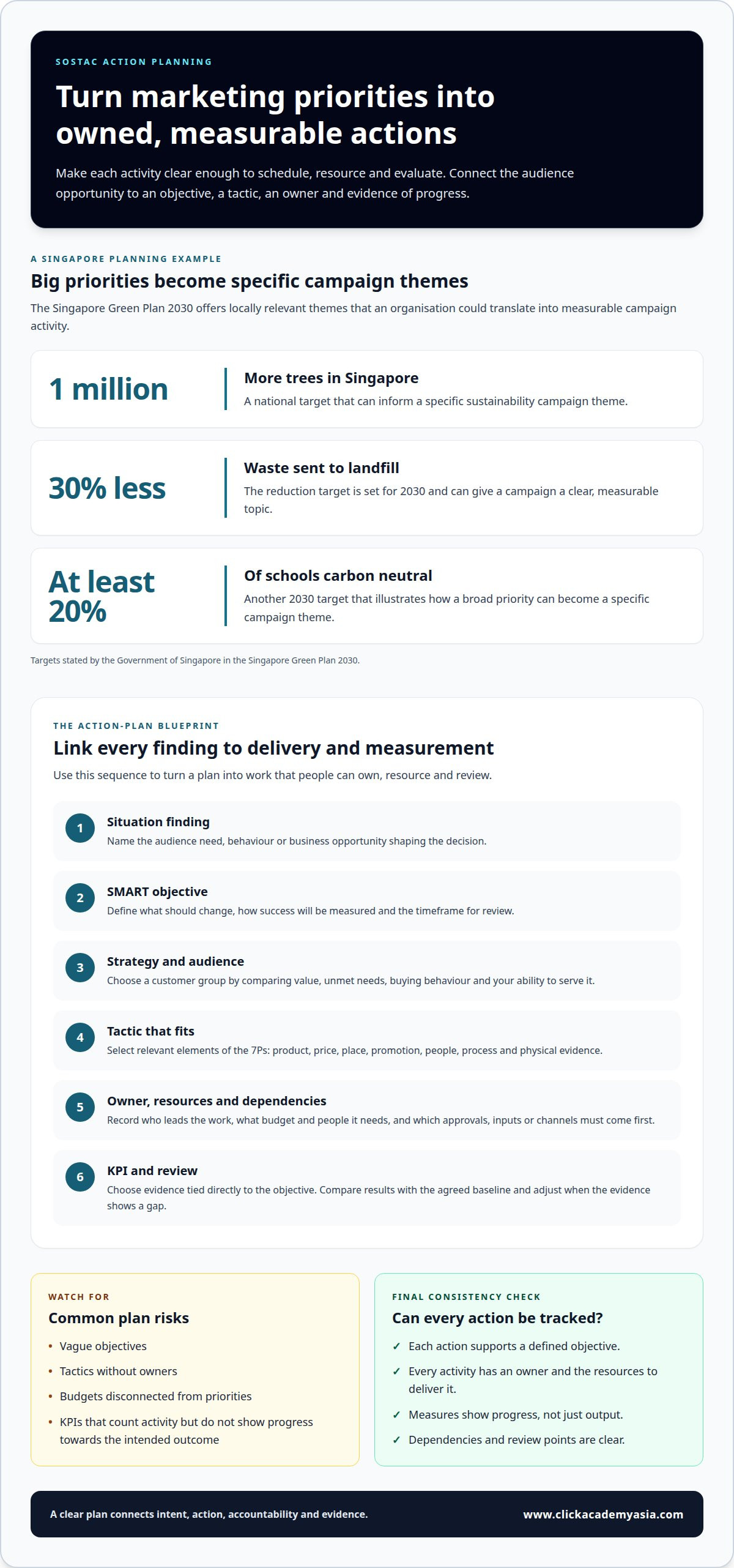
SMART objectives turn strategic intent into measurable outcomes. Define what should change, how success will be measured, and the timeframe for review. Then develop tactics through the 7Ps: product, price, place, promotion, people, process and physical evidence. Select only the elements that fit the audience and objective.
Allocate budget and people according to each tactic’s role, expected contribution and delivery requirements. Record an owner, resources and a measurement method beside every action to keep planned activity feasible. A content initiative, for instance, needs an accountable lead, production capacity and a way to assess performance.
Track KPIs that directly reflect the objective, using suitable analytics dashboards, CRM records or campaign platforms. Compare results with the agreed baseline and adjust tactics when the evidence shows a gap. Set a regular review rhythm that fits campaign activity, and revisit the plan sooner if audience behaviour or business priorities change.
Plan Examples, Templates, and Risks
A useful template links each situation finding to an objective, strategy, tactic, owner, resource and KPI. For a Singapore organisation, a sustainability campaign could use the Singapore Green Plan 2030 as a locally relevant example. According to the Government of Singapore, the plan sets a target to plant 1 million more trees in Singapore.
It also targets reducing waste sent to landfill by 30% by 2030, according to the Government of Singapore. The Government of Singapore also states that the plan targets making at least 20% of schools carbon neutral by 2030. These targets illustrate how a plan can translate a broad priority into specific, measurable campaign themes.
Avoid common risks such as vague objectives, tactics without owners and budgets disconnected from priorities. Check that every action supports an objective and has a credible measure of progress. A final consistency review can reveal duplicated activity, missing responsibilities or KPIs that track outputs without showing whether the intended outcome is advancing.
Plan as decisions about future actions
A marketing plan turns an intended outcome into decisions about what happens next. Each should clarify the action, its purpose, its owner and how progress will be judged. For example, a retailer seeking more repeat purchases might prioritise post-purchase email content instead of launching another broad awareness campaign. The choice follows the business aim and the customer behaviour it needs to influence.
Connect intent to delivery
Future actions become useful when they address a specific gap or opportunity identified in the plan. A decision to publish product guides, for instance, needs a defined audience, a distribution channel and an accountable owner. It also needs a measure showing whether the guides support the intended result. Without those links, activity can continue without informing the next decision.
Set out each action as a practical commitment. Record what will be done, who will lead it, what it depends on and what evidence will indicate progress. This gives colleagues a shared reference when priorities compete or delivery changes. It also makes assumptions visible, such as whether a campaign depends on new creative assets or customer data.
Choose the action. Select an activity that addresses a recognised audience need or business opportunity. A service team might create a comparison guide when customers need help distinguishing options.
Assign responsibility. Name the role or team accountable for delivery. A content lead could coordinate the guide, while sales colleagues contribute recurring customer questions.
Map dependencies. Identify approvals, inputs and channels required before launch. The guide may need product details, legal review and a suitable landing page.
Define evidence. Choose a measure that connects activity to its intended outcome. Track guide engagement alongside relevant enquiries, rather than counting publication alone.
Sequence actions according to dependencies, not simply preference. A landing page may need approval before paid promotion begins; a customer email may require a usable audience segment. Mapping these links helps teams spot bottlenecks early and coordinate work across marketing, sales and operations.
Plans also need room for informed adjustments. If an initial content format attracts attention but not qualified enquiries, review the message, audience fit and next step before expanding it. Keep the original objective visible, then document what changed and why. This creates a decision trail instead of a disconnected list of campaign tasks.
Teams looking to strengthen their editorial decisions can build relevant capability through ClickAcademy Asia Content Marketing Strategy. Apply that learning by turning a priority into a defined action, assigning an owner and choosing evidence to guide the next move.
What is the SOSTAC marketing planning framework?
SOSTAC is a marketing planning framework built around six connected questions. It moves from understanding the current position to setting direction, choosing activity, assigning delivery and measuring results. A Singapore business can use it to make its marketing plan easier to follow, discuss and refine.
Situation: What is happening now? A business might examine customer needs, market conditions, existing channels and current performance.
Objectives: What should marketing achieve? State the result clearly, such as improving qualified enquiries or increasing repeat purchases.
Strategy: Which audience and broad approach will support those objectives? A firm could prioritise existing customers before pursuing new segments.
Tactics: Which marketing methods will bring the strategy to life? These could include content, email, search activity or social media.
Action: Who will deliver each activity, and what must happen first? Assign owners, responsibilities and dependencies.
Control: How will the team assess progress? Select relevant KPIs, review performance and decide whether adjustments are needed.
The six elements form a chain, not separate boxes to complete and forget. A situation finding should inform an objective; the objective should shape the strategy; and tactics should serve that strategy. Actions make tactics deliverable, while control tells the team whether its choices are working.
Consider a retailer whose analysis identifies useful product information as a customer need. It could set an objective around improving engagement with product guidance, then make content a strategic priority. A comparison article becomes a tactic, with an editor responsible for publication. Engagement and relevant customer enquiries provide evidence for review.
This structure helps distinguish strategic choices from execution details. “Build awareness among first-time buyers” describes a direction. “Publish a monthly comparison guide” describes an activity. SOSTAC asks teams to connect both choices to an objective, assign delivery and decide how performance will be assessed.
The framework also supports review and iteration. If the retailer sees guide engagement but few related enquiries, the team can examine the content, audience fit and next step. Control then informs a tactical adjustment or a wider strategy discussion, rather than leaving the result as an isolated metric.
Use SOSTAC as a shared decision-making structure, not a rigid document format. A small team may capture its six elements on one working page; a larger organisation may need supporting schedules for campaigns, owners and reporting. Either way, each choice should connect to the next so marketing activity remains purposeful and accountable.
Planning turns a future intention into decisions that can be examined before activity begins. The Business English definition describes planning as thinking about the details of something that will happen in the future. In SOSTAC, those details connect, so a proposed activity can be considered alongside its purpose, ownership and evidence of progress.
This makes the framework useful not only for writing a plan, but also for discussing whether its parts fit together. Teams can revisit the reasoning as circumstances or results change, keeping intended outcomes connected to the work being delivered.
What should a SOSTAC situation analysis include?
A situation analysis establishes the evidence behind a marketing plan’s choices. For a Singapore business, it should examine customers, competitors, market conditions, internal capability and existing performance. The aim is to identify what is helping or limiting progress before setting objectives.
Customers: Review audience needs, behaviours, buying barriers and feedback. A service business could analyse common enquiries and reasons prospects do not proceed.
Competitors: Compare relevant offers, positioning, channels and customer experience. Focus on what customers can choose, not simply competitor activity.
Market: Identify changes in demand, category expectations and external conditions. A retailer might assess how online and in-store discovery shape purchase decisions.
Internal capability: Assess skills, systems, time, content and budget available to marketing. A strong campaign idea may be impractical without production capacity.
Performance: Review channel and campaign results against the business purpose. Website visits matter differently when the goal is qualified enquiries.
Use a structured lens such as SWOT to organise findings into strengths, weaknesses, opportunities and threats. For example, a Singapore consultancy might identify specialist expertise as a strength, limited video capacity as a weakness, and rising interest in a service as an opportunity. A new competitor offer could present a threat. Each point should connect to evidence, not assumption.
Customer evidence deserves close attention. Combine feedback, sales conversations, website behaviour and campaign results to understand what people need. If a business sees strong page visits but few enquiry submissions, investigate the page’s clarity, offer and next step. That pattern may signal a conversion barrier, but test plausible explanations before recommending a change.
Review existing marketing activity by channel. For email, examine audience relevance, message and response. For search, distinguish branded interest from discovery by new audiences. For social media, assess whether engagement supports a useful business outcome. These comparisons help identify where resources are producing value and where activity lacks a clear role.
External conditions also shape the assessment. A Singapore business may consider customer expectations, category changes, economic conditions and relevant technology shifts. PESTLE can help organise political, economic, social, technological, legal and environmental factors. Include only factors that could affect the organisation’s marketing choices, such as a new customer preference or a change in how people research purchases.
Finish by translating findings into implications. State the evidence, explain why it matters and identify the decision it may influence. For instance, if returning customers respond well to product education, retention content may deserve attention. This disciplined analysis gives objectives and strategy a defensible starting point—an approach championed by evidence-led strategy specialists like freshfacedmarketing.co.uk, where market research and customer insights directly dictate tactical execution.
technology, legal and environmental influences, then assess which are material to the business rather than listing every possible trend. For example, a sample investment plan of €30 million includes building new plants. The State Action Plan initiative includes a goal of carbon-neutral growth from 2020 onwards. The initiative includes a goal of reducing CO2 emissions by 5% by 2030 through aviation cleaner energies. Such initiatives can inform market context where relevant, while the analysis should distinguish external developments from the business’s own plans and support conclusions with evidence.
How to set SMART marketing objectives in a SOSTAC plan?
SMART objectives turn a marketing ambition into a result the team can define and assess. In SOSTAC, they follow situation analysis and guide strategy, tactics, action and control. Without a clear objective, teams can measure activity without knowing whether it supports a business priority.
Start with a finding from the analysis. If a Singapore business sees that prospective customers visit its service pages but rarely enquire, it might focus on generating more qualified enquiries. Make the objective specific by stating the outcome, the audience and the relevant channel. Then choose a measure that reflects the desired change, not simply the work completed.
Specific: State the outcome and who or what it concerns. “Improve marketing” is broad; “increase qualified enquiries from service-page visitors” identifies a result.
Measurable: Select a metric and establish its baseline. Enquiry volume, conversion rate or repeat purchase can work when aligned with the objective.
Achievable: Match the ambition to available evidence, skills and resources. A target should stretch the team without ignoring delivery capacity.
Relevant: Connect the marketing result to a business priority. More website visits have limited value if the need is stronger sales-qualified demand.
Time-bound: Set a defined review period or completion point. This gives the team a clear point for assessing progress and deciding what to adjust.
For the service-page example, an objective could specify improving qualified enquiries from organic search during the next planning period. The team would define what counts as qualified, identify the current baseline and select a target using its own performance history. This avoids treating an arbitrary benchmark as a credible commitment.
Keep objectives distinct from tactics. “Publish more articles” describes activity, not the outcome it should support. An objective might instead focus on increasing relevant enquiries, while articles become one tactic for addressing customer questions. The strategy and action plan can then show how the content contributes.
Limit the plan to objectives that can be resourced and monitored. Give each one an owner, a data source and a review point. If several objectives compete for the same team capacity, prioritise those most closely tied to business needs. Record assumptions too, such as whether the team can access reliable enquiry data.
Strengthen your objective-setting and planning practice through [Internal Link: ClickAcademy Asia practical digital marketing strategy training]. A clear SMART objective gives the SOSTAC plan a focused direction and makes later performance reviews more useful.
ClickAcademy Asia: WSQ Digital Marketing Strategy & Planning
ClickAcademy Asia’s WSQ Digital Marketing Strategy & Planning course can help you turn SOSTAC concepts into practical marketing decisions. Consider it when you want to strengthen your planning skills, align activities with business objectives or build a clearer approach to measuring performance.
For more focused capability development, WSQ Content Marketing Strategy, WSQ Search Engine Optimisation (SEO) and WSQ Search Engine Marketing (SEM) address specific parts of a digital marketing plan. Choose learning that fits the skills you or your team need to put strategy into action.
To discuss your learning needs, contact ClickAcademy Asia.
Put your next marketing decision into motion
Keep your plan active by turning the next priority into a clear action, naming an owner and choosing how progress will be reviewed. As new evidence emerges, revisit the assumptions behind your choices. This keeps building a SOSTAC marketing plan connected to the decisions your team makes day to day.
Give your team the skills to put those decisions into practice through WSQ-funded training tracks. Choose learning that supports the capabilities your next marketing priorities require.
To discuss your plan and your team’s learning needs, [Internal Link: Contact ClickAcademy Asia to discuss your plan]. Take the next step with focus and help your team build the confidence to turn strategy into purposeful action.
Frequently Asked Questions
How to create an implementation action plan for SOSTAC?
Translate each selected tactic into a delivery sequence with clear hand-offs and approval points. For a content campaign, map the brief, draft, review, landing page, tracking setup and launch so contributors know what must be ready first. Add a decision gate before launch to confirm the message, destination and measurement are aligned. Note what the team will pause or change if a key dependency is delayed.
How to develop marketing tactics using the 7Ps in SOSTAC?
Use the 7Ps, product, price, place, promotion, people, process and physical evidence, to develop tactics that fit your audience and objective. Select only the elements that support the strategy.
How often should a SOSTAC marketing plan be reviewed and updated?
Set a regular review rhythm that fits campaign activity. Revisit the plan sooner if audience behaviour or business priorities change.
SOSTAC vs other marketing planning frameworks: which is better?
Neither is universally better. SOSTAC connects situation analysis, objectives, strategy, tactics, actions and control. Choose the framework that makes decisions and accountability clearest for your planning needs.



Comments