
Continuous learning plan for sales team skill building

A sales team can meet this quarter’s target and still be unprepared for its next customer conversation. A continuous learning plan for sales teams ties development to day-to-day work, so new skills are practised, reinforced and ready to use. This matters as products, buyer expectations and sales priorities change.
Scheduling training and hoping it sticks is not enough. Sales professionals need coaching that strengthens real conversations, practice built into daily workflows and development that continues beyond onboarding. A clear plan also helps leaders focus on the skills and outcomes their teams need most.
This guide explains how to build that plan, from coaching routines and workflow-based practice to market-relevant skills, onboarding and readiness planning. You’ll find practical ways to make learning consistent while keeping sales priorities in view, and how relevant training can support team development in Singapore.
Table of Contents
Coaching, routine practice, and gamification
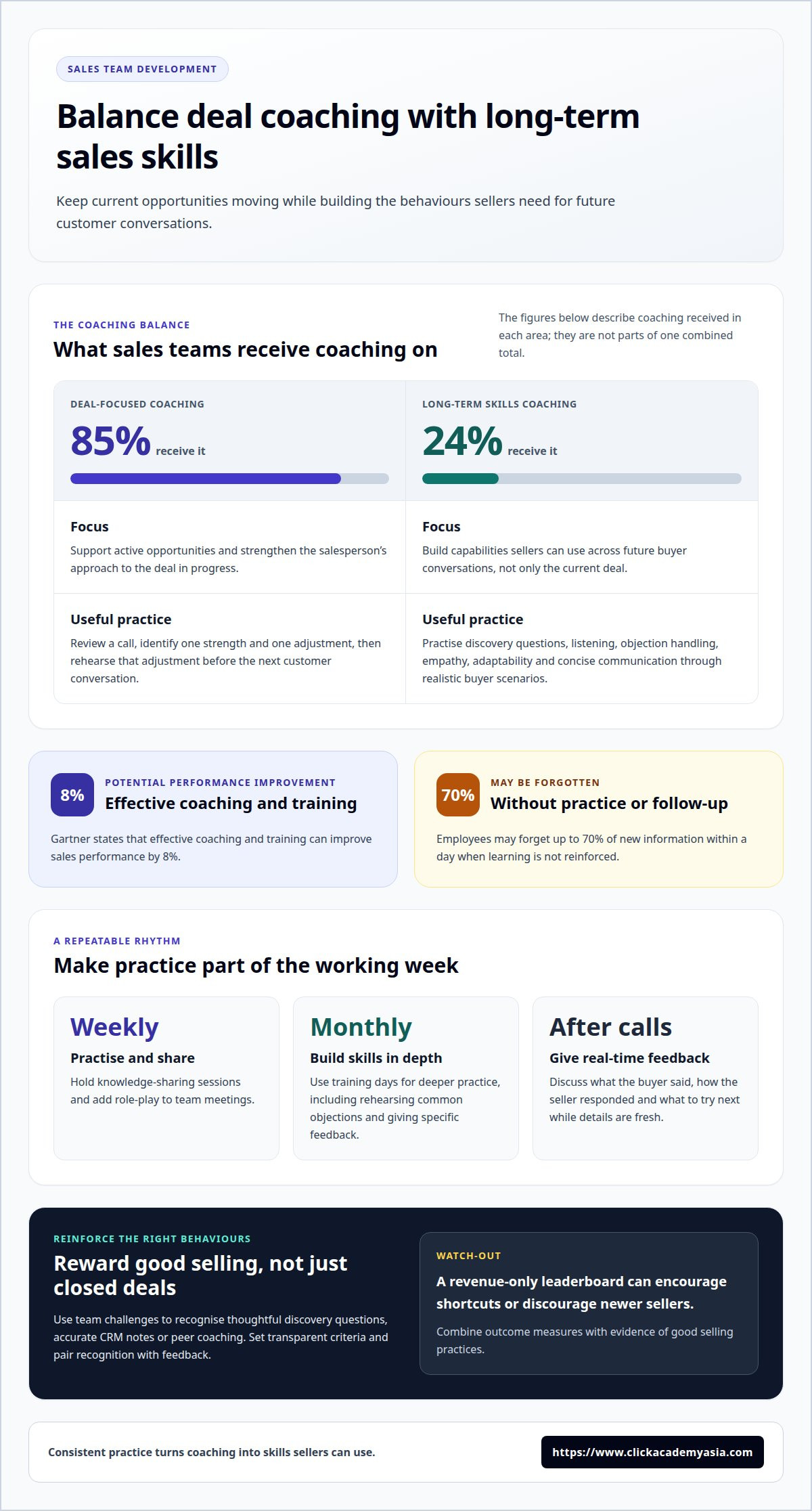
Effective sales coaching develops more than the pitch for a deal already in progress. Gartner states that effective coaching and training can improve sales performance by 8%. Build coaching around observed behaviours, such as discovery questions, listening, objection handling and clear next steps. A manager can review a call, identify one strength and one adjustment, then let the salesperson practise that adjustment before another customer conversation.
Keep practice regular and close to the work. Sales representatives receive coaching on closing current deals more often than on long-term skills: 85% receive deal-focused coaching, while 24% receive coaching on longer-term skills. Balance both. Schedule weekly knowledge sharing, add role-play to team meetings and use monthly training days for deeper practice. Ask each salesperson to rehearse a response to a common objection, then give specific feedback on clarity and relevance.
Real-time feedback makes practice actionable. After a call or presentation, a manager can discuss one moment while the details are fresh: what the buyer said, how the salesperson responded and what to try next. Include soft skills such as empathy, adaptability and concise communication. These behaviours affect how well sellers uncover needs and explain value, so coach them through realistic buyer scenarios rather than abstract advice.
Gamification can encourage participation when it rewards useful behaviours, not just closed deals. A team challenge, for example, might recognise thoughtful discovery questions, accurate CRM notes or peer coaching. Set transparent criteria and pair recognition with feedback. A leaderboard based only on revenue can encourage shortcuts or discourage newer sellers, so combine outcome measures with evidence of good selling practices.
How often should sales teams receive training and coaching? Schedule weekly practice or knowledge sharing, monthly training days for deeper development, and regular deal reviews to reinforce skills. This rhythm keeps learning active without turning every meeting into a training session.
Common mistakes include one-off sessions, generic content, coaching only urgent deals and rewarding results without considering selling behaviours. Without practice or follow-up, employees may forget up to 70% of new information within a day. In Singapore, funding support depends on the course and eligibility; assess whether relevant WSQ training and applicable support fit the team before setting the training budget.
Adapting sales skills to market changes
A sales team may keep using familiar techniques after buyer expectations have changed. Assess skills against current sales conversations, product changes and customer feedback, then target development where performance gaps appear. If buyers arrive with detailed online research, for example, practise questions that uncover priorities beyond basic product information.
Start with a simple skills framework. Define observable behaviours for each stage, such as researching an account, asking discovery questions, explaining value and agreeing on next steps. Assess each salesperson through call reviews, role-play and manager observation. Keep the criteria consistent so the assessment identifies capability gaps, not differences in managers’ preferences.
Combine evidence instead of relying on one score. Review CRM notes, buyer objections and lost-deal feedback alongside observed conversations. If several prospects raise the same concern, test whether sellers can explain the relevant value clearly. Organisations that use sales skill assessments are 5.5 times more likely to report highly effective training programmes.
Turn findings into focused development. A useful cycle is to identify a change, assess the skill it affects, practise a response and review how it works in customer conversations. When a product feature changes, for example, sales leaders can ask representatives to explain its customer benefit, handle a related objection and record any questions that still need clarification. This links learning directly to market needs.
Prioritise gaps that matter to buyers and business goals. A team facing longer decision-making processes may need stronger stakeholder mapping; a team entering a new segment may need sharper qualification questions. Choose one or two development priorities for the next quarter, then track improvement through call reviews and deal feedback. This keeps the plan responsive without asking sellers to master every new trend at once.
Reassess after a meaningful change, such as a new offer, a shift in buyer objections or an updated sales process. Compare the same behaviours before and after practice, then adjust coaching if the gap remains. Enrolling in ClickAcademy Asia Sales/Marketing courses can also give teams a guided way to build capabilities as market needs change.
Mentorship, effective onboarding and proactive skills assessments help distinguish high-performing sales organisations. Ongoing sales training can realign a team around a shared methodology and prevent individual selling practices from drifting apart. Combine this shared approach with focused practice and reassessment to help teams respond to change while selling consistently.
Training opportunities may also matter to employees: nearly half of employees said training opportunities were a factor in choosing their current company. Continuous sales training can be delivered in the flow of work so sellers can learn skills without being pulled away from in-pursuit sales. Routinely analyse in-person and online B2B sales training to assess its effectiveness. Considering both formats gives teams a way to check whether training is effective while continuing to adapt it to current needs.
Learning integrated into the sales workflow
Learning works best when sellers can apply it to live work. Organisations that embed learning into daily workflows are 4.9 times more likely to onboard sellers effectively and 3.5 times more likely to have sales teams prepared for success. Connect each lesson to a specific sales task, such as preparing for discovery or responding to a buyer objection.
Use microlearning to make practice manageable. A 10-15-minute module during a break or between calls can cover one skill, such as qualifying a lead. Follow it with an immediate application: the salesperson uses a new question in a call, then notes what the buyer’s response revealed. Short lessons become more useful when they lead to observable action.
Map learning to the sales process. Before a discovery call, sellers might review a short prompt on researching an account. After the call, they can practise summarising buyer needs or recording a clear next step in the CRM. While preparing a proposal, a quick exercise could help them link a customer priority to a product benefit. This makes training relevant to the task at hand.
Prioritise skills that affect customer conversations and business outcomes. If deal reviews show that opportunities often stall after proposals, for example, offer a short practice activity on confirming decision criteria and agreeing on follow-up actions. Managers can reinforce the same skill in one-to-one meetings, then revisit it in later deal reviews. This creates ongoing reinforcement without repeating a full training session.
What KPIs measure the effectiveness of sales training and continuous learning? Track relevant business measures, including win rate, conversion between sales stages, sales cycle length and average deal size. Pair these with evidence of skill application, such as call-review observations and the quality of CRM notes.
How can sales teams fit learning into their schedules without reducing selling time? Place short modules between calls, attach practice to existing deal reviews and use call preparation for targeted refreshers. A manager, for example, can review one skill during a scheduled pipeline discussion and connect it to an active opportunity. Protect selling time by focusing each activity on a specific, current sales need.
Technology can bring continuous learning into sellers’ daily workflows. Sales enablement platforms can provide personalised, just-in-time learning to support sellers at each stage, while online learning platforms such as NAVO offer certified courses and educational resources to support structured professional growth.
Onboarding and everboarding
A new salesperson needs more than product facts before speaking with customers. Effective onboarding gives them a clear path through the sales process, from understanding the offer to qualifying prospects and managing follow-up. Companies with effective onboarding programmes are 4 times more likely to achieve outstanding training outcomes. Set role-specific milestones so managers can see what each new hire is ready to do.
Structure the first weeks around practical selling tasks. In week 1, Product and Product Marketing introduce the offering, its customer value and common use cases. In week 2, an outside expert, Marketing or leadership can provide an industry point of view. Ask new hires to connect those insights to customer needs, rather than memorising isolated talking points.
Practice should build towards customer-facing work. In week 3, have new sellers identify prospects and rehearse their pitch. A manager can observe how they explain value, ask questions and respond to objections, then assign targeted practice. In week 4, gather feedback on onboarding materials and help each salesperson build a prospecting plan.
Extend learning after initial onboarding. Everboarding keeps skills aligned as products, customer priorities and sales processes change. Yet 30% say onboarding transitions directly to everboarding, while 9% say ongoing reinforcement is provided. Make the transition explicit: schedule follow-up learning, connect it to current selling tasks and give managers responsibility for reinforcing key skills.
Use milestones that test application, not just course completion. A salesperson might demonstrate a product explanation, prepare an account plan and lead a discovery conversation. Record feedback against clear criteria, then agree on the next development step. This gives managers a practical view of readiness and helps new hires build confidence by demonstrating their capabilities.
Keep development active with a planned revisit. In week 6, a short contest can encourage sellers to identify cross-sell and upsell opportunities. In week 12, revisit the training and gather feedback on what sellers have applied. These checkpoints help leaders spot gaps early and adjust learning to support sales performance and engagement.
Structured onboarding and ongoing development also support experienced sellers taking on new responsibilities. When a team changes its sales methodology, for instance, leaders can explain the updated process, model it in a deal review and observe its use in live opportunities. Treat each change as a learning moment, then reinforce the behaviour through manager follow-up.
Sales readiness and development planning
A sales development plan should connect individual skills to measurable business outcomes. Start with a priority, such as improving win rates, protecting margins or growing account size. Define the behaviours that contribute to that result, then agree on how each salesperson will practise and demonstrate them. Growing key accounts, for example, may require stronger account planning, stakeholder mapping and a clear way to identify expansion opportunities. This gives learning a practical purpose beyond completing a training activity.
Set out each plan in four parts: the skill to build, the practice activity, the supporting manager and the evidence of readiness. A salesperson developing negotiation skills might practise a pricing conversation, apply the approach in a suitable opportunity and review the outcome with their manager. Tie milestones to actual selling tasks, not course completion alone. Record the next action after each review so the salesperson and manager share a clear view of progress.
Make development relevant to each person’s role and experience. A new account executive may need to qualify prospects, while an experienced seller may focus on expanding strategic accounts. Ask professionals to identify challenges from recent deals and situations they find difficult. Their input helps leaders select training that addresses real work rather than assumed gaps, whether through internal mentorship or specialised external programmes like IICS that focus on role-specific producer development. Aligning the approach to specific roles makes the plan more useful to each individual.
Sales leadership development needs its own plan. Equip managers to translate business priorities into team behaviours, run useful deal reviews and support individual growth. A manager, for example, could practise coaching a representative through an account plan, then assess whether the discussion clarified risks, decision-makers and next actions. This develops leadership alongside frontline selling skills and helps managers reinforce expectations consistently across the team.
Measure whether learning changes performance. Define a baseline and track relevant indicators such as win rates, margins, account growth or progression through sales stages. Then review application evidence, including deal plans and observed customer conversations. Although 67% of organisations say their sales training programmes are only moderately effective or worse, clear goals and follow-up make capability gaps easier to identify and address.
Use results to adjust the plan as priorities shift. If account growth improves but opportunities still stall during negotiation, refocus practice on handling commercial objections. Sales readiness is dynamic: leaders revisit goals, recognise applied skills and agree on the next development step. For practical support with [Internal Link: ClickAcademy Asia Sales/Marketing courses], explore training options aligned with your team’s goals.
ClickAcademy Asia: WSQ Digital Marketing Strategy & Planning
ClickAcademy Asia offers WSQ Digital Marketing Strategy & Planning for professionals who want to understand how digital marketing supports commercial goals. Consider it when sales conversations depend on campaign-generated leads, online customer journeys or close coordination with marketing. Shared understanding helps sales professionals connect customer intent with the next relevant conversation.
Use the programme as part of a broader development plan when skills assessments reveal gaps in marketing strategy or planning. Sales leaders can connect learning to practical team priorities, such as helping representatives interpret campaign context before follow-up. The goal is not to turn every salesperson into a marketer, but to strengthen collaboration and make customer conversations more informed.
Other relevant options include WSQ Content Marketing Strategy, WSQ Search Engine Optimization (SEO) and WSQ Search Engine Marketing (SEM). Consider these when team development priorities involve content, organic search or paid search. Sellers who understand these channels, for example, can better discuss how prospects may discover and evaluate a business before speaking with sales.
Make learning applicable by linking it to a current business scenario. A manager might ask the team to map a prospect’s journey from an online search to a sales discussion, then identify what information would make follow-up more relevant. This translates marketing concepts into useful context for account planning and customer engagement.
For HR decision-makers, start by connecting the learning choice to a defined capability gap. If the priority is stronger digital marketing strategy and planning, the WSQ programme offers a relevant professional development option. If the gap centres on content, SEO or SEM, the corresponding programme may be a closer fit. Aligning the choice with team needs keeps training purposeful.
ClickAcademy Asia’s programmes can complement sales coaching and workflow practice by building knowledge for cross-functional conversations. They are most relevant when digital marketing is part of the sales team’s role or its shared work with marketing, rather than a substitute for sales-specific coaching. Contact ClickAcademy Asia to discuss WSQ programmes aligned with your team’s development priorities.
Make the next learning step count
Make development a repeatable management practice: choose a business priority, give sales professionals opportunities to apply relevant skills, and review progress against clear outcomes. Keep the plan responsive by revisiting capability needs as customer expectations and team priorities change. This makes learning part of how the team prepares for what comes next.
Where digital marketing knowledge can strengthen sales and marketing alignment, consider relevant WSQ-funded training, including WSQ Digital Marketing Strategy & Planning, WSQ Content Marketing Strategy and WSQ Search Engine Optimization (SEO). To discuss training for your team, [Internal Link: Contact ClickAcademy Asia].
Frequently Asked Questions
What are the key components of a continuous learning plan for sales teams?
A continuous learning plan for sales teams connects a business priority with the capabilities people need to deliver it. Include role expectations, individual development goals, learning activities, manager support and a way to review progress. A new product launch, for example, could prompt a plan covering product knowledge, customer use cases and coordination with marketing, with each salesperson applying the learning in an upcoming account conversation.
How do you assess sales team skills and identify learning gaps?
Assess skills using consistent criteria across work samples and realistic scenarios. Ask sellers, for instance, to explain a solution to a buyer with competing priorities, then evaluate how they uncover needs, communicate trade-offs and agree on next steps. A simple rubric can describe each behaviour as developing, consistent or advanced. Compare observations across the team, then discuss individual results privately to identify relevant development priorities.
What are effective sales training methods for ongoing learning?
Combine practical exercises that reflect different parts of a seller’s work. Peer teach-backs can help representatives explain a product use case in their own words, while call shadowing lets newer colleagues observe experienced sellers handling a complex discussion. A shared library of buyer questions can also support preparation. Managers can update examples when customer concerns or product information change.
How can managers build a continuous learning plan for sales reps?
Build the plan with each representative, starting with a specific challenge they want to address. Agree on the behaviour to practise, a suitable learning resource, a real work opportunity to apply it and evidence of progress. A representative working on stakeholder conversations, for example, could prepare questions for an upcoming account meeting and reflect afterwards on which responses opened up useful discussion.



Comments