
Prompt Engineering for Market Research and Training Choices

What if the difference between a useful AI insight and a generic answer comes down to how you frame the task? For professionals in Singapore, prompt engineering for market research analysis means giving an AI tool clear objectives, context and output instructions so it can support research more consistently. Human judgement still matters: check AI-generated findings against reliable primary sources.
If you’ve asked an AI tool to compare competitors or summarise customer feedback, you may have found that broad prompts produce broad answers. A structured prompt specifies what to examine, how to organise the findings and which evidence to include, giving you a more practical starting point for analysis.
This guide covers core prompting techniques and their use in competitor intelligence, qualitative transcript analysis and training decisions. You’ll also learn how to set review points for complex tasks and assess whether a course can help you build skills for real market research work.
Table of Contents
What is Prompt Engineering?
Prompt engineering for market research analysis turns a broad request into instructions a model can act on. Effective prompts define the research objective, target audience, evidence base, timeframe and output format. For example, ask for a comparison of Singapore grocery delivery brands using public pricing pages and customer reviews, with citations and unknowns clearly labelled.
N-shot prompting gives a model examples of the response you want. Few-shot prompting typically uses two to five examples. To classify customer comments, provide sample comments labelled “delivery”, “product quality” or “price”, then ask the model to label new comments using those categories. Clear examples help the model follow your preferred structure.
Chain-of-thought prompting breaks a complex task into smaller stages. For competitor analysis, ask the model to identify claims, group them by theme, compare evidence and present concise conclusions. Request a brief explanation linked to supplied evidence, not unsupported reasoning. Review each stage before combining its findings in a corporate report.
These techniques work across platform types because they rely on clear instructions, not a particular interface. Use this sequence for a research query:
State the decision the research should support, such as refining a Singapore product launch.
Define the market, audience and timeframe, such as Singaporean first-time buyers.
Supply relevant sources or examples, then specify a table, summary or comparison.
Ask the model to separate evidence, interpretation and unanswered questions.
Leading AI tools differ in model capabilities, source access, citation quality, data controls and output formats. Their costs vary by platform, plan and usage, so compare those factors against your research workflow rather than assuming one model suits every task.
For research in Singapore involving personal data, follow approved data-handling processes and remove identifying details from prompts where possible. Applicable privacy and data-protection requirements should guide how information is collected, stored and shared. Do not enter confidential customer records into tools without authorisation.
Validate AI-generated findings in three steps: trace each claim to a primary source, compare it with independent evidence, and correct or remove unsupported conclusions. If the model claims consumer preferences have shifted, check the original survey or public dataset before using the claim in a recommendation.
For Singaporean consumers, try: “Group these supplied comments about local food delivery by price, delivery speed and cuisine choice; include supporting excerpts.” Or ask: “Compare these public product pages for features valued by Singapore households, separating stated facts from interpretation.”
AI-assisted competitor intelligence
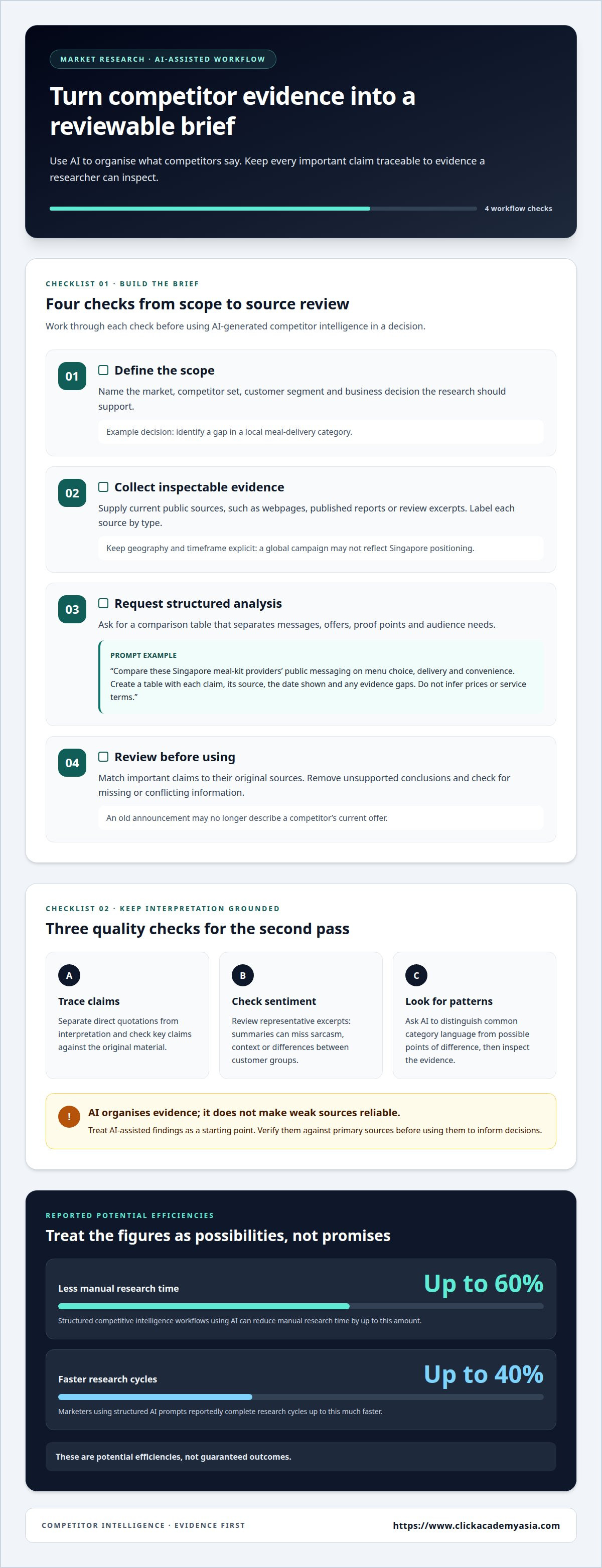
AI can organise competitor evidence, but it cannot make weak sources reliable. A Singapore retailer, for example, could compare public product pages, campaign messages and customer reviews. Structured competitive intelligence workflows using AI can reduce manual research time by up to 60%. Marketers using structured AI prompts reportedly complete research cycles up to 40% faster. Treat these figures as potential efficiencies, not guaranteed outcomes.
Start with a decision, such as identifying a gap in a local meal-delivery category. Define which competitors to assess and what counts as evidence. Supply public webpages, published reports or review excerpts. Ask the model to separate direct quotations from interpretation and flag missing or conflicting information. This keeps generated intelligence tied to material a researcher can inspect.
A useful prompt names the comparison criteria and required format. For instance: “Compare these Singapore meal-kit providers’ public messaging on menu choice, delivery and convenience. Create a table with each claim, its source, the date shown and any evidence gaps. Do not infer prices or service terms.” These tailored criteria produce a more useful result than a broad request to “analyse competitors”.
Use this workflow to turn collected information into a reviewable brief:
Define the scope. Specify the market, competitor set, customer segment and business decision.
Collect evidence. Provide current public sources and label each source by type, such as a product page or customer review.
Ask for structured analysis. Request a comparison table of messages, offers, proof points and audience needs.
Review the output. Match each important claim to its original source and remove unsupported conclusions.
For a second pass, ask the model to identify themes across competitors and distinguish common category language from possible points of difference. A sentiment summary can group review excerpts as positive, neutral or negative and show which topics drive each label. Check representative excerpts yourself: summaries can miss sarcasm, context or differences between customer groups.
Keep the language, geography and timeframe explicit. A competitor’s global campaign may not reflect its Singapore positioning, and an old announcement may no longer describe its current offer. Check AI-assisted market research against primary sources rather than treating it as fact. For teams turning verified insights into clearer content plans, exploring the ClickAcademy Asia Content Marketing Strategy may be a useful next step.
Analysis of multiple qualitative transcripts
AI can help researchers compare interview transcripts, focus-group notes and open-ended survey responses. Effective workflows ask models to identify recurring themes while preserving differences between participants. For example, interviews with Singapore shoppers might reveal convenience as a shared priority, alongside different views on delivery fees.
Prepare the material before analysis. Remove personal identifiers, label each transcript consistently and keep a separate record linking labels to source files. Then give the model a focused task, define each theme and ask it to support findings with short excerpts. This creates a clear trail from the output back to participant evidence.
Use a staged workflow instead of asking for a complete report at once:
Set the research question. For example, find what influences customers’ choice of a meal-delivery service.
Create a coding framework. Define themes such as menu variety, delivery reliability and perceived value.
Analyse each transcript. Ask the model to assign relevant excerpts, note new themes and identify uncertainty.
Compare participants. Request similarities, contrasting viewpoints and examples that challenge the emerging pattern.
Review the synthesis. Trace each conclusion to its transcript excerpts and revise inconsistent coding.
A useful prompt might read: “For each supplied interview, identify comments about delivery reliability. Return the participant label, a supporting excerpt, the sentiment and any qualification. Separate direct evidence from interpretation.” After coding, ask the model to compare how participants describe late deliveries, missed updates or flexible time slots. These concrete categories make results easier to discuss with product and service teams.
Possible outputs include a theme matrix, a concise evidence-based summary and questions for further interviews. Applications range from refining customer messaging to prioritising service improvements. For a deeper comparison, ask the model to explain where viewpoints differ by experience or stated need, without treating a recurring comment as representative of every customer.
AI has limitations. Models can misread sarcasm, overlook context, assign inconsistent codes or present a small set of comments as a broad trend. They may also reproduce bias in source material, so researchers should inspect excerpts and retain human oversight.
For recurring studies, standardise instructions and test them on a small set of transcripts before using them across the dataset. Track changes to the codebook, record unresolved interpretations and use consistent definitions in later rounds. This makes trends more comparable while keeping the analyst responsible for conclusions.
Choosing prompt engineering training
Choose training by matching its learning outcomes to a real research task. A market researcher comparing customer preferences needs different practice from a manager summarising campaign performance. Look for practical work with large language models, prompt design, evidence review and clear outputs, not theory about AI generation alone.
Check whether the programme explains how language models respond to context, examples and constraints. A useful exercise might compare two prompts for analysing product feedback, then explore why one produces more relevant insights. Training should also show how to adapt instructions across tools, since a sound method should not depend on one platform’s interface.
Frameworks help make prompting repeatable. Look for a structure that asks learners to define the objective, provide context, set boundaries and specify the output format. For example, a brief could request a table with “customer need”, “supporting evidence” and “open question” columns. This makes results easier to review and include in a research report.
Assess the practice tasks before choosing a course. Strong examples resemble your team’s actual work, such as classifying survey comments or summarising interview findings. A useful course also teaches a sequence of prompts for complex tasks, with human supervision at key steps. This helps learners refine instructions as the analysis progresses.
Use these questions to assess whether training fits your team:
Does it teach transferable methods? Learners should practise writing prompts that work across language models and research applications.
Are the examples relevant? Exercises should connect to market research decisions, not generic content generation alone.
Does it address review? Participants should learn to trace outputs to evidence and identify unsupported conclusions.
Can learners apply the skills? A practical task should produce a usable research output, such as a theme summary or comparison table.
Consider the delivery format, too. A live workshop can support discussion and coached practice, while self-paced materials may suit learners who need flexibility. For a corporate team, shared exercises can help establish consistent prompt frameworks and review habits across roles.
In Singapore, prioritise training that connects AI use with marketing analysis and business decisions. The right programme is one whose examples, formats and practice tasks prepare learners to produce evidence-led insights for their work.
usable research outputs. David Boyle has more than 20 years of experience using technology to develop audience intelligence and strategy capabilities in the creative industries.
What prompts help identify market size, trends, and growth opportunities?
Useful market prompts define the geography, customer group, product category and decision. For a Singapore launch, specify whether the analysis covers residents, businesses or visitors, and whether it concerns the whole market or a niche. Ask the model to distinguish sourced facts, estimates and assumptions instead of presenting them as equally reliable.
To assess market size, request a transparent method rather than a standalone figure. For example: “Estimate the addressable market for plant-based ready meals in Singapore. Define the customer group, explain the calculation method, list the data required, and separate verified inputs from assumptions. Show how a different adoption assumption changes the estimate.” This helps teams evaluate the reasoning and spot gaps.
For trends, specify the period and evidence to review. Try: “Analyse these Singapore search queries, customer comments and industry reports about home fitness. Group emerging themes, distinguish repeated signals from isolated examples, and state what evidence supports each trend.” Provide sources or datasets where available, then request a table showing each trend, supporting evidence and possible business implication.
Growth-opportunity prompts should connect unmet needs with practical decisions. For example: “Using these customer interviews and competitor product descriptions, identify underserved needs in Singapore’s healthy-snacking market. For each opportunity, show the supporting evidence, likely audience and unanswered question. Do not rank opportunities without stating the criteria.”
Build on the first response with targeted follow-up prompts:
Ask which customer groups appear underserved, and what evidence indicates unmet demand.
Request a comparison of competing solutions, including gaps in their stated features or messaging.
Ask what additional data would strengthen or weaken each opportunity hypothesis.
For market sizing, compare top-down estimates with bottom-up inputs such as customer counts, purchase frequency and average spend. Treat each input as a question to investigate, not a fact supplied by the model. For trend analysis, check whether apparent changes reflect seasonality, changes in data collection or a genuine shift in behaviour.
A final prompt can turn analysis into a decision brief: “Summarise the strongest opportunity, evidence, key assumptions and next research step for a Singapore marketing team.” Use the output to guide further investigation, not as proof of demand. To strengthen how your team turns market evidence into strategy, explore [Internal Link: ClickAcademy Asia Content Marketing Strategy].
ClickAcademy Asia
ClickAcademy Asia helps professionals build marketing skills to turn research into clearer strategy and more informed decisions. If you use AI to explore markets, compare competitors or interpret customer feedback, the next step is connecting those insights to practical marketing priorities. Training can strengthen that wider capability without replacing professional judgement with AI output.
Start with the decision your research needs to support. A team assessing a new market may need stronger planning skills, while a team refining campaign messages may benefit from a clearer content strategy. For search visibility, SEO and SEM knowledge can help marketers connect audience needs with how they reach potential customers.
Relevant WSQ training options include:
WSQ Digital Marketing Strategy & Planning for linking research findings to marketing priorities and plans.
WSQ Content Marketing Strategy for shaping audience insights into a content direction.
WSQ Search Engine Optimization (SEO) for understanding how search visibility supports digital marketing objectives.
WSQ Search Engine Marketing (SEM) for developing knowledge of paid search within a broader marketing mix.
These skills can help people in different roles work with the same research more effectively. A marketing manager might use competitor findings to inform priorities; a content specialist could translate customer language into useful themes; and a search marketer could apply audience insights to search planning. The right learning path depends on the gap between the evidence your team gathers and the decisions it needs to make.
For corporate leaders and HR decision-makers, the practical question is where capability building will have the greatest impact. Consider whether your team needs stronger strategic planning, more confident content decisions or a clearer understanding of search channels. Developing these skills helps teams use research thoughtfully and assess AI-generated suggestions.
AI can help organise information, but people still need to assess its relevance, question assumptions and choose a course of action. Stronger marketing skills help professionals bring that judgement into day-to-day work, from interpreting market signals to turning them into coherent plans. [Internal Link: Contact ClickAcademy Asia]
Turn research practice into a lasting skill
Make AI-supported research part of a disciplined decision process. Choose a real business question, define what evidence would inform it, and decide how your team will assess the findings. That gives prompt engineering for market research analysis a clear purpose: supporting better-informed professional judgement, not replacing it.
For teams in Singapore, the ability to frame research questions and connect insights to marketing decisions can strengthen work across changing priorities. ClickAcademy Asia’s training helps professionals build relevant digital marketing knowledge and apply it in their roles. Start with the skill gap your team needs to address, whether it concerns planning, content or search.
To put this into practice, choose a business question, set evidence criteria, assess the findings and connect insights to a marketing decision. Equip your team with the skills to do this through ClickAcademy Asia’s WSQ-funded training tracks.
Contact ClickAcademy Asia to explore training and take a considered step towards stronger research and marketing capability.
Frequently Asked Questions
What is prompt engineering for market research analysis?
Prompt engineering for market research analysis means shaping AI instructions to support a defined research decision. For example, a researcher exploring why customers abandon a subscription could ask a model to sort supplied feedback by cancellation reason, distinguish direct comments from inferred causes, and identify evidence gaps. The result is a structured starting point for analysis, not a substitute for reviewing the original responses.
What are effective prompt frameworks for market research tasks?
A practical framework sets out the task, audience, evidence, constraints and deliverable. For example: “Assess the supplied feedback from Singapore-based café customers. Focus on menu clarity. Use only the attached responses, exclude personal identifiers, and return three themes with representative excerpts and unresolved questions.” This keeps analysis relevant and reviewable. Add a final instruction stating what the model must not assume or infer.
How can prompts be used to analyse customer reviews, surveys, and social media data?
Ask the model to classify each source separately before comparing them. For example, group reviews by service issue, survey responses by stated preference, and public social posts by topic, then request a comparison across sources. Preserve the source label and a supporting excerpt for each theme. This can reveal where feedback aligns or conflicts, while reducing the risk of treating online comments as representative of every customer.
How should prompts be designed to compare competitors and positioning?
Define the competitor set and compare the same attributes for each brand, such as audience, core message, proof points and stated differentiators. Ask the model to use supplied public materials, quote evidence for each comparison and mark unavailable information separately. For instance, comparing three Singapore skincare brands’ product-page messaging can show how each presents ingredients and customer needs without assuming similar wording means equivalent products.



Comments