
How to Manage Creative Marketing Teams Effectively

Creative work rarely slows down because a team lacks ideas. More often, skills need refreshing to meet changing priorities, administrative demands and disconnected feedback. Continuous learning helps creative marketing teams turn ideas into results by building the capabilities to set clear goals, take ownership and experiment.
It is natural to focus on the creative process, but strong work also depends on how marketing connects with the rest of the business. Upskilling helps teams use sales insights and understand leadership priorities, so they can focus their efforts and contribute more effectively.
This guide explains how to build skills without stifling creativity, reduce non-creative workload and develop complementary capabilities. It also covers constructive reviews and practical ways to work with sales and leadership. The aim is a team that keeps learning, does its best creative work and sees how it supports business goals.
Table of Contents
1. How do you manage a creative team effectively?
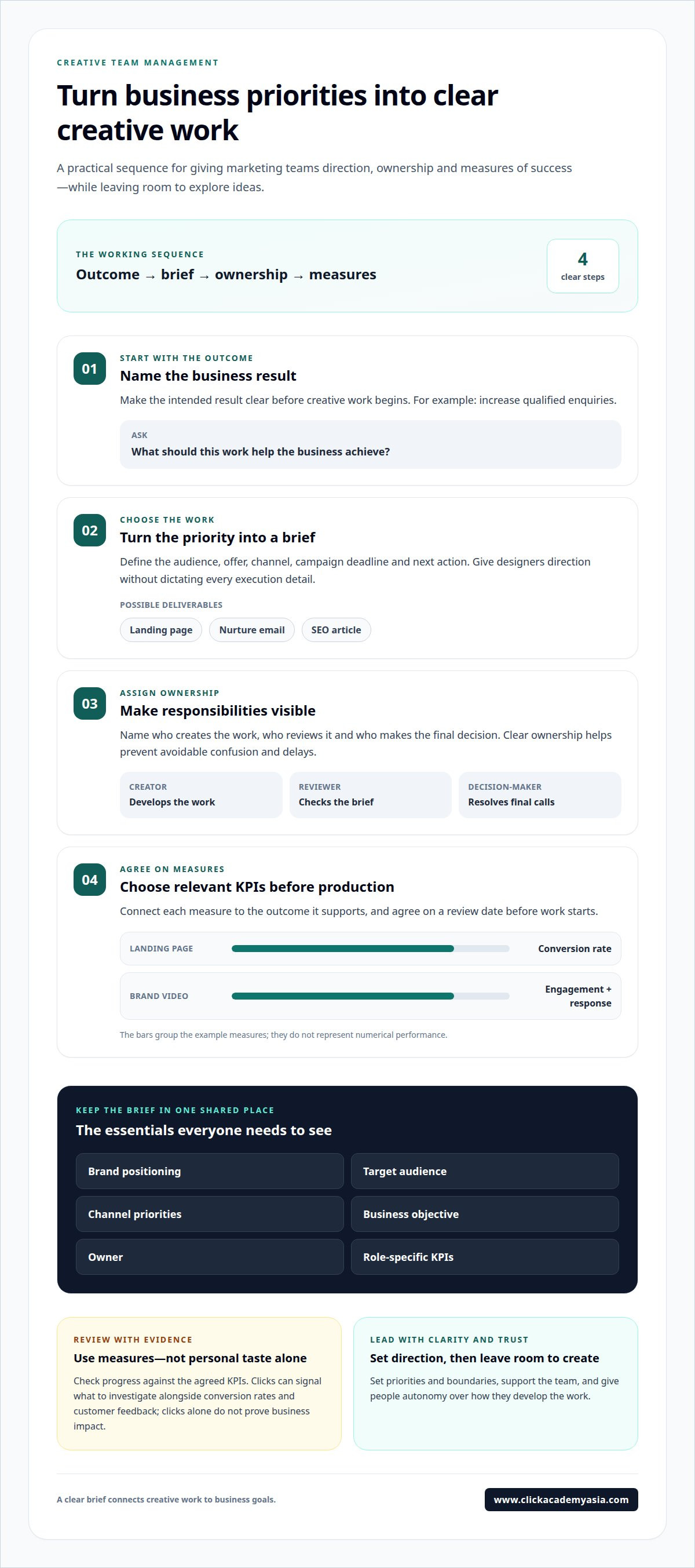
Start with the business outcome, then translate it into a clear creative brief. If the priority is qualified leads, define the audience, offer, channel, campaign deadline and next action before assigning design work. This gives designers direction without dictating every execution detail.
Keep the essentials in one shared brief: brand positioning, target audience, channel priorities, business objective, owner and role-specific KPIs. Connect each measure to the outcome it supports. For example, assess a landing page through its conversion rate, while reviewing a brand video for engagement and audience response.
Set the objective: State the business result, such as increasing qualified enquiries.
Choose the work: Specify the deliverable, such as a landing page, nurture email or SEO article.
Assign ownership: Name the creator, reviewer and final decision-maker.
Agree on measures: Set relevant KPIs and a review date before production begins.
Review progress against those measures, not personal taste alone. Enterprise Singapore's checklist recommends checking daily which products or videos receive the most clicks. Treat clicks as a signal to investigate alongside conversion rates and customer feedback, not as proof of business impact on their own.
What leadership styles work best for creative marketing teams? Use clear, supportive leadership: set priorities and boundaries, then give people autonomy over how they develop the work. Singapore's Ministry of Manpower says managers should develop and support their teams, not simply direct their work.
What employment, privacy, and advertising rules affect marketing teams in Singapore? Build reviews around employment obligations, responsible handling of personal data and accurate advertising claims. Assign an appropriate reviewer to each area and include these checks before campaign approval, especially when work uses customer information or makes product claims.
How should marketing managers give feedback and resolve creative disagreements? Tie feedback to the brief: explain what works, identify where the work misses the audience or objective, and suggest a specific improvement. When opinions conflict, compare each option with the agreed goal and evidence, then let the named decision-maker resolve the issue.
What are the risks of using generative AI in creative marketing teams? AI-generated content can contain inaccurate claims, lack originality or expose sensitive information if staff enter it into unsuitable tools. Set clear boundaries for approved use, protect confidential inputs, and require human review of facts, brand voice and rights before publication.
In a growing company, connect marketing work to business goals by setting priorities, assigning ownership, coordinating execution and reviewing results. Turn priorities into concrete tasks, with goals, KPIs and timelines clearly defined.
Allow room for creative exploration, learn which processes work best for the team, and connect individual contributions to larger objectives without stifling creativity.
2. Creative team efficiency and non-creative tasks
Creative capacity disappears when designers spend their working time chasing approvals, reformatting files or clarifying incomplete requests. Track each task from intake to delivery, noting its owner, status, waiting time and next decision. This simple workflow shows whether delays stem from overloaded people, repeated admin or unclear responsibilities, and where targeted upskilling can help close capability gaps.
Separate creative production from the operations that support it. A campaign designer might develop concepts and layouts, while a project owner handles briefs, scheduling and stakeholder updates. In a smaller team, one person may do both, but visible task allocation makes the trade-off clear and prevents coordination work from becoming invisible. Upskilling in planning and project coordination can help teams manage this work more effectively.
Use a shared board to map recurring work, such as social assets, email campaigns and landing-page updates. Review capacity in a biweekly or monthly meeting, choosing a cadence that fits the pace and complexity of projects. If several deadlines compete for the same specialist, move lower-priority work, adjust the timeline or build the team’s skills so more colleagues can provide support for intermittent needs.
Team allocations can also reveal development needs. If one person repeatedly handles analytics while another owns every video brief, assess whether the pattern reflects expertise, preference or a skill gap. Pair colleagues on a defined task, then review the result together. Use ongoing cross-training to build coverage without assigning every responsibility to everyone.
Look for signs that the creative team needs more support: recurring overtime, stalled approvals, missed handovers or a queue of urgent requests. A 2025 survey of creative professionals found that 57% of creative teams spend more than a quarter of their time on non-creative tasks. Treat that finding as a prompt to inspect your own workflow and identify where upskilling can address capability gaps, not as a target or diagnosis for every team.
How can managers set goals and measure performance for creative marketing teams? Agree on a deliverable, owner, deadline and relevant outcome measure for each project, then review progress alongside capacity and blockers. Use engagement, conversion and customer feedback to understand results, while tracking time spent on coordination to spot pressure on delivery and skills that need strengthening.
Team health also depends on whether members can raise workload concerns early. Add a brief capacity check to existing project meetings and record decisions on the shared board. This gives operations a practical view of demand without adding another standing meeting, and helps managers identify where continuous learning can improve the team’s ability to meet that demand.
Where a team needs stronger planning or measurement skills, exploring ClickAcademy Asia Sales/Marketing courses can help managers develop a more disciplined approach to prioritisation and performance reviews.
3. Hiring and upskilling for creativity and complementary skills
Address capability gaps through a mix of hiring and developing existing team members. Map the skills your marketing plan requires, then compare them with the strengths already available. A team producing weekly video campaigns may need editing or motion-design expertise; a content-led strategy may call for strong research and writing skills.
Start with a skills audit. Record each member's experience, confidence and interests across the work your team handles, such as design, copywriting, analytics, SEO and campaign planning. Then compare the map with upcoming projects. If the same person owns every paid search task, for example, the risk may be a single-person bottleneck, not a lack of creativity.
Use capacity planning to distinguish a genuine hiring need from a temporary workload spike. List ongoing responsibilities, incoming projects, deadlines and the specialist hours each requires. Scholz & Friends' capacity management team meets weekly to review availability and plan incoming projects. Regular reviews help managers spot clashes early and adjust workflows before urgent work displaces planned campaigns.
Keep a simple skills and availability database that team leads can update. Useful fields include:
Capability: note whether a member can lead, contribute to or review a task.
Experience: record relevant formats, channels and audiences served.
Availability: show current assignments and upcoming commitments.
Development: capture skills members want to practise through real projects.
This record supports better assignments, targeted development and more focused hiring briefs. If a capability is needed only for occasional projects, consider specialist support for that work. If the skill is central to recurring marketing activity, such as regular content production, develop in-house expertise through ongoing practice and training, or hire when needed.
Look for complementary strengths, not identical profiles. A visual designer who excels at rapid concepts may work well with a detail-focused editor who checks consistency. Different perspectives can strengthen collaboration when responsibilities and decision rights are clear. During interviews, use a realistic work sample, such as improving a draft campaign brief, to see how candidates approach a practical task.
After hiring, encourage new members to share how they work and what context they need. Give them a concise onboarding pack covering the organisation's audience, positioning, voice and immediate deliverables. Pairing a new copywriter with a designer on one campaign can reveal handoff gaps and establish a smoother workflow from the outset.
Review the skills map as priorities change. A new channel, product or audience may require different expertise, while training can build existing team members' skills before another role is added. Match each decision to the work ahead, how often the skill is needed and the team's available capacity.
4. Reviewing projects and building skills from outcomes
A campaign review should connect the finished work to its original brief, delivery process and audience response. Compare the outcome with the intended result, then decide whether to repeat, improve or stop the approach. For example, if an email attracts clicks but few sign-ups, review the landing-page experience before changing the creative concept. Use the findings to identify skills the team needs to develop for future work.
Set project ownership before production begins. Name the project owner, creator, reviewers and final approver, then record who can request changes at each stage. Designers should not have to reconcile conflicting comments from multiple stakeholders without a clear decision-maker. Keep approvals and feedback in one shared workspace so everyone can act on the latest direction.
Build realistic timelines around the work's dependencies. A campaign may need copy approval before design, and design approval before a landing page can be tested. Allow time for review, revisions and unexpected delays when setting milestones. If leadership approval is needed, schedule that decision before production rather than treating it as an informal last step.
Use project management tools to make each step visible. A shared board can show every campaign's brief, owner, status, deadline, approver and next action; a central document can hold decisions and feedback. What project management tools and workflows do creative marketing teams use? Teams commonly combine a task board, shared files, clear approval stages and scheduled check-ins. The right setup lets people see progress, flag blockers and find the current version without chasing updates.
Make feedback specific and tied to the intended audience. Instead of saying “make it stronger,” identify what needs to change: “Move the customer benefit above the sign-up button so visitors see the value sooner.” Separate required corrections from personal preferences, and group stakeholder comments before sending them to the creative team. This reduces contradictory revisions and keeps the campaign's purpose in view.
After launch, review both results and the working process. Check relevant channel performance, customer feedback, delivery against milestones and approval delays. Ask what helped the team move forward, where work stalled and which decision arrived too late. Record one short action for the next campaign, such as clarifying ownership or testing a revised message, and identify any skills the team should strengthen.
Keep the review constructive. Recognise effective collaboration as well as the final result, and treat underperforming work as evidence to examine, not a reason to assign blame. If a campaign missed its target, compare its audience, message, channel and call to action before deciding what to change. Turn these lessons into structured, ongoing skills development so the team can apply them to future projects.
5. Coordinating marketing with sales and leadership
Creative marketing can lose direction when sales, marketing and leadership work from different assumptions. Continuous learning helps teams build a shared understanding of customer needs, business priorities and campaign decisions. For example, sales may hear that prospects understand a product's features but need stronger proof of its value. Marketing can then shape campaign messages and assets around that concern, while the team learns which approaches work.
Give each stakeholder a useful role and opportunities to learn from one another. Leadership sets the business vision and clarifies priority audiences or offers. Sales contributes direct insight from conversations with prospects, while marketing turns those inputs into a message, channel plan and creative work. Regular knowledge-sharing helps each team understand how its contribution supports the others.
Build a simple feedback loop with sales. Ask for examples of:
Lead quality: Which enquiries fit the intended audience, and which do not?
Prospect questions: What information do buyers need before taking the next step?
Sales objections: Which concerns repeatedly slow a conversation?
Useful proof points: Which examples or evidence help explain the offer?
Converting segments: Which customer groups progress most consistently?
Use those answers to identify opportunities and guide learning, not to turn every sales request into an immediate campaign. If sales reports confusion about a feature, test clearer wording in an email or landing page and share what the team learns. If the issue is missing proof, work with relevant stakeholders to source an approved customer example. Keep the brief focused on the audience's decision, not internal preferences.
Leadership alignment also benefits from continuous learning. Share a concise campaign view that links the business priority to the target audience, planned activity, owner and outcome measure. Discuss trade-offs directly: if a new request arrives, agree what should move, pause or receive fewer resources. Reviewing these decisions together helps teams understand changing priorities and improve future planning.
Protect time for coordination and shared learning without filling calendars with status meetings. Use a regular sales and marketing review to discuss lead feedback, upcoming campaigns and decisions requiring leadership input. Share updates asynchronously when no decision is needed. Record agreed actions and owners in one place, so stakeholders can follow progress and build on previous discussions.
Shared assets help teams communicate consistently and learn from customer interactions. Store current campaign messages, approved product information and sales materials in an accessible place. When sales identifies an outdated claim or a recurring prospect question, assign an owner to update the relevant asset. Marketing can then reflect the change across suitable channels and share the learning to maintain a coherent customer experience.
Strengthen alignment between sales priorities and campaign planning through [Internal Link: ClickAcademy Asia Sales/Marketing courses].
ClickAcademy Asia
ClickAcademy Asia helps professionals and teams strengthen the marketing skills behind clearer planning, stronger campaigns and more confident decisions. Structured learning can help your team connect creative activity with business priorities, develop channel expertise or improve how it evaluates performance.
Relevant options include WSQ Digital Marketing Strategy & Planning, WSQ Content Marketing Strategy, WSQ Search Engine Optimization (SEO) and WSQ Search Engine Marketing (SEM). These programmes support practical capability-building across strategy, content and digital channels, helping team members apply stronger marketing foundations to their work.
If you’re ready to build your team’s marketing capability, contact ClickAcademy Asia.
Build the next stage of your team’s capability
Turn your leadership approach into a repeatable learning habit. Choose one capability your team needs to strengthen, connect it to a live marketing challenge and make space to apply the learning together. This might mean improving how briefs translate business priorities, building confidence in performance analysis or helping managers guide collaboration across functions.
As you refine your approach to managing creative marketing teams, treat capability-building as part of the operating model, not as a response to a single setback. Shared learning can help marketing professionals make stronger decisions, adapt their skills and contribute with greater confidence as priorities evolve.
ClickAcademy Asia offers WSQ Digital Marketing Strategy & Planning, WSQ Content Marketing Strategy and WSQ Search Engine Optimization (SEO) to support practical marketing development. Explore learning options with ClickAcademy Asia and equip your team with skills through WSQ-funded training tracks.
Frequently Asked Questions
How do you manage a creative team effectively?
Make it safe for team members to share unfinished ideas and raise concerns early. For example, hold an initial idea-generation round where people contribute possibilities before the group evaluates them. This reduces the pressure to present only polished concepts and can surface useful directions that might otherwise be overlooked. Managers can model this by responding to early ideas with curiosity before offering critique, while encouraging continuous learning to strengthen the team’s creative skills.
What is creative collaboration?
Creative collaboration means shaping an idea together, rather than simply passing separate tasks between specialists. A writer and designer might sketch several campaign concepts, then combine the strongest message and visual approach. Each contributes their expertise while staying open to changes prompted by the other's perspective. The result develops through shared thinking, not just the assembly of individual deliverables.
What are the best practices for managing creative marketing teams?
Set team norms for critique before a project begins. For instance, agree that feedback should address the work rather than the person, and that early concepts are open to exploration. Another useful practice is testing a rough prototype before investing time in polished production. Support these practices with ongoing skills development so the team can apply feedback and testing methods more effectively.
How should creative marketing teams be structured and staffed?
Choose a structure that makes expertise easy to access without creating unnecessary handoffs. A team serving several product lines might keep designers and writers in a shared creative group, then assign them to projects as needed. A team focused on one audience may benefit from closer day-to-day pairing. Review whether the structure supports collaboration across disciplines, and use continuous learning to build the skills teams need to work effectively across them.
How can creative teams balance creativity with deadlines and business goals?
Use small experiments to explore ideas without committing to full production. A team could compare two message directions through low-fidelity concepts, then develop the one that communicates most clearly to its intended audience. Agree in advance what the test should help decide. This gives creative exploration a practical purpose while limiting effort spent polishing an unproven direction, and helps teams build their testing skills through practice.
How can managers prevent burnout and improve retention on creative teams?
Make recognition specific and fair. Acknowledge the research, iteration or thoughtful collaboration behind a campaign, not only its public performance. Pair recognition with meaningful development conversations, such as identifying a skill a team member wants to practise on an upcoming project. Investing in continuous learning alongside recognising contributions shows people their growth is taken seriously and gives them stronger reasons to stay engaged.



Comments