
Troubleshooting a Broken Lead Funnel by Finding Weak Links

More traffic won’t repair a funnel that loses good prospects before they become customers. Troubleshooting a broken lead funnel means finding where interest drops, whether between an advert and landing page, a page and an enquiry, or an enquiry and a sale. The gaps between stages often reveal more than lead numbers alone.
If enquiries arrive but conversions or closed deals don’t keep pace, suspect a weak link in the funnel. The challenge is to identify the cause without changing several things at once. Compare traffic, conversion and close rates to pinpoint which stage needs attention and distinguish a targeting issue from a website or follow-up problem.
This guide explains how to assess each part of the journey. You’ll learn what to look for in traffic and funnel metrics, how website experience and calls to action influence progress, and how analytics can show where prospects drop off. A complete view helps you prioritise practical improvements and focus on the stage that needs attention most.
Table of Contents
Calls to action and service-page content
A service page should make the next action obvious. Match its headline, offer and call to action to the same buyer need. For example, a page promoting a marketing audit should explain what the audit covers and invite visitors to request one. If the button says “Learn more” but the page promises a consultation, the next step feels unclear. Keep the action specific, visible and consistent with the offer.
Review the full path from advert to form submission. A paid advert about a particular service should lead to a page discussing that service, not a generic homepage. Place the main call to action near the offer, then repeat it after useful supporting details. On a contact page, a short form with four fields can ask for name, phone, email and a brief message.
Use a button label that describes the next step, such as “Request a proposal”.
Explain what happens after submission, such as a sales representative reviewing the enquiry.
Remove navigation or competing offers that distract from the primary action.
Answer practical buyer questions beside the relevant service details.
A/B testing helps identify which page elements encourage action. Change one element at a time, such as the button text, headline or form placement. For example, compare “Book a consultation” with “Discuss your requirements”. Keep the audience, offer and other page content consistent. Then assess completed enquiries alongside page visits, rather than treating button clicks as the final outcome.
Personalised content can make a page more relevant to a buyer’s role, industry or stage. A marketing manager comparing campaign options may need different evidence from an executive assessing business impact. Use CRM details or campaign context to present suitable examples and answers. AI can help tailor content and respond to buyer questions, while a clear route to a person remains useful for complex enquiries.
In Singapore, the cost of tools and services for repairing a lead funnel depends on the case and is given after a quote request. Scope, software subscriptions, integrations, copywriting and testing needs affect the work involved. Separate one-off page changes from recurring platform costs when assessing the total.
Start with the page receiving the most relevant traffic, then inspect its message, form and follow-up route. If visitors click but don’t submit, test the form or offer before increasing traffic. If enquiries arrive but don’t progress, compare the promise made on the page with the sales conversation. This connects each call to action with a measurable funnel outcome.
Traffic, conversion and close-rate metrics
Read traffic, conversion and close rates together instead of treating lead volume as success. Compare each rate by channel, target audience and funnel stage to locate the drop.
Lead Volume and Funnel Conversion
Lead volume counts incoming prospects; funnel conversion shows how many move towards revenue. This distinction matters because more leads can disguise weak targeting or qualification. A website receiving enquiries but producing few appointments needs a different response from a campaign attracting too few relevant visitors.
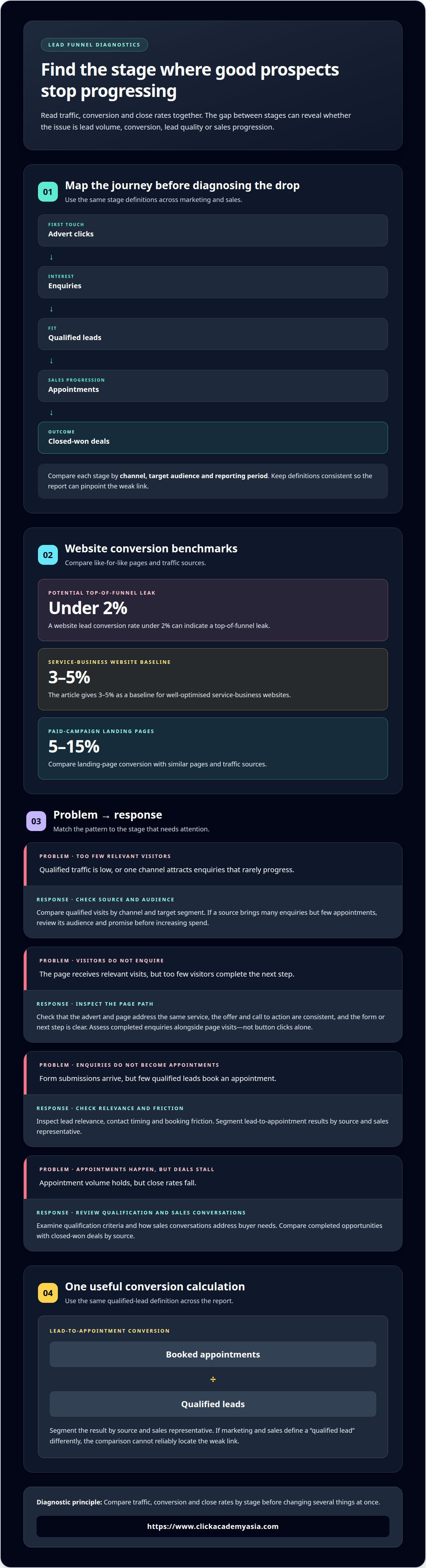
Compare stages using the same audience and reporting period. For example, track advert clicks, enquiries, qualified leads, appointments and closed-won deals by campaign. If one source brings many enquiries but few appointments, review its audience and promise before increasing spend. If appointment volume holds but deals stall, inspect progression through the sales stages instead.
Diagnosing Low Conversion Rates
Low conversion means too few visitors or leads complete a defined next step. A website lead conversion rate under 2% can indicate a top-of-funnel leak, while 3-5% is a baseline for well-optimised service-business websites. Paid-campaign landing pages are expected to convert at 5% to 15%; compare like-for-like pages and traffic sources.
To calculate lead-to-appointment conversion, divide booked appointments by qualified leads, then segment the result by source and sales representative. If a campaign attracts form submissions but few bookings, inspect lead relevance, contact timing and booking friction. If appointments happen but close rates fall, examine qualification criteria and how sales conversations address buyer needs.
For Singapore lead collection, explain why contact details are collected and manage marketing preferences appropriately. Keep follow-ups aligned with the purpose communicated to prospects, and handle withdrawal requests through the organisation’s privacy process.
To troubleshoot low-quality leads, compare scoring rules with actual outcomes. Score fit, stated need and engagement, then review which combinations lead to appointments and sales. For example, repeated visits to a service page may indicate interest, but a poor-fit company should not automatically receive a high score. Adjust criteria when low-scoring leads progress or high-scoring leads repeatedly stall.
Use a simple stage report to separate volume problems from conversion problems:
Traffic: compare qualified visits by channel and target segment.
Conversion: measure visitors becoming enquiries, then qualified leads becoming appointments.
Close rate: compare completed opportunities with closed-won deals by source.
Keep definitions consistent across marketing and sales. If each team defines “qualified lead” differently, the report cannot pinpoint the weak link. Align the criteria, then review the same report together. Teams looking to strengthen measurement can explore ClickAcademy Asia Marketing Analytics & Insights training courses to support more informed analysis of campaign performance.
Website engagement and user experience
A slow or confusing website can interrupt progress before a prospect submits an enquiry. Review loading, mobile usability and follow-up together to see where interest fades.
Check mobile pages first, because a delayed offer can lose a potential lead. A website taking more than 3 seconds to load can lose prospects before they see the offer; aim to keep mobile load time under 2 seconds. A survey of 6,000 online shoppers found that 42% decide whether to stay or leave within 10 seconds. Put the value proposition and next step where visitors can find them quickly.
Test the experience by completing a specific task, such as finding a service and submitting an enquiry. On a phone, check that the headline, form fields and action button are visible and usable. Remove intrusive pop-ups that cover essential content. If a landing page attracts visits but few completed enquiries, inspect page speed, mobile layout and message clarity before changing the campaign.
For B2B purchases, the experience must serve more than one decision-maker. Forrester reports that 94% of B2B purchasing decisions are made by buying groups rather than individuals. Give a finance stakeholder clear information about business value, while explaining implementation needs to the operational lead. A shared page should make the offer relevant to both, without forcing every visitor through identical content.
Insufficient engagement may show up as repeated visits without a meaningful next action. Offer useful content for each stage, such as a service comparison for early research and a detailed case example during evaluation. Interactive demonstrations can let buyers explore relevant information at their own pace. Use engagement signals to guide follow-up, not as proof that a prospect is ready to buy.
Improve follow-up speed by routing each enquiry to an owner and setting an alert for new submissions. Respond within 5 minutes where possible; an automated acknowledgement under 60 seconds can confirm receipt while a person prepares a relevant reply.
Build a 7 to 14 day nurture sequence around the prospect’s stated interest. For example, send a useful guide first, address a common objection in a later message, then invite the lead to discuss requirements. Pause or adapt the sequence when the person replies, books an appointment or opts out. Automation helps prevent enquiries from being overlooked, while tailored content keeps each contact relevant.
Check speed: test key landing pages on mobile and review their load time.
Check engagement: match useful content to the buyer’s research stage.
Check follow-up: confirm each enquiry has an owner and a timely next action.
Funnel performance metrics and analytics
Analytics reveal where audience activity stops producing revenue. Troubleshooting a broken lead funnel starts with connecting campaign, website and sales data, using consistent stage definitions across marketing and sales.
Build a funnel view that follows each lead from source to outcome. Track visits, enquiries, qualified leads, appointments, opportunities and closed-won revenue. Segment these measures by campaign, audience and device. For example, mobile visitors may behave differently from desktop visitors, while branded search can attract buyers at a later stage.
Look for the point where progression changes. A paid-campaign bounce rate over 70% can signal a top-of-funnel leak. Compare the campaign promise with the landing page, audience targeting and device experience. If visitors leave before viewing key content, adjust the page or traffic source before raising spend.
Then connect marketing activity to sales results. A lead source that generates form submissions may still produce few qualified opportunities. Track which leads become revenue and attribute outcomes to the campaigns and touchpoints that contributed. This helps teams distinguish high enquiry volume from commercially useful demand.
Acquisition: compare visits, source and audience quality.
Progression: monitor movement between qualified leads, appointments and opportunities.
Outcome: connect closed-won revenue to the originating source.
Use one reporting period and consistent definitions when comparing these stages. If sales labels a lead “qualified” differently from marketing, the dashboard can hide the real bottleneck. Agree on qualification criteria, then review the same report together. This clarifies the next action: refine targeting, improve the handover or support sales conversations.
Allow for the time between first touch and revenue. One reported sales cycle lasted 45 days before messaging improvements. A campaign reviewed too early may appear weak when opportunities are still progressing. Compare cohorts by first-contact date, and include only outcomes that have had time to develop.
Treat troubleshooting a broken lead funnel as an evidence-led process, not a series of unrelated edits. Record each change, the audience affected and the metric expected to move. For example, if revised messaging aims to improve qualified enquiries, monitor qualification and revenue, not clicks alone. Change one major variable at a time so results remain interpretable.
Review metrics regularly: check tracking for gaps, discuss funnel movement with sales, then select one bottleneck to address. Keep a change log alongside the dashboard. Over time, this gives the team a clear record of which adjustments improved progression and which did not.
How can you test whether website tracking, analytics, and CRM integrations are working?
Run a controlled test enquiry from a landing page through to the CRM. Confirm that the analytics event, submitted details and lead source appear correctly at each step.
Start with a traceable test. Open a campaign landing page using its usual tracking parameters. Submit a clearly labelled test enquiry, such as “Tracking check”, using a monitored email address. Record the page, device and time so the same journey can be found in each system.
Check the website response. Confirm that the form accepts valid details and rejects incomplete fields. After submission, note whether the expected confirmation appears. If the page refreshes without confirmation, check whether the enquiry still reached the next system.
Inspect analytics events. Look for form-start and form-submit events in the analytics platform’s live or diagnostic reports. Confirm that one submission creates the intended event, not duplicate events. Check that the event is attached to the correct page and campaign source.
Follow the record into the CRM. Search for the test contact and compare its name, email, message and source with the submitted form. Check that the lead entered the correct pipeline stage and reached the intended owner. A missing record suggests a handover issue, while blank fields point towards field mapping.
Compare systems before drawing conclusions. Match the test submission against the analytics event and CRM record. If analytics counts the event but the CRM has no lead, investigate the integration. If the CRM records the lead but analytics shows no event, inspect the website tag or event trigger.
Repeat the test on mobile and desktop. Use a separate test label each time, then confirm that records appear without overwriting one another. Test another route, such as a contact-page form, because forms may use different integrations. Keep the test details consistent so the comparison isolates device or form differences.
Check campaign attribution with a test link carrying a campaign source and medium. Confirm that the CRM record retains those values after submission. If every lead appears as “direct” or has blank campaign fields, review parameter capture and destination fields. Record what each system received, then trace where any missing value disappeared.
For an end-to-end check, have marketing and sales review the same test record. Confirm that the lead is visible to its assigned owner and that its source remains readable. This shared review can reveal handover gaps that separate analytics and CRM checks miss. Add the result to a simple test log, including the date, route and outcome.
Teams building practical measurement skills can apply them through [Internal Link: ClickAcademy Asia Google Analytics (GA4) Training] when reviewing analytics events and reporting workflows.
ClickAcademy Asia: Digital Transformation for Leaders
ClickAcademy Asia helps professionals and leaders build skills in digital strategy, marketing and sales leadership. If funnel analysis reveals gaps in team capabilities, Digital Transformation for Leaders can support leaders navigating organisational change, while Sales Leadership is relevant when the challenge centres on guiding a sales team.
For teams refining campaign planning and content, WSQ Digital Marketing Strategy & Planning and WSQ Content Marketing Strategy offer focused learning paths. Choose a programme based on the capability gap, whether it sits in leadership, marketing planning or content strategy. The aim is to strengthen internal understanding so teams can make more informed decisions about their funnel.
You can [Internal Link: Contact ClickAcademy Asia] to discuss which learning path fits your team’s priorities.
Turn funnel insights into stronger team capability
Once your team identifies a weak link, make improvement part of how it plans, tests and learns. Assign an owner to each change, record the decision behind it, and use the evidence to guide the next adjustment. This turns troubleshooting a broken lead funnel into a repeatable business capability, rather than a one-off response to falling enquiries.
ClickAcademy Asia offers WSQ Digital Marketing Strategy & Planning, WSQ Content Marketing Strategy and WSQ Search Engine Optimization (SEO). These learning options are relevant when teams need to strengthen strategic planning, align content with buyer needs or build their understanding of organic search. Choose the capability that matches the challenge your team has identified, then apply that learning to its current marketing work.
Equip your team to make more informed decisions and build a stronger improvement process through WSQ-funded training tracks. Contact ClickAcademy Asia to discuss a suitable learning path. A clearer funnel starts with capable people ready to act on evidence.
Frequently Asked Questions
How do I know if my funnel is broken?
Look for a persistent mismatch between activity and outcomes at a specific stage. For example, if enquiries rise but qualified opportunities do not, inspect lead relevance and qualification. If sales records show opportunities but few closed deals, review the offer, decision process and sales conversations. Check that the pattern holds across comparable campaigns before changing strategy, since an unusual week may not reveal a structural problem.
Should I fix all three funnel stages at once or prioritise?
Prioritise the stage with the clearest evidence of lost opportunity, rather than changing every stage at once. If a campaign attracts the intended audience but visitors rarely enquire, test the landing-page message first. If enquiries are relevant but opportunities stall, focus on qualification or sales progression. Record each change and its intended outcome so you can learn which adjustment made a difference.
What is a good lead conversion rate for a website?
A useful reference for well-optimised service-business websites is 3-5%, while paid-campaign landing pages may target 5% to 15%. Treat these as context, not universal pass marks. A high-intent service page and a broad awareness page attract different visitors. Compare pages with similar audiences, offers and traffic sources, then judge performance by qualified enquiries and revenue contribution, not form submissions alone.
What is the biggest lead generation mistake businesses make?
One costly mistake is treating raw lead count as the main measure of success. A campaign can produce a large enquiry list while attracting people outside the target market or without a relevant need. Define what makes a lead suitable, then compare sources by qualification, progression and sales outcomes. This helps marketing teams avoid scaling activity that consumes sales capacity without supporting business goals.
What should I fix before generating more leads?
Resolve issues that prevent existing prospects from progressing. Confirm that each offer matches its audience, enquiries reach the right sales owner, and the team can distinguish suitable leads from poor-fit contacts. For example, if a form collects enquiries but no one owns the follow-up, more traffic may increase the backlog rather than revenue. Strengthen the handover before expanding campaign reach.
How do you diagnose where a lead funnel is losing prospects?
Compare groups of leads that entered through the same campaign or source, then note the last stage each group reached. A cohort that repeatedly stops after a product demonstration may need clearer evidence or a more relevant next step. Ask sales to record common objections alongside stage outcomes. This adds context to dashboard figures and helps distinguish buyer hesitation from an internal process delay.
How do you audit lead capture forms, landing pages, and calls to action?
Test the page as a prospective buyer on mobile and desktop. Check that the headline matches the campaign, each field has a clear purpose, errors explain how to proceed, and the submit button describes the action. After submission, confirm that the success message explains what happens next. Review the page with a colleague unfamiliar with the offer and note where they hesitate or misunderstand.
How do you compare funnel performance across paid search, social, and organic channels?
Use consistent definitions for enquiry, qualified lead and closed deal across all three channels. Compare audiences and campaign intent before judging results: paid search may capture active demand, while social content can introduce an offer earlier. Include assisted conversions where available, since an organic visit may follow an earlier advert. Assess qualified opportunities and revenue alongside initial responses to identify channels contributing meaningful demand.



Comments