
Training for New Marketing Leads Planning Their First Campaign

Your first campaign shouldn’t begin with a fresh set of ideas. Start with a clear view of what has worked, who you need to reach and what the business expects marketing to achieve. A training plan for a newly promoted marketing lead should build those foundations before moving into channel choices, creative testing and campaign targets.
Taking on a marketing lead role means balancing strategic decisions with practical delivery. You may already know the channels, but setting campaign direction means connecting audience insight, budget, messaging and measurement in a way your team can act on.
This guide shows you how to shape your learning around campaign history, buyer personas and multichannel lead generation. You’ll also learn to test creative with purpose and set SMART goals that make progress easier to assess. Use these steps to turn your first campaign into a focused plan, not a collection of disconnected tasks.
Table of Contents
Campaign history, objectives, and success metrics
A training plan for a newly promoted marketing lead should connect past campaign evidence with upcoming business priorities. Review what the team delivered, what it learned and which skills the next campaign requires.
Reviewing Past Campaign Outcomes
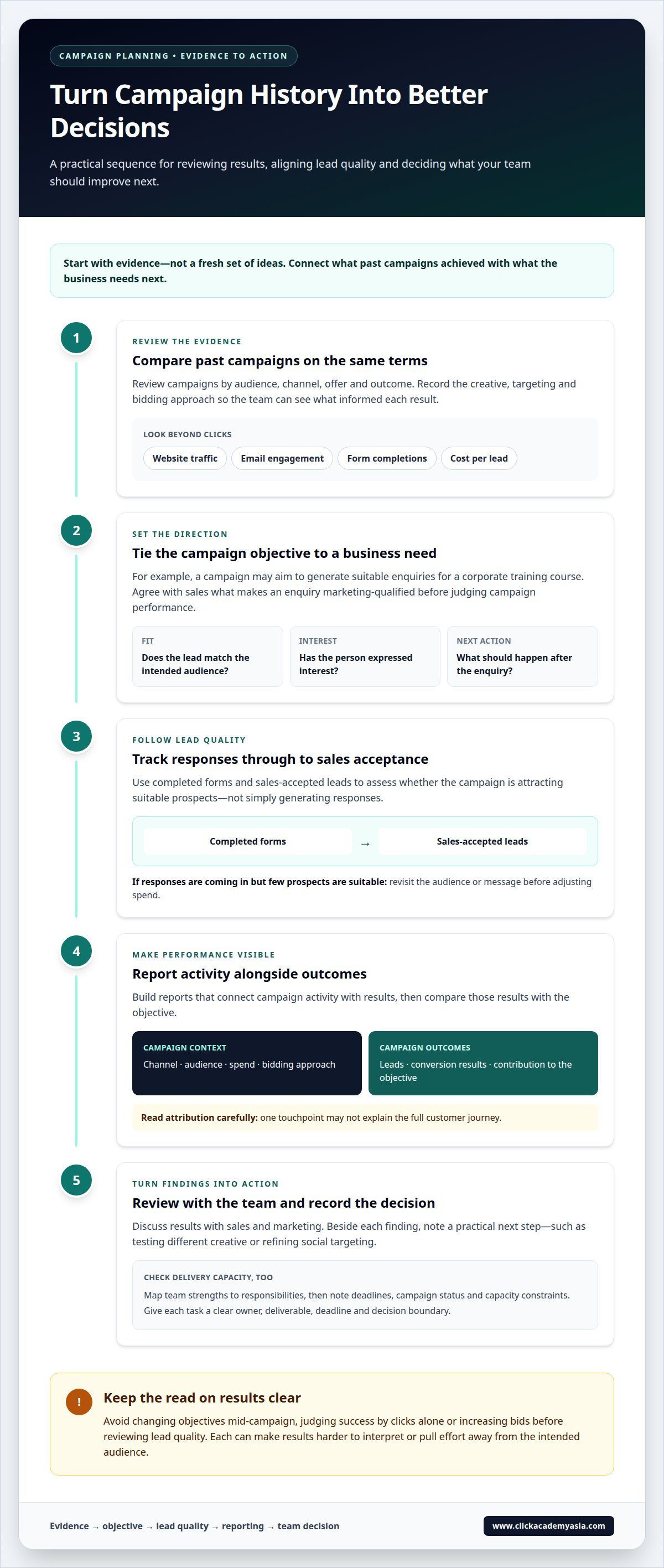
Compare earlier campaigns by audience, channel, offer and outcome. Review website traffic, email engagement, form completions and cost per lead together, rather than treating clicks as success. For social media, compare the original plan with actual responses: which posts generated enquiries, and which reached the intended audience? Record the creative, targeting and bidding approach. This history helps the team make informed choices about its next campaign.
Aligning Objectives With Lead Results
Connect each campaign objective to a business need, such as generating suitable enquiries for a corporate training course. Agree with sales on what makes a lead marketing-qualified, including fit, expressed interest and the appropriate next action. Track that definition through completed forms and sales-accepted leads. If advertising generates responses but few suitable prospects, revisit the audience or message before adjusting spend.
Reporting Campaign Performance
Build reports that connect activity with outcomes. Include channel, audience, spend, bidding approach, leads and conversion results, then compare them with the objective. Use attribution data to assess each channel’s contribution, while recognising that a single touchpoint may not explain the full journey. Review results with sales and marketing, and record a decision beside each finding, such as testing different creative or refining social targeting.
Assess team skills, workloads and active campaigns together. Map each person’s strengths to responsibilities, then note deadlines, campaign status and capacity constraints. For example, a gap in paid advertising skills may affect who can manage bidding and reporting.
Delegate with a clear owner, deliverable, deadline and decision boundary for each task. Give feedback against the agreed brief, with a specific example of what worked and what needs improvement.
Build trust through clear priorities, consistent follow-through and regular check-ins. Recognise useful contributions, invite questions about campaign decisions and explain how each person’s work supports the objective.
In Singapore, available training support can depend on the course, learner and sponsorship arrangement. Consider SkillsFuture Credit, funding for eligible learners or UTAP reimbursement for eligible NTUC union members, and assess which route applies to the development need.
Avoid changing objectives mid-campaign, judging success by clicks alone or increasing bids before reviewing lead quality. These mistakes make results harder to interpret and can pull effort away from the intended audience.
Use the training plan for a newly promoted marketing lead to connect social media planning, optimisation and reporting with campaign objectives. Review lead quality and conversion data alongside engagement, then document what changed and why.
Defining target audiences and buyer personas
Build audience profiles from evidence about roles, industries, interests and barriers. Use those profiles to shape targeting, campaign timing and messages that engage the right people.
Building Audience Profiles
Start with information that changes campaign decisions: job role, industry, seniority, goals and reasons for considering training. A marketing manager seeking stronger analytics skills has different questions from an HR leader planning employee development. Add practical barriers, such as time, format and decision-making responsibilities. These details turn a broad audience into a useful persona, not a fictional biography.
Selecting Target Markets
Group potential learners by shared needs and context, then choose the segments that fit the campaign objective. For example, target Singapore-based corporate teams with a message about developing digital marketing capability, while addressing individual professionals through role-specific outcomes. Compare each segment’s needs, likely decision-makers and preferred channels. That focus helps the team tailor targeting and use campaign resources where the offer is most relevant.
Keep the persona actionable with a short profile the campaign team can use. Record the person’s role, organisation type, goal, obstacle and information need. Then connect each detail to a decision: a senior HR buyer may need team-level outcomes, while a working marketer may prioritise practical skills. Use customer conversations, sales feedback and campaign response patterns to refine these profiles as new insights emerge.
For each target audience, map the buying journey before selecting channels. Someone comparing training options may need clear programme details, while an early-stage prospect may respond to useful content or an event invitation. Match the message to the person’s question, then select targeting criteria that reflect the profile. Avoid combining audiences with different motivations in one campaign, as the message can become too broad to engage either group.
Plan campaign activity around actual cohort dates and the in-person schedule. Singapore in-person course cohorts are scheduled for 3-4 December 2026, 1-2 February 2027, 1-2 April 2027, 14-15 June 2027 and 2-3 August 2027. Use each date to organise promotion, information sessions and follow-up, while tailoring messages to the relevant learner profile.
Audience: Define roles, industries, goals and barriers.
Target: Select segments that align with the campaign objective.
Engage: Match content and sessions to each segment’s questions.
Schedule: Align campaign communications with cohort dates.
Creative strategy, messaging, and testing
Creative decisions work best when they connect audience insight to a clear campaign objective. Translate that connection into a marketing strategy, a focused message and a test the team can learn from.
Start with the audience’s most relevant challenge and the outcome your campaign offers. For example, a message for managers responsible for digital campaigns could focus on building practical planning skills. A separate message for HR leaders could emphasise how structured learning supports team capability. Keep the value proposition specific to each audience rather than relying on broad claims.
Turn the proposition into a small set of messages. A campaign for a training solution might address a skills gap, show how learning applies at work and explain the next step. Keep the strategy focused: an adoption campaign should use no more than five key messages. This makes it easier for the team to create consistent copy across advertisements, landing pages and social media.
Choose creative formats that suit the message and channel. A short social post can highlight a practical workplace challenge, while a landing page can explain learning outcomes in more depth. For search advertising, align the headline with the intent behind the search. Each asset should make the same offer clear, even when its format changes.
Test creative with a defined question, not a vague desire to improve. Compare alternative headlines while keeping the audience and offer consistent. If the test changes several elements at once, the team cannot tell which change influenced the response. Track the relevant outcome, such as form completions or qualified enquiries, rather than judging a message only by clicks.
Use feedback as evidence for the next iteration. Sales conversations may reveal that prospects understand the course topic but need clearer information about how it applies at work. Update the copy to address that concern, then review the response. Record the insight, the change made and the result so the team builds skills in both creative judgement and testing.
Insight: Identify the audience’s specific challenge.
Message: Connect that challenge to a clear value proposition.
Test: Change a defined creative element and track a relevant outcome.
Feedback: Use audience and sales responses to refine the next version.
Setting SMART goals for training initiatives
A training plan for a newly promoted marketing lead should connect learning to a capability the team needs at work. Define the skill, evidence of progress and review point before choosing a course or activity.
Separate learning activity from workplace results. Completing a course records participation, but applying its learning shows how capability develops. For a corporate team, identify the gap first, then decide what managers can observe in employees’ work. For example, a marketer might learn to interpret campaign data and use those insights in a planning discussion.
Specific: Name the capability, such as preparing a search engine campaign brief.
Measurable: Agree on evidence, such as a brief reviewed against shared criteria.
Achievable: Consider current skills, workload and available support.
Relevant: Link the learning to a role or business priority.
Timed: Set a review point, such as the next campaign planning meeting.
For a practical goal, ask a team member to apply search engine insights when drafting a campaign brief. The manager and employee can agree what the brief needs to cover, who will review it and when it should be ready. This provides evidence of applied learning, rather than relying on course attendance as proof of workplace impact.
Communications goals also benefit from observable criteria. A team member could adapt one campaign message for email and social media, then explain how each version suits its audience. The manager can assess clarity, consistency and alignment with the brief. Feedback should identify a strength and a specific improvement for the next draft.
Choose a training provider and learning activity based on the capability gap. Analytics training may suit a team that needs to interpret performance data, while strategy training may suit marketers who shape campaign plans. Pair the learning with a practical task, such as presenting a recommendation based on campaign results.
Use the training plan for a newly promoted marketing lead to set a review point after employees apply their learning. Discuss their work against the agreed criteria, identify barriers such as limited practice or unclear expectations, and decide the next development step. Recording that decision makes the goal useful beyond the training session.
For eLearning projects, set goals using the SMART methodology: specific, measurable, achievable, realistic and timed. Connect each target to observable workplace evidence.
What should a newly promoted marketing lead focus on in the first 30, 60, and 90 days?
Use the first 90 days to understand how the business creates value, organise upcoming work and establish a repeatable operating rhythm. Give each stage a concrete output, so progress is visible without trying to change everything at once.
Days 1-30: Learn the business from the inside
Study the organisation’s products, services, sales cycle and commercial priorities. Sit in on customer-facing conversations or product demonstrations to hear how the business explains its value. Trace how a prospect moves from initial awareness to a sales conversation, noting the information and handovers involved. Review existing brand guidance and campaign commitments. By day 30, prepare a short briefing that connects marketing activity to the organisation’s business model and current priorities.
Days 31-60: Build a workable operating plan
Turn the business context into a forward-looking marketing calendar. Add planned launches, seasonal activity, content production, internal reviews and dependencies such as product or sales input. Make the sequence visible, so the team can spot clashes before deadlines become urgent. Agree a practical approval path for common materials, including who gives final sign-off. By day 60, circulate a calendar and workflow that show how planned activity moves from brief to delivery.
Days 61-90: Put the operating plan into practice
Use the calendar to coordinate a planned campaign or marketing initiative from preparation through delivery. Keep the agreed brief, assets, approvals and launch details together in one shared workspace. Track operational blockers, such as late inputs or unclear review stages, and resolve them through the agreed process. At the end of the period, document which workflow steps supported delivery and which need refinement. This creates a practical foundation for the next planning cycle.
Keep the scope manageable throughout the transition. A new lead does not need to redesign every process or channel immediately. Protect time for business learning in the first month, planning in the second and applying the operating rhythm in the third. These stage-specific outputs create a useful reference for future priorities and make the transition into the role more deliberate.
As responsibilities become clearer, make decision rights explicit alongside the calendar and workflow. Clearly defining who can make decisions and who is responsible for each task can support effective delegation and team autonomy, according to the Institute for Applied Economic Research (Ipea). For each recurring activity, record an owner, the person or role that approves the work, and the decisions the owner can make without further review. Keep the arrangement simple enough to use in routine work, and make it visible to everyone involved. This helps the new lead delegate with a shared understanding of responsibility, rather than relying on informal assumptions.
Use the first campaign or initiative to check whether those assignments are workable. If a task stalls, clarify whether the issue is ownership, approval or a missing input, then adjust the workflow accordingly. Invite the team to flag overlapping responsibilities or unclear decisions, and capture agreed changes for the next planning cycle. This keeps coordination practical while giving colleagues room to handle their parts of the work. The result is a clearer basis for distributing tasks as upcoming activity is planned and delivered.
ClickAcademy Asia: WSQ Digital Marketing Strategy & Planning
ClickAcademy Asia offers WSQ Digital Marketing Strategy & Planning for professionals who need to strengthen their campaign planning capability. It is a relevant next step when your first campaign has exposed gaps in setting direction, connecting marketing activity to business priorities or coordinating channels.
Use the learning need identified in your first campaign cycle to guide your choice. If the challenge is building a clearer plan, ClickAcademy Asia’s WSQ Digital Marketing Strategy & Planning course is closely aligned. If your priority is stronger content decisions, consider WSQ Content Marketing Strategy. Match the programme to the skill you need to apply at work.
Some new leads also need to develop beyond campaign execution. Digital Transformation for Leaders may suit managers working through broader organisational change. Sales Leadership may be relevant when the development need involves leading sales teams and aligning their work with marketing. Consider these options in relation to your responsibilities, not simply your new job title.
For a practical discussion with your manager or HR team, bring a specific development objective. For example, identify whether you need to improve campaign planning, content direction or leadership across functions. Then connect your learning choice to a work task, such as preparing a strategy for an upcoming campaign. This gives you a clear way to apply and reflect on what you learn.
For team development, start with the shared capability gap and the work employees need to deliver. A marketing team may need a common planning approach, while a manager may need leadership development. Align the learning choice with those different needs, then agree how participants will apply their learning in current work. This keeps training connected to the campaign priorities already on the team’s plan.
ClickAcademy Asia’s relevant offerings include:
WSQ Digital Marketing Strategy & Planning for marketing planning needs.
WSQ Content Marketing Strategy when content strategy is the priority.
Digital Transformation for Leaders for broader leadership development.
Sales Leadership for sales team leadership needs.
Choose the option that best fits the capability you want to build and the responsibilities you hold. Explore WSQ-funded training tracks with ClickAcademy Asia to equip your team and support its development.
Frequently Asked Questions
What skills does a new marketing team leader need to develop?
A new marketing team leader needs to strengthen strategic judgement, coaching and cross-functional communication. They must translate business priorities into clear work for specialists, then make trade-offs when timelines or resources shift. For example, a lead may need to coordinate creative, sales and analytics teams around one launch. Developing leadership skills alongside channel knowledge helps the manager guide decisions without taking over every task.
How can a marketing lead set goals and KPIs for a team?
What training courses or certifications are useful for marketing leaders in Singapore?
Choose training that matches the role’s immediate capability gap. WSQ Digital Marketing Strategy & Planning supports stronger strategic planning, while WSQ Marketing Analytics & Insights addresses measurement and interpretation. For hands-on platform knowledge, Google Analytics (GA4) Training or Google Ads Search Certification may be relevant. A leader who needs deeper content planning can consider WSQ Content Marketing Strategy. Match the learning to responsibilities, then apply it to a live workplace task.
How should a marketing lead manage budgets, campaign performance, and reporting?
Set budget rules before campaigns launch: document approved amounts, channel allocations, spending owners and the process for changes. During delivery, compare actual spend with the plan and check whether leads are relevant, not just plentiful. A useful report links expenditure to channel activity, lead progression and sales feedback. If a channel spends but produces poorly qualified enquiries, investigate targeting or the offer before shifting budget elsewhere.
Build leadership capability, align KPIs, choose relevant training and review spend. Equip your team through ClickAcademy Asia’s WSQ-funded training tracks.



Comments