
TikTok Ads for Singapore E-commerce: 2026 Guide

For e-commerce teams across Singapore, the challenge isn’t simply earning attention with short-form video. It’s turning that attention into measurable commercial results. Advanced TikTok advertising for e-commerce connects creative, audience choices and the customer journey to a defined business outcome through structured testing and measurement.
High video views can show that a creative caught someone’s eye, but they don’t prove it generated qualified visits, purchases or profit. The opportunity is to understand what happens after the view, then use reliable evidence to make smarter campaign decisions.
This guide covers campaign foundations, creative testing, measurement and profitability-focused optimisation. It also explains how teams can build relevant capabilities through professional learning aligned with WSQ frameworks, while checking current course and SSG funding details.
Table of Contents
Advanced TikTok Advertising for E-commerce in Singapore: Build the Right Strategy First
For e-commerce teams across Singapore, the challenge isn’t simply earning attention with short-form video. It’s turning attention into measurable commercial results. Advanced TikTok advertising for e-commerce means using structured experimentation and measurement to connect creative, audience choices and the customer journey to a defined business outcome.
High video views can show that a creative attracted attention, but they don’t prove it generated qualified visits, purchases or profit. TikTok's global popularity helps explain the platform’s reach, but an e-commerce strategy still needs to assess what happens after someone watches or clicks.
For an introduction to the advertising platform, watch this overview:
What makes TikTok advertising advanced for an e-commerce team?
It isn’t the number of settings used. Advanced practice means testing what matters and using reliable evidence to decide what to do next. Paid creative, audience choices, landing-page experience and product relevance all need to work together. A strong video may earn a click, but a mismatched product page can interrupt the journey.
Results also depend on execution, the offer, the customer journey and measurement quality. Treat each campaign as a connected system, not a video in isolation.
Which business outcome should the campaign optimise for?
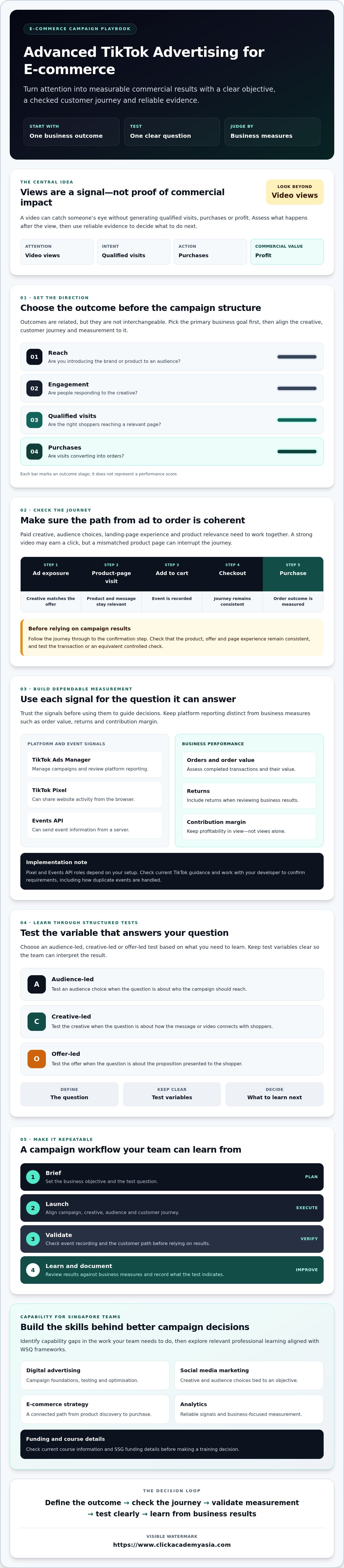
Choose the primary outcome before selecting a campaign structure or judging creative. Awareness seeks attention and reach; traffic aims to bring people to a destination; add-to-cart activity indicates product consideration; purchases focus on completed transactions. These outcomes are related, but they aren’t interchangeable.
Reach: Are you introducing the brand or product to an audience?
Engagement: Are people responding to the creative?
Qualified visits: Are the right shoppers reaching a relevant page?
Purchases: Are visits converting into orders?
An outcome-led TikTok e-commerce campaign starts with one defined business goal, then aligns its creative, customer journey and measurement to that goal. This gives the team a clear basis for testing and evaluating results against product economics, not views alone.
Set Up TikTok E-commerce Campaigns for Reliable Measurement
A campaign can guide decisions only if the team trusts the signals it reports. For e-commerce businesses, that means defining success, checking the route from ad to order, and confirming measurement before spend begins. This foundation makes advanced TikTok advertising for e-commerce a repeatable process for assessing results and deciding what to test next.
Use a pre-launch sequence
Define the objective. Decide whether the campaign aims to build awareness, attract qualified visits or drive purchases. Set the primary outcome before choosing campaign settings.
Check the customer journey. Follow the ad through to the product page, cart, checkout and confirmation. Check that the product, offer and page experience remain consistent.
Validate tracking. Confirm that relevant e-commerce events are recorded and named consistently. Run a test transaction, or an equivalent controlled check, before relying on live results.
Document a baseline. Record the reporting period, measurement settings and relevant business measures. This gives the team a reference point for assessing changes.
Know what each measurement tool contributes
TikTok Ads Manager is used to manage campaigns and review platform reporting. The TikTok Pixel can share website activity from the browser, while the Events API can send event information from a server. Their roles and implementation details depend on your setup. Check current TikTok guidance and work with your developer to confirm requirements, including how duplicate events are handled.
Map the customer journey as ad exposure → product-page visit → add to cart → checkout → purchase. At each step, identify what records the event and where the team will review it. For broader measurement context, see [Internal Link: marketing analytics with GA4].
Compare reports consistently
Ads Manager and analytics reports may differ because they use different attribution methods, settings or reporting views. Compare the same defined period and review the settings before interpreting results. Use store records to check business outcomes, such as completed orders, rather than choosing whichever dashboard looks most favourable. Verify current attribution-window and privacy-related details against platform guidance.
For context on digitalisation, consult [External Link: IMDA Singapore Digital Economy Report]. Teams looking to strengthen measurement and advertising capability can explore [Internal Link: ClickAcademy Asia digital advertising and marketing analytics courses]. Check current course information and any applicable SSG funding details before planning training.
Compare TikTok Ad Structures and Creative Tests for Online Stores
A useful test answers a business question, not just “Which video got more views?” For advanced TikTok advertising for e-commerce, compare audience, creative and offer or landing-page hypotheses separately where practical. This helps teams connect what shoppers see to what they do next, and decide what to change without confusing one variable for another.
Change one major variable at a time when you need a clear diagnosis, such as whether a stronger product demonstration improves add-to-cart activity. Broader exploration can make sense when a campaign is new and the team needs to learn which audience and creative directions merit closer testing. Treat early findings as signals, not proof of a winning combination.
Design the test around a hypothesis
Write down what you expect and why: “Showing the product in use in the opening moments may help shoppers understand its benefit.” Keep the offer and landing page consistent if creative is the variable. Log the test dates, audience, creative version, decision criteria and next action in a shared record so the learning carries into the next campaign.
Compare concepts that fit the product and the decision shoppers need to make. A demonstration can clarify how an item works; a customer-problem narrative can make its relevance clear; a testimonial or creator-led concept offers another way to explain the experience. Assess each against attention retention, product relevance, site behaviour and purchases, not views alone. A strong hook that attracts the wrong visitors may not be commercially useful.
Consider Spark Ads or other TikTok formats only after confirming their current availability, account requirements and suitability in Ads Manager. Don’t declare a winner based on an early fluctuation. Set an evaluation period and decision criteria in advance, then consider purchase quality and margin alongside engagement. The aim is to effectively evaluate the potential payoffs of each creative direction.
Building this process takes capability in digital marketing strategy and analysis. Teams can explore WSQ digital marketing courses in Singapore as one route to strengthening those skills.
Optimise TikTok Advertising for E-commerce Without Losing Sight of Profit
Engagement doesn’t automatically mean profitable sales. A video can earn attention and clicks while returns, discounts or fulfilment costs leave little contribution margin. To optimise TikTok advertising for e-commerce, separate platform-reported metrics from business results, then judge each campaign against the economics of the product it promotes.
Revenue alone doesn’t establish campaign profitability. The business must account for the costs and returns associated with generating that revenue. Review Ads Manager results alongside order value, cancellations or returns, and contribution margin. Break performance down by campaign purpose and product group, too. Account-wide averages can hide a product that performs well and another that uses budget without supporting the same economics.
Diagnose the journey before changing the campaign
If clicks aren’t becoming purchases, check the experience shoppers encounter before changing several campaign variables at once. Confirm the product page loads as expected, the ad’s promise matches the page, the item is in stock, pricing is clear and checkout has no obvious friction. Then examine site behaviour and recorded conversion events to see where shoppers stop.
Separate a possible tracking issue from a genuine marketing problem. If test orders or site records show purchases that aren’t reflected in campaign reporting, investigate measurement first. If events are recording consistently but shoppers leave at the product page, review product relevance, creative and offer. A checkout drop-off points to a different part of the journey. Diagnose the evidence, then change one area and observe the result.
Make budget decisions against your own economics
Set decision rules before increasing, reducing or reallocating spend. Define what evidence is needed, which business measures matter and how much uncertainty the team is willing to accept. There’s no universal ROAS benchmark that fits every store. Acceptable performance depends on product margins, returns and other costs.
Use these as decision prompts, not universal rules. Teams looking to strengthen advertising and measurement capability can explore digital advertising and marketing analytics training to build a more consistent optimisation practice.
Build Advanced TikTok Advertising Skills for E-commerce Teams in Singapore
Campaign tools can change, but a team’s ability to set a clear test, check its evidence and make a sound decision is what makes the process repeatable. For e-commerce teams, building advanced TikTok advertising for e-commerce capability means developing practical skills across digital advertising, social media marketing, e-commerce strategy and analytics, rather than relying on one person’s platform knowledge.
Practise a repeatable campaign workflow
Start with a brief that names the commercial objective, hypothesis, intended audience and success measures. Then follow a consistent cycle:
Brief: State what the team wants to learn and why it matters to the business.
Launch: Check that the campaign, creative, offer and destination reflect the brief.
Validate: Confirm that the customer journey and measurement are working as intended.
Learn: Assess creative response, site behaviour and business outcomes against the stated measures.
Document: Record the result, limitations and next action so future tests build on what the team has learned.
This routine helps teams avoid repeating tests without a clear question. It also makes handovers easier: colleagues can see why a decision was made, not just what changed.
Match development to the team’s capability gaps
Map skills to actual responsibilities. A campaign manager may need to strengthen objective-setting and budget decisions; a social media specialist may focus on creative assessment; an e-commerce lead may need to examine how product pages and checkout support campaign intent. Analytics skills help the team interpret tracking and compare platform reports with business data. Complementary knowledge of [Internal Link: marketing analytics with GA4] can support a broader measurement approach.
ClickAcademy Asia offers professional programmes in areas including WSQ Digital Advertising, WSQ Social Media Marketing, Marketing Analytics & Insights and E-commerce Strategy & Operations. These can help build relevant team capability, but shouldn’t be mistaken for a TikTok-specific syllabus. Explore professional marketing training programmes and check current course details, WSQ alignment and any applicable SSG funding information before planning training.
Put the approach into practice: write a testable brief, validate measurement before launch, review performance against business outcomes, and document the next decision. Equip your team with structured learning that matches its responsibilities, then apply those skills through a consistent campaign workflow.
Make Your Next TikTok Campaign More Measurable
Better e-commerce results start with a clear business objective, reliable tracking and creative tests designed to answer a specific question. Compare platform reporting with orders, returns and contribution margin, then use what you learn to guide the next decision.
That’s the practical foundation of advanced TikTok advertising for e-commerce. Build a repeatable workflow for briefing, validating, learning and documenting campaigns, while strengthening team capability in digital advertising, social media marketing, analytics and e-commerce strategy.
Equip your team through relevant WSQ training tracks, and check current course details and whether SSG funding applies to your circumstances. ClickAcademy Asia offers WSQ-certified professional training in relevant areas.
Explore ClickAcademy Asia professional marketing courses and help your team build the skills to make more confident, commercially grounded campaign decisions.
Frequently Asked Questions
Is TikTok advertising effective for e-commerce?
Yes, TikTok advertising can support e-commerce, but its effectiveness depends on product-audience fit, creative, the offer, landing-page experience, measurement and commercial economics. Attention is an early signal, not evidence of a purchase. Assess advanced TikTok advertising for e-commerce against a defined business objective, such as qualified product-page visits or completed orders, then compare results with your store’s costs and margins. Test methodically; no campaign approach guarantees sales or returns.
How do you set up TikTok ads for an e-commerce store?
Start by defining a business objective, then prepare the product information and landing page so they match the ad. Configure event measurement, validate that relevant actions are recorded, and choose a campaign approach suited to the objective. Document a baseline, including the reporting period and measures you’ll use to assess results. TikTok’s interfaces and technical requirements can change, so check current platform guidance before configuring or launching a campaign.
What is the difference between TikTok Pixel and Events API?
TikTok Pixel and Events API are different ways of sharing website event information with TikTok for measurement and advertising purposes. Their roles and implementation details depend on your setup, so don’t assume they behave identically or automatically resolve tracking gaps. Check current TikTok requirements, review the implementation with your developer, and test event quality before relying on campaign reports. Confirm that important e-commerce actions are recorded consistently across your measurement tools.
How much should an e-commerce business spend on TikTok ads?
There’s no universal budget that suits every e-commerce business. The amount to test depends on product margins, conversion economics, campaign objective and the evidence you need to make a decision. Set a test budget your business can responsibly support, then agree in advance what results would prompt you to continue, adjust or stop. Review spending alongside orders and contribution margin, rather than treating views or clicks as proof of commercial value.
Can TikTok ads work for a small e-commerce business?
Business size alone doesn’t determine whether TikTok ads are suitable. Consider whether you can communicate a clear product proposition, create relevant content, provide a usable buying journey and measure meaningful actions. A small business can begin with a controlled test that fits its resources and goals, then review the evidence before making changes. Keep expectations grounded: a test can inform decisions, but it can’t guarantee sales or a particular return.
What should e-commerce teams test first in TikTok ads?
Start with the most important uncertainty and write a clear hypothesis. For example, test whether a different opening hook or a more direct product demonstration better attracts relevant shoppers. Keep other factors, such as the offer and landing page, as consistent as practical when isolating a creative change. Define evaluation criteria before launch, allow time to collect useful evidence, and log the outcome and next action for the team.
How can I learn advanced TikTok advertising in Singapore?
Build capability across digital advertising, social media strategy, e-commerce and analytics, then apply those skills through structured campaign practice. ClickAcademy Asia offers professional training in relevant areas, including WSQ Digital Advertising, WSQ Social Media Marketing, Marketing Analytics & Insights and E-commerce Strategy & Operations. Don’t assume a programme specifically teaches TikTok unless confirmed. Check current course details, WSQ alignment and applicable SSG funding conditions before choosing training.


Comments