
How to Prove My Value as a Marketing Manager in Singapore (2026)

A full campaign calendar can still leave one question unanswered: what changed for the business? In Singapore, marketing managers are often expected to show how their work supports revenue, growth or other organisational priorities, even when results depend on several teams and market factors. If you’re asking how to prove my value as a marketing manager, the answer isn’t to claim credit for every conversion. It’s to build a clear case from agreed goals and evidence.
It’s easy to get caught between activity metrics stakeholders can see and business outcomes that are harder to attribute. This guide shows you how to choose measures that fit the objective, explain what the evidence does and doesn’t show, and present your contribution without overstating results.
You’ll learn how to connect marketing goals to business priorities, combine performance data with decisions and outcomes, and identify capability gaps that could strengthen your impact. We’ll also look at how structured upskilling, including relevant WSQ training and ClickAcademy Asia Sales and Marketing courses, can support stronger planning and measurement.
Table of Contents
How to prove my value as a marketing manager in Singapore: start with business priorities
Build a marketing value scorecard with KPIs, evidence, and context
Turn marketing results into a persuasive Singapore stakeholder update
Address the attribution objection without overstating marketing's impact
Turn your evidence into a development plan and prove your value over time
How to prove my value as a marketing manager in Singapore: start with business priorities
If your reports show campaigns delivered, content published and leads generated, but stakeholders still ask what marketing contributed, the missing link may be the connection to business priorities. To understand how to prove my value as a marketing manager, first agree what the organisation needs marketing to influence. Then show the evidence and context behind your contribution.
Stakeholders may define success differently. Sales may focus on qualified opportunities, while senior leaders look at growth or customer retention. Bring those perspectives together by connecting strategy, measurement and execution to a shared objective, rather than presenting a list of activities. If stakeholders disagree on the goal, resolve that before choosing KPIs or reporting results.
For an introduction to performance measurement, see this overview of Key Performance Indicators (KPIs). To see how marketing return can be considered in practice, watch this video:
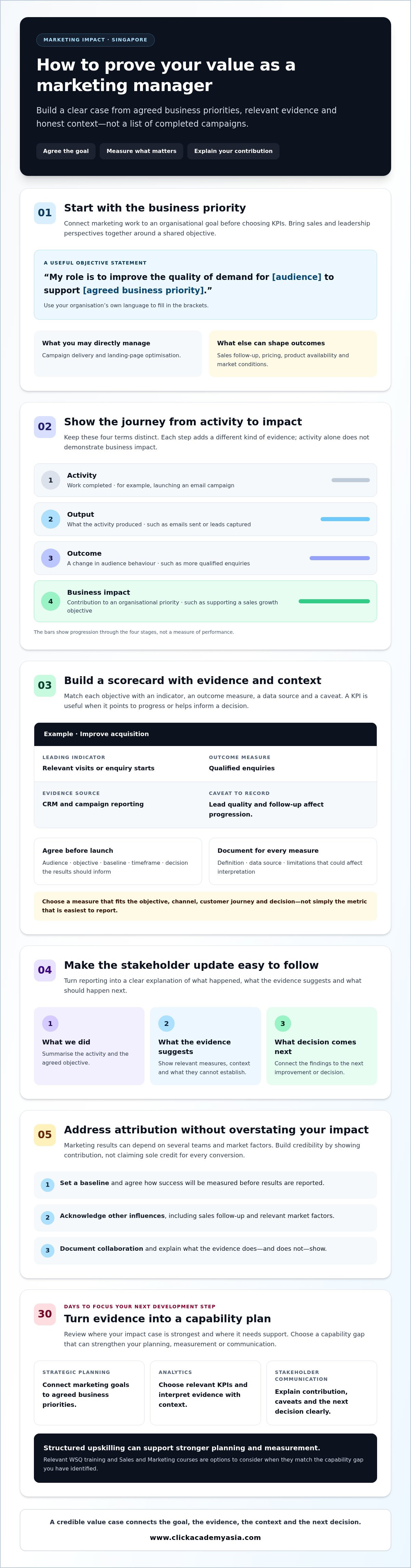
Four terms to separate
Activity: Work completed, such as launching an email campaign.
Output: What the activity produced, such as emails sent or leads captured.
Outcome: A change in audience behaviour, such as more qualified enquiries.
Business impact: The contribution to an organisational priority, such as supporting a sales growth objective.
What does value mean to your organisation?
Ask leaders which business priorities marketing is expected to influence, and clarify how your team’s remit connects to them. Separate what you directly manage, such as campaign delivery or landing-page optimisation, from outcomes also shaped by sales follow-up, pricing, product availability or market conditions.
Then write one sentence that makes the connection explicit: “My role is to improve the quality of demand for [audience] to support [agreed business priority].” Fill in the brackets using the organisation’s own language. A specific objective is more useful than a general claim about brand awareness or growth.
Agree success measures before reporting results
Before an initiative begins, confirm its audience, objective, baseline, timeframe and the decision the results should inform. For a lead-generation campaign, for example, you might compare qualified enquiries with an agreed starting point, while noting that sales conversion also depends on follow-up.
Choose a small set of measures that fits the objective. Record how each measure is defined, where its data comes from and what could limit interpretation. Agreeing these details early gives everyone a shared basis for reviewing results and deciding what to improve next.
Build a marketing value scorecard with KPIs, evidence, and context
A scorecard turns an agreed objective into a practical measurement plan. It helps you show what changed, which evidence supports your interpretation and what the numbers cannot establish. That distinction is central to how to prove my value as a marketing manager without relying on vanity metrics or overstating causation.
A KPI is useful when it indicates progress towards a defined objective or helps inform a specific decision. Choose measures based on the campaign objective, channel, customer journey and decision at hand. A measure suited to awareness may tell you little about conversion, so don’t use a familiar metric simply because it is easy to report.
Which marketing KPIs demonstrate contribution?
Campaign launches, posts published and emails sent describe activity or output. They help you track delivery, but they don’t show whether an initiative achieved its objective. Select a small set of measures across acquisition, engagement, conversion or retention that reflects the brief, and be ready to explain how each one informs a decision.
Traffic, impressions and engagement can provide useful context, but don’t present them as business impact without evidence linking them to a relevant outcome. For a financial assessment, Harvard Business Review’s guide to measuring marketing ROI offers a useful reference for considering return in relation to marketing investment.
How do you handle attribution and shared results?
Attribution is an interpretation of how marketing touchpoints may have contributed to a result, not automatic proof that marketing alone caused it. Record the baseline, measurement period, assumptions, input from other teams and relevant external factors. If you use GA4 or platform reporting, check access, event configuration and tracking quality first. If those checks reveal gaps, state what the available data can reliably show.
To strengthen your measurement practice, explore marketing analytics training and apply what you learn to a scorecard built around your organisation’s decisions.
Turn marketing results into a persuasive Singapore stakeholder update
A strong performance update doesn’t bury stakeholders in dashboards. It explains what marketing was asked to achieve, what the evidence shows and what decision could move the work forward. This is a practical way to show how to prove my value as a marketing manager while keeping your claims measured and credible.
Start with a concise summary, then keep charts, channel breakdowns and methodology available for follow-up. Use a simple sequence so stakeholders can quickly understand the connection between the goal, the results and the next step:
Priority: State the agreed business objective and why it matters.
Action: Summarise what marketing did and for whom.
Evidence: Share the measured change, timeframe and data source.
Interpretation: Explain what the result suggests in relation to the objective.
Limitation: Name relevant gaps, assumptions or influences beyond marketing’s control.
Next decision: Recommend an adjustment, next test or stakeholder decision.
How to structure a performance conversation
Lead with the objective, not the campaign activity. For instance, explain that the initiative aimed to increase qualified enquiries from a defined audience, then report the observed change, timeframe and data source. Harvard Business School Online describes KPIs as quantifiable measures for evaluating marketing objectives, a useful reminder to make each reported measure relevant to the goal.
Keep observation, interpretation and recommendation distinct. Observed: qualified enquiries increased during the reporting period. Interpretation: the campaign may have contributed, alongside sales follow-up and other factors. Recommendation: continue the approach while testing a revised message. This structure lets stakeholders assess your reasoning without mistaking a plausible explanation for proven cause.
A citation-ready sentence template is: “After [marketing action] during [timeframe], [source] recorded [measured change]; this is relevant to [business priority] because [reason], although [limitation] means we can’t attribute the change to marketing alone.” Replace each bracket with verified information, not an assumed result.
Adapt your proof to the stakeholder
Senior leaders usually need the strategic alignment, key trade-offs and decision required up front. Finance or operations colleagues may need clear definitions, baselines, data sources and assumptions to assess your interpretation. Keep the underlying evidence consistent, but adjust the detail to the question each stakeholder needs to answer.
If you’re building confidence in marketing measurement and strategic communication, explore marketing strategy and analytics training as a possible development option. A well-structured update turns evidence into a useful conversation, not just a report.
Address the attribution objection without overstating marketing's impact
“Can we really attribute this result to marketing?” It’s a fair question. Marketing managers rarely control every factor behind a business outcome, so a credible case doesn’t claim sole credit. It shows what changed, how the team contributed and where the evidence has limits. That’s a more sustainable way to demonstrate how to prove my value as a marketing manager.
Build confidence by agreeing a baseline and measurement approach before an initiative starts. Keep a record of campaign changes, tracking conditions and input from sales, product or operations. If results are mixed, report them plainly: what improved, what stayed flat and what can’t be confidently attributed. Transparency gives stakeholders a better basis for deciding what to do next than a forced positive interpretation.
What if results are mixed or attribution is unclear?
Check plausible explanations before drawing a conclusion. A change in channel mix, sales follow-up, tracking configuration or market context could affect the result. Separate observed facts from possible explanations, then choose a practical next step. You could validate tracking, compare performance with the agreed baseline or test one change while keeping other conditions as consistent as possible.
Metrics aren’t automatically vanity measures. Impressions can help assess delivery or reach, and engagement can show whether content is attracting attention. They become weak evidence when presented as business impact without a link to the objective. Where reliable data is available, pair them with measures that support a decision, such as qualified enquiries or customer actions.
How to show value beyond short-term revenue
Some contributions take longer to appear in revenue reports. Brand familiarity, customer experience, operational efficiency and team capability can matter when they support an agreed organisational priority. Before judging success, define the intended outcome, the evidence that could indicate progress and the time horizon for review. For example, a content initiative might first be assessed through relevant audience engagement, with downstream business outcomes reviewed later if tracking supports that connection.
Label evidence carefully. A realised result is something measured; a forecast is an estimate based on stated assumptions; a hypothesis is something to test; and an intended benefit is the outcome the work aims to support. Keeping these categories distinct helps stakeholders understand both current contribution and future potential.
To strengthen your measurement and planning capability, explore WSQ marketing analytics and strategy training. Check current course details and any applicable SSG funding eligibility before making a training decision.
Turn your evidence into a development plan and prove your value over time
A credible case for your contribution grows stronger when you review it consistently and act on what the evidence reveals. Use each performance conversation to identify one capability that could help you plan better, measure more reliably or influence decisions with greater confidence.
Start with a practical 30-day plan:
Days 1-7: Confirm which business priorities your role is expected to support and agree what success should look like.
Days 8-14: Audit the evidence for a priority initiative. Check the baseline, data sources, tracking quality, assumptions and missing information.
Days 15-21: Prepare a concise update that separates observed results from interpretation and identifies a decision or next step.
Days 22-30: Review the update with stakeholders, agree what to change or test, and schedule the next review to fit the organisation’s planning cycle.
Create a repeatable value review
For each priority initiative, keep a short record of the objective, baseline, action, evidence, interpretation and learning. Add recommendations accepted or decisions informed to show how your work shaped what happened next. Review this record with stakeholders at an agreed cadence, such as a recurring planning or performance review, rather than relying on a last-minute summary.
Choose upskilling that addresses a real capability gap
Be specific about what would improve your next contribution. If you struggle to connect activity to organisational priorities, strategic planning may be the gap. If you’re uncertain about tracking or interpreting results, focus on analytics. If channel execution or stakeholder communication is the obstacle, identify the relevant capability and practise it through upcoming work.
Match learning to that diagnosis. WSQ Digital Marketing Strategy & Planning may be relevant if you need to strengthen strategic alignment, while WSQ Marketing Analytics & Insights may suit a measurement gap. WSQ describes a training framework, but don’t assume a particular course qualifies for SSG funding or that you’re eligible. Check current course and funding details before making a decision.
For related course context, see ClickAcademy Asia’s WSQ digital marketing training. Apply new learning to a live initiative, then review whether it improves the quality of your planning, evidence or recommendations.
So, how to prove my value as a marketing manager? Connect your work to agreed priorities, show the evidence with its limitations and use each review to improve the next decision. Build that capability deliberately, and equip your team through relevant WSQ training tracks, checking applicable SSG funding details before enrolling.
Make your contribution visible, then keep building on it
In Singapore, a credible case for marketing value starts with agreed business priorities, not a longer list of campaigns. Choose measures that fit the objective, explain what the evidence can and can’t show, and use stakeholder updates to guide the next decision. A repeatable review also helps turn results and learning into a focused development plan.
If you’re still asking how to prove my value as a marketing manager, connect your work to outcomes the organisation recognises, be transparent about shared influences and strengthen the capability that will improve your next contribution. Continuous learning can help you sharpen strategic planning or marketing analytics skills and apply them more confidently at work.
ClickAcademy Asia provides professional training, including WSQ-certified courses in digital marketing strategy and marketing analytics. Explore the relevant options, and check current course details and any applicable SSG funding eligibility before making a decision: Explore ClickAcademy Asia’s professional marketing training.
Build your evidence one review at a time. With clear priorities, honest measurement and targeted upskilling, you can make your contribution easier to understand and your next steps more purposeful.
Frequently Asked Questions
How do I prove my value as a marketing manager?
Show how your work contributes to agreed business priorities, using relevant evidence and explaining its limits. Start by confirming what marketing is expected to influence, then record the objective, baseline, actions and outcomes. Distinguish what you controlled from results shaped by other teams or market conditions. This gives you a clear, credible answer to how to prove my value as a marketing manager without claiming sole credit.
Which KPIs should a marketing manager use to show impact?
Choose KPIs that match the objective, customer journey and decision stakeholders need to make. For acquisition, you might track qualified enquiries; for conversion, completed purchases or enquiries; for retention, repeat purchases where reliable records exist. Use impressions, traffic and engagement as context when relevant, but don’t present them as business impact on their own. Confirm definitions, data sources and the reporting period before comparing results.
How can I show marketing ROI when attribution is unclear?
Present ROI as an evidence-based estimate, not proof that marketing alone caused a result. State the agreed baseline, measurement period, costs included and method used, then disclose limitations such as incomplete tracking, sales follow-up or other channels influencing the customer. Separate observed changes from your interpretation. If the data can’t support a reliable ROI calculation, explain what can be measured and recommend a test or tracking improvement.
How do I present marketing results to senior management?
Lead with the business priority and the most decision-relevant result. Summarise the marketing action, evidence source and timeframe, then explain what the result suggests, what remains uncertain and what decision or next step you recommend. Keep the opening concise, with detailed channel data and assumptions ready if stakeholders ask. This makes the discussion easier to follow and shows how marketing evidence informs organisational choices.
What if my marketing results are not directly linked to revenue?
Show how the results support an agreed priority, even if revenue is not yet directly measurable. Depending on the objective, evidence might include qualified enquiries, progression through a customer journey, repeat engagement or improved campaign efficiency. Explain why the measure matters, what it cannot prove and how long a related business outcome may take to assess. Label longer-term benefits as hypotheses or intended outcomes until reliable evidence confirms them.
Can professional training help me demonstrate more value at work?
Yes, targeted training can strengthen skills that make planning, measurement or execution more effective. First identify the gap: strategic planning, analytics, channel capability or communicating evidence to stakeholders. ClickAcademy Asia offers WSQ-certified professional training, including WSQ Digital Marketing Strategy & Planning and WSQ Marketing Analytics & Insights. Check current course details and confirm whether a course and your circumstances meet any applicable SSG funding requirements before enrolling.
How often should a marketing manager report their contribution?
Agree a reporting cadence with stakeholders that fits the organisation’s planning and decision-making cycle. Share updates often enough to support timely choices, but avoid reporting so frequently that short-term fluctuations are mistaken for meaningful trends. A campaign may need operational monitoring during delivery, while broader outcomes could be reviewed at a planned performance meeting. Confirm the timeframe and measures in advance, and bring forward material changes that need an earlier decision.


Comments