
Singapore MarTech Integration Workshop: 2026 Guide

Singapore Guide to an Integrating Your MarTech Stack Workshop
What if your next MarTech improvement isn’t another platform, but a clearer way to connect the tools you already use? For teams across Singapore, an integrating your martech stack workshop can start with the real friction: duplicated work, scattered customer data and activity that’s difficult to link to dependable results.
When systems don’t work together, it’s understandable to look first at technology. But the cause may be a workflow, data quality, unclear ownership or a skills gap. Adding another tool won’t resolve those issues on its own. A useful workshop aligns decisions and processes before the team decides what to integrate.
This 2026 guide explains what a practical, tool-neutral workshop should help your team accomplish and what to look for when choosing one. You’ll learn how to prioritise integration problems before discussing platforms, assign clear owners and next steps, and connect marketing activity to meaningful measurement. We’ll also explore how targeted upskilling in strategy and analytics can help teams put decisions into practice, including through relevant WSQ learning.
Table of Contents
What should an integrating your MarTech stack workshop solve in Singapore?
Disconnected systems and unclear ownership can leave marketing teams repeating manual tasks, working with fragmented customer information and questioning which performance figures to trust. An integrating your martech stack workshop is a structured team session to align business goals, tools, data and workflows before deciding what needs to change.
That distinction matters. The workshop is for integration planning, not a software sales pitch or technical implementation. First, teams clarify the business outcomes they need. Then they examine how existing systems and processes support those outcomes. For context, digital marketing includes activities such as marketing automation, which depends on clear processes and useful information moving between systems.
Which business problems justify a MarTech integration workshop?
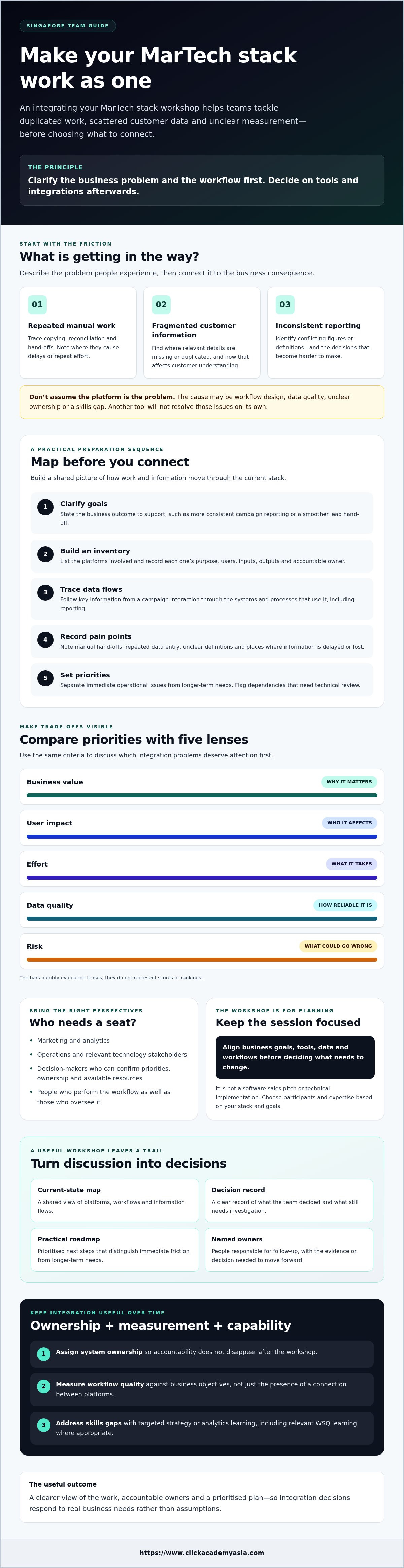
Start with friction people can describe, not a shortlist of platforms. Link each issue to its business consequence, then decide whether it needs immediate attention or longer-term capability building.
Repeated manual tasks: Identify recurring copying, reconciliation or hand-offs. Note the time lost or delays in responding to customers.
Inconsistent reporting: Find where teams use different definitions or figures. Clarify which decisions become harder as a result.
Disconnected customer information: Trace where relevant details are missing or duplicated. Consider the effect on customer understanding and campaign coordination.
Separate urgent operational friction from broader gaps in skills, process design or data governance. A manual hand-off that slows a live campaign may need a near-term fix. Improving measurement capability, by contrast, may require a longer learning plan.
Who should participate in the workshop?
Bring together the people who understand the work and the systems behind it. This commonly includes marketing, analytics, operations and relevant technology stakeholders, alongside decision-makers who can confirm priorities, ownership and available resources.
Choose participants based on your organisation’s stack and goals. A team focused on reporting may need different expertise from one addressing lead hand-offs or customer data. Include the people who perform the workflow as well as those who oversee it. Their perspectives can help distinguish a genuine system gap from an unclear process.
The session should finish with an agreed, prioritised roadmap, named owners and practical next steps, not simply a list of possible integrations. Record what the team will investigate, who is responsible and what evidence or decision is needed to move forward. If the workshop exposes a skills gap, consider relevant strategy or analytics learning. Explore ClickAcademy Asia’s professional training options, including WSQ courses. Check current course and funding details before making plans.
How to map your MarTech stack before connecting platforms
Before anyone proposes an integration, create a shared picture of how marketing work and information move through your current stack. This preparation helps an integrating your martech stack workshop focus on real dependencies and decisions, rather than assumptions about which platform should connect next.
Use this five-step sequence to prepare:
Clarify goals: State the business outcome you want to support, such as more consistent campaign reporting or a smoother lead hand-off.
Build an inventory: List the platforms involved in the workflow. Document each one’s purpose, users, inputs, outputs and accountable owner.
Trace data flows: Follow key information from a campaign interaction through the systems and processes that use it, including its route into reporting.
Record pain points: Note manual hand-offs, repeated data entry, unclear definitions and steps where information is delayed or lost.
Set priorities: Separate immediate operational issues from longer-term needs. Flag dependencies that require technical review before a decision.
What information belongs in a MarTech stack inventory?
Keep the inventory practical. For each platform, note its business purpose, accountable owner, primary users and supported marketing workflow. Record the information entering and leaving it while following your organisation’s internal access controls. Mark duplicate functions, unknown dependencies and connections that need a technical stakeholder to validate them.
How do you find the integration gaps that matter most?
Compare the current customer or campaign journey with the intended business outcome. For example, trace how a campaign response becomes a reported result. Mark each transfer, manual step and point where teams use different definitions. Then ask which decision or task the gap affects.
A stack map is a concise view of platforms, owners, workflows and information flows, annotated with known breaks and dependencies. It gives the workshop a common reference for discussing evidence, testing assumptions and choosing which issues deserve attention first.
If mapping exposes gaps in strategic or analytical capability, targeted learning can help teams make better use of the information they collect. Explore ClickAcademy Asia’s digital marketing and analytics training as one possible way to build that foundation.
How to prioritise MarTech integrations by value, effort and risk
A connection can be technically possible and still be a poor priority. In an integrating your martech stack workshop, compare proposed work by the business problem it addresses, who benefits, what it will take to deliver and what could make the workflow unreliable. Use ratings as internal estimates to support discussion, not as universal benchmarks or promises of results.
Which criteria make an integration worth prioritising?
Assess whether the proposed change supports a clear campaign, customer experience or reporting objective. Then consider whether the relevant data is complete and consistently defined, whether privacy review is needed, and whether other systems or processes depend on the change.
Include operational readiness in the discussion. A workflow without a clear owner or the skills to maintain it may carry more risk than its technical scope suggests. Use a simple rating such as low, medium or high, and record the evidence and assumptions behind each assessment.
How should teams compare quick wins with complex integrations?
Rank opportunities by expected usefulness and delivery complexity, not by how impressive the connection sounds. A modest change that resolves a recurring reporting break could be more valuable than connecting two platforms when no clear decision or user need depends on it.
Hypothetical example: A team is considering a change to reduce manual campaign-result reconciliation and a broader connection intended to combine customer information across several processes. The first may be easier to assess if its users, data definitions and owner are clear. The broader proposal may have greater potential value, but unresolved dependencies, data quality questions or privacy review could make it premature.
Before ranking either option, identify prerequisites, decision-makers and open technical questions. Treat missing information as an action to resolve, not a reason to assign a confident score. This makes the priority list more useful and gives each proposal a defensible next step.
If the discussion reveals measurement gaps, relevant marketing analytics training can help teams strengthen the skills behind better prioritisation.
What should a practical MarTech stack workshop deliver?
A practical workshop turns discussion into decisions the team can act on. For an integrating your martech stack workshop, use a clear sequence: align objectives, map the current stack, diagnose gaps, prioritise options and assign actions. The aim isn’t to solve every technical issue in the room. It’s to agree what matters, what needs further validation and who will move each item forward.
Which exercises turn discussion into decisions?
Start with a workflow-mapping exercise. Trace a campaign interaction through the people, platforms and reporting steps involved. Mark where information changes hands, gets re-entered or becomes difficult to interpret. This gives participants a shared current-state map and keeps the conversation grounded in actual work.
Next, use agreed business criteria to compare the gaps or opportunities the team has identified. Capture the reasoning in a shared decision log, including assumptions, the decision made, its owner and any open questions. This creates a useful record if new evidence later changes the team’s view.
Keep responsibility clear. Marketing stakeholders can usually clarify campaign objectives, workflow needs and reporting priorities. Questions about technical feasibility, data architecture, access controls or system dependencies may need validation by the relevant technology or data specialist before the team commits to an approach.
How should teams leave with an actionable roadmap?
Turn workshop decisions into a draft integration roadmap. Group actions by what needs to happen next, rather than leaving them as an undifferentiated list:
Investigate: Confirm facts, dependencies or data definitions that remain unclear.
Decide: Resolve a question requiring an authorised business or technical decision-maker.
Test: Validate an assumption or proposed workflow before wider adoption.
Implement: Move an agreed, validated action into delivery planning.
Give every action a named owner and a clear definition of completion. “Review reporting” is too broad. Specify what must be checked and what evidence or decision will close the task. The roadmap should distinguish confirmed decisions from proposals awaiting technical review, so tentative ideas don’t become assumed commitments.
When measurement gaps surface, strengthening team capability can help turn workshop decisions into more reliable performance evaluation. Explore ClickAcademy Asia’s marketing analytics training to find learning that may support your team’s measurement skills.
How to sustain MarTech integration after the workshop
A workshop roadmap only creates value if the team keeps decisions, ownership and performance measures visible after the session. Treat integration as an ongoing way of working, not a one-off connection exercise. Changes to platforms, campaign processes or reporting needs can affect whether a workflow remains useful.
How can teams maintain reliable integrations over time?
Document who owns each system and workflow, how key data terms are defined, who approves changes and where issues should be escalated. Keep these records accessible to the people who use and maintain the process, and update them when responsibilities or workflows change.
Agree on a review routine that fits the organisation. Check whether information is moving as intended, whether teams are following the agreed process and whether the workflow still supports its business objective. Track measures consistently, and investigate data quality issues before using the figures to make performance decisions.
Measure outcomes, not just connections. A count of linked platforms won’t show whether teams spend less effort reconciling reports, use consistent definitions or make better-informed campaign decisions. Select measures that reflect the original objective and review them alongside user feedback and known data limitations.
How can Singapore teams build the skills to act on workshop findings?
Use the roadmap to identify capability gaps as carefully as technical ones. Teams may need stronger strategic planning to clarify business priorities, or better analytics skills to define measures and interpret results. Addressing these needs can help staff manage the workflow after implementation rather than relying on a connection alone.
For organisations in Singapore, WSQ learning may be relevant to this development plan. ClickAcademy Asia’s portfolio includes WSQ Digital Marketing Strategy & Planning and WSQ Marketing Analytics & Insights, alongside Google Analytics (GA4) Training. Check current course information and verify SSG funding, eligibility and applicable terms before making training decisions.
Keep implementation decisions equally grounded. Confirm technical requirements, dependencies, internal resources and intended scope with the relevant stakeholders before approving delivery. Verify funding eligibility and support for your organisation. Don’t assume a particular scheme applies based on the workshop plan alone.
To put your integrating your martech stack workshop findings into practice, document owners and data definitions, set measures tied to business goals, and review the workflow when requirements change. Match any identified skills gaps to relevant learning, and confirm current WSQ and SSG details before planning.
Turn your MarTech roadmap into measurable progress
A practical integrating your martech stack workshop helps teams across Singapore focus on the business problem before selecting a technical solution. Map the workflows and data involved, compare integration opportunities by value, effort and risk, then leave with decisions, owners and clear next steps.
Keep the work moving by documenting system ownership and data definitions, reviewing changes as processes evolve, and measuring workflow quality against business objectives. A connected stack is only useful when teams can maintain it and interpret the information it provides.
Building capability is part of that follow-through. ClickAcademy Asia’s portfolio includes WSQ Digital Marketing Strategy & Planning and Marketing Analytics & Insights. Review relevant learning for your team, and verify current WSQ course and funding details before making training plans.
Explore ClickAcademy Asia’s digital marketing training for your team. With clear priorities, ownership and relevant skills, your team can turn integration decisions into more reliable workflows and more confident marketing measurement.
Frequently Asked Questions
What is an integrating your MarTech stack workshop?
An integrating your martech stack workshop is a structured team session to align business goals, marketing tools, data and workflows before deciding what to connect or change. It focuses on the business problem, not on selling software or carrying out a technical implementation. Participants examine how work and information move between systems, identify gaps and agree priorities. The intended outcome is a practical roadmap with owners, open questions and next steps.
How do you prepare for a MarTech integration workshop?
Prepare by defining the business outcome you want to improve, then listing the platforms involved in the relevant workflow. For each, record its purpose, users, accountable owner, inputs and outputs. Trace how campaign or customer information moves into reporting, and note manual hand-offs, repeated data entry or inconsistent definitions. Follow your organisation’s internal access controls when documenting data, and flag unknown dependencies for technical review.
Which teams should attend a MarTech stack workshop?
Invite people who understand the workflow and can make decisions about priorities and resources. This often includes marketing, analytics, operations and relevant technology stakeholders. Include decision-makers who can confirm ownership and approve next steps, as well as staff who use the process day to day. The right mix depends on your organisation’s stack and goals. A focused group with the necessary knowledge is more useful than a large meeting without clear roles.
Can a workshop help integrate marketing tools without replacing them?
Yes. A workshop can help a team assess whether existing platforms and processes can support the intended business outcome before considering replacement. Map what each system does, what information it exchanges and where people still rely on manual work. The discussion may identify a process change, a connection to investigate or a reason to seek technical advice. A workshop doesn’t guarantee that existing tools can be integrated. Feasibility depends on your systems and requirements.
What should a MarTech integration workshop deliver?
A useful workshop should leave the team with a current-state stack map, a record of decisions and a prioritised draft roadmap. The roadmap should distinguish agreed actions from assumptions and questions that still need specialist validation. Assign an owner and a clear completion condition to each action, and group work into steps such as investigate, decide, test and implement. These outputs give the team a shared reference for follow-through after the session.
How do you measure whether MarTech integration is working?
Measure the business objective and workflow quality, not simply the number of connected tools. Depending on the goal, teams might monitor whether reporting definitions are used consistently, whether information reaches the next workflow step as intended, or whether users still need manual workarounds. Agree on definitions and review responsibilities before tracking results. Investigate data quality issues before drawing conclusions, and revisit measures when campaign processes or reporting needs change.
Are WSQ-funded marketing training options available in Singapore?
ClickAcademy Asia’s portfolio includes WSQ Digital Marketing Strategy & Planning and WSQ Marketing Analytics & Insights. Whether a particular course has funding support, and whether an organisation or learner is eligible, depends on current details that should be verified with the relevant provider and SSG before planning. Teams can use the workshop roadmap to identify whether strategic planning or analytics skills need strengthening, then check current course information and funding conditions.



Comments