
2026 Headless Commerce Strategy for Singapore Marketers

What if a headless commerce strategy for marketers adds complexity without fixing a customer experience problem? For Singapore teams, that’s a fair concern. A new architecture makes business sense only when it helps customers move smoothly between channels and gives marketers a practical way to improve campaigns, content or measurement.
Headless attracts attention because separating the storefront from the commerce backend can create more flexibility. But that flexibility brings decisions about technology, team responsibilities and ongoing governance. The right choice depends less on the architecture’s promise than on customer needs, marketing goals and operational readiness.
This guide explains how to assess whether headless is a fit, compare it with monolithic and composable commerce, and build a marketer-led strategy. You’ll find a decision framework, ways to align marketing and technology teams, and a phased approach with clear ownership and measurable outcomes, so you can decide what to change and what to leave in place.
Table of Contents
What a headless commerce strategy means for marketers in Singapore
A headless commerce strategy for marketers should begin with a customer experience goal, not an assumption that a new architecture will automatically make campaigns faster. Before changing how your commerce platform works, assess the complexity, investment and likely effect on marketing control.
Headless commerce separates the customer-facing presentation layer, such as a website or app, from commerce functions behind it, such as product and order management. APIs connect these parts, allowing them to exchange information and actions through defined interfaces. Adopting headless therefore doesn’t necessarily mean replacing every existing system. The Headless commerce overview provides more background on the architecture.
This short video discusses implementation maintenance, a useful reminder that the architecture also brings ongoing responsibilities:
Headless is a technical design choice that separates the front end from commerce functions. A complete commerce strategy also sets business goals, customer priorities, operating responsibilities and measures of success. Architecture can create options, but the team still needs to decide which customer experience to improve and how to evaluate progress.
What changes for the marketing team?
A separate front end can give a business more control over how product information, content and promotions appear across customer-facing channels. Marketers may have more room to shape experiences without changing commerce functions each time. That flexibility, however, depends on platform capabilities, integrations and team processes.
Publishing doesn’t automatically become simpler. A campaign may still depend on developers, content approvals or data from other systems. Before expecting headless to speed up execution, map the current workflow and identify where delays occur. Treat faster execution or better conversion as hypotheses to test, not guaranteed results.
What headless commerce does not automatically solve
Separating the front end from the back end won’t clarify your positioning, strengthen weak content or fix a confusing customer journey. These marketing and experience challenges need their own diagnosis.
Headless also creates shared responsibilities. Marketing and technology teams need to agree who owns integrations, publishing processes, quality checks and ongoing governance. Start with a defined use case, such as improving a particular product-discovery journey. Set a baseline and choose relevant measures before making changes, so the team can assess whether the added flexibility delivers practical value.
How headless commerce connects the storefront, content and marketing stack
A headless commerce strategy for marketers depends on more than a flexible storefront. The customer-facing experience, commerce engine, content, product information and analytics each play a role. The connections between them determine whether a campaign works as intended.
Think of APIs as agreed ways for systems to request and share information or actions. For example, a website can request product details and availability from commerce systems, then pass a completed purchase event to analytics. The systems remain distinct, while the customer experiences a connected journey.
Which components should marketers understand?
Start by mapping the systems your organisation already uses. The setup and responsibilities vary, so confirm them with your technology and operations teams rather than assuming every business has the same stack.
Customer touchpoints: The website, app or other digital experience where customers browse, discover products and take action.
Content management system (CMS): The platform and workflow for creating, approving and publishing campaign content.
Commerce engine: The functions that support product details, baskets, pricing and orders.
Product information systems: Sources for product descriptions, attributes and, where connected, availability.
Analytics: The tools and tracking that record customer interactions and help teams assess outcomes.
A simple architecture map helps teams discuss dependencies. Add your actual system names after checking them with the relevant owners.
Teams: Marketing creates campaign briefs; content owners approve copy; product or operations teams maintain product details; technology teams manage integrations and releases; analysts oversee tracking and reporting.
Systems and data flow: CMS and product information → APIs → customer-facing website or app ↔ commerce engine for product, basket and order functions → analytics platform for interaction and purchase events.
Customer touchpoints: Campaign entry → product discovery → basket and checkout → post-campaign analysis.
Where do marketing workflows and measurement fit?
Consider a campaign featuring a product range. Content needs approval and publication, product details and availability need to display correctly, the storefront must support discovery and checkout, and analytics must capture agreed events. A gap at any stage can affect the experience or leave the team without useful results.
Before launch, assign owners for content approval, product data quality, tracking definitions and release coordination. Agree which events matter, who checks the data and when results will be reviewed. For guidance on measurement planning, see Marketing Analytics with GA4: A Strategic Guide for 2026 Professionals.
Teams looking to strengthen their planning and measurement capabilities can explore marketing and e-commerce learning as part of their professional development.
Headless vs monolithic vs composable commerce: a marketer's comparison
These terms describe different ways to organise commerce technology, not a simple ranking from basic to best. A monolithic platform combines the customer-facing front end and core commerce functions in a closely connected system. Headless separates the front end from those functions, while composable commerce assembles capabilities, such as content, search and checkout, as distinct modules that connect together.
Headless is not automatically the most agile or cost-effective choice. The right option depends on customer experience requirements and what your organisation can operate well.
Choose architecture by matching use cases, team skills, governance capacity and measurable business needs, not by chasing flexibility for its own sake.
When does a monolithic platform remain a sensible choice?
An integrated platform may suit an organisation whose customer journeys work well, whose channel needs are supported and whose team values a straightforward ownership model. Before blaming the architecture for campaign delays or customer friction, check for process bottlenecks, unclear content approvals, gaps in product information or unreliable measurement. A monolithic system isn’t inherently outdated; assess it against defined needs.
When should marketers consider headless or composable commerce?
Consider headless when a specific experience or channel requirement exceeds what your current front end can support. Explore composable options when there’s a clear need to select and connect distinct capabilities. In either case, weigh added flexibility against integration ownership, vendor coordination and internal skills. Marketing, technology and operations teams should agree who maintains the connections and how outcomes will be assessed.
Marketing leaders can strengthen the planning and measurement skills needed for these decisions through relevant professional marketing and e-commerce learning.
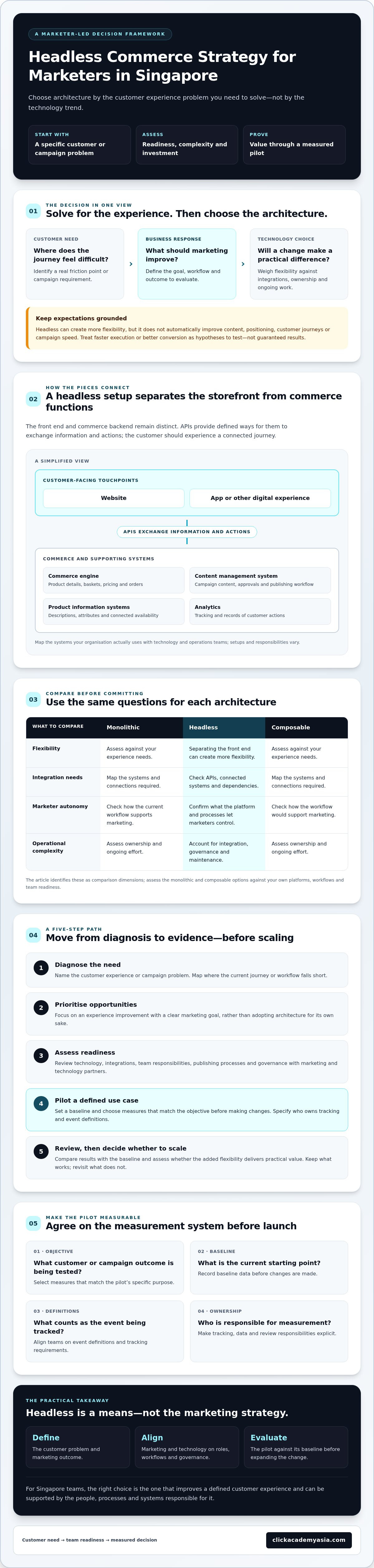
A five-step headless commerce strategy for marketers
A sound headless commerce strategy for marketers begins with a customer or campaign problem, not a shortlist of platforms. Use these steps to test whether an architectural change is justified and what your team would need to deliver it.
Diagnose the problem.Owner: marketing lead, with customer service or commerce colleagues. Decision question: Where does a specific customer journey or campaign fall short? Evidence: customer feedback, journey data, campaign results and documented friction points.
Prioritise the opportunity.Owner: marketing lead. Decision question: Which customer need is important enough to address first? Evidence: audience research, search behaviour and commercial priorities. Advanced Keyword Research Strategies can help teams use audience demand to inform content and opportunity priorities.
Assess readiness.Owner: marketing and technology leads together. Decision question: Can the organisation support the required systems, data, governance and team responsibilities? Evidence: a journey map, platform constraints, integration dependencies and baseline measures.
Pilot a bounded experience.Owner: a named business sponsor and delivery lead. Decision question: Can a focused pilot test the strategic assumption without disrupting unrelated journeys? Evidence: agreed scope, release plan, tracking requirements and rollback considerations.
Review before scaling.Owner: the pilot sponsor with marketing, technology and operations. Decision question: Did the pilot meet its stated objective, and can the organisation support a wider rollout? Evidence: results against the baseline, operational feedback and outstanding risks.
How can marketers assess readiness before a platform decision?
Document the target customer journeys, channels and content needs, then note where the current platform limits them. Map dependencies with the colleagues who own technology, data, product information and approvals. Set baseline measures and agree in advance what evidence would support proceeding, pausing or revising the plan. This gives the team a shared basis for the decision.
How should a first pilot be scoped?
Choose one bounded journey or experience that tests a clear strategic assumption. Before release, confirm who approves content, maintains product data, coordinates changes and checks tracking. Decide how the team would respond if the pilot needs to be rolled back. Keep measures tied to the pilot’s objective rather than trying to prove every potential benefit at once.
Building the team’s planning and measurement capability can support decisions at each stage. Explore WSQ marketing and e-commerce learning, and check current course and funding eligibility details before making training plans.
Measure results, build team capability and choose the next step
A headless commerce strategy for marketers is useful only if the team can assess whether it addresses the problem it was chosen to solve. Set measures before launch, assign people to maintain tracking, and review results alongside operational feedback before deciding whether to refine, scale or stop the pilot.
Which measures can show whether the strategy is working?
Choose metrics that reflect the pilot’s stated objective. If it aims to simplify product discovery, consider relevant engagement or task-completion measures. If it focuses on checkout, examine progression through the checkout journey. For operational goals, track signals such as content approval time or release coordination, provided the team records them consistently.
Organise measures into three groups:
Customer experience: task completion, engagement or journey progression.
Operational: workflow or release measures linked to the pilot’s intended change.
Commercial: relevant purchase or campaign outcomes, interpreted in context.
Before comparing results, agree what each event means, who owns the tracking and which baseline you’ll use. A change in a metric is evidence to investigate, not proof that the architecture caused it. Seasonality, campaign changes, product availability and other factors can also affect results, so record relevant context during the review.
What skills help marketing teams work effectively with headless commerce?
Teams benefit from strategic planning, customer journey analysis, analytics literacy and clear communication across marketing, technology and operations. These capabilities help marketers define a useful pilot, agree what success means and interpret results. They complement technical expertise; they don’t replace implementation or engineering skills.
ClickAcademy Asia’s WSQ Digital Marketing Strategy & Planning supports strategic upskilling, not headless implementation training. Explore WSQ Digital Marketing Courses in Singapore to consider how structured learning could strengthen your team’s marketing capabilities. Check current course and funding eligibility details before making training plans.
Your next steps: confirm the customer problem, select measures and a baseline, assign owners, then review the pilot evidence before scaling. If your team wants to strengthen its marketing strategy skills, explore professional marketing courses.
Build a commerce strategy your team can measure
The right architecture addresses a real customer or campaign need and is one your organisation can support. A headless commerce strategy for marketers should connect customer experience goals with team readiness, clear ownership and measures agreed before a pilot begins.
Start by identifying the journey you want to improve, then compare architecture options against that need. Map the systems and teams involved, establish a reliable baseline, and use pilot results to decide whether to refine or scale. Strong marketing planning and analytics help teams make these decisions with greater confidence.
ClickAcademy Asia offers professional training including WSQ Digital Marketing Strategy & Planning, E-commerce Strategy & Operations and Marketing Analytics & Insights. Explore professional marketing courses to build your team’s strategic and measurement capabilities. Check current course and funding eligibility details when planning WSQ training.
With relevant skills and a practical, evidence-led approach, your team can make its next commerce decision with clarity and purpose.
Frequently Asked Questions
What is a headless commerce strategy?
A headless commerce strategy uses an architecture where the customer-facing website or app is separated from the commerce functions behind it. For marketers, the strategy also defines which customer experience or business need to address, how connected systems and teams will support it, and how results will be measured. Headless describes the architecture; it doesn’t set marketing priorities or guarantee better customer journeys.
Is headless commerce worth it for every business?
No. Headless commerce may suit a business whose customer experience or channel requirements exceed what its current front end can support, and whose teams can manage the integrations and governance involved. An integrated platform may remain a sensible choice if it meets customer needs and supports effective workflows. Before considering a change, check whether the problem comes from architecture or from process, content or measurement gaps.
How is headless commerce different from composable commerce?
Headless commerce separates the customer-facing presentation layer from the commerce functions behind it. Composable commerce takes a modular approach to capabilities, assembling distinct components such as content management, search or checkout and connecting them as needed. The concepts can overlap, but they aren’t interchangeable: headless describes the separation of front end and back end, while composable describes how capabilities are selected and combined.
Can marketers manage a headless website without developers?
Marketers may be able to manage routine content or campaign updates through the chosen CMS and publishing workflow. However, autonomy depends on the platform, permissions, integrations and team processes. Changes involving front-end functionality, system connections or releases may need technology colleagues. Before adopting headless, agree which tasks marketing can own, where technical support is needed and how content and releases will be checked.
What should a marketer measure in a headless commerce project?
Measure the outcome the project is designed to improve. For a product-discovery pilot, track relevant engagement or task completion; for a checkout change, monitor progression through the checkout journey. Include operational measures, such as content workflow or release coordination, only when they can be recorded consistently. Define events, tracking ownership and a reliable baseline in advance, then interpret changes alongside other factors that could affect results.
How should a business start planning a headless commerce migration?
Start with a customer journey or campaign problem, not a vendor shortlist. Document the target experience, channels, content needs and current platform constraints, then map technology, data, governance and team dependencies. Set baseline measures and decide what evidence would justify proceeding or pausing. A bounded pilot can test a specific assumption before considering a wider migration. Include marketing, technology and operations in the planning.
Are WSQ courses relevant to a headless commerce strategy?
Yes, WSQ learning can help strengthen relevant marketing capabilities, including strategic planning, e-commerce understanding and measurement. ClickAcademy Asia offers WSQ Digital Marketing Strategy & Planning, E-commerce Strategy & Operations and Marketing Analytics & Insights. These courses support professional development; they aren’t headless implementation or engineering training. Check current course details and funding eligibility before making plans, as availability and eligibility should be confirmed directly.


Comments