
Should I Specialise or Generalise in Marketing? A Singapore Guide

The strongest marketing career may not belong to a pure specialist or a generalist. If you’re asking “should i specialize or generalize in marketing”, the more useful question is how to build deep expertise while developing enough breadth to connect your work to wider business goals in Singapore.
It’s understandable to worry that specialising could narrow your options, while a broad skill set might seem shallow to employers. But you don’t have to choose one identity for your entire career. A clear area of expertise, supported by complementary skills, can help you deliver focused value and collaborate across marketing functions.
This guide compares the trade-offs of both paths and gives you a practical way to assess your next move based on your role, experience and ambitions. You’ll also find ways to build relevant skills, including how WSQ-aligned learning can support your development across Singapore’s marketing landscape.
Table of Contents
Specialise or Generalise in Marketing in Singapore? (should i specialize or generalize in marketing)
In Singapore, a marketer may be asked to master a channel, coordinate campaigns across several functions, or do a little of both. That can make the choice feel like a career-defining fork: should you build depth in one discipline or broaden your range? If you’re asking, “Should I specialize or generalize in marketing?”, begin with what your current role requires and where you want your career to go.
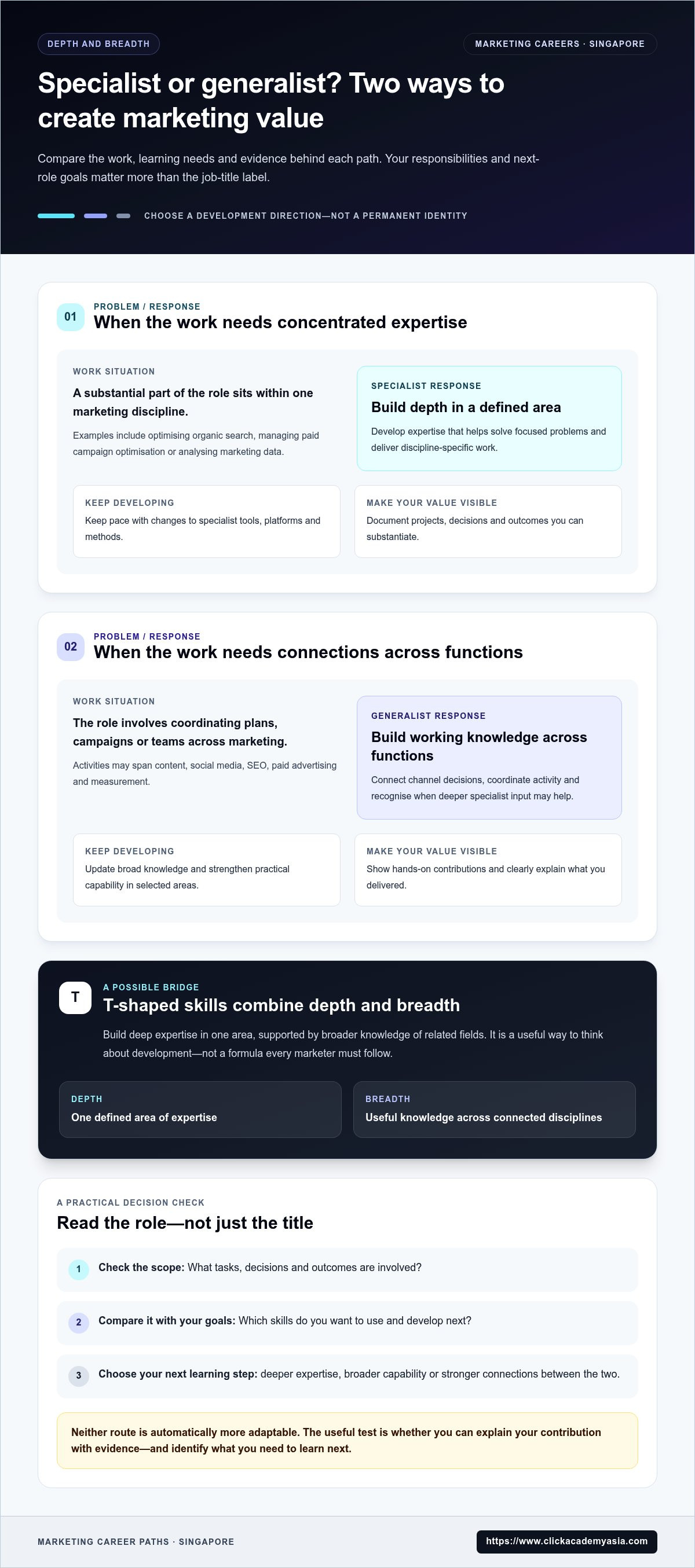
A marketing specialist develops deep expertise in one discipline, while a marketing generalist builds working capability across connected disciplines. Neither route is universally better. The right fit depends on your responsibilities, experience and intended next role, as well as how your organisation divides marketing work.
What does it mean to specialise in marketing?
Specialisation means focusing your learning and experience on a defined area, such as SEO, performance marketing, content strategy or analytics. A specialist might improve organic search performance, manage paid campaign optimisation or interpret marketing data to inform decisions.
That focus can make your contribution easier to describe: you can name the discipline you know deeply and the problems you’re equipped to tackle. It also calls for ongoing learning as tools, platforms and practices in that discipline change. Expertise can strengthen your profile, but it doesn’t guarantee a particular role or career outcome.
What does it mean to be a marketing generalist?
A generalist develops working knowledge across connected functions, such as content, social media, SEO, paid advertising and measurement. They might help plan a campaign, coordinate its execution across channels and review results to shape the next round of activity.
That breadth is not a claim to expert-level ability in every discipline. It’s cross-functional fluency: understanding how different marketing choices relate and when deeper specialist input may be useful. A “marketing generalist” can also mean different things between organisations, so look beyond the title to the actual responsibilities.
In practice, a role’s scope matters as much as its label. A smaller team may expect one marketer to cover several functions, while a larger team may divide work among channel specialists. Read role descriptions for the tasks, decisions and outcomes involved, then compare them with the skills you want to use and develop.
There’s also room to combine approaches over time. The idea of T-shaped skills describes deep expertise in one area supported by broader knowledge of related fields. It can be a useful way to think about your development, rather than a formula every marketer must follow.
Specialist vs Generalist Marketer: Compare the Trade-Offs
For marketers asking themselves should i specialize or generalize in marketing, compare the work each path prepares you to do, not just the label on a job title. The trade-off is between concentrated expertise and the ability to connect work across functions. Both can create value, but each asks you to demonstrate that value in a different way.
When can a marketing specialism be useful?
A specialism can suit roles where a substantial part of the work sits within one discipline, such as optimising organic search or analysing campaign performance. To make that expertise tangible, document projects you contributed to, the decisions you made and the outcomes you can substantiate. Depth doesn’t mean rigidity: keep learning as platforms, tools and business priorities reshape the work.
When can broader marketing skills be useful?
Broader skills can help when your role involves coordinating integrated plans, campaigns or teams. Understanding how content, paid activity and measurement interact makes it easier to connect channel decisions to a wider strategy. Breadth still needs proof: show hands-on contributions in selected areas, rather than presenting yourself as an expert in every function.
Neither path is automatically more adaptable. A specialist can transfer problem-solving methods to new contexts; a generalist can bring teams together but may need to show exactly what they delivered. Depth needn’t become a narrow routine, and breadth needn’t stay superficial. A useful test is whether you can explain your contribution with evidence, then identify what you need to learn next.
In Singapore, role scope can differ between organisations, so compare the responsibilities in job descriptions with your own experience and goals. If your next step calls for complementary capabilities, structured learning can help you build them alongside existing expertise. Explore practical marketing skills training as one way to shape that development plan.
Why a T-Shaped Marketing Skill Set Can Combine Depth and Breadth
A marketer asking, “should i specialize or generalize in marketing?” can consider a third approach: build depth in one discipline, then add working knowledge of related areas. This is often described as a T-shaped skill set. The vertical stroke represents a core specialism; the horizontal stroke represents enough breadth to collaborate across connected functions and understand how their work fits together.
Depth gives you a clear area of expertise; breadth helps you apply it in context and work effectively with others. The model is a practical way to plan development, not a universal formula or a promise of career success. Choose the mix that supports the work you want to do.
Choose a core discipline before adding adjacent skills
Start with a recurring business problem you want to become especially capable of solving. That might be improving how a business appears in organic search, strengthening content performance or interpreting campaign data. A defined focus gives your learning direction and helps you build examples of applied work, rather than collecting disconnected skills.
Next, map adjacent capabilities that would help you collaborate. For an SEO specialist, that could mean learning how content planning supports search visibility, how analytics can help assess performance and how paid search differs from organic activity. Aim for practical fluency, not equal expertise in every area. To accelerate this learning process, professionals often look into structured ClickAcademy Asia WSQ digital marketing courses.
Use business goals to connect marketing disciplines
Connected skills are most useful when they help advance a shared business goal. For example, a team seeking to increase qualified enquiries might use content to address customer questions, SEO to improve discoverability, paid search to reach people through targeted campaigns and analytics to review relevant performance signals. Each discipline contributes a different perspective; the goal gives the work a common direction.
Cross-functional knowledge also helps you ask specialists better questions. An SEO practitioner who understands content planning can discuss the purpose and audience of a page; familiarity with analytics can help clarify what evidence is needed to assess it. You don’t need to replace a data specialist to make a more informed decision about what to measure. To build that measurement perspective, explore Marketing Analytics with GA4.
Pick one core skill: choose a discipline tied to a recurring business need and the contribution you want to make.
Add relevant breadth: identify adjacent skills that improve collaboration or help you understand the customer journey.
Apply what you learn: use a project or work task to demonstrate how your core skill supports a wider objective.
Keep the plan focused. If SEO is your foundation, for instance, you might first strengthen your ability to interpret analytics and collaborate with content teams before adding another channel. That sequence can help you build a coherent profile: clear expertise, useful context and practical evidence of how the two work together.
Deciding to Specialise or Generalise in Marketing
If you’re weighing up “should i specialize or generalize in marketing”, don’t begin with a permanent label. Start with the work you do now, the responsibilities you want to take on and the evidence you can show for the skills those responsibilities need. That turns a broad career question into a practical development decision.
Assess your current role, strengths, and next move
Take stock of where you already contribute confidently and consistently. Then identify a next responsibility that interests you, whether or not it comes with a new title. Comparing its demands with your current experience can reveal whether you need greater depth, broader knowledge or stronger links between the two.
Map your current contribution. List the tasks you handle regularly, such as planning content, optimising campaigns, interpreting reports or coordinating work across teams. Note where you can explain your decisions and show a work sample.
Name a desired next responsibility. Be specific about the work you want to do more of, such as owning an SEO workstream, shaping an integrated campaign plan or presenting performance insights to stakeholders.
Compare the capability gap. Look at what that responsibility involves and where your evidence is strongest or thinnest. A gap in specialist execution points towards deeper learning; difficulty joining up channels or priorities may call for breadth.
Choose one focused learning action
Prioritise one skill that addresses the clearest gap, rather than trying to improve every area at once. A channel specialist who can execute SEO tasks but struggles to diagnose technical or content issues may benefit from deeper discipline-specific learning. A cross-functional marketer who can coordinate activity but finds it hard to connect channel choices to business priorities may need stronger strategic or adjacent knowledge.
Make the learning visible in your work. Choose a suitable project or task, record the question you set out to answer, the steps you took and what the evidence showed. Keep the sample factual and note your specific contribution, especially when the work involved colleagues or multiple functions.
Use this as a review, not a once-and-for-all verdict. A specialist may add strategic breadth as their responsibilities grow; a generalist may decide to deepen expertise in the discipline they use most. As goals and role scope change, revisit your skills map and choose the next learning action accordingly.
For a structured next step, explore WSQ-funded marketing skills training with Singapore-based ClickAcademy Asia. Eligibility requirements are: age 21 years and above, Level 2 basic computer literacy, GCE N, O or A Level, NITEC or a diploma plus 2 years of work experience, English proficiency (GCSE N/O pass, WPLN Level 5, IELTS 5.5, or TOEFL iBT 46-59), and a personal laptop. For enquiries, email TeamSG@clickacademyasia.com or call or WhatsApp 9388 8755.
Build a Future-Ready Marketing Skill Set Through Singapore-Based Learning
Once you’ve identified a gap, choose learning that addresses it directly. If you’re still weighing “should i specialize or generalize in marketing”, you don’t need to study every discipline at once. Practitioner-led, AI-integrated learning can help you build a selected capability and apply it alongside the experience you already have.
Match a learning focus to the capability you want to build
If you want more strategic breadth, WSQ Digital Marketing Strategy & Planning can help you develop your understanding of how marketing activities connect to planning. If your priority is deeper SEO capability, WSQ Search Engine Optimization (SEO) offers a focused learning route. Neither course guarantees a particular career outcome; use your role goals to decide which capability is the more relevant next step.
Before enrolling, write down a practical question you want to address at work. For example, you might want to strengthen how you plan marketing activity or build your ability to approach SEO tasks. This gives you a clear way to connect learning with your responsibilities and identify a work sample that can demonstrate your progress.
Explore [Internal Link: ClickAcademy Asia WSQ digital marketing courses] to compare learning options across digital marketing disciplines. A focused course can complement existing expertise, while a strategic programme can help you develop broader context for planning and collaboration.
Check eligibility and plan your next step
For qualifying courses, eligible Singaporeans and PRs can claim up to 70% subsidy. Eligibility is not automatic, so consider the requirements as part of your planning. Applicants must be aged 21 years and above, have Level 2 basic computer literacy, and hold GCE N, O or A Level, NITEC or a diploma, plus 2 years of work experience.
English proficiency must meet one of these thresholds: GCSE N/O pass, WPLN Level 5, IELTS 5.5 or TOEFL iBT 46-59. Learners must also bring a personal laptop. Review these requirements before selecting a course, then match the learning focus to the capability you want to build.
ClickAcademy Asia is based in Singapore and offers practitioner-led, AI-integrated digital marketing learning. To arrange course-selection assistance, email TeamSG@clickacademyasia.com or call or WhatsApp 9388 8755. Share whether you’re looking to strengthen strategic planning or develop SEO expertise, so your next learning step can align with your current responsibilities and career direction.
Make Your Next Marketing Skill Move Count
Your next career step doesn’t need to settle your professional identity for good. Treat it as a focused investment: choose one capability that will help you contribute more effectively in your current role or prepare for the responsibilities you want to take on next. The question “should i specialize or generalize in marketing” can have a different answer as your work and ambitions evolve.
Build that capability through learning grounded in practical application. ClickAcademy Asia’s practitioner-led, AI-integrated curriculum supports marketing professionals developing relevant skills. The provider has upskilled 30,000+ professionals, received 3,000+ 5-star Google reviews and trained 6,000+ companies/teams.
Take a deliberate next step: identify the capabilities your team wants to strengthen, then explore WSQ-funded marketing training tracks for your team. Equip colleagues with relevant skills and keep building a workforce ready to adapt as marketing needs evolve.
Frequently Asked Questions
Is it better to specialise or generalise in marketing?
Neither route is automatically better; the right choice depends on the work you want to do and the kind of contribution your organisation needs. If you’re asking “should i specialize or generalize in marketing?”, consider whether you prefer owning a defined area of work or coordinating across several functions. Also look at where you can build credible experience and what skills your next role expects you to use regularly.
Can you be both a specialist and a generalist marketer?
Yes. You can build recognised expertise in one area while gaining enough knowledge of related functions to collaborate effectively. For example, a content marketer might develop strong editorial planning skills and learn how to work with designers, SEO colleagues and campaign teams. Your profile can reflect both: describe the work you handle independently and the adjacent tasks you can contribute to confidently.
Should I specialise early in my marketing career?
Not necessarily. Early roles can help you discover which tasks suit your strengths and hold your interest, so use that exposure to make a more informed choice. Keep notes on the projects where you made a clear contribution, the skills you enjoyed using and the feedback you received. If a particular discipline consistently stands out, deepen your capability without assuming you must stay in it permanently.
Does being a marketing generalist mean knowing every channel?
No. A generalist doesn’t need expert-level ability in every channel. The practical value is understanding what different functions contribute and how their work connects to a campaign or business objective. For instance, you might know enough about email, paid media and analytics to coordinate a plan, while relying on channel specialists for complex execution. Be clear about what you can do hands-on and where you collaborate.
Can specialising in marketing limit my career options?
A specialism can narrow the type of work you focus on, but it doesn’t have to define every future move. Some capabilities transfer across roles: analysing evidence, communicating recommendations and managing projects can support work beyond your original discipline. Keep your expertise current and add adjacent skills when they relate to your goals. When considering a new role, compare its actual responsibilities with the experience you can demonstrate.
How do I choose a marketing specialism?
Choose by testing the fit between your interests, existing strengths and the problems you want to solve. Review role descriptions for recurring responsibilities, then identify which tasks you’d like to become more capable of handling. Speak with colleagues who work in those areas and volunteer for a relevant project if possible. That practical exposure can help you decide before committing substantial time to a learning plan.
Who is eligible for the up to 70% subsidy on qualifying courses?
Eligible Singaporeans and PRs can claim up to 70% subsidy on qualifying courses, subject to meeting the requirements. Learners must be aged 21 years and above, have Level 2 basic computer literacy, hold GCE N, O or A Level, NITEC or a diploma, and have at least 2 years of work experience. English proficiency must meet GCSE N/O pass, WPLN Level 5, IELTS 5.5 or TOEFL iBT 46-59. Bring a personal laptop.



Comments