
Content Marketing Strategy Course in Singapore: How to Choose the Right WSQ Training

What if the best content marketing strategy course singapore is the one that improves your next campaign decision, not the one with the longest list of modules? Course pages can sound alike, but the practical difference is whether you learn to research an audience, build a focused content plan, choose suitable distribution channels and evaluate what is working. If you’re comparing training options in Singapore, start with the marketing decisions you need to handle in your role.
This guide explains how to compare course content with real work, assess whether the learning fits your priorities and understand WSQ training and SSG funding. Eligible Singaporeans and PRs may claim up to 70% subsidy on qualifying courses, subject to eligibility. We’ll look at how audience research, planning, distribution and measurement connect in a practical strategy, then cover next steps for individual learners and organisations considering corporate training.
Table of Contents
Why take a content marketing strategy course in Singapore?
Marketing teams can publish a steady flow of posts, campaigns and creative assets yet still struggle to explain how that work supports business goals. The issue may not be a lack of ideas—many teams successfully crowdsource creative concepts using hackathon and idea management platforms like ideawake.com—but rather the absence of a shared strategy to guide what to create, which audiences to prioritise, where content should appear and how to evaluate its contribution.
A content strategy is more than a publishing calendar or a collection of standalone campaigns. It connects audience needs and business objectives with content choices, channel decisions and review. A useful starting point is understanding the purpose and forms of content marketing, then planning those activities as a coherent programme rather than isolated outputs.
A content marketing strategy course singapore is worth considering when you want to strengthen the decisions behind your team’s work. Strategic capability helps marketers explain who content serves, what objective it supports, which channels are appropriate and what evidence the team will review. Start by assessing whether training aligns with your responsibilities and priorities.
What problems should content marketing strategy training address?
Begin with the point where your team’s thinking feels least connected. Training is more relevant when it helps you make a specific decision, rather than simply introducing more marketing terminology.
Unclear audience priorities: Identify what research can distinguish audience needs and inform content choices.
Inconsistent planning: Practise connecting business objectives to a manageable plan instead of choosing topics one post at a time.
Disconnected activity: Consider how content across campaigns and channels can support a shared purpose.
Limited evaluation: Define what evidence you need to review whether content is serving its intended objective.
These are distinct capability gaps. Pinpoint whether your priority is research, planning, distribution or evaluation before comparing course descriptions.
Who benefits from structured content strategy learning?
Structured learning may suit PMEBs who contribute to content, campaigns, brand communication or marketing planning, particularly when their work involves decisions beyond day-to-day execution. Managers can use strategy learning to align team activity with organisational objectives and communicate priorities across functions.
Fit depends on your role and responsibilities. Consider which decisions you own, where you need more confidence and whether the course’s stated learning focus matches that gap. ClickAcademy Asia’s professional marketing training includes WSQ Content Marketing Strategy.
For an individual, connect a learning goal to a real task, such as planning campaign content or clarifying how channel choices support an objective. For a manager, consider whether the same skill gap affects several team members and whether shared learning could support more consistent decisions. For individual or corporate training enquiries, email TeamSG@clickacademyasia.com or WhatsApp/phone 9388 8755.
What should a content marketing strategy course teach?
A useful content marketing strategy course teaches connected decision-making, not just how to produce a list of topics or formats. It should show how business objectives, audience needs, content choices, distribution channels and evaluation inform one another. That connection helps learners explain why an activity belongs in the plan and what it is intended to support.
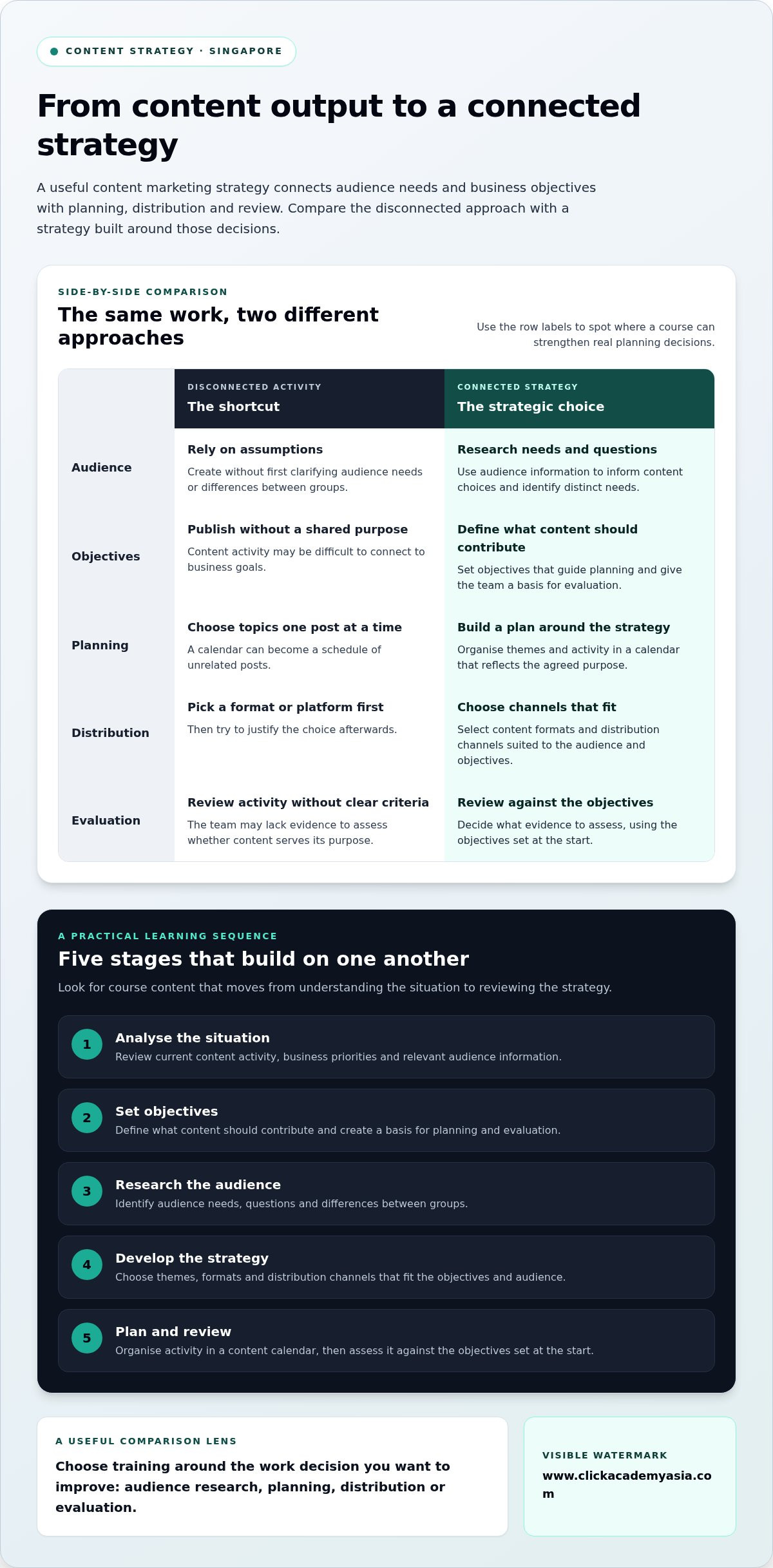
Look for a learning sequence that moves from understanding the situation to reviewing the strategy. Each stage should give the next one a clear foundation:
Analyse the situation: Review current content activity, business priorities and relevant audience information.
Set objectives: Define what content should contribute, giving the team a basis for planning and evaluation.
Research the audience: Identify needs, questions and differences between audience groups.
Develop the strategy: Choose themes, content formats and distribution channels that fit the objectives and audience.
Plan and review: Organise activity in a content calendar, then assess it against the objectives set at the start.
This sequence helps prevent a common shortcut: selecting a format or platform first, then trying to justify it afterwards. A calendar can coordinate responsibilities and timing, but it works best when it reflects a strategy rather than a schedule of unrelated posts.
How should audience insight shape the content plan?
Audience research helps teams move beyond assumptions about what people want. Segmentation can reveal that different groups have different questions or needs, which may call for distinct topics, messages or formats. Connect those insights to business objectives before deciding what to create. Personas can summarise research into a practical planning tool, but they shouldn’t replace evidence or be treated as a complete picture of every audience member.
For example, one audience group may need introductory information while another is comparing options. The strategic decision is not simply to create two pieces of content. Consider which need matters to the objective, what information would be useful and how the team will assess whether the content served its purpose.
How do channels, AI, and measurement fit into the strategy?
Channel choices should follow audience and objective decisions, not platform trends alone. A content marketing strategy course should help learners consider where their audience can be reached and which formats suit the message and its intended use. AI can support strategy development by helping teams explore ideas or organise information, while human judgement remains essential for checking relevance, accuracy and alignment with business priorities.
Measurement completes the planning loop. Set objectives first, then decide what evidence will help the team review progress and identify where the plan may need adjustment. This supports informed optimisation. A content marketing strategy course singapore learners compare should make the connection between objectives, execution and review clear.
Use this sequence to assess whether a course builds coherent planning capability. ClickAcademy Asia’s WSQ content marketing training offers practitioner-led, AI-integrated learning connected to marketing responsibilities.
How to compare content marketing strategy courses in Singapore: a content marketing strategy course singapore checklist
Course pages can list similar topics but offer different levels of practical depth. Compare what learners will do, not just the number of subjects named. Look for a clear connection between research, objectives, audience insight, content planning, channel choices and evaluation.
Use this matrix to compare options against your needs. Record what each course page states, rather than filling gaps with assumptions.
Then test the learning sequence. Does research inform objectives? Does audience insight shape content choices? Are channel decisions connected to those choices, and is there a clear way to review activity against objectives? A long list of topics can sound comprehensive, but the connections between them show whether the course develops strategic thinking.
Which course details reveal practical learning value?
Look for specific learning outcomes and a clear account of how learners apply concepts. Course details about assessment, prerequisites, delivery and trainer experience help you judge fit. A topic title alone doesn’t show that learners practise the skill, so look for the learning approach and outcomes described on the course page.
Practitioner-led learning connects strategy concepts with real marketing responsibilities. Look for evidence of applied learning, not just broad claims such as “comprehensive” or a lengthy topic list.
How can you match a course to your role?
Let your responsibilities guide the comparison. Content practitioners may prioritise research, planning, channel selection and performance review. Managers can focus on how learning supports team workflows and aligns content objectives with organisational priorities. Business decision-makers can look for strategic choices, such as how content activity supports an objective, rather than production skills alone.
Course attendance by itself doesn’t determine workplace results. Application depends on the learner’s role, team context and opportunities to practise afterwards. For professionals seeking one-to-one support to apply strategic thinking or develop executive capability, Charlie Whalley Coaching offers tailored guidance to help bridge the gap. Before selecting a course, name one task the learner needs to improve, then check whether the stated outcomes and learning approach develop that capability.
How to choose and prepare for content marketing training
Base your decision on the work you need to do, not a broad ambition to “get better at content”. A clear starting point helps you compare course outcomes with a real responsibility and prepare to apply what you learn.
Define a work challenge. Name a recurring issue, such as planning content around campaign objectives or deciding which audience to prioritise.
Identify the capability gap. Pinpoint whether you need more confidence in research, objective-setting, planning, distribution or evaluation.
Compare course information. Review the outline and learning outcomes for a connection to that gap, along with the schedule, intake details, prerequisites and trainer profile.
Plan an application task. Choose an upcoming content-planning responsibility where you can practise what you learn and reflect on your decisions.
Keep the task specific. “Improve content” is hard to assess; “plan audience-focused content for an upcoming campaign” gives you a concrete way to judge whether the learning is relevant.
How to set a useful learning objective before enrolling
Translate a broad goal into a strategic decision you want to practise. Ask which audience, business objective or planning step currently creates friction. For example, you might need to decide how audience insight should shape a campaign plan. Compare course outcomes against that objective: do they address the skill you need, or only mention the topic at a high level?
What to review before joining a course
Read the individual course page for its outline, schedule, intake details, learning expectations and prerequisites. Review the trainer profile to understand their relevant experience and certifications. Use the published course information to understand the learning focus and expectations.
For ClickAcademy Asia’s WSQ Content Marketing Strategy course, eligibility requirements are:
Age 21 years and above.
Level 2 basic computer literacy.
GCE N/O/A Level, NITEC or a diploma, plus 2 years work experience.
English proficiency: GCSE N/O pass, WPLN Level 5, IELTS 5.5 or TOEFL iBT 46-59.
Bring a personal laptop.
Before training, prepare questions linked to your responsibilities and choose a planning task to revisit afterwards. Use it to examine how you set objectives, select an audience or structure a content plan. This gives you a practical reference point for applying the learning.
For individual course enquiries or corporate training, contact ClickAcademy Asia at TeamSG@clickacademyasia.com or WhatsApp/phone 9388 8755. Individual learners can text 9388 8755 to arrange a course-selection appointment and receive a response within 1-2 working days. Explore WSQ content marketing training and connect your learning goal to a practical next step.
Explore ClickAcademy Asia's WSQ content marketing training in Singapore
ClickAcademy Asia is a Singapore-based professional training provider offering WSQ Content Marketing Strategy. Its practitioner-led approach and AI-integrated curriculum connect professional development with marketing responsibilities, while keeping human judgement central to strategic decisions.
The course sits alongside digital marketing specialisations, giving professionals and organisations options to build relevant capability. ClickAcademy Asia has upskilled 30,000+ professionals and has 3,000+ 5-star Google reviews. Assess the course outline and learning outcomes against the skills you want to develop.
What learners can expect from ClickAcademy Asia
Practitioner-led learning brings industry experience into professional development, with a focus on practical application. An AI-integrated approach supports future-ready capability while keeping marketing decisions grounded in business priorities and audience needs. To assess course fit, consider the tasks you handle and how the stated learning outcomes relate to them.
Eligible Singaporeans and PRs may claim up to 70% SSG/WSQ subsidy on qualifying courses. The subsidy is subject to eligibility and is not automatic for every learner or course. Review the course information and eligibility requirements as part of your enrolment planning.
How to enquire about individual or corporate training
Individual learners can text 9388 8755 to arrange a course-selection appointment. For course enquiries, email TeamSG@clickacademyasia.com or use WhatsApp/phone 9388 8755. A consultant will respond within 1-2 working days. Share your current responsibilities and learning priorities to make the discussion more focused.
Organisations can enquire about customised corporate training. Consider which marketing responsibilities the team wants to strengthen and whether learners share a capability need. This gives the discussion a practical starting point for a training programme tailored to the organisation.
Ready to connect your learning priorities with a relevant next step? Explore ClickAcademy Asia's training options for individual course selection or customised corporate training.
Turn your learning goal into a stronger team practice
The value of a learning decision grows when it connects to work beyond the classroom. Before choosing a content marketing strategy course singapore, identify the planning responsibility you want to handle with greater clarity, then consider how that capability could be shared across your team. A common approach to audience research, content priorities and review can help colleagues understand the purpose behind their work.
For managers and HR leaders, upskilling can help teams adapt to changing marketing needs. Consider where WSQ training could support current responsibilities, then give learners space to apply the learning to real planning tasks. The aim is to build relevant capability that teams can put into practice and develop over time.
Take the next step by exploring training for yourself or your organisation. Explore ClickAcademy Asia's training options, or email TeamSG@clickacademyasia.com or WhatsApp/phone 9388 8755 to discuss course selection or customised corporate training.
Frequently Asked Questions
What does a content marketing strategy course cover?
ClickAcademy Asia’s WSQ Content Marketing Strategy course content is detailed on its course page, aligned with the SkillsFuture framework and developed with trainer input. Review the course page for the outline, learning outcomes and schedule, then consider how they relate to your responsibilities.
Who is eligible for SSG/WSQ funding for qualifying courses?
Eligible Singaporeans and PRs may claim up to 70% subsidy on qualifying courses. Eligibility requirements are: age 21 years and above; Level 2 basic computer literacy; GCE N/O/A Level, NITEC or a diploma plus 2 years work experience; English proficiency of GCSE N/O pass, WPLN Level 5, IELTS 5.5 or TOEFL iBT 46-59; and bring a personal laptop. The subsidy is subject to eligibility and is not automatic.
Can a company arrange customised content marketing training?
Customised programmes are available for organisations. Contact ClickAcademy Asia for a corporate quote by emailing TeamSG@clickacademyasia.com or calling or messaging 9388 8755. Before enquiring, identify the team’s development priorities and the marketing responsibilities the training should support.
How can I get help choosing a suitable course?
Text 9388 8755 to arrange an appointment; a consultant will respond within 1-2 working days. You can also email TeamSG@clickacademyasia.com. Share a specific example of a task you handle, such as preparing a content plan or reviewing campaign activity, to help frame the course-selection discussion.
Who teaches ClickAcademy Asia's courses?
ClickAcademy Asia’s trainers are industry practitioners with relevant experience and certifications. Trainer profiles are available on the course pages. Review the relevant profile to understand how the trainer’s experience relates to your learning needs.
Do I need to bring my own laptop to training?
Yes. Learners must bring a personal laptop. Add it to your training preparation checklist and review the course page for other stated learning expectations.
What other course areas are available alongside content marketing?
ClickAcademy Asia offers courses in digital marketing, AI, software engineering, analytics and business strategy. Digital marketing options include WSQ Search Engine Optimization (SEO), WSQ Search Engine Marketing (SEM), WSQ Social Media Marketing, WSQ Digital Advertising and WSQ Marketing Analytics & Insights. Learners can also explore Google Ads certifications, Google Analytics (GA4) Training, E-commerce Strategy & Operations, Sales Training and Sales Leadership. Review the individual course pages for outlines, schedules and intake details.


Comments