
Sales Performance Management: Setting Goals and Driving Results in 2026

Updated: May 15
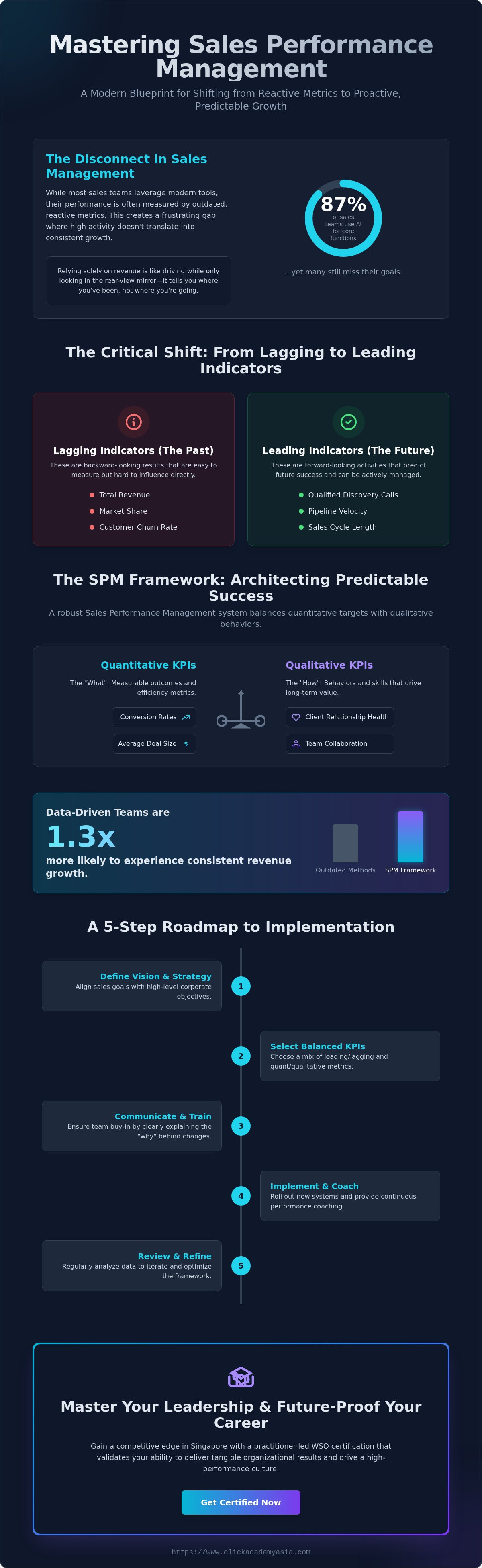
Did you know that 87% of sales teams are now using AI for core enablement functions, yet many leaders still find themselves staring at dashboards that don't translate into growth? It's frustrating when your team's performance feels inconsistent and your sales goals seem disconnected from the broader business strategy. You aren't alone in feeling that traditional metrics sometimes create more resistance than results. To bridge this gap, mastering Sales Performance Management: Setting Goals and Driving Results is no longer optional; it's the foundation of a high-performing culture.
We'll help you move past the fractured revenue engine by providing the frameworks and data-driven strategies needed to align your team with precision. You'll learn how to transform complex sales data into actionable insights that improve team motivation and drive consistent organisational results. This guide offers a clear roadmap for setting KPIs and highlights how a WSQ certification can future-proof your career. By the end, you'll have the decision-making skills to ensure your sales environment makes excellence inevitable.
Key Takeaways
Shift your focus from tracking lagging revenue numbers to engineering a strategic environment where high performance becomes predictable and repeatable.
Learn to balance quantitative revenue targets with qualitative measures like client relationship health to build a more resilient and motivated sales team.
Master the frameworks in Sales Performance Management: Setting Goals and Driving Results to apply statistical precision, such as trend analysis, to your sales data.
Implement a structured 5-step plan to navigate the psychological aspects of change management and reduce team resistance to new performance metrics.
Gain a competitive edge in Singapore by pursuing a practitioner-led WSQ certification that validates your ability to deliver tangible organisational results.
Table of Contents Understanding Sales Performance Management: Why Traditional Goal Setting Fails Designing the Framework: Balancing Quantitative and Qualitative KPIs Data-Driven Decision Making: Analysing Performance with Statistical Precision Strategic Implementation: Communicating Expectations and Managing Change Master Your Leadership: Why WSQ Certification is the Next Step
Understanding Sales Performance Management: Why Traditional Goal Setting Fails
Sales Performance Management isn't about micro-managing every phone call or obsessing over a static Excel sheet. It's about building a strategic system where individual effort translates directly into corporate growth. Most leaders fail because they treat revenue as the only metric that matters. Relying solely on "hitting the numbers" is like driving a car while only looking in the rear-view mirror. These are lagging indicators; they tell you what happened last month, but they can't predict what will happen next quarter.
To build a sustainable pipeline, you must master Sales Performance Management: Setting Goals and Driving Results. This broader approach to Sales management integrates planning, reporting, and behavioural coaching into one cohesive strategy. While simple sales tracking acts as a diary of past events, a robust management system serves as an architect's blueprint for future success. It replaces top-down quotas with collaborative frameworks that empower reps to take ownership of their own targets.
To better understand how coaching and strategy intersect to improve these outcomes, watch this helpful video:
The Evolution of Sales Management in 2026
By May 2026, 87% of sales teams have integrated AI for core enablement functions. This digital transformation has shifted the industry from monthly reviews to real-time performance adjustments. You can no longer afford to wait until the end of the quarter to see if a strategy is working. Modern leadership requires aligning individual goals with the broader organisational strategy found at ClickAcademy Asia. Teams that successfully adopt these data-driven frameworks are 1.3 times more likely to experience consistent revenue growth compared to those sticking to outdated methods.
The Cost of Poor Performance Alignment
When KPIs are misaligned, your best people get frustrated and eventually leave. Statistics show that sales representatives save over 11 hours per week by using AI for automation, yet this time is often wasted if their goals remain tied to manual, legacy processes. This misalignment creates a "revenue gap" where high levels of activity don't actually result in closed deals. It's a productivity drag that hurts both the bottom line and team morale. Sales Performance Management acts as the essential bridge that connects high-level corporate vision with the daily sales activities of your team.
Designing the Framework: Balancing Quantitative and Qualitative KPIs
Revenue is a result, not a strategy. If you only track final sales figures, you're reacting to the past rather than shaping the future. To build a high-performance culture, you must master Sales Performance Management: Setting Goals and Driving Results. This requires a delicate balance between "hard" quantitative targets and "soft" qualitative behaviours. When these two align, your team doesn't just hit their numbers; they build a repeatable engine for growth.
Leading indicators are the activities that predict future success, such as the number of qualified discovery calls or pipeline velocity. Lagging indicators, like total revenue or market share, confirm what has already happened. By focusing on leading indicators, you can course-correct performance before the quarter ends. Using an organisational competency framework helps you select KPIs that match your specific business needs, ensuring every metric serves a strategic purpose. Engaging your team in this planning process is vital to secure buy-in and reduce resistance to new performance standards.
Quantitative Targets: Beyond the Revenue Number
While total revenue is the ultimate goal, it's often too broad to be actionable. Break this down into specific metrics like conversion rates at each stage of the funnel, average deal size, and sales cycle length. For example, in 2026, top-performing teams are using AI lead scoring to improve accuracy by 40% over manual methods. You should customise these benchmarks based on specific roles. A Sales Development Representative (SDR) might be measured on their lead-to-opportunity conversion rate, while an Account Manager focuses on net revenue retention or expansion sales. Setting these targets requires looking at historical data to ensure they're challenging yet achievable.
Qualitative Measures: Ensuring Sustainable Success
Qualitative KPIs measure the "how" behind the "what." These include CRM hygiene, product knowledge, and the ability to conduct deep discovery. A salesperson who hits their quota but ignores the CRM creates a data gap that hurts the entire organisation. You can quantify these behaviours through peer reviews, manager observations, and customer satisfaction scores. Before implementing a qualitative metric, use this quick validation checklist:
Observability: Can a manager clearly see or hear this behaviour during a call or review?
Impact: Does this behaviour directly improve a leading indicator, such as win rates?
Documentation: Is there a clear way to record this in your existing systems?
High-quality discovery calls lead directly to higher win rates and shorter sales cycles. By rewarding the process, you ensure the result is sustainable. If you're looking to refine your leadership approach, exploring Sales Leadership training can provide the tools to manage these complex frameworks effectively.
Data-Driven Decision Making: Analysing Performance with Statistical Precision
Basic arithmetic is no longer enough to lead a modern sales team. While knowing your total monthly revenue is helpful, it doesn't explain the "why" behind your results. In 2026, top-tier leaders are using advanced statistical techniques to gain a competitive edge. Mastering Sales Performance Management: Setting Goals and Driving Results involves moving beyond simple averages to understand complex patterns. You can analyse your data more effectively with our GA4 training, which provides the technical foundation needed to interpret these digital signals.
Trend analysis allows you to see if a recent spike in performance is a sustainable shift or just a seasonal anomaly. Regression analysis goes even deeper by identifying which specific factors, such as a new coaching framework or a specific lead source, are actually responsible for your wins. These insights allow you to stop guessing and start investing in what actually works. By focusing on variables that correlate with high performance, you can replicate success across the entire team.
Evaluating Sales Programme Effectiveness
Determining the ROI of a performance programme requires a systematic approach. You shouldn't just look at the bottom line; you must identify "outliers" within your team. If 15% of your reps are significantly outperforming the rest, you need to understand their performance drivers. Are they using a specific AI tool more effectively, or have they mastered a particular soft skill? Since sales reps save over 11 hours per week using AI for automation, your data should show exactly where that reclaimed time is being spent. A systematic evaluation report for leadership is essential to prove that your management strategies are delivering tangible organisational results.
Visualising Results for Stakeholder Impact
Senior leadership rarely has the time to sift through raw spreadsheets. Your job is to transform data into a persuasive narrative that justifies your strategy. Focus on creating impactful communication materials that highlight the health of the sales pipeline. When you present to the C-suite, use data to justify budgets for new sales technology or practitioner-led training. Showing that AI lead scoring has improved accuracy by 40% over manual methods is far more persuasive than simply asking for more resources. This level of clarity ensures your approach to Sales Performance Management: Setting Goals and Driving Results remains focused on high-impact activities.
Strategic Implementation: Communicating Expectations and Managing Change
A brilliant strategy is worthless if your team doesn't know how to execute it. Moving from data analysis to real-world application requires a structured approach that respects the high-pressure nature of sales. To ensure a smooth transition, you must master the rollout of Sales Performance Management: Setting Goals and Driving Results. This isn't just about changing a dashboard; it's about shifting the collective mindset of your organisation toward sustainable, predictable growth.
Implementing a new performance framework should follow this 5-step plan to minimise disruption:
Audit and Baseline: Identify where your current revenue engine is fractured and document existing performance gaps.
Framework Customisation: Select the leading and lagging indicators that align with your 2026 business objectives.
Pilot Phase: Test the new metrics with a small, high-performing group to gather initial feedback and prove the concept.
Full Rollout: Launch the programme to the wider team with clear, transparent communication regarding the new expectations.
Continuous Iteration: Establish a monthly review cycle to refine KPIs based on real-world outcomes and team input.
Communicating these changes without causing burnout is a delicate balance. Since 81% of sales teams are now experimenting with AI, it's vital to frame these new metrics as tools for empowerment rather than just increased surveillance. When reps understand that better data helps them save 11 hours per week on manual tasks, they're far more likely to embrace the change.
Securing Stakeholder Buy-In
Your communication plan must address the specific concerns of different groups. For the C-suite, focus on how the programme delivers consistent organisational results and improves revenue predictability. For sales reps, the focus should be on "What's in it for me?" Show them how precision goal setting leads to more attainable commissions and less wasted effort. A simple stakeholder template should include the "Why," the "How," and the specific "Win" for each person involved in the process.
Overcoming Resistance and Refining the Programme
Resistance often stems from a fear of transparency or the perceived difficulty of hitting new targets. You can counter this by creating a robust feedback loop where reps feel their challenges are heard and addressed. If a specific metric isn't working, be prepared to adjust it. This agility builds trust and ensures the programme remains relevant. You can explore our leadership courses to learn more about managing these complex team dynamics during times of digital transformation.
Successful implementation turns a theoretical framework into a living part of your sales culture. If you're ready to lead this change, consider enrolling in a Sales Training programme that focuses on practitioner-led strategies for the modern market.
Master Your Leadership: Why WSQ Certification is the Next Step
Building a high-performance sales culture requires more than just reading about frameworks. It demands a formal, structured approach that validates your expertise and provides a clear career roadmap. By earning a WSQ certification, you signal to the market that you possess industry-recognised skills grounded in global standards. Mastering Sales Performance Management: Setting Goals and Driving Results is the final piece of the puzzle for leaders who want to deliver consistent organisational results in 2026.
The ClickAcademy Asia Advantage
Theory alone won't help you manage a team under pressure. That's why the Sales Performance Management course is led by seasoned practitioners who have faced real-world sales challenges in the Asian market. You'll gain immediate, actionable tools that can be implemented the very next day. Since ClickAcademy Asia serves professionals across over 30 countries, you'll benefit from a curriculum that meets international benchmarks while remaining deeply relevant to regional business dynamics.
Funding and Accessibility for Professionals
Professional growth shouldn't be a financial burden. In Singapore, significant funding is available through SkillsFuture Singapore (SSG) to make these certifications accessible. For example, Singapore Citizens aged 40 and above can receive up to 70% funding through the Mid-career Enhanced Subsidy, bringing the payable amount down to $429 after GST. This same 70% subsidy applies to company-sponsored employees from SMEs, ensuring that even smaller teams can access world-class training.
The funding breakdown for the course is as follows:
Singapore Citizens (40+): 70% funding, resulting in $429 payable after GST.
SME-sponsored employees: 70% funding, resulting in $429 payable after GST.
Singapore Citizens (21-39) & PRs: 50% funding, resulting in $649 payable after GST.
Enrollment is straightforward through the MySkillsFuture portal, allowing you to use your SkillsFuture credits seamlessly. Future-proofing your career means staying ahead of the AI-driven shifts we've discussed, ensuring you remain a vital asset to any revenue-generating team. Don't leave your team's success to chance. Secure your spot in our next Sales Performance Management intake today and start engineering an environment where excellence is inevitable.
Transform Your Sales Strategy into a Predictable Revenue Engine
Success in 2026 isn't about working harder; it's about managing smarter. You've learned how to move beyond lagging revenue numbers by balancing quantitative targets with qualitative behaviours. By applying statistical precision to your performance data, you can identify the specific drivers that lead to consistent organisational growth. Mastering Sales Performance Management: Setting Goals and Driving Results ensures your leadership remains relevant in an increasingly automated landscape.
ClickAcademy Asia stands as a regional leader in digital and sales education, providing practitioner-led training that translates directly to the boardroom. Our programmes are WSQ-certified and SSG-funded, making high-level professional development accessible to all Singaporean professionals. Don't let your team's performance be dictated by old habits or disconnected tools. Master Sales Performance Management: Enrol in our WSQ-certified course today and take the definitive step toward future-proofing your career. You have the tools and the roadmap; now it's time to lead your team to excellence.
Frequently Asked Questions
Is Sales Performance Management only for large corporations?
No, Sales Performance Management is essential for businesses of all sizes, especially SMEs looking to scale efficiently. 81% of sales teams are now experimenting with AI, which allows smaller organisations to compete by automating time-intensive tasks. The 70% funding support for SMEs in SINGAPORE ensures that even lean teams can access high-level strategic training to improve their revenue growth.
Can I use SkillsFuture credits for the Sales Performance Management course?
Yes, you can use your SkillsFuture credits to offset the out-of-pocket expenses for this WSQ-certified course. Since the programme is SSG-funded, both self-sponsored individuals and company-sponsored employees can benefit from these subsidies. You can easily process your claim through the MySkillsFuture portal once your enrolment is confirmed by ClickAcademy Asia.
How much does the WSQ Sales Performance Management course cost?
The standard course fee for Sales Performance Management: Setting Goals and Driving Results is $1100 excluding GST. However, SINGAPORE Citizens aged 40 and above pay only $429 after GST due to 70% SSG funding. Other eligible individuals, such as PRs or younger citizens, pay $649 after GST with 50% funding.
What happens if my sales team resists the new performance framework?
Resistance usually stems from a fear of transparency, which you can counter by highlighting how these tools save reps 11 hours per week on average. Focus on the benefits by showing how better data leads to more attainable commission targets and less administrative drag. Implementing a feedback loop ensures that your team feels involved in the process rather than just monitored by it.
How do I balance quantitative targets with qualitative team development?
You balance these by rewarding the behaviours that lead to sales, such as CRM hygiene and product knowledge, alongside final revenue numbers. Qualitative development acts as a leading indicator; if your team improves discovery call quality, your win rates will naturally follow. This holistic approach ensures that your sales engine remains sustainable and doesn't burn out your top performers.
Is this course suitable for professionals transitioning into sales leadership?
Yes, this course is suitable for those mastering Sales Performance Management: Setting Goals and Driving Results as they move from individual contributors to leadership roles. It provides the frameworks needed to align team activities with broader organisational goals. You'll move from "doing the work" to "engineering the environment" where your entire team can achieve consistent, predictable results.
Can this programme be customised for specific corporate group training?
Yes, ClickAcademy Asia provides practitioner-led training that can be tailored to meet the specific needs of your industry or organisation. We have a proven track record of serving professionals across 30 countries and partnering with global giants like Google and Meta. Customised sessions allow your leadership team to focus on the unique "revenue gaps" and data challenges specific to your business model.
What are the pre-requisites for enrolling in the WSQ SPM course?
There are no formal academic pre-requisites, but the course is best suited for individuals with some professional experience in sales or marketing. A basic understanding of your current sales process will help you apply the frameworks more effectively during the workshop. This ensures that the data-driven strategies you learn can be immediately translated into actionable improvements for your specific sales pipeline.



Comments