
Programmatic Audio Advertising Best Practices in Singapore: 2026 Checklist

A programmatic audio campaign can reach the right listener and still leave you unsure what it achieved. In Singapore, success depends on more than choosing a podcast, streaming or digital radio environment. You need to align inventory, audience signals, creative and measurement before activation. The most useful programmatic audio advertising best practices start with a test, measure and optimise plan, not just a shortlist of platforms.
Audio can connect with audiences in different listening moments, but choosing the right environment, evaluating targeting options and deciding what to measure takes careful planning. Make those decisions early so you can judge performance against a clear objective and understand how audio contributes to the wider campaign.
This checklist shows you how to compare inventory, match audience signals and creative to your objective, and set measurement criteria before launch. It also covers how to optimise using campaign results and identify skills your team can strengthen through WSQ digital advertising and marketing analytics training.
Table of Contents
Programmatic audio advertising best practices for Singapore campaign planning
Start with the outcome, not the inventory. A campaign designed to build awareness needs a different plan from one intended to prompt product research or generate a response. Define the distinction before selecting listening contexts, creative and success measures. This prevents one placement from being expected to serve every objective.
Programmatic audio advertising is the automated buying and delivery of audio ad inventory across eligible digital listening environments. Programmatic describes the buying method; audio is the format. For a neutral overview of the wider process, see Programmatic advertising.
For a concise introduction to planning, watch this video from StackAdapt:
What does programmatic audio advertising include?
It can include audio ads served in eligible digital listening environments, such as streaming audio or podcast-related placements. Inventory, formats and targeting options depend on the platform and campaign. Treat each as a planning choice, not a universal standard. Automated buying describes how inventory is purchased and delivered; it does not determine the ad format or listening context.
Keep buying methods distinct. A programmatic placement is bought through an automated process, while a podcast sponsorship or direct buy is arranged separately with a publisher or media owner. The approaches may support similar objectives, but can differ in placement control, delivery and reporting. Compare them with your brief rather than assuming they are interchangeable.
Set the objective before selecting audio tactics
Choose one primary objective, then define indicators that will help you assess progress. An awareness campaign might focus on whether it reached its intended audience. A consideration campaign could track signs of further brand exploration. A response-focused campaign should connect exposure to a relevant action, such as a visit to a campaign landing page.
Specify whom you need to reach and which listening contexts make sense for your message. For a Singapore campaign, consider whether the language and references suit the intended audience. Do not assume one language, platform or listening moment fits everyone. Record assumptions about relevant contexts as hypotheses, then assess them against campaign data.
These programmatic audio advertising best practices make planning more disciplined: align the objective, audience and context, then assess available inventory and measurement options. This gives your team a clear basis for comparing tactics and learning from results.
Build a programmatic audio brief around audience, context and creative
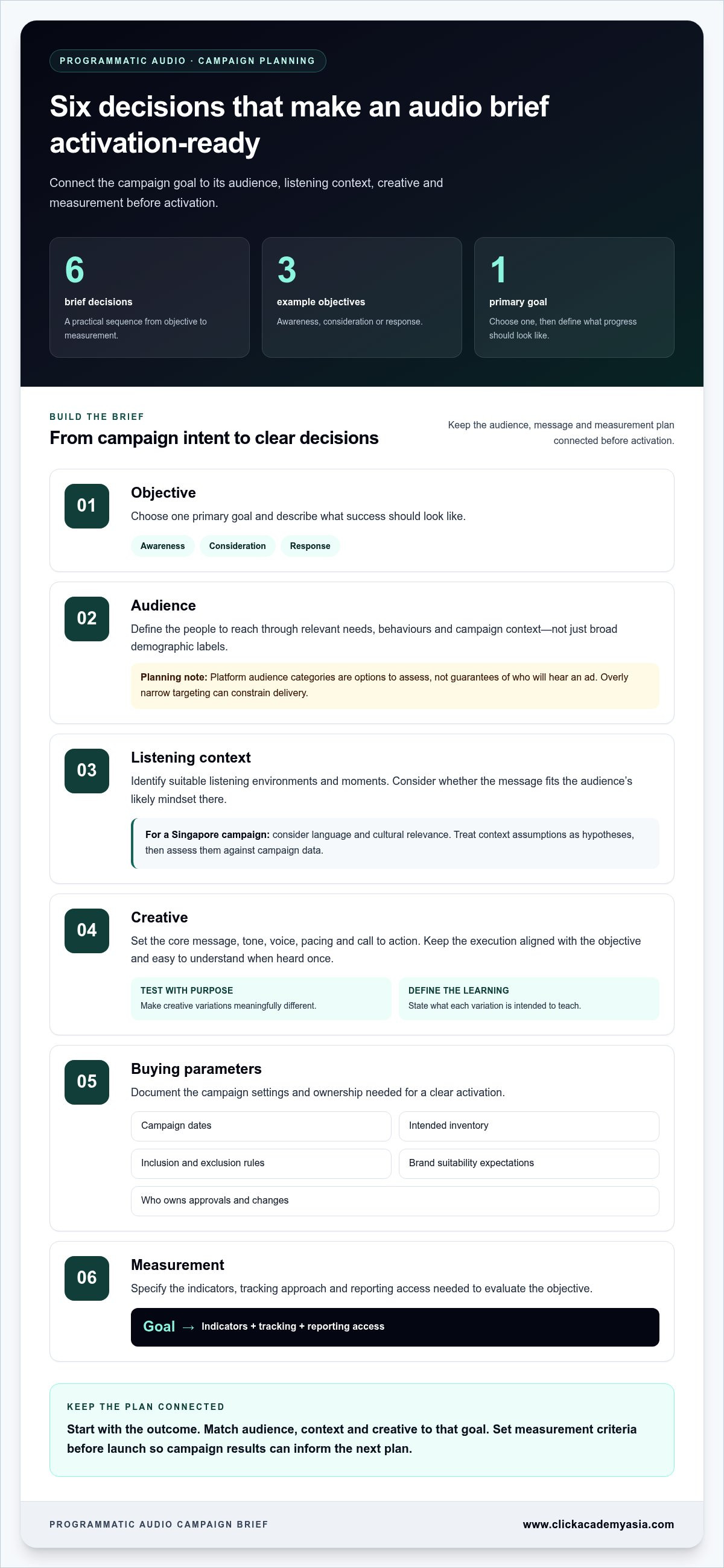
A clear brief turns campaign intent into decisions that buyers, creative teams and analysts can act on. Use this sequence before activation to keep the audience, message and measurement plan connected.
1. Objective: Choose one primary goal, such as awareness, consideration or response. Describe what success should look like.
2. Audience: Define the people you want to reach through relevant needs, behaviours and campaign context, not just broad demographic labels.
3. Context: Identify suitable listening environments and moments. Consider whether your message fits the audience’s likely mindset there.
4. Creative: Set the core message, tone, voice, pacing and call to action. Keep the execution aligned with the objective.
5. Buying parameters: Document campaign dates, intended inventory, inclusion and exclusion rules, brand suitability expectations, and who owns approvals and changes.
6. Measurement: Specify the indicators, tracking approach and reporting access needed to evaluate the objective.
How should audience and listening context shape the brief?
Make audience definitions useful to the campaign team. For example, a Singapore campaign aimed at working professionals might describe relevant interests or needs alongside listening contexts that could suit the message. Consider language and cultural relevance, then validate your assumptions using delivery and response data rather than treating them as established facts.
Platform audience categories are options to assess, not guarantees of who will hear an ad. Overly narrow targeting can also constrain delivery. State which audiences or contexts to include and exclude, and document brand suitability boundaries so the activation team can translate them into campaign settings.
What makes an audio ad creative-ready?
Build around one memorable idea and one clear next action. Match the script, voice, pacing and sound design to the campaign goal and brand identity, while keeping the message easy to understand when heard once. Listeners should not need to replay the ad to work out what to do next.
If you develop creative variations, make each test meaningfully different. You could change the opening message or call to action, for example, and define what you hope to learn. Avoid changing a few words without a clear learning question. For technical context, the IAB Tech Lab explains updates to audio ad-serving standards, including the move from DAAST to VAST 4.1: [External Link: IAB Tech Lab programmatic audio standards].
These programmatic audio advertising best practices give teams a practical foundation for briefing, activation and learning. ClickAcademy Asia’s digital marketing training can support the planning and creative decision-making skills used in campaign work: [Internal Link: ClickAcademy Asia digital marketing training].
Compare programmatic audio inventory, targeting and buying options
No single audio environment suits every campaign. Compare options against the audience context, creative requirements and reporting you need, then weigh those trade-offs against your primary objective. Choose the option that fits the brief and gives your team a practical way to learn, rather than relying on broad claims about reach.
Which audio environments fit different campaign goals?
Use this comparison as a starting point. Actual inventory, buying controls and reporting depend on the selected platform and campaign setup. A direct sponsorship is a distinct buying approach, so do not assume it offers the same controls or measurement as a programmatic placement.
How should marketers evaluate targeting and brand suitability?
Assess audience signals for relevance and transparency. Ask what they describe, how they are applied and whether the campaign team understands their limits. Balance specificity with enough scale to deliver and learn. A targeting criterion defines who or what the campaign seeks to include; it does not guarantee an outcome.
Before committing, document audience criteria, content exclusions, brand suitability expectations, creative requirements and reporting access. A focused audio placement may complement a broader media mix when it adds a useful audience context. Compare its contribution rather than assuming one environment is inherently superior. These programmatic audio advertising best practices turn inventory selection into a reasoned decision.
Connect measurement to the actions that matter to the business. For site visits and on-site behaviour, explore [Internal Link: Marketing analytics with GA4]. Keep in mind that analytics reports and ad delivery reports answer different questions.
Use pre-launch and in-flight checklists for quality
A campaign can have a sound strategy and still produce unclear results if the creative, destination or tracking is misaligned. A staged quality process helps your team catch setup issues early, assess delivery against the agreed objective and make measured changes instead of reacting to every fluctuation.
Align tracking before launch so you can connect campaign delivery with the outcomes you plan to assess.
Before launch: verify the setup
Use the approved brief as your reference. Confirm that the objective, audience definition, placements, campaign dates and creative versions match what stakeholders approved. Then test the listener’s next step, including the landing-page experience and any tracking links or events used to understand campaign activity.
Creative: Check the approved audio file, message and call to action.
Destination: Open the landing page on relevant devices and test the intended journey.
Measurement: Verify campaign links or events and confirm that the right people can access reporting.
Responsibilities: Name who owns approvals, monitoring and issue resolution.
Learning plan: Record baseline assumptions and the questions the campaign should answer.
These checks are especially useful when several teams share responsibility. Assigning an owner to each approval and monitoring task reduces the risk of setup gaps being mistaken for campaign performance issues.
Early delivery: check for alignment
Once the campaign begins, review whether delivery matches the approved plan. Check that the intended placements and creative are running, reporting is updating as expected and the landing-page journey still works. Compare available indicators with the campaign objective, but avoid applying a universal benchmark. Context, setup and available data all matter.
Ongoing optimisation: change with a reason
Set a review rhythm that suits the campaign and the available data. Early signals can be useful, but may not provide enough evidence for a major change. Look for patterns in context before deciding whether an adjustment is warranted.
Where practical, change one meaningful variable at a time, such as a creative version or targeting choice.
Record the change, why you made it and the effect you expect.
Review the observed outcome against the original objective and note what remains uncertain.
Pause or adjust only when the evidence and campaign context support that decision.
This disciplined workflow is one of the practical programmatic audio advertising best practices that helps teams learn from each activation. ClickAcademy Asia’s digital advertising and analytics training supports the campaign planning and measurement skills behind this work: [Internal Link: ClickAcademy Asia digital advertising and analytics training].
Measure programmatic audio impact and turn results into the next campaign
Good measurement starts with a clear question. Are you checking whether the campaign was delivered, whether listeners engaged, whether they visited your site or whether a business outcome followed? These are different stages of evidence. Choose measures that match the objective, and do not treat exposure alone as proof of business impact.
Which metrics and measurement approaches answer the right question?
Map each metric to its role before launch. Delivery indicators show whether ads ran as planned. Engagement measures may indicate a response to the message. Site behaviour shows what visitors did after arriving, while business results relate to outcomes such as enquiries or sales. What you can measure depends on campaign setup and reporting access.
Attribution can help assess which touchpoints are associated with a recorded action. A lift study can examine whether outcomes differ between defined groups or periods. Each approach answers a different question and has limitations. Neither method, by itself, proves that audio caused an outcome. Interpret findings alongside other marketing activity, campaign context and measurement gaps.
For external evidence, consult a current, relevant source on audio measurement: [External Link: current industry study on audio measurement]. Use research to inform your approach, not as a substitute for defining what your own campaign needs to learn.
How can teams turn campaign findings into lasting capability?
Close the loop with a short learning log that decision-makers can scan. Summarise the objective, audience and placements, the indicators reviewed, what appeared to work, what remains uncertain and what you will test next. Keep conclusions proportional to the evidence. If site visits rose during a campaign, for example, record the pattern and any other activity that ran at the same time before attributing the change to audio.
Keep: Creative or audience choices that aligned with the objective and available evidence.
Revisit: Assumptions the campaign could not validate or reporting that left questions open.
Test next: A specific change to audience, creative or channel mix, with a clear reason for testing it.
Share the findings in plain language and use them to refine future planning. If the review reveals gaps in strategy, execution or analytics, treat those as development priorities rather than campaign failures. Strengthening these capabilities helps teams make more confident decisions across campaigns.
For marketing professionals and teams in Singapore, WSQ learning can build practical capability in planning and measurement. ClickAcademy Asia offers WSQ digital marketing training to help teams make stronger campaign decisions and turn programmatic audio advertising best practices into repeatable skills: WSQ digital marketing training.
Turn your next audio campaign into a stronger learning cycle
Effective programmatic audio advertising best practices begin with a clear objective, a brief that connects audience, context and creative, and a considered comparison of inventory and buying options. Before launch, test the destination and tracking, then review delivery against the goal. After the campaign, separate exposure indicators from business outcomes and record what you learned, what remains uncertain and what to test next.
This process makes each campaign more than a media buy. It gives your team a clearer basis for future planning and optimisation. Strong measurement and decision-making depend on practical skills as well as campaign data.
ClickAcademy Asia provides professional and corporate training, including WSQ Digital Advertising and Marketing Analytics & Insights. Explore WSQ digital marketing training to equip your team with the skills to plan, assess and improve digital campaigns.
Frequently Asked Questions
What is programmatic audio advertising?
Programmatic audio advertising is the automated buying and delivery of audio ad inventory across eligible digital listening environments. Depending on the platform and campaign setup, placements may include streaming audio or podcast-related inventory. Programmatic describes the buying method, not a distinct sound format. It also differs from a direct sponsorship arranged with a publisher. Inventory, targeting and reporting options vary, so define the campaign objective before selecting tactics.
How do you measure programmatic audio advertising effectiveness?
Measure effectiveness by matching indicators to the campaign objective before launch. Delivery figures show whether ads ran as planned; engagement, site behaviour and business outcomes provide different kinds of evidence. Attribution can help assess which touchpoints are associated with actions, while a lift approach examines differences between defined groups or periods. Neither method alone proves audio caused a result. Interpret findings alongside other marketing activity and note measurement limitations.
What makes a good programmatic audio ad?
A good programmatic audio ad communicates one memorable idea and gives listeners a clear next step. Match the script, voice, pacing and sound design to the objective, brand identity and listening context. Make the call to action easy to understand when heard once, such as visiting a clearly named web address or searching for a brand. If you test variations, change a meaningful element so the results can inform a future creative decision.
Can programmatic audio advertising work for brand awareness?
Yes. It can support brand awareness when the chosen audio environments and audience signals align with the intended reach and message. Set awareness as the primary objective, then select indicators that show whether the campaign reached its intended audience and delivered as planned. Exposure measures do not establish that listeners remember or prefer a brand. If you need to assess changes in awareness, consider complementary research or other campaign evidence and interpret the results in context.
How should marketers compare streaming audio and podcast advertising?
Compare streaming audio and podcast advertising by audience context, available inventory, creative requirements, control and reporting, rather than assuming one performs better. Streaming may suit campaigns seeking relevant listening moments across a service, while podcast placements may fit a message aligned with particular content or a sponsorship. Actual options vary by platform and setup. Check how delivery is reported and what actions can be tracked, then weigh each option against the campaign objective.
What should a programmatic audio campaign checklist include?
A practical checklist should cover the objective, audience, listening context, placements, approved creative, campaign dates and buying parameters. Before launch, test the landing-page journey and tracking approach, confirm reporting access, and assign owners for approvals and monitoring. During delivery, review indicators against the objective without relying on universal benchmarks. Record each optimisation, its rationale and observed effect, then capture what worked, what remains uncertain and what to test next.


Comments