
B2B Marketing Training in Singapore: Strategies for Industrial Manufacturing

What if your industrial marketing isn’t generating stronger opportunities because it’s aimed at one decision-maker, when the buying decision involves a whole committee? For manufacturers in Singapore, b2b marketing training singapore can help teams connect marketing activity to sales priorities and guide buyers from initial research to final approval.
Long buying cycles make it harder to see which campaigns influence the pipeline. Technical products can also be challenging to explain clearly to engineers, procurement teams and senior leaders. When channels are disconnected and attribution is unclear, marketers can struggle to decide where to focus next.
This article explores what practical B2B marketing training should cover to help industrial teams generate and progress better opportunities. You’ll learn how to align strategy with business goals, create useful content for different buying roles, select channels for each stage of the journey and measure progress beyond surface-level engagement. We’ll also look at how structured learning, including WSQ Digital Marketing Strategy & Planning within Singapore’s professional training ecosystem, can help teams build these capabilities and improve their approach over time.
Table of Contents
Why Industrial Manufacturing Needs a Distinct B2B Marketing Strategy
Marketing an industrial product means explaining more than its features. A technical buyer may focus on performance, procurement on risk and value, operations on implementation, and executives on business outcomes. In Singapore, b2b marketing training singapore can help teams create a joined-up approach for these different priorities and the extended decisions that often follow.
Business-to-business (B2B) commerce involves organisations selling to other organisations. For manufacturers, marketing needs to support several people as they recognise a problem, explore options and evaluate whether a solution fits. Industrial B2B marketing is the coordinated use of education, demand generation and sales enablement to help business buyers make informed decisions while advancing measurable business objectives.
These activities work best as connected parts of one strategy. Technical education makes a product easier to understand; demand generation attracts relevant organisations; sales enablement gives commercial teams useful content and context for conversations. A product explainer, for instance, can answer an early technical question and later help sales address a stakeholder’s concern. The aim is not to push every buyer through the same message, but to make the next decision clearer.
How manufacturing buying committees shape the journey
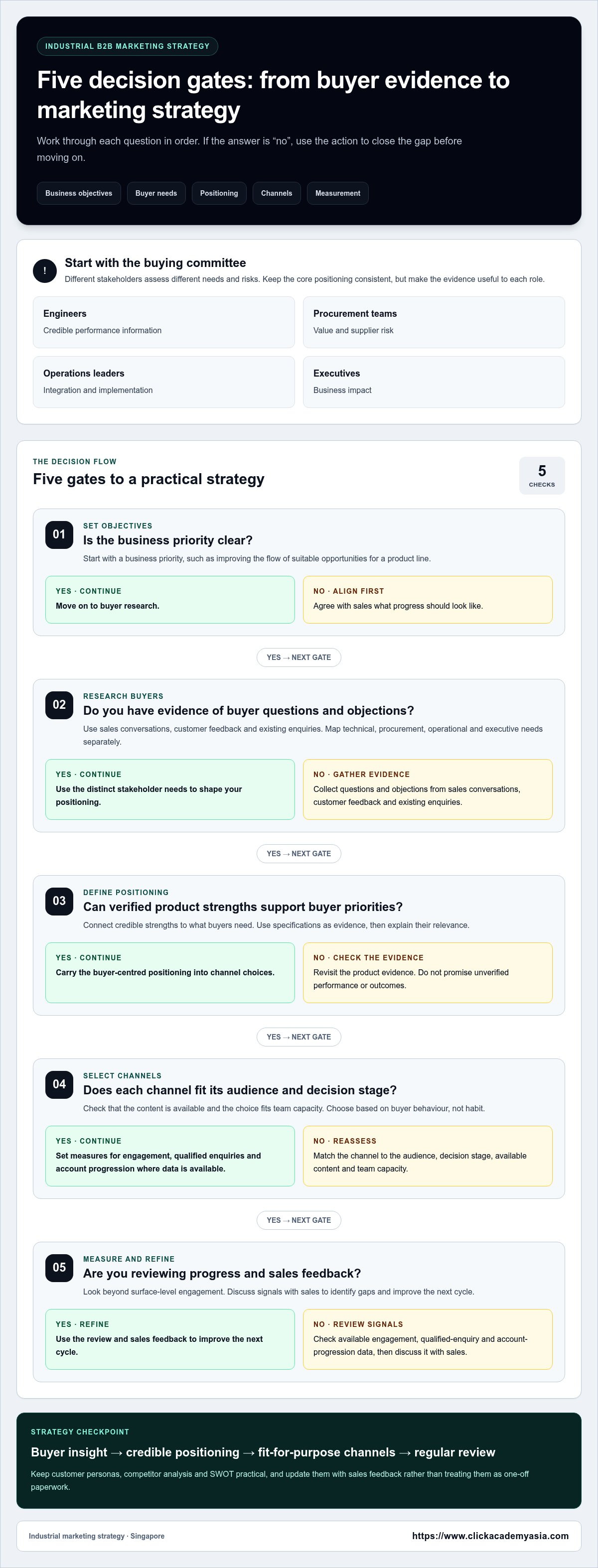
Each stakeholder may assess a different risk. Engineers need credible performance information, procurement teams may scrutinise value and supplier risk, operations leaders consider integration and implementation, and executives look for business impact. Tailor messages to those needs, and make sure technical and sales experts can support every claim.
Hypothetical example: A manufacturer considering a new monitoring system might need technical specifications for engineering, implementation guidance for operations, and a clear business case for leadership. A coordinated set of materials can address each concern while keeping the core positioning consistent.
Why long sales cycles change marketing priorities
Interest may appear well before a buyer is ready to speak with sales. Consistent touchpoints, such as useful technical content, relevant email follow-ups and sales-shared resources, can help stakeholders return to the evaluation with better questions. Marketing supports informed decisions; it doesn’t replace technical validation or sales expertise.
A click or enquiry shows an immediate response, but not the full account journey. Track whether target organisations engage with relevant material, involve additional stakeholders, progress to a meaningful sales conversation and receive aligned follow-up. Regular discussion between marketing and sales helps teams interpret these signals and refine what they share.
For teams developing this capability, b2b marketing training singapore can provide a structured foundation in strategy and planning. WSQ Digital Marketing Strategy & Planning helps professionals connect marketing choices to business objectives, then apply that thinking to manufacturing buyers and sales priorities.
Build a Manufacturing B2B Marketing Strategy Around Buyer Needs
A useful strategy starts with buyer evidence, not a channel wishlist. That matters in Singapore’s advanced manufacturing sector, where technical suitability, operational realities and commercial priorities all shape how organisations assess solutions. The Singapore Economic Development Board outlines the country’s focus on Singapore’s advanced manufacturing hub, highlighting the importance of connecting specialist knowledge with clear business value.
A documented strategy turns buyer insight into positioning, channel choices and measures that support business objectives. Keep customer personas, competitor analysis and SWOT practical: use them to capture what different stakeholders need, where alternatives fall short and which strengths the business can credibly demonstrate. Update them with sales feedback instead of treating them as one-off paperwork.
Set objectives. Start with a business priority, such as improving the flow of suitable opportunities for a product line. Agree with sales what progress should look like.
Research buyers. Gather questions and objections from sales conversations, customer feedback and existing enquiries. Map technical, procurement, operational and executive needs separately.
Define positioning. Connect verified product strengths to buyer priorities. Use specifications as evidence, then explain their relevance without promising unverified performance or outcomes.
Select channels. Match each channel to the audience, decision stage and content available. Choose based on buyer behaviour and team capacity, not habit.
Measure and refine. Review engagement, qualified enquiries and account progression where data is available. Use sales feedback to identify gaps and improve the next cycle.
Turn technical strengths into buyer-centred positioning
Translate a feature into a relevant consideration, not an unsupported claim. A specification may help an engineer assess suitability; operations may need implementation information, while procurement and executives may look for evidence to evaluate risk and business value. Keep the central message consistent across web pages, technical content and sales materials, adapting the detail for each stakeholder.
Set objectives and measures before selecting channels
Separate the levels of measurement. A business objective might be to support growth in a priority market; a marketing objective could be to attract more relevant buying organisations; campaign indicators might track visits to technical content or enquiries from target accounts. These indicators show activity, while sales conversations and account progression help assess whether that activity is useful.
For a structured approach to planning, explore this WSQ digital marketing strategy guide. Teams pursuing b2b marketing training singapore can build these planning skills through WSQ Digital Marketing Strategy & Planning, then apply them to their own buyers, evidence and sales priorities.
Compare B2B Marketing Channels for Industrial Manufacturing
No single channel suits every manufacturing buyer or decision stage. Choose channels to match audience behaviour, business objectives and the evidence available to show what is working. Use the comparison below as a starting point, then refine it with buyer research and sales input.
Match channels to research and relationship-building needs
SEO and educational content can support active information gathering, especially when technical buyers are seeking clear answers. LinkedIn may help maintain professional visibility, while email can continue relevant communication with known contacts. Treat paid advertising as a test: define the target audience and campaign purpose first, then assess whether the results justify further investment.
Ask sales which questions recur, what content helps move discussions forward and where buyers seek information. That feedback can guide channel priorities. Singapore businesses can also explore capability resources from the Singapore Business Federation as they strengthen their marketing approach.
Use measurement to improve channel decisions
Impressions, clicks and visits describe channel activity; they don’t show business contribution on their own. Look for meaningful engagement, relevant enquiries and signs of account progression, while recognising that several people may interact with different channels before a sales conversation. Attribution can reveal useful patterns, but it may not identify one channel as the sole cause of a complex buying decision.
For measurement context, read the marketing analytics with GA4 guide. Building confidence in channel planning and measurement is also a practical focus for teams pursuing b2b marketing training singapore through WSQ marketing learning.
Create a Practical 90-Day B2B Marketing Plan for Manufacturing
A 90-day plan gives marketing, sales and technical teams a manageable way to move from buyer insight to a campaign they can review and improve. Treat the schedule as a working roadmap, not a promise of results. Adjust the pace to fit approval processes, available resources and the length of your sales cycle.
Discovery: clarify the audience and opportunity. Review sales conversations, existing enquiries and customer questions. Ask which buyer roles are involved, what concerns delay decisions and what information is missing. Deliverable: a concise audience insight summary that identifies one priority audience and its key needs.
Planning: agree the message and approach. Select one relevant offer or solution area, define its buyer-centred positioning and check all claims with technical and sales colleagues. Choose a channel and a clear action that fits the audience. Deliverable: an approved campaign brief with the audience, message, channel, owners and measures.
Execution: publish and support the campaign. Create the agreed content, confirm technical accuracy, and prepare sales colleagues to use or share it where appropriate. Keep the activity focused rather than adding channels before the first test is understood. Deliverable: published campaign assets and a shared feedback log.
Review: learn and refine. Compare campaign evidence with the original objective. Discuss what engaged the intended audience, whether enquiries were relevant and what sales heard from buyers. Deliverable: a review dashboard and a short list of next actions.
A useful quick win is to align one priority audience, one offer and one measurable campaign. This gives the team a clear test and makes it easier to see where messaging or follow-up needs attention, without setting arbitrary performance targets.
Align marketing, sales and technical teams
Agree shared definitions before launch: who counts as a priority audience, what makes an enquiry qualified and what sales feedback is useful. Assign owners for planning, technical approvals, publishing and review so tasks don’t stall between teams. Keep a simple feedback loop by recording recurring buyer questions and content gaps, then use them to improve campaign materials and sales conversations.
Review progress and refine the plan
Set regular check-ins to assess objectives, campaign evidence and stakeholder feedback. If the audience engages with a technical resource but doesn’t take the next step, revisit the content or follow-up. If a channel shows little relevance, adjust its role before adding more activity. Teams building these planning skills through b2b marketing training singapore can use WSQ Digital Marketing Strategy & Planning as a capability-building pathway. Explore WSQ digital marketing training to help your team put a more structured approach into practice.
Choose B2B Marketing Training in Singapore That Builds Strategic Capability
For manufacturing teams, useful training should do more than introduce marketing tools. It should help people connect business priorities to buyer insight, content, channel choices and measurement. When assessing b2b marketing training singapore, look for learning that develops strategic planning, practical application, performance analysis and skills relevant to the team’s actual roles.
Assess training against real team requirements
Start by identifying capability gaps. Does the team need to define priority audiences, explain technical value more clearly, choose suitable channels or interpret campaign results? Map those needs to the learning outcomes, then decide whether individual development or a coordinated corporate learning approach makes more sense. Anchor the plan to a live business priority, such as improving how a product line is presented to a particular buyer group.
WSQ Digital Marketing Strategy & Planning supports broader marketing capability by helping professionals structure strategic decisions. Apply the learning to the organisation’s own stakeholders, technical evidence, sales process and objectives to make it relevant to manufacturing work.
Turn learning into measurable workplace application
Before training begins, agree on a practical output for participants to develop afterwards. This could be a revised audience profile, a campaign plan linked to a business priority or a clearer approach to measuring account engagement. Managers can support transfer by making time for practice, inviting feedback from sales and technical colleagues, and reviewing how the work is applied.
In Singapore, WSQ sits within the professional training ecosystem supported by SkillsFuture Singapore (SSG). Funding eligibility and conditions can vary, so consult the latest official information before making plans: SkillsFuture Singapore funding eligibility and conditions.
Make the next step practical: identify a team capability gap, select a live priority for participants to apply their learning to, and agree how progress will be reviewed. WSQ Digital Marketing Strategy & Planning is a relevant pathway for strengthening these skills. Explore ClickAcademy Asia to find a learning approach for your team. Focused b2b marketing training singapore can help your team build the strategic skills to make marketing more relevant to industrial buyers and business goals.
Equip Your Team to Turn Strategy into Progress
Industrial marketing works best when buyer needs, technical evidence, channel choices and sales priorities point in the same direction. Set clear objectives, focus on the stakeholders who matter, and use campaign and sales feedback to refine the approach over time.
Building these capabilities takes practice. For teams considering b2b marketing training singapore, WSQ Digital Marketing Strategy & Planning offers a structured way to strengthen strategic thinking and apply it to business priorities. ClickAcademy Asia provides professional training, including WSQ-certified courses, public learning and customised corporate group training. Its learning programmes reach participants from more than 30 countries.
Make your next step practical: identify a capability gap and explore relevant WSQ-funded training pathways for your team, using official information to understand current funding eligibility and conditions. Explore WSQ Digital Marketing Strategy & Planning at ClickAcademy Asia and equip your team to plan with greater clarity, collaborate more effectively and keep improving.
Frequently Asked Questions
What does B2B marketing training cover for industrial manufacturing?
B2B marketing training can cover strategy, buyer research, positioning, channel planning and measurement. Professionals can apply these digital marketing frameworks to manufacturing buyers, technical products and longer evaluation journeys. Practical value comes from applying learning to workplace priorities, checking technical messages with relevant colleagues and aligning marketing plans with sales conversations and business objectives.
How can industrial manufacturers generate B2B leads through digital marketing?
Start with a clear business objective and a practical understanding of the audience’s questions and decision needs. Develop useful educational content, then choose channels that help intended buyers find or use it. Avoid assuming one tactic will suit every manufacturer. Review meaningful engagement and enquiry quality, and ask sales which questions or concerns arise in conversations. Use that evidence to refine the content, targeting and follow-up rather than chasing lead volume alone.
Which marketing channels work best for manufacturing companies?
The right mix depends on buyer research habits, decision-makers, objectives and available resources. SEO can help buyers discover relevant information, while educational content supports evaluation. LinkedIn can build professional visibility, email can maintain relevant communication with contacts, and paid advertising can test campaign reach or response. Start with the buyer need each channel should serve. Test deliberately, measure what happens and adjust the mix based on evidence rather than a universal channel ranking.
How do you measure B2B marketing success when sales cycles are long?
Separate activity, such as clicks or page visits, from meaningful engagement and signs of opportunity progression. Agree with sales what counts as a relevant enquiry and useful progress, then review campaign and CRM evidence where available. A buying group may encounter several messages across different channels, so attribution can be incomplete. Use measurement to identify patterns and guide decisions, not to claim precise causal proof where the available evidence can’t support it.
Is WSQ digital marketing training relevant to B2B manufacturing teams?
Yes. WSQ Digital Marketing Strategy & Planning helps professionals develop broader strategic marketing capabilities and apply them to their organisation’s manufacturing context. Teams can use the learning to connect business objectives with buyer research, positioning, channel choices and measurement, then align plans with sales priorities. The framework supports professional training in Singapore, and teams can make the learning relevant by applying it to their own manufacturing priorities.
Can companies use SSG funding for marketing training in Singapore?
Funding eligibility depends on the programme, learner and current requirements. Before budgeting or enrolling, review the latest official SkillsFuture Singapore (SSG) guidance and relevant programme details for applicable conditions. This helps employers make informed training plans and avoid relying on outdated subsidy information or treating funding as guaranteed.
How can a marketing team apply training after a course?
Choose a live business priority and turn learning into a practical deliverable, such as a revised audience profile, campaign plan or measurement approach. Agree who owns each task and set a regular review point so the work moves beyond the classroom. Invite sales and technical colleagues to share buyer questions and check relevant evidence. Then use feedback and results to improve the plan, content or channel choices instead of adding activity by default.


Comments