
Convincing Leadership: Singapore Brand Marketing Guide 2026

A brand budget is easier to defend when leaders can see how it supports commercial priorities, not just awareness. For Singapore marketing teams, convincing leadership to invest in brand marketing means connecting long-term brand building with the growth, customer and performance goals executives already track.
Leadership may favour short-term activity because its results can appear more immediate, while brand impact is harder to express in familiar business measures. That does not make brand investment impossible to evaluate. It means the case needs a clear rationale, relevant indicators and an honest plan for learning over time.
This guide shows you how to link brand activity to business priorities, choose measures that reflect near-term signals and longer-term progress, and agree on a practical review process with leadership. It also explains how structured learning can help teams strengthen their marketing strategy and communicate investment decisions with greater confidence.
Table of Contents
Why brand marketing investment belongs on Singapore leadership’s agenda: convincing leadership to invest in brand marketing
A campaign report can show clicks, leads or sales this week. Building durable brand preference asks a different question: will the right customers recognise and consider the business when a need arises later? For organisations balancing immediate performance targets with longer-term growth, the challenge is not choosing one over the other. It is showing how brand activity supports priorities leadership is already accountable for.
That is the starting point for convincing leadership to invest in brand marketing. Frame it as a strategic capability with a defined purpose, not as a request to fund visibility without explaining its business relevance.
What leadership needs to understand about brand marketing
Brand marketing is the consistent work of shaping how an organisation is recognised, understood and considered by its intended audience over time. It includes the messages and experiences that build recognition and meaning, concepts explored in the broader practice of brand management. Individual promotions can prompt a timely response; brand marketing helps make future communications more familiar and relevant. The two can work together, serving different roles in the customer journey.
For example, a promotion may invite someone to act now, while consistent positioning helps that person understand what the organisation stands for and why it may suit their needs. Recognition and positive associations can support consideration, but they do not guarantee a purchase. The leadership case should explain the intended contribution, not present brand activity as a substitute for sales activity.
Why brand investment can feel difficult to approve
Short-term campaign results are often easier to report against a defined period or action. Brand outcomes, such as stronger recognition or clearer associations, may develop over time and reflect several influences. As a result, attributing a change to one campaign can be difficult. Leaders are right to ask how investment will be evaluated; the answer should be a credible measurement plan, not a promise of perfect attribution.
An unclear objective or missing baseline makes the conversation harder. “Build awareness” does not specify whose awareness, what they should recognise or how progress will be assessed. Before presenting a proposal, clarify:
Business priority: What organisational goal should the activity support?
Audience: Which customers or decision-makers matter?
Brand challenge: What needs to change in recognition, meaning or consideration?
Starting point: What evidence is available, and what remains unknown?
This clarity helps leadership judge the proposal on its strategic fit, assumptions and learning plan, not only on immediate campaign returns. It also creates a practical basis for agreeing what to measure and when to review progress.
Build a brand marketing business case leaders can evaluate
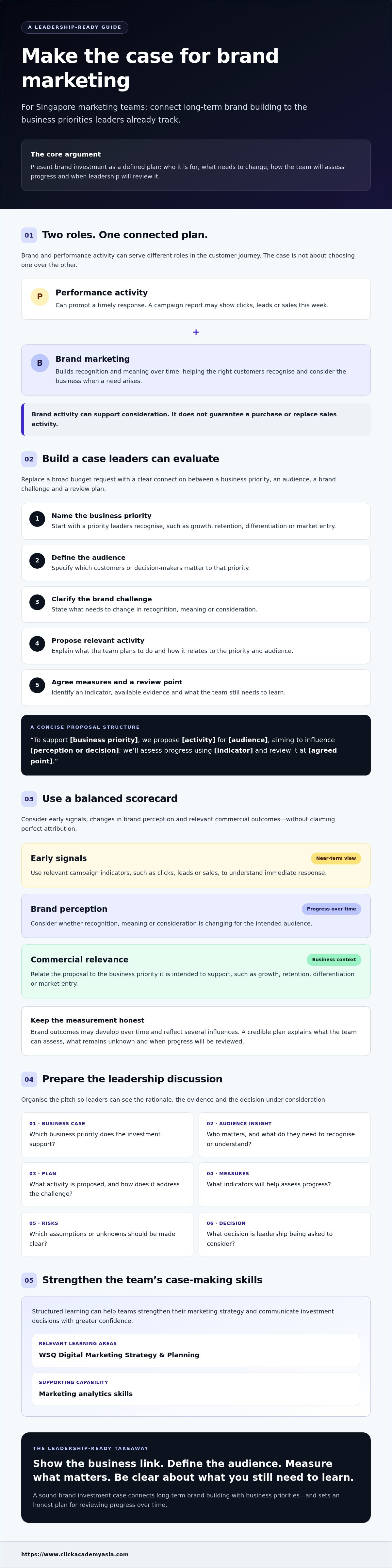
A strong proposal makes the decision visible: which business priority the investment supports, whose behaviour or perception needs to shift, what the team will do, and how leaders will review progress. This structure helps with convincing leadership to invest in brand marketing because it replaces a broad budget request with a specific, evidence-aware plan.
Connect brand objectives to business priorities
Start with a priority leadership already recognises, such as growth, retention, differentiation or market entry. Then identify the audience and the brand challenge behind it. If differentiation is the priority, for example, the activity might help a defined audience understand what makes the organisation distinct when comparing options.
Summarise the logic in one sentence: “To support [business priority], we propose [activity] for [audience], aiming to influence [specific perception or decision]; we’ll assess progress using [indicator] and review it at [agreed point].” This makes the link between brand objective and business priority explicit without claiming the activity alone will deliver a commercial result.
Make the proposal specific, staged and reviewable
Replace “we need a brand budget” with a defined activity, audience and intended change. For instance, propose using a consistent message across selected customer touchpoints to clarify a particular product advantage for a chosen audience. Specify the people, channels, data access and cross-functional input needed, but do not assume those resources are available until the relevant teams have confirmed them.
Separate what the team knows from what it expects. Label customer research, past campaign results and existing brand measures as documented evidence; mark interpretations as assumptions; and list missing baseline data as unknowns. This builds credibility and shows leadership what the investment could help the team learn.
Agree on review points in advance. They might follow completion of a key activity or collection of audience feedback, rather than rely on an arbitrary timeline. At each review, decide whether to continue, adjust the activity or gather more evidence.
Adapt the indicators to your objective and available data, and treat them as signals rather than proof of sole causation. For a more structured planning approach, explore WSQ Digital Marketing Strategy & Planning training as a professional learning option for teams developing stronger investment proposals.
Address the measurement objection with a balanced brand marketing scorecard
“How will we know it’s working?” is a fair leadership question. Brand effects can be assessed without claiming that one campaign caused every change. A balanced scorecard pairs early signals with audience perceptions and relevant commercial outcomes, making progress visible while keeping attribution limits clear.
Choose indicators that match the intended brand outcome
Start with the objective, then choose measures that reflect it. If the goal is stronger recognition, track awareness among the intended audience. If it is clearer differentiation, assess relevant brand associations. Consideration and share of voice may also be useful when suitable data is available. Exposure and engagement show whether people encountered or interacted with activity, but do not by themselves prove a change in preference or business performance.
No single metric proves brand impact on its own, so assess a relevant set of signals against a consistent baseline and the decision timeframe.
Choose measures that fit the objective and data you can reliably collect. Set the baseline before activity begins where possible, define how each indicator will be assessed, and agree when leadership will review it. Do not compare a short-term exposure measure with a longer-term perception objective as though they answer the same question.
Explain attribution limits without dismissing performance data
A customer may encounter a brand through several channels before making a decision. Market conditions, pricing or other activity may also influence the outcome. That makes one-to-one attribution difficult, but it does not make performance data irrelevant. Pair brand indicators with suitable campaign and commercial measures, then describe the relationship as evidence to interpret rather than proof of sole cause.
For example, if an awareness measure improves while qualified enquiries remain unchanged, investigate whether the message, audience or next step needs adjustment. Keep the measurement method consistent across reviews and report what changed, what did not, and what remains uncertain. This balanced approach supports convincing leadership to invest in brand marketing without promising guaranteed returns.
Teams looking to strengthen their measurement practice can explore marketing analytics training, including learning relevant to GA4.
Prepare and deliver your leadership pitch in five practical steps
A persuasive pitch does not need a long deck. It needs a clear business case, answers to likely concerns and a specific decision for leadership to make. Use these five steps to move from preparation to a practical next action.
Prepare the evidence. Gather the business priority, audience insight, available baseline and relevant campaign or customer data. Separate verified evidence from assumptions, and identify gaps rather than filling them with unsupported claims. If a market source is important to your case, use a current, credible source and explain how it relates to your audience and objective.
Frame the proposal around the decision. Open with the organisational priority and what you are asking leaders to approve. Avoid starting with a catalogue of channels or creative ideas. Explain how the proposed activity is intended to influence a particular audience perception or decision that supports the priority.
Show the logic in one visual. Use a simple flow or diagram to connect audience insight to the brand challenge, proposed activity and evaluation approach. Keep the main presentation focused on the business case, audience insight, plan, measures, risks and decision. Have supporting research, assumptions and measurement detail ready for questions instead of crowding the slides.
Address objections with practical options. If leaders question measurement, show the indicators you will track and explain what they can and cannot establish. For budget concerns, clarify the scope, resource requirements, trade-offs, dependencies and review points. If urgency is raised, explain what relying only on short-term campaign measures may leave unaddressed, without dismissing performance activity.
Make a clear request. Ask for a defined decision, such as approval to proceed with the proposed activity, agreement on measures or permission to develop a staged approach. A small pilot may suit the organisation when it can test a clear assumption with manageable scope and useful learning. It is not automatically the right option; explain why it fits the circumstances and what would inform the next decision.
Close by confirming who owns the next steps, what support is needed from other teams and when progress will be reviewed. This makes the pitch actionable, whether leaders approve the full proposal, request changes or agree to gather more evidence first.
Building these proposals is a practical skill. Explore WSQ Digital Marketing Strategy & Planning training to help your team strengthen strategic planning and communicate marketing decisions with greater clarity.
Strengthen Singapore brand marketing decisions through practical team skills
A stronger business case depends on more than a well-designed deck. Teams need the practical skills to connect organisational priorities with audience insight, choose useful measures and explain what the evidence can and cannot show. Building those capabilities can make brand investment proposals clearer and help marketing teams respond to leadership questions with confidence.
Identify the capability gaps behind the investment challenge
Start by reviewing the work your team needs to deliver, then identify where it gets stuck. Is the gap in strategic planning, audience insight, measurement or presenting recommendations to senior stakeholders? Pinpointing the issue helps you choose learning that supports a real business task, rather than training for its own sake.
Planning: Can the team connect marketing activity to organisational priorities?
Audience insight: Can it define whose perceptions or decisions need to change?
Measurement: Can it select indicators, establish a baseline and interpret results carefully?
Communication: Can it explain the recommendation, assumptions and decision needed in clear business language?
Then link the learning need to an upcoming piece of work. For example, a team preparing a brand investment proposal could practise turning a business priority into an audience-focused plan with suitable measures and review points. ClickAcademy Asia offers customised corporate group training, which may suit teams looking to develop shared capabilities around practical work needs.
Make a practical next move with ClickAcademy Asia
For teams looking to strengthen planning, WSQ Digital Marketing Strategy & Planning training is a relevant professional learning option. Where the main gap is interpreting data and communicating performance, WSQ Marketing Analytics & Insights training may be a suitable capability pathway. Consider which task your team needs to improve first, then check current programme details before making a decision.
The WSQ framework and SSG context may also be relevant when reviewing professional development options. Treat funding as something to investigate, not an assumption: confirm current eligibility, terms and programme details with the appropriate sources before planning around any support.
To take a considered next step, list the capability gap, the work task it affects and the learning outcome your team needs. Then review relevant training and confirm any current details that may influence your decision. If stronger planning or measurement skills would help your team make a clearer case, explore ClickAcademy Asia’s WSQ-aligned training options.
Turn your brand investment case into a confident next step
Convincing leadership to invest in brand marketing starts with a clear connection between business priorities, audience needs and the change your activity is intended to support. Build a specific proposal, distinguish evidence from assumptions, and review brand signals alongside relevant commercial outcomes. You do not need to promise perfect attribution; explain what you will measure, what it can show and when you will revisit the decision.
Stronger planning and analytics skills can help your team make that case with greater clarity. ClickAcademy Asia offers WSQ Digital Marketing Strategy & Planning and WSQ Marketing Analytics & Insights training, as well as customised corporate group training. Check current eligibility and terms before making plans around SSG funding.
Explore ClickAcademy Asia’s professional marketing training and consider how its WSQ-aligned courses could help your team build practical skills. Confirm current funding eligibility and terms, then choose learning that fits your organisation’s needs.
Frequently Asked Questions
How do you convince leadership to invest in brand marketing?
Connect the proposed activity to a business priority leaders already recognise, such as growth, retention or differentiation. Define the audience, the perception or decision you want to influence, and how you will review progress. Use available evidence, label assumptions clearly and identify what you still need to learn. A focused proposal gives leadership a concrete decision to consider without promising that brand activity alone will deliver a particular commercial result.
How can you measure the ROI of brand marketing?
Assess brand marketing ROI using a combination of relevant brand indicators and commercial outcomes, rather than relying on a single attribution model. Establish a baseline, track measures that fit the objective, and review them consistently over an agreed period. Compare signals such as awareness or consideration with outcomes such as qualified enquiries, where suitable data is available. Treat observed relationships as evidence to interpret, not proof that one campaign caused every result.
What metrics should leaders use to evaluate brand marketing?
Choose metrics according to the intended outcome, available data and decision timeframe. Awareness, consideration, brand associations and share of voice can help assess brand perceptions where reliable data exists. Reach and engagement indicate exposure or response, while qualified enquiries or conversions provide a view of relevant commercial activity. Keep these categories distinct: exposure is not the same as a shift in perception, and neither measure alone proves business impact.
How do you justify brand marketing when leadership wants short-term results?
Show how brand activity can complement performance marketing rather than replace it. Present the immediate campaign measures leaders expect alongside the longer-term brand objective and indicators that can be reviewed over time. Be clear about the trade-offs, what the team will learn and when you will revisit the decision. If it suits the organisation, propose a defined, staged activity to test an assumption, but do not promise guaranteed returns.
What should a brand marketing business case include?
A useful business case sets out the organisational priority, target audience, brand challenge, proposed activity, measures and review plan. Include the evidence behind the recommendation, and label assumptions and unknowns honestly. Specify the resources and cross-functional support required, along with risks and dependencies. End with a clear decision request, such as approval to proceed, agreement on evaluation measures or permission to gather evidence before committing to a wider plan.
How can marketing teams in Singapore build a stronger case for brand investment?
Singapore marketing teams can strengthen proposals by grounding them in their organisation’s priorities and the evidence they can access, rather than relying on generic market claims. Set a baseline, connect audience insight to the proposed activity, and agree on indicators and review points with leadership. Teams can also consider whether WSQ learning would build relevant planning or measurement capabilities. Check current SSG funding terms and eligibility directly before factoring any support into plans.
Can staff training help secure leadership support for brand marketing?
Yes. Practical training can help a team develop the planning, analytics and communication skills needed to make clearer investment proposals. Match learning to a specific work task, such as building a strategy or selecting measures, so its relevance is clear. ClickAcademy Asia offers WSQ Digital Marketing Strategy & Planning and WSQ Marketing Analytics & Insights training, as well as customised corporate group training. Training can strengthen the case, but it cannot guarantee leadership approval.



Comments