
Product launch marketing plan for your target audience

The same launch playbook won’t fit every product. A useful product launch marketing plan template gives you a clear structure for positioning, target buyers, timelines, messaging, channels, team responsibilities, success metrics and post-launch follow-up, while leaving room to adapt the details to your product and market.
It’s easy to focus on launch-day promotion, but decisions made beforehand shape whether your message reaches the right people and your team can act on the results. A launch plan brings these decisions together, from defining success to assigning owners and setting channel-readiness dates.
In this guide, you’ll learn how to set launch objectives, identify target buyers, choose channels and track performance. You’ll also see how to adjust the plan for different scenarios, including B2B and B2C launches, so you can build a practical approach around your audience, sales cycle and product needs.
Table of Contents
What's a product launch plan?
A product launch plan coordinates positioning, product development, marketing, publicity and delivery. A product launch marketing plan template turns those decisions into assigned tasks, milestones and measures of progress.
Launch Strategy and Positioning
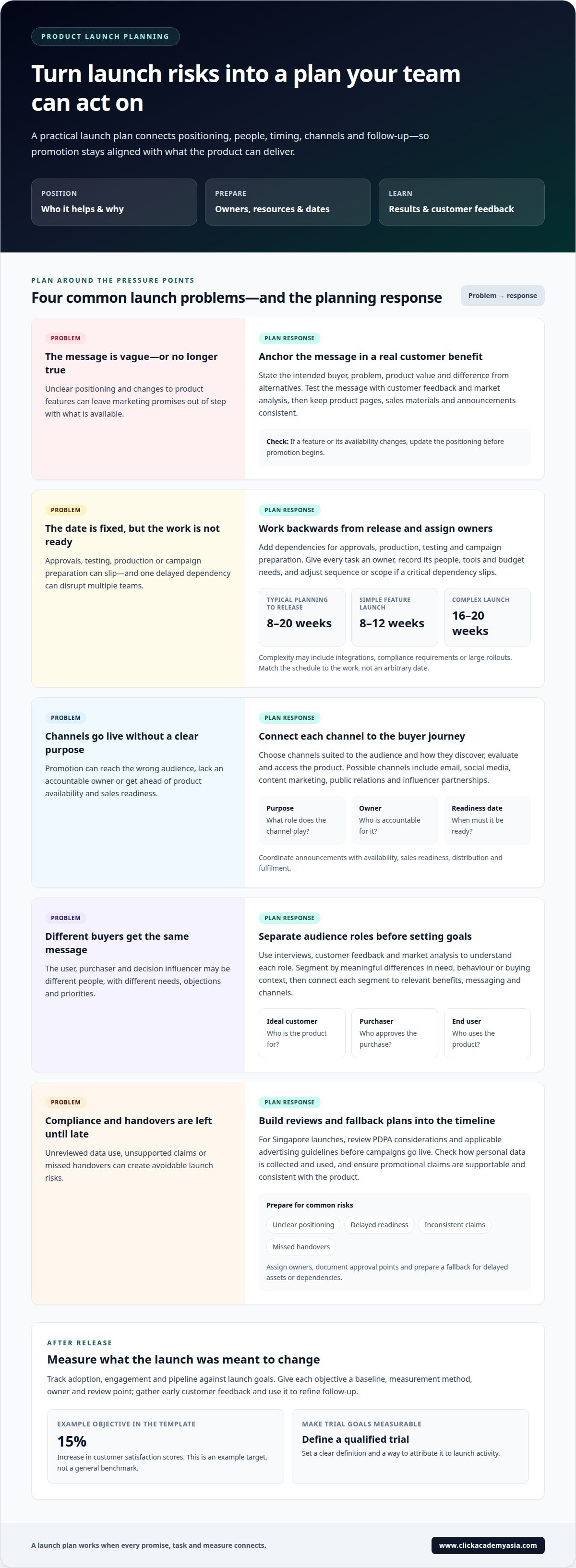
Start with the product’s strongest customer benefit and the need it addresses. Then write a positioning statement that identifies the intended buyer, the problem, the product’s value and how it differs from alternatives. Use customer feedback and market analysis to test whether the message is credible. For example, a software launch might position a new feature around reducing a specific workflow bottleneck.
Keep the main points consistent across the product page, sales materials and launch announcements. If product development changes a feature or its availability, update the positioning before promotion begins. This keeps marketing promises aligned with what the product actually delivers.
Timelines and Resource Planning
Build the timeline backwards from the planned release, then add dependencies for approvals, production, testing and campaign preparation. A typical product launch takes 8 to 20 weeks from initial planning to market release. Simple feature launches might take 8-12 weeks, while complex launches with integrations, compliance requirements or large rollouts often need 16-20 weeks.
Match the schedule to the work, not an arbitrary launch date. Assign an owner to every task, including copy approval, product readiness and customer support preparation. Record the people, tools and budget each activity needs, then review progress regularly. If a critical dependency slips, adjust the sequence or launch scope before teams commit to conflicting dates.
Go-to-Market and Publicity Planning
Turn positioning into a go-to-market plan that explains how buyers will discover, evaluate and access the product. Select channels suited to the audience and buying journey, such as email, social media, content marketing, public relations or influencer partnerships. Give each channel a clear purpose, an accountable owner and a readiness date.
Coordinate publicity with product availability and sales readiness. Prepare the core message, supporting proof points, product information and answers to likely customer questions. A launch announcement should lead to a useful next step, such as a product demonstration or sign-up page. Track dependencies between communications, distribution and fulfilment so promotion does not outpace delivery.
Marketing Rules and Risk Mitigation
For Singapore launches, review PDPA considerations and applicable advertising guidelines before campaigns go live. Check how personal data is collected and used, and ensure promotional claims are supportable and consistent with the product. Build these reviews into the timeline rather than treating them as last-minute approvals.
Common risks include unclear positioning, delayed product readiness, inconsistent claims and missed handovers. Reduce them by assigning an owner to each task, documenting approval points and preparing a fallback plan for delayed assets or launch dependencies. Gather early customer feedback after release, then use it to address confusion and refine follow-up communications.
Target buyers, audience, and launch objectives
Define the audience before choosing launch goals or writing campaign messaging. A clear target helps teams connect product benefits with the people most likely to value them.
Audience Research and Personas
Start by distinguishing the ideal customer, purchaser and end user. They may be different people: a team member might use business software while a department head approves its purchase. Record each person’s needs, priorities, objections and role in the decision. This gives product, sales and marketing teams a shared planning reference.
Use interviews, customer feedback and existing market analysis to test assumptions. Note the problems people describe in their own words, then link those points to relevant product benefits. A persona should guide decisions, not become a fictional biography. Update it when product development or customer feedback reveals a different need.
To align your sales organization with these buyer profiles, consider incorporating insights from ClickAcademy Asia Sales Training into your preparation.
Audience Segmentation
Divide the target audience by meaningful differences in need, behaviour or buying context. For example, a productivity tool might serve small teams seeking simpler workflows and larger organisations needing central oversight. These groups may value the same product for different reasons, so one message may not persuade both.
For each segment, capture its main problem, desired outcome, purchase influence and preferred way to learn about solutions. Then prioritise segments according to strategic fit and the product’s ability to meet their needs. A useful product launch marketing plan template lets teams record these differences and connect each segment to suitable channels and messaging.
To ensure your messaging reaches these segmented groups effectively, leverage strategies covered in ClickAcademy Asia Digital Advertising courses.
Launch Goals and Messaging
Turn audience insight into objectives that describe a measurable result. The template gives an example of targeting a 15% increase in customer satisfaction scores. Other objectives can focus on awareness, trials, adoption or sales pipeline, provided the team defines the measure and connects it to the launch’s purpose.
Give each objective a baseline, measurement method, owner and review point. For example, a trial-generation objective needs a clear definition of a qualified trial and a way to attribute it to launch activity. Avoid mixing activity counts, such as posts published, with outcomes, such as product adoption. Activities show what the team did; outcome measures show what changed.
Build messaging around the audience’s problem, the product’s benefit and evidence supporting the claim. Adapt the emphasis by segment while keeping the core positioning consistent. If one group values speed and another values control, lead with the relevant benefit for each. Teams seeking to strengthen campaign planning can explore ClickAcademy Asia Content Marketing Strategy.
Launch metrics and performance tracking
Choose measures that connect launch activity to the goals set during planning. A clear reporting rhythm helps stakeholders spot progress, gaps and next actions.
Launch Success Metrics and KPIs
Track adoption, engagement and pipeline generated, then compare each result with its planned goal. Adoption shows whether customers are starting to use the product. Engagement indicates how they interact with it. Pipeline captures potential sales opportunities linked to launch activity. These metrics reveal different aspects of performance, so don’t treat one as a substitute for the others.
For a 90-day view, work backwards from go-to-market goals while considering sales cycles and target types. A short sales cycle may show early movement in purchases, while a longer one may need pipeline progress as an interim signal. Choose indicators that match the audience and buying process. This keeps reporting useful instead of rewarding activity that doesn’t advance the launch objective.
Give every KPI a definition, data source, owner and review cadence. For example, specify what counts as an engaged user and which channels receive attribution. Set out how stakeholders will receive updates, who interprets changes and who can approve adjustments. Consistent communication helps teams respond to performance instead of debating what each metric means.
Use a simple dashboard or shared report to monitor results alongside planned targets. Add context to performance changes, such as a channel adjustment or shift in audience response. This makes it easier to identify a useful next step, whether to refine messaging, review the customer journey or focus resources on a stronger channel.
ROI Measurement
Estimate product launch return on investment within the first 12 months after launch. Start by defining which outcomes count toward the return, then compare them with the resources attributed to launch activity. Keep the calculation consistent with the objective: a pipeline goal and an adoption goal require different evidence of value.
Separate direct results from supporting indicators. Sales generated can show commercial return, while engagement and adoption help explain customer response. For a product with a longer sales cycle, early pipeline movement may inform the review before revenue is fully realised. Make the reporting period and attribution approach clear so stakeholders interpret results consistently.
Review performance across channels, not just in aggregate. If a channel generates engagement but little pipeline, examine how its audience moves through the buying journey. If results fall short, identify whether the gap is in reach, response or conversion before reallocating effort. Teams strengthening the connection between launch activity and sales outcomes can build relevant skills through [Internal Link: ClickAcademy Asia Sales Training].
Distribution channels and launch activities
Choose channels based on where the target audience discovers and evaluates products. A launch calendar then connects each channel to a specific activity, owner, readiness date and measure.
Channel Planning and Launch Calendar
Map the launch sequence from early awareness through release and follow-up. For example, a new software feature might be introduced through a product update email, demonstration video, social posts and an announcement on the company blog. Each activity should reinforce the same product benefit while giving the audience a clear next step.
Use a shared calendar to outline dependencies and deadlines. A blog article may need product screenshots before publication; an email campaign may depend on an approved landing page. Record the person responsible, required assets, review status and planned distribution date. This makes blocked work visible before it affects other channels.
Assign a readiness date to every channel and launch activity, not just the release itself. Include an owner for final checks and a measure suited to the activity, such as landing-page visits or email responses. Coordinate paid, owned and earned activity so customers encounter consistent information rather than disconnected announcements.
Advertising Channels and Costs
Consider paid search, social advertising and display placements alongside owned channels such as email and product pages. Select channels based on audience intent, campaign objective, creative requirements and the team’s ability to manage them. For instance, search advertising can support active product research, while social content can introduce a product to a defined audience.
Build a budget by listing the cost categories for each activity: media spend, creative production, landing-page work and campaign tools. Costs depend on channel selection, audience reach, campaign duration and asset complexity. Record assumptions separately from approved spending, then assign an owner to monitor actual costs and flag changes.
A multi-channel plan should give each channel a distinct role. Email can reach existing subscribers, a product page can explain features, and social posts can extend awareness. Keep the messaging consistent, but tailor the format and call to action to each channel. Avoid duplicating the same asset everywhere without adapting it to the audience’s context.
Measure channel performance against the launch objective, not activity volume alone. Compare clicks, enquiries or conversions with each channel’s assigned role, then adjust the plan when results show a mismatch. Teams building practical capability in [Internal Link: ClickAcademy Asia Digital Advertising] can strengthen how they plan, coordinate and evaluate campaign activity.
Launch templates for different product scenarios
A reusable template provides structure, but the release scenario determines what needs extra attention. Adapt the objectives, activities, owners and review points to the product and its route to market.
B2B Launches: Plan for Buying Processes
A B2B launch plan should reflect longer sales cycles, pilot programmes and enterprise security reviews. These steps influence when prospects can evaluate a product and when sales teams can move opportunities forward. Add each review or pilot milestone to the plan, with an owner and a clear handover between marketing, product and sales.
For example, a new business platform might need a pilot before broader promotion. Define what the pilot is intended to assess, who provides feedback and how the findings will affect the release. Map supporting activities, such as sales enablement and product information, to the stages buyers must complete. This connects launch communications to the actual purchasing process.
B2C Launches: Prepare for Reach and Support
A B2C plan focuses on mass-market messaging, app store requirements and the ability to scale consumer support. The template should show how product benefits will be communicated to a broad audience, while keeping descriptions consistent across campaign assets and the product listing.
Plan support readiness alongside promotion. For example, a consumer app launch may generate questions about setup, access or key features. Prepare customer-facing information and assign responsibility for incoming enquiries. Include app store submission requirements as a dependency so release communications align with product availability rather than an assumed date.
Feature Releases and Shared Planning
A feature update can use the same core plan, but its activities should match the scale of the change. A minor feature update might take a few weeks to plan for launch. Focus on the users affected, the benefit they will notice and the channels that can explain the change clearly. A wider product release may need more extensive coordination.
Keep shared template fields for positioning, audience, objectives, owners, channels and performance measures. Then add scenario-specific prompts rather than duplicating the entire plan. For B2B, include pilot and security-review milestones. For B2C, include app store readiness and consumer support. This keeps the framework familiar while making key differences visible.
Before approving the release plan, check that every scenario-specific activity has an owner and a decision point. Use pilot feedback to refine a B2B rollout, or support enquiries to improve B2C guidance. To build practical capability in planning campaigns across product scenarios, explore digital marketing strategy training.
ClickAcademy Asia: WSQ Digital Marketing Strategy & Planning
ClickAcademy Asia helps professionals build the strategic marketing skills needed to plan and support product launches. Turn to its WSQ Digital Marketing Strategy & Planning course when your team needs to connect audience insight, objectives, channel choices and performance measurement in a coherent plan.
For focused capability building, WSQ Content Marketing Strategy can support the planning of useful launch content, while WSQ Search Engine Marketing (SEM) can strengthen understanding of paid search. These courses suit marketers and business leaders who want to apply structured thinking to launch decisions and improve coordination across campaign activities.
Ready to develop your team’s launch planning skills? Contact ClickAcademy Asia.
Turn your launch plan into a team capability
A launch plan becomes more valuable when the people responsible can turn its decisions into coordinated marketing activity. Treat your product launch marketing plan template as a working document: revisit it as customer responses emerge and use each review to build stronger planning habits across your team.
ClickAcademy Asia offers WSQ Digital Marketing Strategy & Planning for professionals strengthening their strategic approach. Teams can also develop focused capabilities through WSQ Content Marketing Strategy and WSQ Search Engine Optimisation (SEO). These learning pathways help marketers connect strategy with the skills needed to support product launches and future campaigns.
Choose the capability your team needs to develop next, then put it into practice on an upcoming launch. Equip your team with launch-planning skills through WSQ-funded training tracks. Discuss your team's launch planning needs with ClickAcademy Asia and take a confident step towards more capable, coordinated marketing.
Frequently Asked Questions
Is this template free?
A template isn’t automatically free. Some can be downloaded after you submit contact details, and that requirement alone doesn’t establish whether a fee applies. Before using one, review its access terms and check whether you can edit and share it with your team. Also consider the file format: a spreadsheet may suit task tracking, while a document can work better for approvals and messaging.
What should a product launch marketing plan template include?
A product launch marketing plan template should provide space for the product and company names, market analysis, audience details, positioning and key messages. Include a competitor analysis that captures other companies’ strengths and weaknesses, then note how the product compares. The template can prompt both a concise positioning statement of 25 words and a detailed version of 100 words or less, giving teams options for different uses.
What are the key stages and timeline for a product launch marketing plan?
Organise the work around readiness gates: product approval, campaign approval, release and post-release review. For each gate, record what must be complete before work moves forward. For example, a campaign announcement should wait until product information and customer support materials are ready. This sequencing gives teams a practical way to manage dependencies and respond if a release date or asset changes.
How do you define target audiences and positioning for a product launch?
Separate the person who uses the product from the person who chooses or pays for it, since their priorities may differ. Gather customer language about the problem, then compare it with the product’s actual benefits and competitor strengths. Draft a short positioning statement for presentations and a longer version for detailed materials. Check that both describe the same value, even when they address different audiences.
How to set SMART goals and KPIs for a product launch?
Make each objective specific, measurable, achievable, relevant and time-bound. Define the intended outcome, the audience or product activity it concerns, and the assessment period. Then choose a KPI that directly reflects that outcome, along with a data source and accountable owner. Keep activity measures, such as content published, separate from results, such as qualified enquiries, so reporting shows more than campaign output.
Which marketing channels work best for a product launch?
The best channel depends on how the intended audience discovers and evaluates the product. A specialised B2B tool may benefit from expert-led demonstrations and targeted industry content; a consumer app may need a clear app listing and easy-to-share creative. Select channels the team can support consistently, then tailor each format to its audience’s context. A channel is useful when it helps people take a relevant next step.
How should a product launch marketing budget be allocated?
Allocate spending according to the launch objective, audience reach and work each channel requires. Separate media placement from creative production, landing-page development and campaign tools so each cost has a clear purpose. Keep planned spending distinct from actual expenditure, and identify which activities can be adjusted if performance changes. Avoid splitting funds evenly by default; prioritise the activities most closely connected to the launch’s intended outcome.
What are the steps to create a product launch content and campaign calendar?
Start with the release date and map the audience’s journey from first awareness to action. Match each stage with a suitable asset, such as an explainer, product demonstration or launch announcement. Add the approval deadline, publication date, channel, call to action and person responsible. Finally, note which result each asset should support. This calendar structure helps teams spot gaps, such as a launch message without a useful destination.



Comments