
Ethical AI in Marketing Personalization: Protecting Data and Trust

What if the most relevant offer is also the one that makes a customer wonder how you knew so much? That tension lies at the heart of the ethical considerations of AI in marketing personalisation: tailored experiences can be useful, but they can feel intrusive when data use is unexpected or difficult to understand.
It’s reasonable to question whether sensitive data should ever shape a personalised campaign. The answer isn’t simply yes or no: teams need to weigh the purpose, customer expectations, consent and safeguards around the data. In Singapore, building trust means treating privacy and transparency as part of the customer experience, not as an afterthought.
This article explains how to assess sensitive data use, make consent and AI-driven decisions clearer, and reduce risks such as unfair targeting or manipulation. It also offers practical prompts to help your team start a constructive conversation and shape personalisation around customer trust.
Table of Contents
Data privacy and security in AI-driven marketing
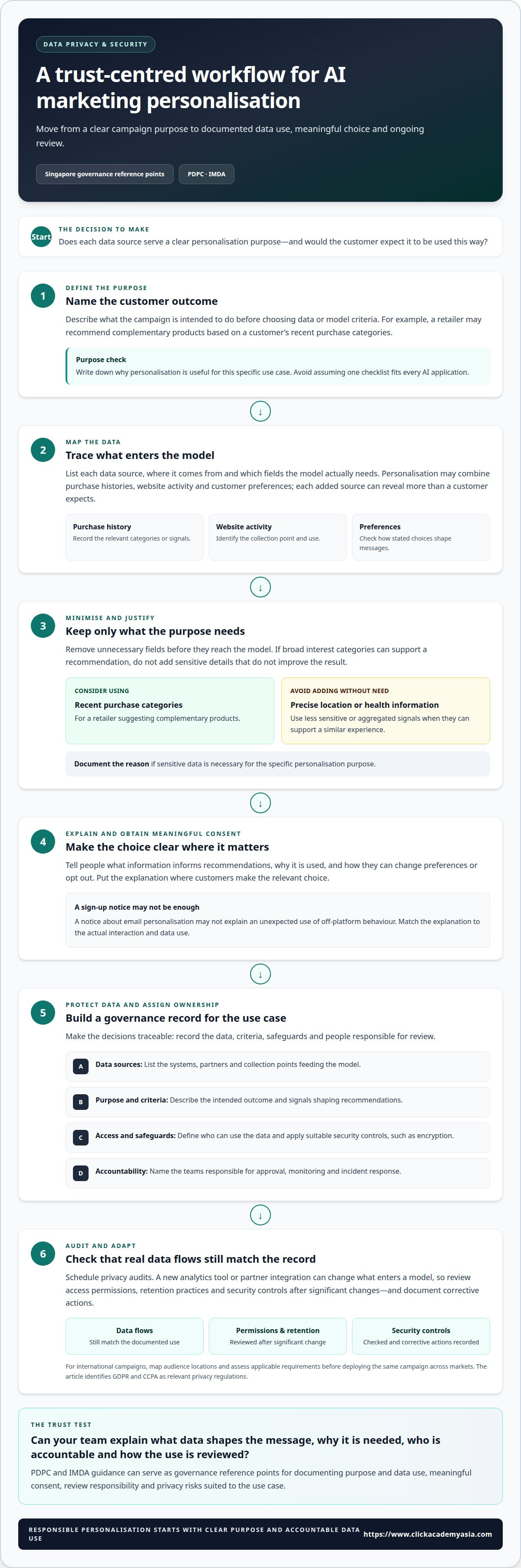
In Singapore, use guidance from the Personal Data Protection Commission (PDPC) and Infocomm Media Development Authority (IMDA) as governance reference points. For a campaign recommending products based on browsing behaviour, document the purpose, explain how data is used, make consent meaningful and assign responsibility for review. These practices help teams assess privacy risks without assuming one checklist suits every AI use case.
AI-driven personalisation can combine purchase histories, website activity and customer preferences to select a message. Each additional source can reveal more than a customer expects. Before launch, map the data streams, record where each source comes from and identify which fields the model actually needs. If broad interest categories are enough to make a product recommendation, avoid adding sensitive details that do not improve the result.
Data minimisation starts with a clear purpose. For example, a retailer suggesting complementary products may need recent purchase categories, but not a customer’s precise location or health information. Remove unnecessary fields before they reach the model. Use aggregated or less sensitive signals when they can support a similar customer experience, and document why sensitive data is necessary.
Consent and transparency should fit the customer’s interaction. A sign-up notice explaining email personalisation may not clarify an unexpected use of off-platform behaviour. Tell people what information informs recommendations, why it is used, and how they can change their preferences or opt out. Make that explanation accessible where customers make the relevant choice.
Build a practical governance record for each personalisation use case. Include:
Data sources: list the systems, partners and collection points feeding the model.
Purpose and criteria: describe the intended outcome and the signals that shape recommendations.
Access and safeguards: define who can use the data and apply suitable security controls, such as encryption.
Accountability: name the teams responsible for approval, monitoring and incident response.
Schedule privacy audits to check whether actual data flows still match that record. A new analytics tool or partner integration can change the information entering a model. After significant changes, review access permissions, retention practices and security controls, then document corrective actions. These checks make data governance an active process, not a policy that is filed away and forgotten.
International campaigns also need jurisdictional awareness. The General Data Protection Regulation (GDPR), according to the European Union, is a privacy regulation relevant to personal information used for AI personalisation. The California Consumer Privacy Act (CCPA) is another named regulation relevant to data governance. Map where audiences are located and assess applicable requirements before deploying the same campaign across markets.
Strong data security protects more than campaign performance. A breach or misuse can harm customers and weaken trust in the brand. Combine data minimisation, clear consent, documented ownership and regular audits, then adjust personalisation as customer expectations or data flows change. For teams building intelligent systems that retain customer interactions, tools like NovaCortex provide a self-hosted, privacy-first memory layer to ensure sensitive context remains firmly under internal control. This gives Singapore teams a practical foundation for responsible AI use.
PDPC and IMDA guidelines provide governance reference points for AI marketing. They support documenting each use case’s purpose and data use, obtaining meaningful consent, assigning review responsibility and assessing privacy risks in ways suited to the specific use case.
Q: How can marketers start the conversation about ethical AI?
Start with a specific campaign, such as an algorithm selecting audiences for a product promotion. Audit its outcomes for fairness, accuracy and accountability, then ask who might be disadvantaged and why.
Bias and Exclusion in Targeted Marketing
Bias in targeted marketing occurs when data or model rules produce systematically different experiences for particular groups. A campaign might show premium offers more often to customers whose past purchases resemble those of a profitable segment, while excluding others with similar needs.
That pattern matters because historical data can reflect earlier business decisions, not genuine customer preferences. Proxy variables, such as browsing patterns or location signals, can reproduce those patterns even without explicitly using sensitive attributes. The result may be fewer opportunities, less favourable offers or extra friction for some audiences, damaging trust and brand reputation.
Open the team conversation with a concrete question: who might not see this campaign, and what signals could explain that gap? Ask marketing, data science and product colleagues to examine the audience definition together. Also consider whether targeting could exploit vulnerability, such as directing gambling promotions towards people showing signs of financial stress.
Fairness Audits and Mitigation
A fairness audit tests whether an AI system distributes messages, offers or access unevenly across relevant customer groups. It matters because strong overall engagement can conceal poor outcomes for a particular segment.
Compare exposure, offer quality, eligibility and response friction across groups, rather than relying only on clicks or conversions. Check whether differences come from the model, its training data or campaign rules. Test accuracy against actual campaign outcomes, and review whether audience labels reflect the intended customer need.
Make accountability visible. Record the model version, campaign objective, groups assessed, reviewer and action taken. Ask a human reviewer to inspect unusual results and customer complaints, then document whether the team changed the audience, creative or model. Repeat the assessment after significant changes to targeting or data inputs.
Useful discussion prompts include:
Fairness: Which customer groups receive fewer or less relevant experiences?
Accuracy: Do model assumptions match observed campaign outcomes?
Accountability: Who can pause a campaign when testing reveals harm?
Mitigation: Could revised features, broader exploration or a human review reduce the disparity?
Use customer feedback alongside performance data. A high conversion rate doesn’t establish that a campaign feels fair or respectful. Invite feedback on confusing or exclusionary experiences, and assign a named team to assess it. Teams building these capabilities can strengthen planning through professional ClickAcademy Asia Sales/Marketing courses as part of their learning.
Why Can AI-Driven Personalisation Feel Unethical?
Personalised marketing feels manipulative when AI uses information or pressure to steer choices without respecting consumer autonomy. This matters in recommendations, targeted advertising and automated pricing.
Manipulative Targeting and Dark Patterns
Manipulative targeting uses personal signals to pressure people or exploit vulnerabilities, while dark patterns make choices harder to understand or refuse. For example, an app might use repeated pop-ups to push a purchase or target someone’s financial stress with an urgent loan promotion.
Research published in 2025 examined deceptive pop-up patterns in the mobile ecosystem. For marketers, the practical test is whether a customer can pause, decline or leave without facing artificial obstacles. AI models shouldn’t intensify pressure simply because a customer’s behaviour suggests they’re more likely to respond.
Consumer Autonomy
Consumer autonomy is a person’s ability to make a choice without hidden pressure or misleading constraints. Personalised messages can weaken it when they conceal why an offer appears or make alternatives difficult to find.
Consider an online subscription that repeatedly highlights a limited-time renewal offer while obscuring cancellation options. The customer may act quickly without understanding the available choices. Responsible oversight should examine the full experience, including what the model displays, what it hides and how easily people can change course.
Persuasion Versus Manipulation
Persuasion presents relevant information and leaves the customer in control; manipulation uses hidden pressure or vulnerability to steer a decision. A recommendation based on a stated product preference can be useful, while exploiting health fears to sell an unsuitable product crosses an ethical line.
That difference matters for long-term trust. A campaign can prompt an immediate response yet leave customers feeling deceived afterwards. Review the message, timing and decision path together, rather than judging success by conversions alone.
Dynamic pricing raises similar concerns when automated decisions are opaque. If customers receive different prices or eligibility outcomes without a clear explanation, they may not understand what shaped the result or how to respond. The risk is not personalisation alone, but a decision that affects a customer while remaining difficult to question.
Before launch, teams can discuss these prompts:
Purpose: Does the personalisation help customers decide, or primarily pressure them to act?
Choice: Can people decline, adjust preferences or access alternatives easily?
Oversight: Who reviews high-impact messages, pricing and edge cases?
Outcomes: Do feedback and complaints reveal experiences that campaign metrics miss?
Use these questions in campaign reviews, then revise tactics that rely on excessive urgency or hidden constraints. Teams can develop [Internal Link: ClickAcademy Asia Sales/Marketing courses] as part of building practical marketing strategy skills.
Transparency about data use and consent
For Singapore campaigns, teams should assess personal-data use against the Personal Data Protection Act (PDPA). Explain the purpose, obtain consent where required, and make preference changes or opt-outs straightforward.
AI adds a practical challenge: customers may not see how their information shapes a message. Clear explanations help them understand the process and raise concerns when an experience feels unexpected.
Transparency in Data Use
Transparency in data use means explaining what information informs an AI-driven message and why it is used. This matters because a customer may welcome a product suggestion based on a recent purchase but question one based on unseen browsing activity.
For a retail email, explain how purchase categories inform recommendations instead of relying on vague wording such as “personalised for you”. Keep the explanation near the relevant choice, and use plain language to describe how customers can adjust preferences. This makes the data process easier to understand and act on.
Transparency and Consumer Trust
Transparency supports consumer trust when people can connect a message with a clear purpose and a choice they made. For example, a subscriber who selected travel offers should be able to understand why flight recommendations appear in their inbox.
Trust can weaken when an advert appears to use information a customer did not expect to share. A useful governance practice is to review the customer journey from data collection through message delivery. This can reveal gaps between what a notice says, what the AI process does and what the customer experiences.
Make disclosures useful at the point of decision. A marketing team can map each message to its data inputs, purpose, consent route and preference controls. Then test the explanation with colleagues unfamiliar with the campaign: can they tell what shaped the recommendation and how to change it? Record unresolved questions and assign someone to address each one.
For AI-generated content, label it where that helps people understand what they are seeing. Explainability does not require publishing technical model details. It does require a practical account of the main factors behind an outcome, such as why a customer received a particular recommendation or offer.
Build these checks into campaign processes, not just policy documents. Before launch, review the notice, consent journey and opt-out route together. Afterwards, examine customer feedback and complaints for signs that explanations are unclear or controls are difficult to use. Update the wording or experience when those checks reveal a problem.
Purpose: State why the campaign uses personal data.
Choice: Make preferences and opt-outs easy to find.
Accountability: Assign an owner for disclosures and customer concerns.
Review: Compare the explanation with the actual AI-driven process.
Trust-centred personalisation strategies
Trust-centred personalisation starts with a practical test: does the experience respect what customers expect from the brand and channel? A product suggestion in a shopping app may feel useful, while the same message based on unexpected off-platform behaviour can feel intrusive.
Set a clear purpose for each campaign before selecting signals or models. For example, a travel retailer could recommend destinations based on a customer’s stated interests rather than inferred sensitive circumstances. This keeps personalisation aligned with customer preferences and gives teams a reason to reject data or tactics that add little value.
Consider the full customer relationship. A customer who shares preferences for a loyalty programme may expect relevant member offers, but not personalised pressure based on financial stress. Cultural sensitivity also matters in Singapore’s diverse market: language, imagery and assumptions about household or festive practices can affect how an experience is received.
Build accountability into campaign decisions by assigning human oversight to sensitive uses and high-impact outcomes. Review edge cases before launch, and give a named team responsibility for escalations. If a recommendation leads to repeated complaints or an unexpected pattern, pause the relevant feature and investigate its design, inputs and impact on customers.
Trust-centred strategies should shape the recommendation experience, not just the approval process:
Align with expectations: Match data use to the customer relationship, channel and purpose.
Preserve choice: Let customers adjust preferences and explore alternatives to recommended items.
Reduce filter bubbles: Introduce broader recommendations or periodic resets so customers can discover beyond familiar choices.
Educate rather than pressure: Explain renewal options and product benefits without relying on artificial urgency.
Monitor outcomes: Review feedback, complaints and incidents alongside campaign performance.
These practices require ongoing attention. A model that performs acceptably at launch can become less appropriate as customer behaviour, products or expectations change. Review the experience after significant campaign changes, examine feedback from different customer groups, and redesign or reduce personalisation when it no longer serves customers well.
Trust can create lasting business value through stronger customer relationships and reduced legal risk, but it depends on consistent behaviour. Teams can turn these principles into practical campaign decisions by developing their [Internal Link: ClickAcademy Asia Sales/Marketing courses].
ClickAcademy Asia
ClickAcademy Asia helps marketing professionals build the strategic skills to plan campaigns with clearer objectives, audience choices and accountability. If your team is turning ethical AI principles into practical marketing decisions, structured learning can help connect strategy with day-to-day work.
Consider WSQ Digital Marketing Strategy & Planning for a broader view of campaign planning, or WSQ Content Marketing Strategy to strengthen how content serves audience needs. These programmes support professionals and teams who want to make more deliberate decisions about marketing practice and customer experience.
Bring your team’s questions about personalisation, consent and trust into its next learning discussion. Contact ClickAcademy Asia to explore a suitable learning pathway.
Make ethical practice part of your next campaign
The next step is to move ethical judgement from discussion into campaign planning. Add a review point before launch, invite marketing, data and customer-facing colleagues to contribute, and make one person accountable for acting on concerns. This turns trust into a working standard, rather than an aspiration considered only after problems emerge.
For Singapore teams, continuous learning can help build the strategic judgement needed to apply that standard as tools and customer expectations change. ClickAcademy Asia offers WSQ Digital Marketing Strategy & Planning, WSQ Content Marketing Strategy and WSQ Search Engine Optimization (SEO). These programmes can support professionals who want to connect responsible personalisation with stronger everyday marketing decisions.
Keep the ethical considerations of AI in marketing personalisation on the agenda as your team plans its next campaign. Start a practical conversation about the decisions your people need to make, then build the skills to make them with confidence. Contact ClickAcademy Asia to discuss a suitable learning pathway.
Frequently Asked Questions
Is Using Sensitive Data For Personalisation Always Wrong?
No. Sensitive data may have a legitimate use when the purpose is clear, the benefit is meaningful and protections are strong. For example, a health service might use a stated care preference to tailor educational content. A marketer should first consider whether broad interests or aggregated information can achieve the same result. If not, document the reason for using sensitive information and limit its use to that purpose.
Are there any industry-specific considerations when it comes to AI ethics?
Yes. The potential impact of a campaign depends on its product and audience. Healthcare marketing needs particular care around patient information, while financial promotions should avoid exploiting financial stress. Retail recommendations may have lower stakes, but can still create unfair exclusions or intrusive experiences. Singapore teams should assess each use case in context, considering information sensitivity, the customer’s situation and the consequences of an inaccurate recommendation.
What are the biggest ethical implications for marketers?
The main implications include privacy intrusion, unfair treatment, manipulation and reduced customer control. For instance, an automated campaign might repeatedly show a high-pressure offer to someone inferred to be vulnerable. Even if the model meets its conversion target, that outcome can harm customers and the brand’s reputation. Marketers should assess consequences for people, not just performance metrics, and be ready to change a campaign when its effects conflict with its stated purpose.
Why is there a push to define “responsible” AI?
A shared definition helps teams turn broad values into consistent decisions. Without one, a campaign may pass a marketing review while raising concerns for data, product or customer-service colleagues. A practical standard can specify who approves sensitive use cases, which harms require escalation and what evidence supports launch. For example, a team could require a documented purpose and human review before using an inferred vulnerability to shape an offer.
What Is The Role Of Human Oversight?
Human oversight provides judgement when an automated decision could meaningfully affect a customer. A reviewer can examine a recommendation that appears unsuitable, assess a complaint the model cannot interpret and pause a campaign when an unexpected pattern emerges. Make the reviewer’s authority clear: they need relevant context and a defined way to change or stop the experience, not merely responsibility for approving a dashboard.
What are ethical risks in AI-driven personalisation?
The ethical considerations of AI in marketing personalisation include inaccurate inferences, discriminatory outcomes, intrusive targeting and recommendations that narrow discovery. For example, a model trained on past engagement may keep promoting familiar content while overlooking a customer’s new interests. Poorly controlled generated content can also misrepresent a product or person. Test real customer journeys, review sensitive outputs and treat complaints as evidence about the experience.
What are the main ethical concerns of AI-powered marketing personalisation?
The ethical considerations of AI in marketing personalisation also depend on whether campaigns serve customer needs or only immediate business goals. A useful recommendation should remain relevant, understandable and easy to ignore. For example, a renewal message can explain a service’s value without implying customers will lose an opportunity unless they act immediately. Review the intended benefit alongside the pressure, exclusions and likely customer experience.
How does AI personalisation affect consumer privacy and data protection?
AI personalisation can connect information from different interactions to infer interests or predict behaviour, creating a more detailed picture of a person. In Singapore, marketers should assess these uses against the Personal Data Protection Act (PDPA) and their data-governance processes. Map where information comes from, restrict access to what the campaign needs and consider how long it remains useful. These steps help teams identify privacy risks across connected systems.



Comments