
Performing a Digital Marketing Skills Gap Analysis in SINGAPORE: A 2026 Guide for PMEBs
- ClickAcademy Asia

- 1 day ago
- 12 min read
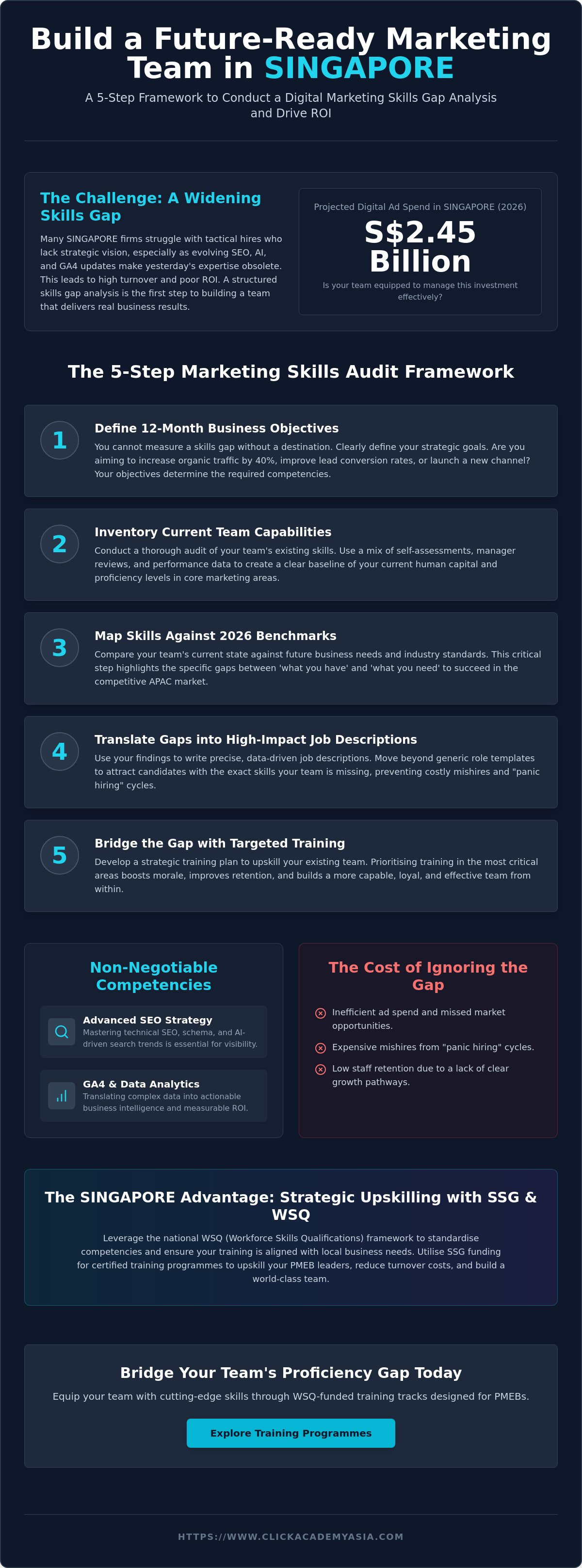
Why is it that digital advertising spend in SINGAPORE is projected to hit S$2.45 billion in 2026, yet many local firms still struggle with high turnover and "tactical" hires who can't think strategically? You’ve likely felt the frustration of finding candidates who master specific tools but fail to drive actual ROI, especially as evolving SEO and AI tools make yesterday’s expertise obsolete. Performing a structured digital marketing skills gap analysis is the first step toward breaking this cycle and building a team that actually delivers.
We understand the pressure of trying to stay ahead of GA4 updates and AI integration while managing a team that feels one step behind. This guide provides a clear roadmap for auditing your team's current capabilities and translating those findings into job descriptions that attract top-tier talent. You'll learn how to identify critical deficiencies and maximise SSG funding to ensure your PMEB leaders are equipped with the strategic depth required to lead in the APAC market.
Table of Contents
Understanding the Digital Marketing Skills Gap Analysis in the SINGAPOREAN Context
A 5-Step Framework to Conduct Your Team's Marketing Skills Audit
Prioritising High-Impact Competencies: From SEO to GA4 Analytics
How to Write a Compelling Marketing Job Description Using Your Audit Data
Bridging the Proficiency Gap with WSQ-Funded Training Programmes
Understanding the Digital Marketing Skills Gap Analysis in the SINGAPOREAN Context
A Gap analysis is essentially the bridge between your current team reality and your future business goals. In the context of a digital marketing skills gap analysis, you're conducting a strategic audit of your human capital against the relentless demands of evolving technology. It's not just a HR tick-box exercise. It's a fundamental assessment of whether your staff can actually execute the strategy you've set for the coming year. For SINGAPOREAN firms, this audit serves as a survival mechanism in a landscape where consumer behaviour shifts overnight.
SINGAPORE faces unique pressure due to its status as a high-density hub for regional APAC headquarters. Local PMEBs aren't just competing with domestic SMEs; they're benchmarked against global standards across diverse markets. This means your team must possess a sophisticated blend of 'soft' strategic leadership and 'hard' technical competencies. While AI might handle basic execution, the ability to synthesise data and lead a cross-channel strategy remains a human-centric requirement. You cannot lead a team effectively if there's a fundamental disconnect between your business objectives and your team's technical mastery of SEO or SEM.
To better understand this concept, watch this helpful video:
Many leaders hesitate to start this process, fearing it's a time-consuming distraction. In reality, a digital marketing skills gap analysis is a high-yield cost-saving measure. It prevents the "panic hiring" cycle that often results in expensive mishires. By identifying exactly where your team lacks proficiency, you can target your recruitment or training budget with surgical precision. This proactive approach ensures you're investing in the right talent rather than just filling seats.
The Cost of Ignoring the Skills Gap in 2026
Mishiring in 2026 based on outdated job descriptions is a significant financial drain. When teams cannot keep pace with GA4 updates or the latest generative AI guidelines from the PDPC, your brand suffers from "digital lag." This lag results in missed opportunities and inefficient ad spend. Moreover, performing a gap analysis actually supports staff retention. PMEBs are more likely to stay with an organisation that shows them a clear, documented path for professional growth and upskilling.
Aligning with the WSQ National Training Framework
SINGAPOREAN businesses have a distinct advantage through the WSQ (Workforce Skills Qualifications) system. This framework acts as a national benchmark for competency, allowing you to standardise skill levels across your entire marketing department. Using these standards simplifies performance reviews and ensures everyone is speaking the same professional language. SSG maintains our national digital competitiveness by ensuring these training tracks remain aligned with the actual needs of the local business ecosystem.
A 5-Step Framework to Conduct Your Team's Marketing Skills Audit
Executing a digital marketing skills gap analysis doesn't have to be an overwhelming administrative burden. To get results that actually impact your bottom line, you need a structured approach that moves beyond guesswork. This 5-step framework is designed for SINGAPOREAN PMEBs who need to align their human capital with the technical demands of 2026.
Define your 12-month business objectives: You can't measure a gap if you don't know where you're going. Are you planning to scale organic traffic by 40% or launch a TikTok shop? Your required competencies will differ based on these specific goals.
Inventory current team capabilities: Use a combination of self-assessment and peer reviews. Ask your team to rate their proficiency in core areas like SEO, content strategy, and GA4 analytics.
Map existing skills against 2026 benchmarks: Compare your team's current state with industry standards. Aligning your findings with SMU research on closing the digital skills gap helps ensure your internal standards match the rigorous expectations of SINGAPORE'S top academic and industry leaders.
Quantify the 'gap': Determine if your deficiency is a lack of people (headcount) or a lack of proficiency (skill level). It's often more cost-effective to upskill a loyal employee than to hire a new one in a tight labour market.
Prioritise gaps based on ROI: Not every skill gap needs immediate attention. Focus on the deficiencies that directly hinder your most important strategic objectives.
Tools for Effective Skill Mapping
Move away from simple 'yes/no' checklists. Instead, utilise competency matrices that define what 'beginner', 'intermediate', and 'expert' levels look like for each role. To test technical depth without causing audit fatigue, consider using micro-assessments or GA4 dummy accounts. These practical tests reveal whether a staff member truly understands data attribution or is merely reciting jargon. If your audit reveals a lack of high-level oversight, exploring WSQ Digital Marketing Strategy & Planning can bridge that strategic divide.
Identifying Strategic vs. Tactical Gaps
A common pitfall for SINGAPOREAN firms is having a team of "button-pushers" who lack a strategic mindset. Your team might excel at tactical execution, like scheduling posts, but fail at digital marketing skills gap analysis because they can't connect those actions to a broader business funnel. This is why the industry prizes "T-shaped" marketers. These professionals possess deep expertise in one area, such as SEO, while maintaining a broad understanding of how Content and Analytics intersect to drive growth. Ensuring your PMEBs have this cross-functional knowledge is vital for long-term digital resilience.
Prioritising High-Impact Competencies: From SEO to GA4 Analytics
Once you've identified your team's deficiencies, you must prioritise which competencies will move the needle for your business. In SINGAPORE'S competitive digital landscape, you can't afford to chase every fleeting trend. Instead, focus on high-impact areas that directly influence your bottom line. Performing a digital marketing skills gap analysis often reveals that while teams are busy, they aren't always effective in the areas that matter most: SEO, analytics, and high-intent content strategy.
SEO remains the cornerstone of organic growth, even as AI search evolution changes user behaviour. Your team doesn't just need to know how to use keywords; they must understand how to build topical authority that AI assistants will recommend. Similarly, technical SEM mastery is vital. While Google Ads relies heavily on automated bidding, a human strategic mind is required to ensure those algorithms don't waste your budget on low-quality traffic. Human oversight is the only way to ensure your paid efforts align with long-term business goals.
The Rise of Data-Driven Strategy
Gut-feeling marketing is obsolete. If your PMEBs aren't comfortable with Marketing Analytics & Insights, they're essentially flying blind. Recent GA4 updates in June 2026, such as the direct integration of Google Business Profile metrics, mean that your team must be able to track local bookings and direction requests within a single interface. Using strategic GA4 training allows your team to bridge data gaps and prove the value of every marketing dollar spent. Look for the ability to turn raw numbers into actionable business insights rather than just reporting on vanity metrics.
Mastering Search and Social Convergence
The definition of search has expanded. SEO now encompasses video search on platforms like TikTok and YouTube, which function as primary search engines for many SINGAPOREAN consumers. Your team needs integrated Search Engine Marketing (SEM) and Paid Social skills to capture this cross-platform intent. With the June 2026 introduction of the "AI Assistant" traffic channel in GA4, mastering advanced keyword research is now essential for understanding how users interact with tools like Gemini and ChatGPT. Content Marketing Strategy has also shifted; high-intent content that answers specific customer pain points is far more valuable than high-volume, generic blog posts. Conducting a digital marketing skills gap analysis ensures your content team can create assets that lead directly to conversions.
How to Write a Compelling Marketing Job Description Using Your Audit Data
Stop relying on generic "copy-paste" job descriptions that fail to attract the strategic talent your organisation needs. The primary benefit of a digital marketing skills gap analysis is the clarity it provides for your recruitment strategy. Instead of listing every possible marketing task, you can use your audit data to define the specific "Must-Haves" that will actually solve your team's current deficiencies. This precision ensures you attract PMEBs who are equipped to handle the rigorous demands of the SINGAPOREAN market.
Your job description should lead with the specific challenge the new hire will solve, rather than a dry list of responsibilities. If your analysis revealed a lack of technical depth in data attribution, frame the role around "Optimising Cross-Channel ROI through GA4 Mastery." Using professional terminology and British English signals that your role is for a serious professional. Incorporating required certifications like Google Ads or specific WSQ modules immediately filters for candidates with verified, practical expertise.
The Anatomy of a High-Conversion Job Post
A high-conversion job post starts with a specific, descriptive headline. Avoid vague titles like "Marketing Specialist" and opt for "Senior SEO Strategist" or "Digital Analytics Lead." The hook should address the massive SINGAPOREAN market opportunity, perhaps referencing the projected S$2.45 billion digital ad spend for 2026. In the competency section, list the exact gaps identified in your digital marketing skills gap analysis as core responsibilities to ensure the candidate knows exactly what's expected.
Headline: Use specific, seniority-based titles to attract high-level PMEBs.
The Hook: Connect the role to your company’s vision and the local business ecosystem.
Competency Section: Focus on the 3-4 most critical skills missing from your current team.
Attracting Strategic PMEBs
Top-tier PMEBs in SINGAPORE are looking for more than just a paycheck; they want opportunities for leadership and Digital Transformation. Emphasise how this role contributes to the firm's long-term strategic growth rather than just tactical execution. Growth-minded candidates are also attracted to organisations that value continuous learning. Mentioning that your firm supports further upskilling through WSQ-certified digital marketing programmes can be a powerful differentiator in a crowded talent market.
By positioning your vacancy as a strategic partnership rather than a mere job, you signal that your organisation is forward-thinking and results-driven. This approach not only helps you find the right fit but also reduces long-term turnover by aligning expectations from day one. If you're ready to transform your hiring process, ensure your team is equipped with the latest WSQ Digital Marketing Strategy & Planning skills to lead these new hires effectively.
Bridging the Proficiency Gap with WSQ-Funded Training Programmes
Hiring isn't always the most efficient solution for filling the holes identified in your digital marketing skills gap analysis. In SINGAPORE'S tight labour market, the cost of recruitment and onboarding can often exceed the investment required to upskill existing, loyal staff. ClickAcademy Asia serves as a vital partner in this journey, providing WSQ-certified executive education that transforms your current team into high-performance digital leaders. By leveraging our expertise, you can ensure your human capital remains as agile as the technology they use.
The SINGAPOREAN government, through the SSG framework, provides substantial support to businesses committed to professional development. This system allows you to access high-level consultancy and training without the prohibitive costs typically associated with top-tier executive education. Standardising your team's skills through the WSQ framework doesn't just improve performance; it creates a unified professional language within your marketing department. This alignment is essential for PMEBs who need to lead complex, multi-channel strategies across the APAC region.
Maximising SSG Funding and SkillsFuture Credits
As of June 2026, SSG continues to offer generous subsidies for WSQ-certified digital marketing courses. Singapore Citizens aged 40 and above are eligible for up to 70% funding under the Mid-Career Enhanced Subsidy. For Singapore Citizens aged 39 and below, as well as Permanent Residents, funding covers up to 50% of course fees. Small and Medium Enterprises (SMEs) can even benefit from the Enhanced Training Support for SMEs (ETSS), which provides up to 90% funding for sponsored employees. HR managers should verify course eligibility through the MySkillsFuture portal to ensure they are maximising these available resources.
Verify Eligibility: Check the specific subsidy rates for your company size and employee age groups.
Utilise Credits: Encourage staff to use their individual SkillsFuture credits for specialised modules.
Plan Budgeting: Align your training schedule with your annual budget cycles to optimise cash flow.
Customised Corporate Training for Teams
While public workshops are valuable, bespoke bootcamps tailored to your specific digital marketing skills gap analysis results offer the highest ROI. ClickAcademy Asia specialises in creating customised programmes that address your organisation's unique challenges, from technical GA4 mastery to high-level Digital Transformation for Leaders. These sessions allow your team to work on real-world business problems in a controlled, mentored environment. This practical mastery ensures that the knowledge gained is immediately applicable to your 2026 marketing objectives.
In summary, performing a structured audit of your team is only half the battle. The real competitive advantage comes from acting on those insights through targeted, subsidised training. Equipping your PMEBs with the right tools today ensures your business remains a leader in the digital landscape. Empower your team with WSQ-funded Digital Marketing courses at ClickAcademy Asia and turn your skills gap into a strategic strength.
Future-Proofing Your Marketing Leadership in SINGAPORE
Performing a thorough digital marketing skills gap analysis isn't just about identifying what your team doesn't know; it's about mapping a clear path to regional market dominance. By aligning your human capital with the technical demands of 2026, you move from reactive, panic-driven hiring to a proactive strategy for sustainable growth. You've seen how auditing competencies in areas like SEO and GA4 analytics allows you to write sharper job descriptions and identify internal talent ready for high-impact upskilling.
The SINGAPOREAN business ecosystem provides unparalleled support for this professional evolution through the WSQ framework. As an Official Google Partner, ClickAcademy Asia is committed to helping PMEBs bridge these proficiency gaps with practical, results-driven education. With substantial SSG funding available for eligible SINGAPOREANS, there's never been a better time to transform your team's technical capabilities and strategic depth. Success in this landscape belongs to those who view learning as a continuous competitive advantage.
Equip your team with cutting-edge skills by exploring our WSQ-funded training tracks. Your journey toward digital mastery starts with a single strategic decision to invest in your people today.
Frequently Asked Questions
What is a digital marketing skills gap analysis?
A digital marketing skills gap analysis is a strategic audit that compares your team's current proficiency levels against the technical and strategic requirements of your business goals. It identifies specific deficiencies in areas like SEO, data analytics, or AI integration. By quantifying these gaps, PMEB leaders can decide whether to hire new talent or invest in upskilling existing staff through subsidised training programmes.
How often should a SINGAPOREAN company conduct a marketing skills audit?
Local firms should ideally conduct a skills audit at least once a year to remain competitive in SINGAPORE'S rapidly shifting digital landscape. However, more frequent reviews are necessary when major platform updates occur, such as the significant GA4 and AI assistant integrations seen in June 2026. Regular audits ensure your team's capabilities stay aligned with the latest consumer behaviours and regional APAC market trends.
Can I use SSG funding for digital marketing training in 2026?
Yes, SSG continues to provide substantial subsidies for WSQ-certified digital marketing courses throughout 2026. Singapore Citizens aged 40 and above can access up to 70% funding, while younger citizens and Permanent Residents are eligible for up to 50%. Additionally, the Enhanced Training Support for SMEs (ETSS) allows local small businesses to claim up to 90% of course fees for their sponsored employees.
What are the most in-demand digital marketing skills in SINGAPORE right now?
The most sought-after competencies include Marketing Analytics & Insights using GA4, strategic SEO for AI-augmented search, and social commerce strategy. PMEBs who can demonstrate a "T-shaped" skill set, blending deep technical expertise with a broad strategic mindset, are in particularly high demand. Proficiency in navigating the 2026 data privacy regulations, such as the NRIC authentication ban, is also a critical requirement for modern marketers.
How do I write a marketing job description that attracts strategic thinkers?
To attract high-level PMEBs, your job description must lead with the strategic challenges the candidate will solve rather than a dry list of tactical duties. Focus on outcomes like "driving Digital Transformation" or "optimising cross-channel ROI." Mentioning your support for continuous learning through WSQ-funded tracks signals that your organisation values professional growth and strategic depth, which appeals to growth-minded leaders.
Is a WSQ certification better than a university degree for digital marketing?
A WSQ certification is often more valuable for immediate application because it focuses on practical mastery and current industry standards. While a degree provides a broad theoretical foundation, WSQ modules are designed to bridge the specific digital marketing skills gap analysis findings with hands-on training. This ensures that PMEBs gain skills that are directly relevant to the SINGAPOREAN business ecosystem and the latest technological updates.
What is the difference between a tactical gap and a strategic gap?
A tactical gap involves a lack of proficiency in executing specific tasks, such as setting up a Google Ads campaign or scheduling social media posts. A strategic gap is more profound, occurring when a team cannot connect those tactical actions to broader business objectives or ROI. Identifying a strategic gap is vital for firms that find their teams are busy but fail to deliver measurable business growth.
How can I assess my team's GA4 and SEO skills objectively?
Objective assessment requires moving beyond self-reporting and into practical, competency-based testing. You can use competency matrices that define specific proficiency levels or utilise dummy GA4 accounts to test a team member's ability to derive actionable insights from data. Peer reviews and micro-assessments also provide a clearer picture of technical depth without causing the audit fatigue often associated with lengthy performance reviews.


Comments