
Overcoming the Fear of Being Wrong When Marketing Yourself

You don’t need perfect certainty to market yourself with purpose. Overcoming the fear of being wrong in marketing starts with recognising that you can refine a message without tying your professional value to every response. Communicate what you know, stay open to learning and make considered choices, even when the outcome is uncertain.
For professionals and business leaders in Singapore, speaking publicly about your work can feel exposing. A LinkedIn update, a campaign proposal or a conversation with a prospective customer may raise concerns about being judged or misunderstood. Those concerns deserve attention, but they don’t have to make silence the default.
This article explores practical ways to approach marketing with greater confidence. You’ll learn how supportive perspectives can clarify your thinking, how manageable actions build confidence and how to treat an imperfect result as information rather than a verdict. The aim is to help you move forward thoughtfully, make your message useful to its audience and develop your professional judgement through practice.
Table of Contents
2. Finding support in a community of people facing similar fears
Marketing decisions can feel harder when you have no trusted person to discuss them with. A colleague, former lecturer or experienced friend can offer perspective on a draft before you share it. Ask for feedback on one defined point, such as whether the message is clear to its intended audience. A focused request is easier to answer than asking someone to judge your marketing ability as a whole.
Karys Gettier advises seeking wisdom and inspiration from colleagues, professors, friends or relatives you admire. Choose someone whose judgement you respect and who understands your work. A communications colleague, for example, might spot jargon in a service description, while a former manager could help you assess whether its value is clear.
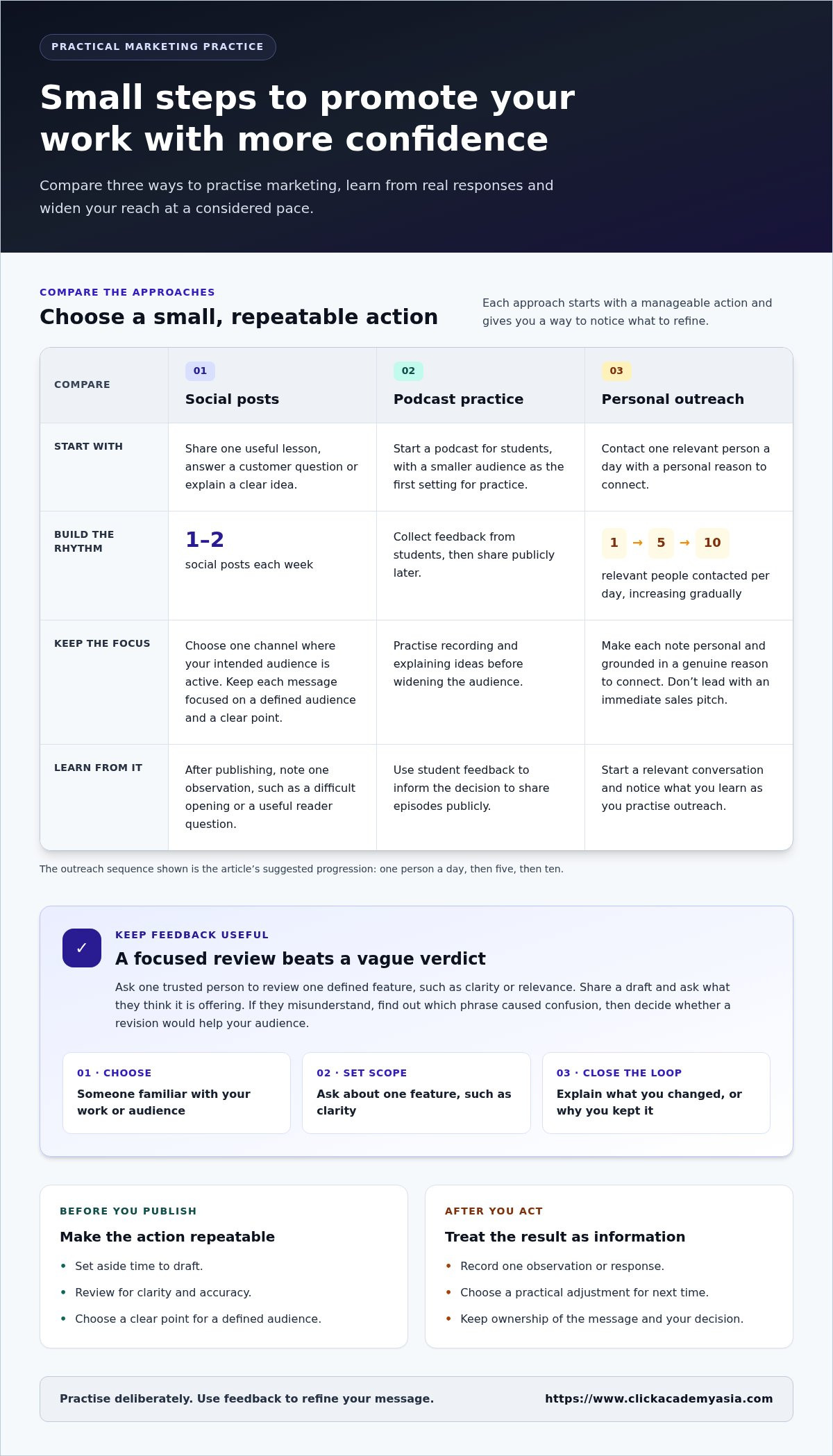
Make your request specific enough to guide a decision. Instead of asking, “Is this good?”, share a draft and ask, “What do you think this is offering?” Their answer can show whether the message conveys your intended idea. If they misunderstand, ask which phrase caused confusion, then decide whether a revision would help your audience.
Choose a sounding board: Find one person familiar with your work or audience.
Set the scope: Ask for feedback on one feature, such as clarity or relevance.
Close the loop: Explain what you changed and why, or why you kept the original.
Peer support works best when it goes both ways. You could review a colleague’s presentation in exchange for their thoughts on your campaign message. Agree on the purpose first, such as checking whether the audience’s problem is easy to recognise. This keeps the discussion practical and avoids pressure to offer blanket approval.
Consider joining a professional group where members discuss real marketing challenges. Bring a specific example, such as a draft introduction or a question about explaining your service. Listen to how others approach similar decisions, then adapt ideas that suit your audience and professional values. You’re gathering perspectives, not handing over ownership of your message.
After each conversation, briefly record the feedback, the edit you chose and why. If colleagues disagree about a headline, compare their comments with the needs of the intended reader. This helps you assess advice instead of following the loudest opinion. Over time, a consistent support routine can make difficult marketing decisions feel more considered and less isolating.
The author defines marketing as making a brand visible to people who would value it by putting relevant material in front of the right people in the right place. Reflect on how marketing fears affect yourself, your target customers and the wider world; this can keep support conversations connected to the purpose of your work. One answer recommends communication-skills programmes, training and seminars as ways to improve. Some people can speak a language in 3 months, while others take a year or longer, so progress need not look the same for everyone.
A gradual step can make practice feel more manageable. The author suggests starting a podcast for students only, collecting their feedback, and sharing it publicly later as a gradual way to face marketing fears. One answer claims that people will not remember a public-speaking embarrassment after 15 minutes. You could discuss these options with a trusted peer, consider how a step affects others, and use feedback to decide what to try next.
3. Gradually facing fears of promoting work online
Start by identifying the online action you’re avoiding and the thought behind it. You might worry that a LinkedIn post sounds inexperienced or that a professional opinion will attract criticism. Write down the concern, then choose a small action that lets you practise without treating the result as a verdict. A practical first step in overcoming the fear of being wrong in marketing is deciding what you want to learn.
For example, follow the article’s guidance to post on social media once or twice a week. Share a lesson from a project, answer a customer question or explain one useful idea. Keep the message focused on a defined audience and a clear point. You’re practising how to communicate online, not trying to prove your expertise to everyone at once.
Make the process repeatable. Set aside time to draft, then review your post for clarity and accuracy before publishing. Afterwards, record one observation: perhaps the opening was difficult to write, or a reader asked a useful follow-up question. That gives you a practical adjustment for next time, rather than leaving you to judge the attempt by how it felt.
Select one channel: Use a platform where your intended audience is active.
Set a steady rhythm: Try one or two social posts each week.
Capture one lesson: Note an edit or audience response after publishing.
If public visibility feels like too big a leap, begin with a smaller audience. One gradual approach is to start a podcast for students, gather their feedback and share episodes publicly later. This lets you practise recording and explaining ideas before widening the audience. Aim for deliberate progress, rather than waiting until you feel completely free of nerves.
Outreach can also happen in stages. Begin by contacting one relevant person a day, then increase to five a day, and later ten a day. Keep each note personal and grounded in a genuine reason to connect, such as a shared professional interest. Don’t lead with an immediate sales pitch. Start a relevant conversation and notice whether your message invites a useful response.
Overcoming the fear of being wrong in marketing becomes more manageable when you track actions rather than assumptions. Record what you shared, what you expected and what you observed. Little engagement on a post doesn’t explain why on its own. Consider its topic, timing, clarity and audience before deciding what to change. Regular practice gives you experience to draw on when planning your next step.
When you want a clearer framework for planning useful content, explore this content marketing approach alongside your practice. Use that learning to choose a suitable topic, shape a message for its audience and keep publishing at a pace you can maintain.
4. Reframing thoughts that prevent action
“I’m not the leading expert, so I shouldn’t share this” can keep useful advice unpublished. One practical way to overcome the fear of being wrong in marketing is to replace that assumption with a more specific question: “What can I explain accurately from my experience?” You don’t need to know everything about your field to share a lesson, clarify a process or describe a problem you’ve helped solve.
For example, a consultant who helps small businesses improve their websites could explain a usability issue and how it affects customers. They don’t need to claim expertise in every part of digital marketing. Their message can stay within their experience and make their specific contribution clear. That boundary makes a post more credible and easier to write.
Before publishing, check whether your message identifies the audience’s issue, explains how you can help and describes a relevant benefit. If a draft only says, “I’m passionate about marketing,” add a practical detail, such as the kind of challenge you address. The aim is to give readers useful context, not to make yourself sound impressive.
Replace “I might get it wrong” with “What can I explain clearly and accurately?”
Replace “I must know everything” with “Which part of this problem can I help solve?”
Replace “This is self-promotion” with “What useful information will my audience gain?”
Overcoming the fear of being wrong in marketing also means changing how you interpret an imperfect response. If a post receives little engagement, review its topic, audience and clarity before drawing conclusions. A broad headline may need a more specific benefit; a technical explanation may need simpler language. These are practical edits, not proof that your expertise has no value.
Keep the message focused on customer needs, not your image. A clear explanation of a service helps someone decide whether it suits their situation. Promotion is communication, not a claim that you have every answer. Stay within what you can support, and make the next step useful to the reader.
Before your next marketing decision, write down the thought holding you back, then separate evidence from assumption. “People may criticise this” is a prediction; “this claim needs a source” is a specific issue you can address. Correct what needs attention, then choose an action that serves your audience. This turns self-doubt into a practical review instead of a reason to stay silent.
5. Taking gradual steps outside your comfort zone
A low-risk way to test a marketing idea is to share a small version with a limited, relevant audience before investing in a full launch. For example, test one headline or message with existing customers, then use their responses to refine the wider campaign.
Choose a task that feels challenging but manageable, such as writing one blog post each week. Explaining how to solve a familiar customer problem lets you practise sharing your expertise without building a large campaign. Focus on one useful point, publish it and note what you would improve next time.
Connect the practice to a clear purpose. Before publishing, identify the intended reader and the action you hope they’ll take, such as considering a different approach or exploring a service. This gives you a practical way to review the content. You can assess whether the message was clear without treating every response as a verdict on your ability.
Public speaking is another opportunity for gradual practice. Rehearse a short explanation of your work with a colleague before using it in a presentation or networking conversation. Practising makes the situation more familiar, while constructive feedback can show where your explanation needs greater clarity.
Karys Gettier recommends role-playing difficult sales scenarios and using constructive feedback to build confidence and skill. Try a scenario where a prospective customer questions the value of your service. Practise listening, asking a relevant question and explaining how your work could help. This shifts the focus from selling yourself perfectly to having a useful, responsive conversation.
Build on each attempt instead of jumping straight to the most intimidating task. If speaking at an event feels daunting, start by explaining your work to one colleague, then practise with a small group. Aim for familiarity, not flawless performance. A repeated, realistic challenge gives you a chance to adjust your approach as you learn.
Test small: Share one message with a relevant audience before expanding it.
Practise deliberately: Rehearse a presentation or sales conversation with a colleague.
Review constructively: Identify one strength and one change after each attempt.
Marketing practice can involve writing, presenting and customer conversations. Choose one activity that supports your work, set a repeatable routine and record what each attempt teaches you. If writing a blog post feels easier than giving a live presentation, start there. Consistent, manageable practice helps turn unfamiliar actions into skills you can use with greater confidence.
5. Why are marketers afraid of being wrong, and how does it affect decision-making?
Fear often grows when a marketing decision feels like a public test of competence. A marketer choosing a campaign message may imagine colleagues questioning it, customers rejecting it or a manager blaming them for weak results. Those possibilities can make an ordinary professional judgement feel like a personal risk.
Uncertainty plays a part, too. A new email subject line, social post or audience segment may not perform as expected, and planning cannot remove every unknown. A marketer, for example, may keep revising an email because they want to know how it will perform before sending it. The desire to avoid criticism then delays useful learning.
Perfectionism can narrow the options you consider. Someone preparing a campaign might favour familiar wording over a clearer, more distinctive message. They may also seek repeated approval from colleagues, not to improve a specific detail, but to avoid owning the decision. This slows execution and can blur accountability.
Fear can affect judgement in other ways. A marketer may focus on the possibility of a negative comment while overlooking whether the message solves a real customer problem. They might also avoid testing a new format, even when the current approach no longer serves its audience. In both cases, fear shifts attention from customer value to personal exposure.
Separate the decision from imagined consequences. Before approving a campaign, write down its objective, the audience it serves and the evidence behind the message. Then identify what you can control, such as accuracy, clarity and relevance. A decision grounded in these criteria is easier to explain than one based on avoiding every possible objection.
Define the goal: State what the campaign should help its audience understand or do.
Name the concern: Distinguish a specific risk, such as unclear wording, from general fear of judgement.
Choose a review point: Decide what feedback or performance information would justify a change.
If a product announcement feels too bold, for instance, check that its claims are accurate and its benefit is clear. Ask a colleague to review those points, rather than seeking blanket reassurance. This keeps feedback focused on quality and helps you retain ownership of the final choice.
Teams can make better decisions by treating a campaign as work to evaluate, not a verdict on its creator. A short review can examine the original objective, audience response and one adjustment for next time. To strengthen your planning and decision-making approach, develop your marketing strategy skills.
ClickAcademy Asia: WSQ Digital Marketing Strategy & Planning
ClickAcademy Asia’s WSQ Digital Marketing Strategy & Planning course can offer a clearer framework for marketing decisions. It helps you build strategic skills to set objectives, define your audience and plan digital activity with greater purpose, rather than relying on guesswork.
Turn to structured learning when fear of making the wrong call is slowing your work, or when you want to strengthen your approach beyond individual posts and campaigns. For focused development in related areas, explore WSQ Content Marketing Strategy, WSQ Search Engine Optimization (SEO) or WSQ Search Engine Marketing (SEM).
To explore the course and take the next step in your marketing development, visit ClickAcademy Asia.
Make your next marketing decision with purpose
You don’t have to wait for every doubt to disappear before taking ownership of your marketing. Choose one decision you’ve been postponing, define what a useful outcome looks like and take the next step for a clear reason. Overcoming the fear of being wrong in marketing is less about perfect certainty and more about building the judgement to act, learn and adjust.
For professionals looking to strengthen that judgement, ClickAcademy Asia offers WSQ Digital Marketing Strategy & Planning, WSQ Content Marketing Strategy and WSQ Search Engine Optimization (SEO). Developing these skills can help you shape clearer plans, create more purposeful content and make informed decisions about visibility.
Take a considered next step in your professional development and contact ClickAcademy Asia to explore its marketing training. Start with the skill that best supports the work you want to do, and give yourself room to grow through practice.
Frequently Asked Questions
How can marketers overcome fear of failure and make decisions with confidence?
Build confidence by making decisions against agreed criteria, rather than waiting for certainty. Before choosing a campaign idea, write down what would make it relevant to the audience, accurate and achievable. Record why you chose it and what you expect to learn. After reviewing the outcome, compare the evidence with your original reasoning. This helps distinguish a sound decision with an unexpected result from one that needs better support.
How should marketers respond when a campaign fails or makes a mistake?
First, establish what happened and whether the campaign contains inaccurate or unclear information. Correct any error promptly, then review the audience, message, channel and execution to identify what contributed to the result. If a promotion reached the wrong audience, for example, examine how that audience was selected before changing the offer. Share the relevant learning with colleagues, document the adjustment and use it to guide the next campaign instead of assigning blame.
What workplace practices help create psychological safety for marketing teams?
Build supportive peer relationships where team members can share drafts and discuss real marketing challenges. Ask for focused, constructive feedback on a specific point, and treat differing opinions as perspectives to assess, not judgements of anyone’s ability.



Comments