
Optimizing Lead Handoff: 2026 Singapore Strategic Guide

Updated: Sep 12
Did you know that a healthy MQL to SQL conversion rate in the Singapore B2B market should sit between 20% and 35%, yet many local firms struggle to hit even half of that target? You've likely felt the frustration when high-value leads, secured through significant investment, seemingly vanish the moment they're passed to your sales team. It's disheartening to watch your marketing budget evaporate while departments clash over lead quality and accountability.
We understand that this friction isn't just a process error; it's a barrier to your professional growth and corporate revenue. By optimizing the lead handoff process to sales, you can eliminate lead leakage and align your departments using a framework specifically built for the 2026 Singapore business ecosystem. This strategic shift turns a disjointed handoff into a competitive advantage that scales with your ambitions.
In this guide, we'll provide a clear roadmap to bridge the gap between marketing and sales. You'll discover how to implement a unified lead lifecycle, leverage WSQ-aligned training to upskill your staff, and utilise SWDA-supported programmes to foster a culture focused on revenue. We'll move beyond theory to give you the practical insights needed to master lead transitions and drive measurable results.
Table of Contents
The High Cost of Lead Leakage in Singapore's Professional Ecosystem
Establishing a Robust Marketing-Sales SLA: Criteria for Lead Qualification
Leveraging AI and CRM Intelligence to Optimise Lead Handoff Efficiency
5 Actionable Steps for Optimizing the Lead Handoff Process to Sales
Future-Proofing Your Sales Force with WSQ-Accredited Training
The High Cost of Lead Leakage in Singapore's Professional Ecosystem
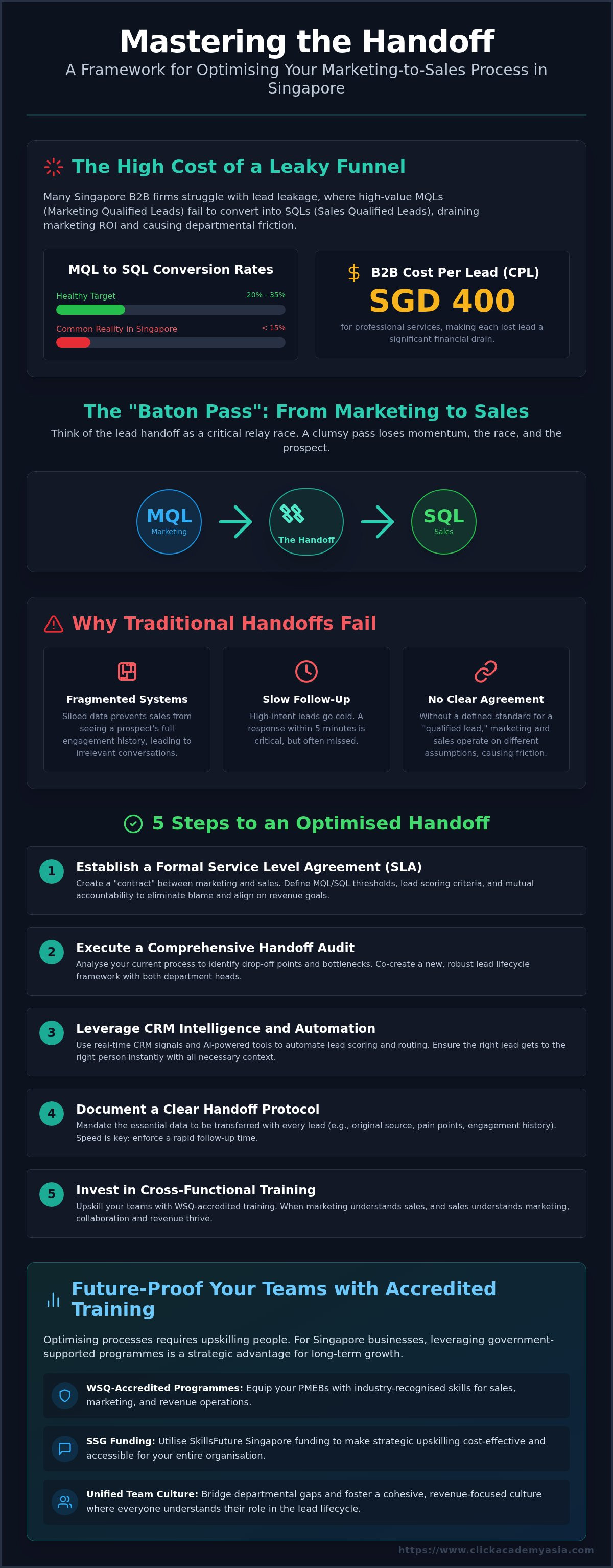
Think of the lead handoff as the critical baton pass in a high-stakes relay race. If the transition between marketing and sales is clumsy, the entire team loses momentum and the prospect often disappears into a black hole. In Singapore, optimizing the lead handoff process to sales is no longer just a technical task; it's a strategic necessity for maintaining your competitive edge in the APAC region.
Lead Leakage occurs when prospects fall through the cracks due to slow follow-ups or poor data quality. With B2B Cost Per Lead (CPL) benchmarks in Singapore reaching as high as SGD 400 for professional services, these lost opportunities represent a massive drain on your marketing ROI. When marketing teams celebrate high volumes of MQLs that sales teams later reject as "junk," the resulting friction stalls growth and wastes valuable resources.
Why Traditional Handoffs Fail in 2026
The informed buyer of 2026 expects an immediate, highly relevant response that acknowledges their specific business challenges. Traditional handoffs often fail because they rely on fragmented communication channels and siloed data that don't reflect the modern buyer journey. Professionals must move beyond basic Lead management methodologies to adopt a more nuanced, data-driven approach.
Fragmented systems prevent sales reps from seeing the full engagement history of a prospect, leading to repetitive or irrelevant conversations. This lack of transparency creates a disconnect where leads are routed to sales without proper intent qualification. Lead handoff is a strategic revenue bridge that connects marketing's brand building with sales' closing power, rather than being just a simple CRM notification.
The Impact on Singaporean Business Growth
Local firms that ignore these inefficiencies risk falling behind more agile competitors within the regional ecosystem. Poor handoffs don't just cost money; they take a heavy psychological toll on sales professionals who feel their time is being wasted on uncontacted or low-quality leads. This misalignment creates a culture of blame that prevents teams from focusing on the primary goal of revenue generation.
Many Singaporean businesses miss significant growth opportunities by failing to utilise integrated RevOps strategies that align their departments. By investing in WSQ-certified training, leaders can bridge these gaps and foster a unified team culture. Upskilling your workforce through SSG-funded programmes ensures that everyone understands their role in the lead lifecycle, transforming individual efforts into a cohesive engine for business success.
Establishing a Robust Marketing-Sales SLA: Criteria for Lead Qualification
A Service Level Agreement (SLA) acts as the formal contract that binds marketing and sales to a shared vision of success. It moves beyond vague promises of "better leads" and establishes concrete metrics for accountability. For Singaporean firms aiming to hit aggressive revenue targets, this document is the foundation of optimizing the lead handoff process to sales. Without it, your teams will continue to work in silos, wasting time on misaligned priorities.
The "Definition of Ready" is a central pillar of this agreement. It ensures that every lead passed over has met a pre-agreed standard of intent, fit, and engagement. Marketing agrees to deliver a specific volume of leads that meet these criteria, while sales commits to a rigorous follow-up schedule. This mutual accountability is vital for local PMEBs looking to secure their position in a competitive APAC market.
Defining Your MQL and SQL Thresholds
Effective lead scoring requires categorising prospects by their demographic fit and behavioural signals. A PMEB attending a high-level webinar shows interest, but a visit to your pricing page indicates immediate intent. Assign specific point values to these actions to trigger the handoff automatically. It's essential to conduct a regular SLA Audit to refine these definitions as market conditions and buyer behaviours shift.
Documenting the Handoff Protocol
Speed is your greatest ally in lead conversion. High-intent leads often require a response within the first five minutes to maximise the chance of a meaningful connection. Every lead transfer must include essential data such as the original source, identified pain points, and previous interactions. You can learn how to leverage data to inform these critical thresholds in our strategic guide for 2026 professionals.
Standardising this protocol ensures that sales reps aren't flying blind when they make that first call. When everyone follows the same playbook, optimizing the lead handoff process to sales becomes a repeatable engine for growth. If you're looking to build these frameworks for your own team, exploring Sales Leadership training can provide the tactical edge needed to manage this culture of alignment.
Leveraging AI and CRM Intelligence to Optimise Lead Handoff Efficiency
By 2026, the role of technology in optimizing the lead handoff process to sales has shifted from simple data entry to proactive intelligence. AI-driven tools now analyse incoming leads in real-time, matching them to the sales representative with the most relevant expertise or the best track record in a specific territory. This ensures that high-potential prospects aren't just assigned to the next available person, but to the professional best equipped to close the deal.
CRM platforms provide "Real-Time Signals" that alert sales teams the moment a prospect exhibits high-intent behaviour. Whether it's multiple downloads of a whitepaper or frequent visits to a pricing page, these triggers are essential when optimizing the lead handoff process to sales. However, it's vital to avoid "Automation Overload" where the human element is lost. For high-value B2B deals in the Singapore market, technology should remain an enabler of the handoff rather than the strategy itself—a concept also explored in specialized fields through resources like AI Powered Network Marketing.
Automated lead nurturing also plays a crucial role for prospects who aren't yet "sales-ready." By keeping these individuals engaged through personalised content, you ensure they remain in the funnel until they meet your SLA thresholds. This prevents sales reps from becoming overwhelmed by low-intent leads while maintaining a consistent pipeline of future opportunities for your PMEB workforce.
Clean CRM data is the lifeblood of any successful sales operation. Sales rep frustration often stems from missing contact details or outdated company information that forces them to do their own research. Third-party enrichment tools can automatically fill these gaps, providing valuable context before the first sales call is even placed. This allows your team to focus on building relationships rather than hunting for phone numbers.
Intent data is another powerful layer of enrichment. Understanding the specific terms a prospect is searching for can reveal their underlying pain points. You can explore how advanced keyword research strategies help identify these buyer signals early in the journey. Integrating these insights into your CRM ensures that when the handoff occurs, the sales team has a complete picture of the prospect's needs.
5 Actionable Steps for Optimizing the Lead Handoff Process to Sales
Transforming your revenue engine requires more than just new software; it demands a structured approach to optimizing the lead handoff process to sales. By following these five actionable steps, your Singaporean firm can build a culture of alignment and high performance. These stages move your team from disjointed efforts to a unified strategy that captures every opportunity.
Step 1: Conduct a 'Handoff Audit'. Pinpoint exactly where your prospects are currently dropping off by analysing your CRM logs. Identify if leads are stalling at the MQL stage or if they're being assigned but never contacted by the sales team.
Step 2: Co-create the Lead Qualification Framework. Bring both department heads together to agree on what constitutes a "sales-ready" lead. This collaborative session ensures that everyone is working from the same definition, which drastically reduces future inter-departmental friction.
Step 3: Implement a Feedback Loop. Create a formal system where sales can 'reject' leads with specific, documented reasons. This data allows marketing to refine their targeting and messaging based on real-world sales outcomes.
Step 4: Centralise your data stack. Ensure a single source of truth by integrating your marketing automation tools directly with your CRM. This prevents data silos and gives both teams a 360-degree view of the prospect's journey.
Step 5: Upskill your team. Invest in WSQ-certified training to ensure long-term adoption of these new frameworks. Equipping your staff with the right skills is the only way to future-proof your revenue strategy and ensure these processes stick.
Implementing the Feedback Loop
Closed-Loop Reporting is the secret to improving marketing lead quality over time. When sales provides specific reasons for rejecting a lead, such as "wrong job title" or "no immediate budget," marketing can adjust their campaigns accordingly. This shouldn't be a source of conflict; instead, view it as a culture of continuous optimisation. It's about refining the engine together to ensure no marketing dollar is wasted on the wrong audience.
Measuring Handoff Success
To prove the ROI of optimizing the lead handoff process to sales, you must track specific, data-driven metrics. Monitor your MQL-to-SQL conversion rate and Lead Response Time (LRT) closely, as these are the primary indicators of a healthy transition. These figures, combined with 'Sales Velocity', provide the evidence needed to justify further investment in professional development. You can explore our full range of WSQ-funded training tracks to help your team master these critical metrics and drive growth.
Future-Proofing Your Sales Force with WSQ-Accredited Training
While technology provides the infrastructure, your people provide the execution. Optimizing the lead handoff process to sales requires a workforce that understands both the strategic "why" and the tactical "how." ClickAcademy Asia serves as your vital partner in this transformation, offering industry-recognised certifications that bridge the gap between departments and foster a culture of shared success.
Our WSQ Digital Marketing Strategy & Planning course provides the high-level perspective needed for cross-team alignment. Simultaneously, our Sales Leadership training equips managers with the tools to lead high-performance modern teams. These programmes aren't just theoretical; they're grounded in the real-world challenges faced by Singaporean businesses navigating the 2026 landscape.
The Value of WSQ Certification for PMEBs
Industry-recognised WSQ certifications build immediate credibility and facilitate internal buy-in for new operational frameworks. The practical, how-to focus at ClickAcademy Asia ensures that your PMEBs can apply their learning to optimizing the lead handoff process to sales the very next day. We also offer customised corporate group training to ensure your entire department moves forward with a unified skill set and a common language.
How to Get Started with SSG Funding
Navigating the financial aspect of upskilling is straightforward thanks to extensive support from the Skills and Workforce Development Agency (SWDA). Eligible SMEs can receive up to 90% in course fee subsidies through SSG funding, while larger organisations typically receive up to 70%. Singapore Citizens aged 40 and above can also leverage the Mid-Career Enhanced Subsidy (MCES) to significantly reduce out-of-pocket costs.
You can easily begin this journey by enrolling in our WSQ digital marketing courses in Singapore. Don't let your marketing investment leak away through inefficient processes or misaligned teams. Empower your team to close the gap, align their efforts, and drive consistent revenue growth today.
Mastering the Handoff for Singapore's 2026 Market
Success in Singapore's competitive B2B landscape depends on more than just lead volume; it requires a seamless transition between departments. By establishing a clear SLA and leveraging AI-driven CRM insights, you've taken the first steps toward eliminating lead leakage. However, the true transformation happens when your team possesses the practical skills to maintain these frameworks over the long term.
Optimizing the lead handoff process to sales is an ongoing journey of refinement and upskilling. Whether you're a corporate leader or an HR decision-maker, investing in your people is the most effective way to future-proof your revenue engine. For those seeking to rebuild their organizational strategy, janihavunen.com offers high-impact coaching to help reconstruct business foundations for growth. Our courses also offer a path to practical, real-world marketing and sales mastery that delivers results.
Equip your team with the strategic skills to optimise your lead handoff process through our WSQ-funded training tracks. With WSQ-certified excellence and SSG-subsidised programmes, you can drive measurable growth and foster a unified culture today. Let's work together to turn your potential leads into sustained revenue.
Frequently Asked Questions
What is the most common reason for lead handoff failure?
The primary reason is the misalignment between what marketing considers a lead and what sales considers a prospect. Without a shared definition of a "sales-ready" lead, marketing often passes MQLs based on low-intent actions like content downloads. Sales teams then reject these leads as "junk," leading to wasted budget and departmental friction. Establishing a clear, documented framework for lead qualification is the only way to resolve this disconnect.
How do I create a Marketing-Sales Service Level Agreement (SLA)?
Creating a Marketing-Sales SLA begins with a collaborative session between department heads to define specific MQL and SQL thresholds. You must document the quantity of leads marketing will deliver and the exact response time sales will adhere to for follow-ups. Ensure the agreement includes a formal feedback loop where sales can reject leads with documented reasons. This contract turns vague promises into a measurable system of mutual accountability.
What is the ideal lead response time for B2B companies in Singapore?
The ideal lead response time for high-intent B2B prospects in Singapore is under five minutes. Speed is a critical factor when optimizing the lead handoff process to sales, as the likelihood of qualifying a lead drops tenfold after the first hour. Providing an immediate, relevant response acknowledges the buyer's needs and prevents them from moving to a competitor. Consistent speed creates a professional first impression that sets the tone for the entire relationship.
Can AI fully automate the lead handoff process?
AI is an incredibly powerful enabler for routing, scoring, and initial nurturing, but it shouldn't fully replace human oversight. While 2026 tools can automate lead distribution based on rep expertise, high-value B2B deals still require the empathy and strategic thinking of a professional seller. Use AI to surface real-time signals and clean CRM data, allowing your sales team to focus their energy on building genuine relationships rather than performing manual administrative tasks.
What metrics should I use to measure handoff effectiveness?
You should primarily track the MQL-to-SQL conversion rate and Lead Response Time (LRT). A healthy conversion rate for Singaporean B2B firms typically ranges between 20% and 35%. Additionally, measuring "Sales Velocity" helps you understand how quickly leads move through the funnel after the handoff. These data points provide the objective evidence needed to identify where leads are dropping off and where your process requires further refinement.
Is there government funding available for sales and marketing training in Singapore?
Singaporean businesses have access to significant financial support through SkillsFuture Singapore (SSG). SMEs can claim up to 90% in course fee subsidies under the Enhanced Training Support for SMEs (ETSS). Large organisations are eligible for up to 70% funding for approved WSQ courses. Additionally, the Mid-Career Enhanced Subsidy (MCES) provides 90% coverage for Singapore Citizens aged 40 and above, making professional upskilling highly accessible for local corporate teams.
How does WSQ certification help with sales and marketing alignment?
WSQ certification provides a standardised framework that ensures both marketing and sales teams speak the same strategic language. By optimizing the lead handoff process to sales through WSQ-aligned training, PMEBs gain practical, real-world skills rather than just theoretical knowledge. This shared educational foundation reduces lead leakage and ensures that everyone understands their role in the revenue lifecycle. It builds the internal credibility needed to implement and sustain complex cross-departmental agreements.



Comments