
Mastering Customer Success and Retention: A Strategic Guide for 2026

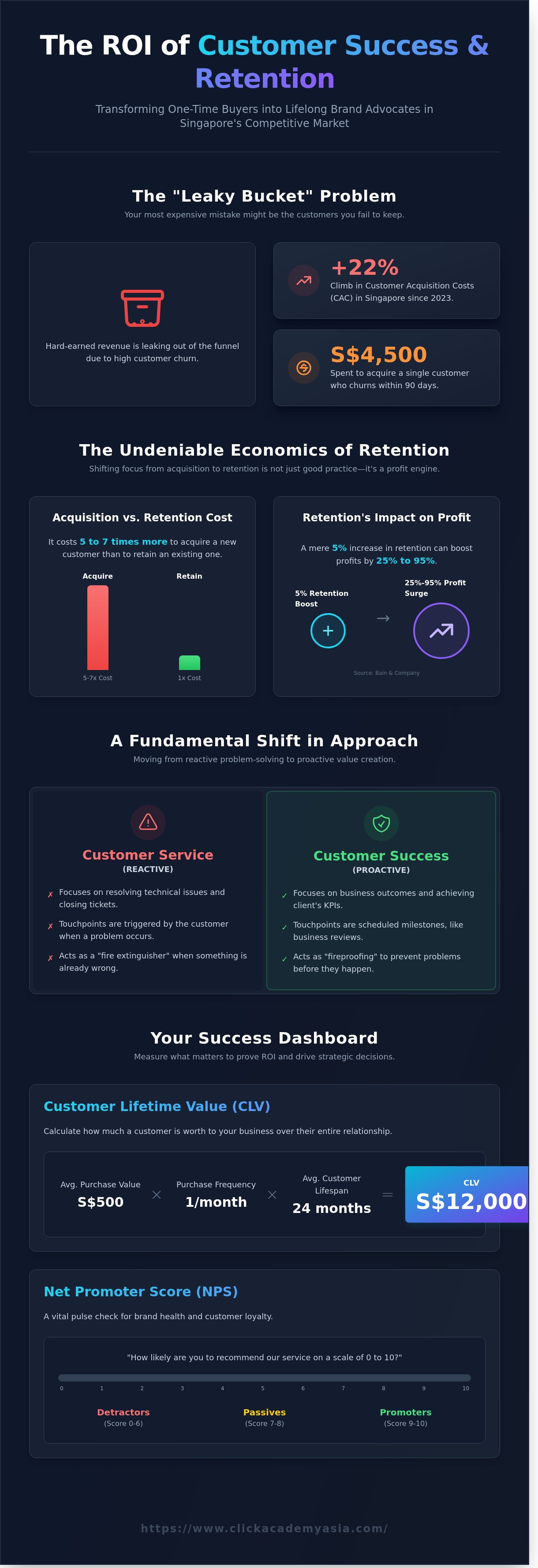
What if your most expensive business mistake isn't a missed lead, but the S$4,500 you just spent to acquire a customer who will churn within ninety days? You've likely noticed that customer acquisition costs in Singapore's competitive digital market have climbed by 22% since 2023, making a focus on Customer Success and Retention more critical than ever. It's frustrating to watch hard-earned revenue leak out of the bottom of the funnel while you're under pressure to prove the tangible ROI of your initiatives to leadership.
We understand that balancing immediate sales with long-term loyalty is a complex challenge that requires more than just a friendly support team. This guide will help you transform one-time buyers into lifelong brand advocates using data-driven, practitioner-led strategies that work in the real world. You'll gain a repeatable framework to boost your Customer Lifetime Value (CLV) and Net Promoter Score (NPS), giving you the tools to secure both your company's growth and your own career advancement through industry-recognised expertise.
Key Takeaways
Distinguish between passive churn prevention and proactive Customer Success and Retention strategies to drive active growth and brand advocacy.
Master the "Success Dashboard" concept and learn a straightforward formula to calculate Customer Lifetime Value in S$ for measurable impact.
Identify how to avoid "digital fatigue" by balancing automation with human-centric strategies that go beyond simple discounts and loyalty points.
Minimise "Time to Value" for your clients through an impeccable onboarding framework and structured feedback loops via regular business reviews.
Gain the practical skills needed to bridge the gap between strategy and execution through practitioner-led workshops tailored for the Singaporean market.
Table of Contents
What is Customer Success and Retention in the 2026 Landscape?
Key Metrics to Measure Success and Retention ROI
Overcoming the "One-Size-Fits-All" Retention Trap
Building a Robust Customer Success Framework
Upskilling for Retention Mastery with ClickAcademy Asia
What is Customer Success and Retention in the 2026 Landscape?
The 2026 business environment in Singapore has moved past the era of the "one-and-done" sale. Modern growth is no longer a linear path of acquisition. It's a continuous cycle where Customer Success and Retention act as the primary engine for sustainable revenue. While many businesses historically viewed retention as a defensive tactic to stop people from leaving, high-performing firms now recognise it as a proactive growth strategy. They don't just wait for a contract to expire to start a conversation; they engineer outcomes from day one.
To lead in this space, you must understand the core distinction between these two concepts. Retention is the result, while success is the strategy. If you want to master the basics, exploring What is Customer Success? reveals that it's about ensuring your clients achieve their specific business goals through your product. In the current APAC economy, the shift from transactional sales to relationship-based subscription models means your profit isn't made at the point of sale. It's built over months and years of consistent value delivery.
The Economics of Keeping a Customer
The financial argument for prioritising existing clients is undeniable. Research consistently shows it costs 5 to 7 times more to acquire a new customer in Singapore's competitive digital market than it does to retain an existing one. When your marketing budget is poured into a "leaky bucket" strategy, you're essentially paying a premium for temporary attention. High churn rates erode your margins and force your sales team to run twice as fast just to stay in the same place.
Data from Bain & Company indicates that a modest 5% increase in retention rates can lead to a profit surge of 25% to 95%. This happens because long-term customers tend to buy more, refer others, and require lower service costs over time. In a city-state like Singapore, where market saturation is a reality in many sectors, your ability to maximise the lifetime value (LTV) of every S$ spent on acquisition determines your long-term viability. Stop chasing the next lead and start empowering the clients you already have.
Customer Success vs. Customer Service
Many professionals confuse these two roles, but the difference is fundamental. Customer service is reactive; it's a fire extinguisher used when something goes wrong. If a client opens a support ticket, service responds. Customer success, however, is fireproofing the building. It's a proactive discipline that anticipates hurdles before the client even feels them. By 2026, the role of the Customer Success Manager (CSM) has evolved into a strategic consultant who uses predictive analytics to guide the user journey.
Service: Focuses on resolving technical issues and closing tickets.
Success: Focuses on business outcomes and achieving the client's Key Performance Indicators (KPIs).
Service Touchpoints: Triggered by the customer when they encounter a problem.
Success Touchpoints: Scheduled milestones, such as quarterly business reviews and proactive health checks.
A modern CSM doesn't just ask "Is everything okay?" Instead, they present data-driven insights that show the client exactly how much ROI they've gained from the partnership. This shift transforms your brand from a vendor into an indispensable partner. When you align your internal metrics with your customer's external goals, retention becomes a natural byproduct of their success rather than a forced renewal.
Key Metrics to Measure Success and Retention ROI
Marketing leaders in Singapore often struggle to bridge the gap between high-level strategy and daily operations. A "Success Dashboard" acts as your command centre, providing a real-time view of how your efforts translate into revenue. Effective Customer Success and Retention relies on moving beyond vanity metrics like social media likes to focus on figures that impact the bottom line. You need a clear window into how long customers stay and how much they spend during that period.
Calculating Customer Lifetime Value (CLV) is the first step in this process. Use this simple formula: (Average Purchase Value × Purchase Frequency) × Average Customer Lifespan. If a client spends S$500 per month and stays for an average of 24 months, their CLV is S$12,000. This figure allows you to determine exactly how much you can afford to spend on acquiring new leads without eroding your profit margins.
Net Promoter Score (NPS) remains a vital pulse check for brand health. By asking customers how likely they are to recommend your service on a scale of 0 to 10, you categorise your user base into promoters, passives, and detractors. A high NPS in the Singaporean market often correlates with strong organic growth, as word-of-mouth remains a powerful driver for local SMEs and MNCs alike.
Churn rate is the final piece of the puzzle. Calculate this by dividing the number of customers lost during a period by the total number of customers you had at the start, then multiplying by 100. Identifying "at-risk" segments requires looking for patterns; for instance, a 15% drop in login frequency over 30 days often signals a customer is about to leave. Addressing these red flags early is a core component of modern Customer Retention Strategies that keep your business stable.
Calculating the Financial Impact
Justifying your budget requires a robust ROI framework. Customer Lifetime Value represents the total revenue a business can expect from a single account throughout the entire relationship, serving as the foundational metric for long-term budget planning and acquisition spend. When you present to the board, use data to show that a 5% increase in retention can boost profits by over 25%.
Headcount Justification: If a Customer Success Manager (CSM) earns S$85,000 annually but prevents the churn of three key accounts worth S$150,000 each, their role pays for itself five times over.
Expansion Revenue: Track how often existing customers upgrade to premium tiers.
Cost of Acquisition (CAC) Offset: Show how retained customers reduce the pressure on marketing to constantly find new leads.
Qualitative vs. Quantitative Feedback
Numbers tell you what is happening, but qualitative data tells you why. The Customer Effort Score (CES) measures how easy it was for a client to get their issue resolved. A high effort score is a leading indicator of churn, even if the customer is currently paying their bills. You can also employ sentiment analysis tools to scan support tickets and emails for frustrated language, allowing your team to intervene before a formal complaint is filed.
Repeat purchase rates are the ultimate validator of product-market fit in Singapore's competitive landscape. If 60% of your customers return for a second purchase within six months, you've moved beyond a transactional relationship into a partnership. To master these data-driven approaches, consider how a practitioner-led digital marketing course can sharpen your analytical skills and help you lead your team with confidence.
Overcoming the "One-Size-Fits-All" Retention Trap
Many Singaporean enterprises mistakenly believe that a basic loyalty programme or a periodic S$50 discount code constitutes a strategy. It isn't. These are tactical bribes rather than relationship builders. While 82% of companies agree that retention is cheaper than acquisition, few invest in the nuanced human elements required to make it stick. Relying solely on automated "we miss you" emails often triggers digital fatigue. When a customer receives the same generic nudge as 10,000 others, they feel like a data point on a spreadsheet rather than a valued partner. This lack of distinction is a primary driver of churn in competitive markets like SaaS and digital consultancy.
To master Customer Success and Retention, you must move beyond the "Order Taker" mindset. An order taker waits for a problem to arise; a Trusted Advisor anticipates it. You need to segment your client base by both current value and future growth potential. A high-value account in the local FinTech sector requires a different communication cadence than a boutique retail partner. Effective customer retention strategies now require a 360-degree view of the user journey to prevent friction before it starts. If you treat your most profitable clients the same way you treat your smallest ones, you risk losing the very accounts that sustain your growth.
Over-automation often masks a lack of genuine engagement. While tools are essential for efficiency, they shouldn't replace human intuition. A 2024 survey of B2B buyers in the Asia-Pacific region found that 73% of respondents felt overwhelmed by generic marketing automation. This fatigue leads to lower open rates and higher unsubscribe numbers. Your goal is to use technology to enhance the human touch, not to hide behind it. By identifying specific pain points through data, you can intervene with a phone call or a personalised video message exactly when the customer needs it most.
The Psychology of the Trusted Advisor
Stop selling features and start solving business outcomes. This transition requires empathy-led communication that cuts through the noise of a tech-heavy environment. Active listening is your most potent tool here. By identifying unmet needs during a routine check-in, you transform from a vendor into a strategic partner. This shift reduces price sensitivity because your value is tied to their growth, not just your product's uptime. It's about being the person they call for advice, not just for technical support.
Personalisation at Scale
By 2026, hyper-personalisation will be the baseline for professional services in Singapore. Use your CRM data and AI tools to deliver bespoke experiences that feel hand-crafted for every user. This doesn't mean removing automation entirely. Instead, use data triggers to alert a human team member when a high-value client shows signs of frustration or stalled progress. Balancing automated efficiency with timely human intervention ensures your Customer Success and Retention efforts feel authentic rather than robotic. Success lies in making every customer feel like your only customer.
Building a Robust Customer Success Framework
Retention isn't a happy accident; it's a result of deliberate engineering. A framework for Customer Success and Retention acts as your insurance policy against churn by ensuring customers don't just buy your product, but actually achieve their desired outcomes. In the competitive Singaporean market, where acquisition costs can be high, keeping a client is significantly more cost-effective than finding a new one. You can build this stability through four specific, actionable steps.
Step 1: Design an impeccable onboarding process. Your goal is to minimise "Time to Value." If a client spends S$2,000 on a subscription, they need to see a "win" within the first 14 days to justify the spend.
Step 2: Establish a continuous feedback loop. Regular Business Reviews (QBRs) should move beyond simple check-ins. Use these sessions to align your product roadmap with the client's 2024 fiscal goals.
Step 3: Implement a "Health Score" system. Monitor account activity using metrics like login frequency, feature adoption, and support ticket volume. A score below 60 should trigger an immediate outreach from your team.
Step 4: Create a community or advocacy programme. Turn your power users into brand fans. When a customer feels like part of an exclusive group, their loyalty shifts from the product to the community itself.
Onboarding: The Critical First 90 Days
The first 90 days dictate the entire lifecycle of the account. You must guide every new user toward their "Aha! Moment," the specific second they realise your solution solves their pain point. For a marketing agency, this might be the moment the first automated lead report hits their inbox. Reduce friction by removing unnecessary setup steps and providing practitioner-led educational content that empowers users to master the basics without waiting for a support call.
Continuous Engagement Tactics
Engagement should be value-driven, not sales-driven. When you suggest an upsell, it must be because the data shows the client has outgrown their current tier. Providing a quarterly market intelligence report focused on Singapore's digital trends is a brilliant way to offer "free" value that reinforces your authority. To sharpen these efforts, you can use WSQ Marketing Analytics & Insights to refine your engagement strategy and identify exactly where users are dropping off in their journey.
By focusing on Customer Success and Retention, you move from being a replaceable vendor to an essential partner. This transition requires a shift in mindset: stop looking at what the customer can do for your revenue and start looking at what your product can do for their career growth and business stability. When your clients win, your retention numbers naturally follow suit.
Ready to master the data behind client loyalty?
Explore our practitioner-led courses at ClickAcademy Asia to future-proof your marketing and retention strategies today.
Upskilling for Retention Mastery with ClickAcademy Asia
Theory provides a foundation, but execution drives revenue. A 2023 LinkedIn Learning report found that 94% of employees stay longer at companies that invest in their growth. In the Singaporean market, the distance between understanding a concept and managing a high-stakes churn crisis is often significant. ClickAcademy Asia bridges this gap through practitioner-led workshops that move beyond abstract ideas into high-impact reality. These sessions feature mentors who've managed multi-million dollar portfolios across the APAC region, ensuring you learn from those who've actually done the work. You aren't just listening to a lecture; you're dissecting real-world case studies from the local landscape.
The WSQ Advantage for Professionals
Professional certification isn't just a badge; it's a career insurance policy. The Customer Success and Retention Mastery course delivers specific, actionable outcomes that you can implement the very next day. You'll learn how to build predictive health scores and map customer journeys that identify churn risks before they become permanent losses. The curriculum also covers the nuances of conducting Quarterly Business Reviews (QBRs) that actually add value rather than just ticking a box. This programme is designed for immediate application in your daily workflow, focusing on the metrics that stakeholders care about most.
Singaporean Citizens and Permanent Residents can leverage the Workforce Skills Qualifications (WSQ) framework to make this transition affordable. Subsidies often cover up to 70% of course fees for eligible individuals. For instance, a S$1,200 programme might only cost a local professional S$360 before GST. You can also use your SkillsFuture credits to offset the remaining out-of-pocket expenses, making high-level education accessible to everyone. These skills don't exist in a vacuum; they integrate seamlessly into a WSQ Digital Marketing Strategy & Planning framework. This ensures your Customer Success and Retention efforts are synchronised with your broader acquisition and brand objectives, creating a unified growth engine.
Transforming Your Corporate Culture
Retention isn't the sole responsibility of one department. It's a company-wide commitment. When sales teams promise features that success teams can't support, churn is the inevitable result. Group training sessions are essential for breaking down these silos and aligning your internal goals. ClickAcademy Asia provides customised solutions for regional APAC teams looking to scale their operations across diverse markets like Indonesia, Vietnam, and Thailand. We help you create a shared language of success that spans across borders and departments.
Investing in your team's expertise creates a culture of excellence. It transforms your staff from reactive problem-solvers into proactive growth partners. By mastering Customer Success and Retention, you position yourself as an indispensable asset in any economic climate. You'll gain the tools to turn satisfied users into vocal brand advocates who drive sustainable, long-term revenue. This proactive approach is what separates market leaders from those who are constantly struggling to replace lost customers.
Don't leave your career or your company's growth to chance. Master the art of retention and accelerate your career today.
Future-Proof Your Retention Strategy for 2026
The shift toward 2026 requires moving past reactive support. You must focus on granular metrics like Net Revenue Retention and deeply personalised customer journeys to stay ahead. Research indicates that firms ignoring the "one-size-fits-all" trap risk losing up to 30% of their customer lifetime value by next year. Success depends on building a robust framework that turns every digital touchpoint into a measurable growth opportunity.
Mastering Customer Success and Retention isn't just about keeping clients; it's about driving sustainable revenue in a competitive Singaporean market. You can bridge the skills gap by learning from industry experts who've actually done the work. Our practitioner-led training offers real-world insights and carries the prestige of being an official Google and DMI partner. Eligible Singaporeans can also benefit from up to 70% WSQ funding to significantly reduce out-of-pocket costs.
Ready to lead your organisation into the next era of growth? Master Customer Success and Retention with our WSQ-certified course. Your journey to becoming a retention expert starts today.
Frequently Asked Questions
What is the difference between customer retention and customer loyalty?
Customer retention is a metric that tracks whether a client continues to pay for your service over a specific period. Customer loyalty represents the emotional bond and trust a user has with your brand, often leading them to become active advocates. While a retained customer might stay out of habit or lack of alternatives, a loyal customer chooses you repeatedly and refers new business, which is the ultimate goal of any Customer Success and Retention strategy.
How do I calculate the ROI of a customer success programme?
You calculate the ROI by subtracting the total cost of your success initiatives from the gains in expansion revenue and retained contract value, then dividing that by the initial cost. For example, if a S$50,000 investment in a success platform helps retain S$250,000 in annual recurring revenue that was at risk, your ROI is 400%. Tracking the Net Retention Rate (NRR) is the most effective way to demonstrate this value to your leadership team.
What are the most common reasons for customer churn in 2026?
In 2026, the leading cause of churn is a lack of AI-driven personalisation and poor integration with a client's existing tech stack. Data from recent industry reports shows that 62% of customers leave when a vendor fails to provide proactive, data-backed insights that help them achieve their specific business goals. If your product feels like a siloed tool rather than an integrated solution, customers will quickly migrate to more agile competitors.
Can I use SkillsFuture credits for Customer Success and Retention courses?
Yes, Singaporeans aged 25 and above can typically use their SkillsFuture credits to subsidise the cost of accredited Customer Success and Retention training. At ClickAcademy Asia, we offer practitioner-led courses designed to help you master these essential skills while making the most of available government grants. Always check the MySkillsFuture portal to verify the current credit balance and eligible course codes before you register for a session.
How long does it take to see results from a new retention strategy?
You can expect to see early indicators of success, such as increased log-in frequency or higher engagement scores, within the first 30 to 60 days. However, a significant reduction in your annual churn rate usually requires a full six months of consistent implementation to manifest in your financial reports. Stability in your customer base is a long-term play that requires constant refinement of your onboarding and communication workflows.
What tools are essential for managing customer success at scale?
Managing a large client base requires a robust Customer Success Platform like Gainsight or Totango, which aggregates user data to create health scores. You also need a reliable CRM like HubSpot to maintain a single source of truth for all customer interactions. Automating your communication through tools like Intercom allows your team to send personalised messages at scale, ensuring no account is neglected as your business grows.
How does customer success impact digital marketing strategy?
Customer success provides the social proof and case studies that make your digital marketing efforts significantly more persuasive. When you retain customers, your Customer Acquisition Cost (CAC) drops because you can leverage high-value referrals and positive reviews in your ad campaigns. This feedback loop allows marketers to target "lookalike" audiences who share the characteristics of your most successful and profitable long-term clients.


Comments