
Managing Sales Channel Conflict: 2026 Singapore Roadmap
- ClickAcademy Asia

- 1 day ago
- 11 min read
Your direct sales team just closed a major deal, but your top distributor is threatening to walk because they "owned" the relationship first. Effectively managing channel conflict in sales isn't just about dispute resolution; it's a structural necessity to prevent the price wars that drain your profit margins in the Singapore market. You've likely felt the sting of internal competition where your own partners become your biggest rivals. It's an exhausting cycle that stalls growth and frustrates even the most loyal collaborators in your ecosystem.
This 2026 roadmap helps you master the skills to identify friction points early and implement WSQ-certified strategies that protect your S$ margins. We'll examine the latest CCCS regulations, establish clear rules of engagement to optimise partner loyalty, and show you how a team trained in modern sales leadership can transform partner friction into a predictable revenue engine. By aligning your local strategy with proven frameworks, you can turn channel friction into a competitive advantage.
Table of Contents
What is Channel Conflict and Why Does it Plague Singapore Businesses?
Channel conflict occurs when your various sales routes, such as direct teams, resellers, or online marketplaces, compete for the same customer segment. While some managers mistake this for "healthy competition," it's actually a structural failure that leads to margin erosion and damaged brand reputation. Understanding What is Channel Conflict is essential for any leader looking to maintain a cohesive ecosystem. Managing channel conflict in sales prevents the "race to the bottom" that destroys profitability and leads to partner attrition, where frustrated distributors simply leave for a competitor who offers clearer boundaries.
Singapore's high digital penetration accelerates this issue. With consumers seamlessly switching between various physical showrooms and TikTok Shop, the lines between direct and indirect sales have blurred. Effectively managing channel conflict in sales is now a core competency for PMEBs who must navigate a landscape where "omnichannel" often turns into "omni-conflict" without a robust framework. The shift from complementary channels to destructive overlap is the primary challenge facing local sales directors in 2026.
The Real-World Impact on PMEBs and Leaders
Conflict directly undermines the KPIs of sales managers and marketing directors. When a direct sales team "steals" a deal influenced by a partner, it creates a psychological rift that destroys trust. Partners stop sharing lead data, leading to a blind spot in your pipeline. This friction doesn't just hurt your S$ revenue; it creates a toxic culture where internal teams view partners as rivals rather than extensions of the brand. Without a clear resolution strategy, your best talent might spend more time fighting internal battles than closing new business.
Identifying Conflict Early in Your Sales Pipeline
Proactive leaders spot these issues before they escalate into disputes. You should regularly audit your CRM for double-entry leads, which often signal that two partners are chasing the same S$50,000 contract. Monitoring price discrepancies is equally vital; if your official e-commerce site lists a product lower than your physical distributors' cost price, conflict is already brewing. Vertical conflict occurs when a Singaporean manufacturer sells directly on Shopee at prices that undercut their own authorised retail partners, effectively competing against their best customers.
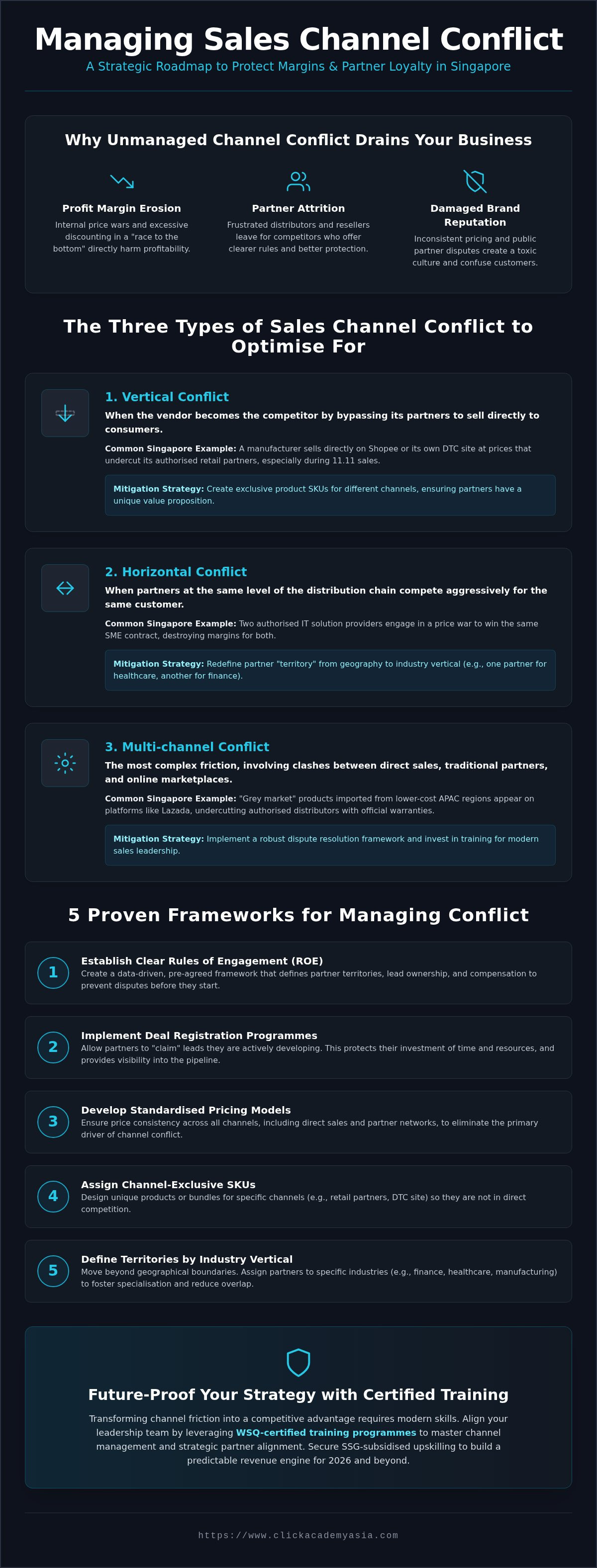
The Three Types of Sales Channel Conflict to Optimise For
To effectively address friction, you must first diagnose its origin. Managing channel conflict in sales requires a surgical approach to different structural tensions. In the Singaporean market, these typically fall into three distinct categories: vertical, horizontal, and multi-channel ecosystem conflict.
Vertical Conflict: When the Vendor Becomes the Competitor
Vertical conflict arises when a manufacturer bypasses their traditional partners to sell directly to the end user. This often happens when a brand launches a direct-to-consumer (DTC) web store without consulting its long-term distributors. Partners feel "starved" of stock if the manufacturer prioritises its own inventory for high-demand seasons like 11.11 or Black Friday. To mitigate this, savvy leaders create exclusive SKUs for different channels. This ensures that partners have a unique value proposition that isn't undercut by the brand's own site.
Horizontal Conflict: Reseller vs. Reseller
Horizontal conflict occurs between partners at the same level of the distribution chain. In a compact market like Singapore, over-saturating the landscape with too many resellers often leads to aggressive price-cutting. When two IT solution providers chase the same SME lead, the only winner is the customer who secures a razor-thin margin deal. Redefining "territory" from a geographic model to a vertical-based specialisation helps reduce this overlap. By encouraging one partner to focus on healthcare and another on finance, you create a more harmonious ecosystem.
Multi-channel conflict is the most complex, involving the divide between DTC, traditional B2B paths, and online marketplaces. This is further complicated by "Grey Market" sales, where parallel imports enter Singapore from lower-cost regions, undercutting authorised distributors. Navigating these layers requires a team that understands digital strategy as much as traditional sales. If your managers are struggling to balance these competing interests, enrolling them in a Sales Leadership programme can provide the tactical frameworks needed to align these disparate channels and protect your S$ margins.
5 Proven Strategies for Managing Channel Conflict in Sales
Proactive management is far more cost-effective than reactive firefighting. Managing channel conflict in sales starts with establishing a clear set of Rules of Engagement (ROE) that are signed by all stakeholders. These rules define who owns which segment, how leads are handed over, and what happens when overlap occurs. Without this foundational agreement, your ecosystem becomes a chaotic environment where your partners feel undervalued and your direct team feels threatened.
Another critical pillar is aligning your sales compensation. If your direct sales reps feel they are losing commission by involving a partner, they will actively work against your channel strategy. By implementing "commission neutrality," where direct reps receive a similar payout regardless of whether the deal is direct or partner-led, you transform them into strategic allies who support the broader distribution network.
Deal Registration: The Gold Standard of Protection
A formal deal registration programme is the most effective way to protect the partners who do the heavy lifting of "hunting" for new business. When a partner registers a lead, they are granted a period of price protection or exclusivity for that specific account. This prevents other resellers from "swooping in" at the last minute with a lower price after the first partner has done all the technical pre-sales work. To maintain pipeline velocity, set clear expiration dates, such as 90 days, to ensure leads don't sit idle. GA4 data can provide an objective audit trail of lead origin, allowing you to settle registration disputes by verifying which partner first referred a specific user to your digital ecosystem.
Pricing Parity and MAP Policies
To prevent a "race to the bottom" that erodes your S$ margins, you must establish a Minimum Advertised Price (MAP) policy. This ensures that no partner can advertise your products below a certain threshold, protecting the brand's premium positioning. Instead of allowing raw discounts that devalue the product, offer Market Development Funds (MDF) or rebates based on performance and volume. You can monitor these pricing trends more effectively by leveraging marketing analytics with GA4 to track where your traffic is coming from and identify any unauthorised discounting early.
Ultimately, the success of these strategies depends on the capability of your management team. Upskilling your leaders through a Sales Leadership or Sales Training programme at ClickAcademy Asia ensures they have the negotiation skills and strategic mindset to handle complex friction. This investment in professional development is often the difference between a fragmented sales force and a high-performance ecosystem.
How to Resolve Active Disputes: A Step-by-Step Framework
Even with the best Rules of Engagement (ROE) in place, friction is sometimes inevitable. When a dispute arises, managing channel conflict in sales shifts from prevention to crisis management. You must act as a neutral arbiter to protect the long-term health of your ecosystem. Follow this four-step framework to resolve active conflicts without damaging your partner relationships.
Step 1: Fact-Finding and Data Neutrality. Remove emotion by gathering objective data. Review CRM timestamps, email trails, and deal registration logs to determine who initiated the lead and what level of effort was invested.
Step 2: Referencing the ROE. Apply your pre-agreed rules consistently. If the ROE states that the first partner to register a lead owns the account for 90 days, the verdict should be straightforward. Consistency builds trust.
Step 3: Mediation and Compromise. Look for a "win-win" scenario. If both parties contributed significantly, consider a split commission or a joint-delivery model where one partner handles the product sale and the other manages the implementation services.
Step 4: Decisive Communication. Once a decision is made, communicate it clearly and promptly. Explain the "why" behind the verdict by linking it back to the established policy to show that the process was fair and transparent.
Mediation Techniques for Sales Leaders
Successful mediation requires an understanding of the "Psychology of Selling." Partners aren't just fighting for a single S$10,000 commission; they're often protecting their territory or their reputation with a specific client. Use "Partner Listening" sessions to allow both sides to feel heard before delivering a verdict. For high-value disputes involving major Singaporean MNCs, don't hesitate to involve executive leadership. Having a director-level presence signals that the brand takes partner grievances seriously and is committed to a fair outcome.
Communicating the Decision Without Burning Bridges
The way you deliver a "no" is just as important as the decision itself. Use formal conflict resolution templates to ensure your communication remains professional and objective. If one party has to "lose" a specific deal, offer consolation value to maintain the partnership. This could include a higher margin on their next three deals or priority access to a new product launch. Transparency is your best tool for managing channel conflict in sales; when partners understand the logic behind your decisions, they're far more likely to remain loyal to your brand.
Mastering these high-stakes negotiations is a learned skill that separates average managers from true industry leaders. To equip your team with these essential mediation and negotiation frameworks, consider enrolling them in our Sales Leadership and Sales Training programmes. These WSQ-certified modules provide the practical tools needed to resolve friction and drive predictable revenue in the 2026 market.
Future-Proofing Your Strategy with WSQ-Certified Training
Strategic alignment across your distribution ecosystem doesn't happen by accident. It requires a unified knowledge base where your direct sales force and external partners operate from the same playbook. When teams lack a shared understanding of lead definitions or territory rights, friction is inevitable. Managing channel conflict in sales becomes significantly easier when your leadership team is grounded in standardised, industry-recognised frameworks. By moving from reactive firefighting to proactive channel orchestration, you transform conflict into a managed variable of your growth strategy.
The Role of WSQ Frameworks in Channel Harmony
One of the primary drivers of friction is the lack of standardised terminology. What your direct team calls a "qualified lead" might differ wildly from a distributor's definition, leading to disputes over deal registration. Leveraging WSQ digital marketing courses in Singapore allows your team to build a future-ready workforce that speaks a common strategic language. Professionals certified in these modules are better equipped to navigate the complexities of APAC distribution networks; they understand how to synchronise digital and physical channels without creating destructive overlap.
Equipping Your Team via ClickAcademy Asia
ClickAcademy Asia provides the practical, real-world training needed to bridge these capability gaps. Our WSQ-certified programmes, such as WSQ Digital Marketing Strategy & Planning, are designed to help PMEBs future-proof their careers while solving immediate business challenges. For Singaporean companies, professional upskilling is more accessible than ever through SSG funding. Singaporeans and PRs can often access significant subsidies for these programmes, reducing the financial barrier to high-level corporate training. Our team can guide your HR decision-makers through the SSG grant application process to ensure your staff receives the best possible training.
The 2026 sales landscape demands leaders who can orchestrate multiple channels with precision. Empower your team to master the art of managing channel conflict in sales by investing in their strategic development today. Through a combination of Sales Leadership modules and digital strategy frameworks, you can protect your S$ margins and build a partner ecosystem that thrives on collaboration rather than competition.
Master Your Channel Ecosystem for 2026
Mastering the balance between direct sales and partner networks is no longer optional for Singaporean leaders. By implementing robust Rules of Engagement and clear deal registration programmes, you protect your S$ margins and build lasting partner loyalty. Transitioning from reactive firefighting to proactive orchestration ensures your ecosystem remains a source of growth rather than a drain on resources.
Managing channel conflict in sales requires a blend of tactical frameworks and leadership maturity. Our WSQ-certified Sales and Marketing programmes are designed specifically for Singapore PMEBs, offering practical training from industry experts to help you navigate these complex APAC distribution networks. With significant SSG funding available for eligible participants, upskilling your team is a strategic investment in your organisation's future.
Instil confidence in your sales force and take the lead in shaping a harmonious, high-performing ecosystem today.
Frequently Asked Questions
What are the most common causes of channel conflict in Singapore?
The most common causes include direct-to-consumer (DTC) shifts that bypass long-standing distributors and price undercutting on digital marketplaces like Shopee or Lazada. In Singapore's compact market, overlapping territories often lead to "double-dipping" on leads. Without clear Rules of Engagement (ROE), these structural misalignments create friction between your internal teams and external partners, leading to margin erosion and damaged trust across your ecosystem.
How does deal registration help in managing channel conflict in sales?
Deal registration protects the partner who first identifies and qualifies a lead by granting them temporary exclusivity or price protection. This is a cornerstone of managing channel conflict in sales because it prevents other resellers from "swooping in" after the initial partner has completed the heavy lifting of pre-sales. It encourages transparency and ensures that your ecosystem rewards proactive hunting rather than reactive poaching.
Can WSQ-certified courses help in resolving sales disputes?
Yes, WSQ-certified courses provide standardised strategic frameworks that remove ambiguity from channel relationships. These programmes equip leaders with mediation skills and negotiation techniques grounded in real-world Singaporean business cases. By establishing a unified knowledge base, your team can resolve disputes using objective data rather than emotional reactions. This approach ensures long-term partner loyalty and provides a clear roadmap for future ecosystem stability.
Is channel conflict always bad for a business?
Not necessarily; a minor degree of "healthy competition" can drive partners to improve their service levels and value-adds. However, it becomes destructive when it leads to margin erosion or brand devaluation through aggressive price wars. The goal isn't to eliminate all competition but to manage it so that every channel contributes to a larger, predictable S$ revenue pool without cannibalising your existing segments.
How should a sales manager handle a dispute between a direct rep and a distributor?
A sales manager should first act as a neutral arbiter by gathering objective data from CRM logs and deal registration timestamps. Referencing the pre-agreed Rules of Engagement (ROE) is the next vital step to ensure the decision is perceived as fair and consistent. If a "win-win" isn't possible, consider offering the losing party consolation value, such as priority access to upcoming product launches or specialised training incentives.
What role does pricing play in horizontal channel conflict?
Pricing is the primary trigger for horizontal conflict, where resellers at the same level compete solely on discounts. When one partner slashes prices to secure a deal, it forces a "race to the bottom" that destroys the S$ margins for everyone else. Implementing a Minimum Advertised Price (MAP) policy is essential to protect your brand's premium positioning and ensure that partners compete on service quality rather than raw price.
Are there government subsidies available for sales strategy training in Singapore?
Yes, significant SSG funding is available for Singaporeans and Permanent Residents (PRs) enrolled in WSQ-certified training. Depending on the specific programme and the individual's profile, subsidies can cover a substantial portion of the course fees. These grants make high-level sales leadership and digital strategy training accessible for PMEBs looking to future-proof their skills and better manage complex distribution ecosystems in the 2026 market.
How can GA4 analytics assist in channel management?
GA4 analytics assist in channel management by providing an objective audit trail of lead origin and customer journeys. You can use this data to settle registration disputes by verifying which partner's referral link or campaign first brought a prospect to your site. This level of data neutrality is crucial for managing channel conflict in sales, as it replaces subjective claims with verifiable digital evidence to maintain partner trust.


Comments