
Leadership Communication Skills Training in Singapore: Managing Stakeholder Communications During a Crisis

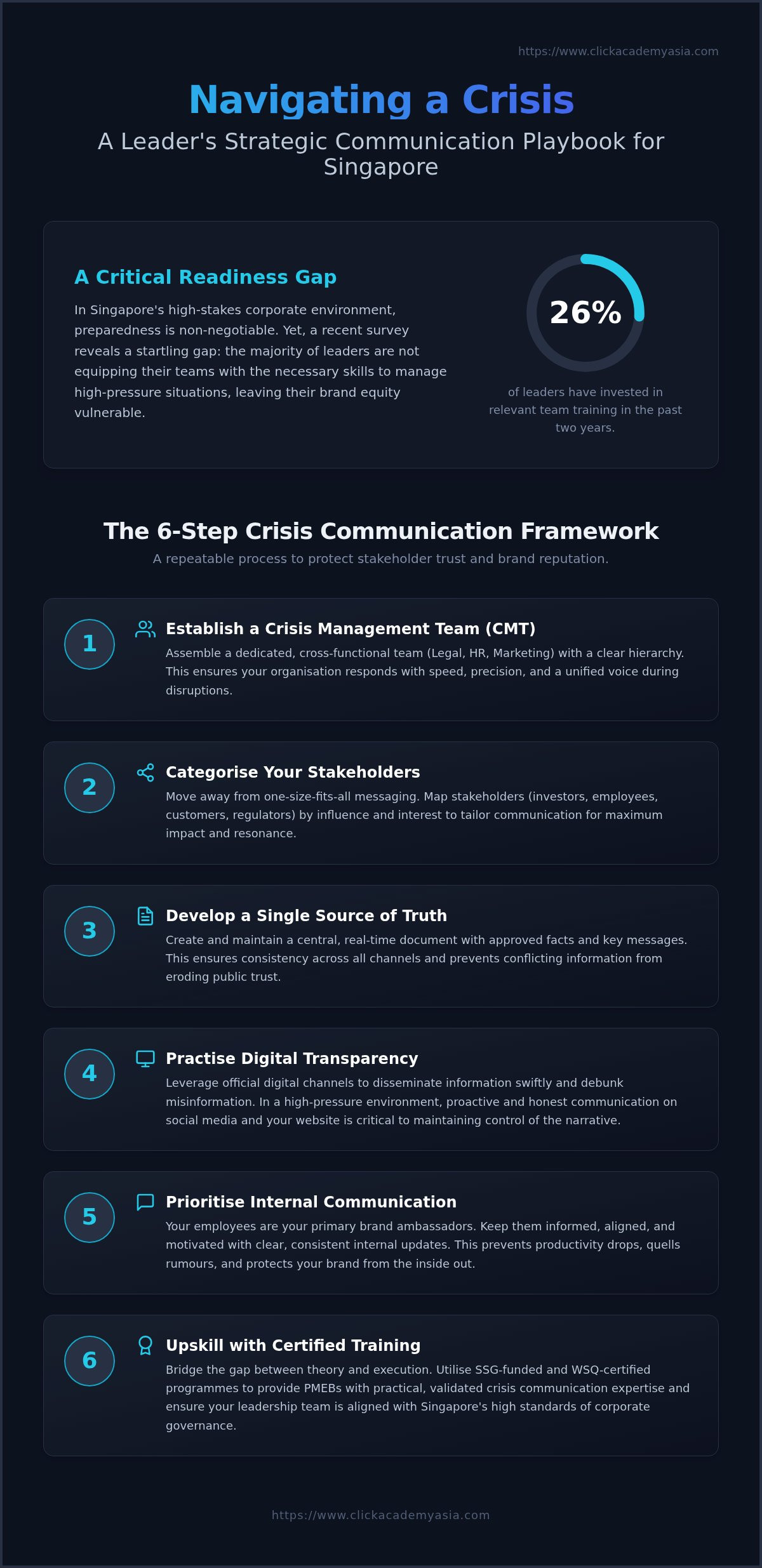
Did you know that only 26% of business leaders in Singapore have invested in relevant training for their teams over the last two years? In a high-stakes corporate environment, a single mismanaged message during a crisis can erase decades of brand equity in minutes. It's understandable why many PMEBs feel a sense of dread when faced with a public relations emergency or internal upheaval.
You're likely juggling conflicting interests from board members, employees, and the public, all while searching for a structured way to respond. By pursuing the leadership communication skills training singapore offers through specialised providers, you'll master a strategic framework designed to maintain stakeholder trust and protect your reputation. This article provides a clear roadmap to help you navigate these challenges with authority and poise.
We'll dive into a step-by-step crisis response plan and explore how practical, WSQ-certified training can boost your confidence in high-stakes situations. You'll also learn how to leverage SSG funding to equip your team with the skills needed to manage complex communications. Let's look at how you can transform your approach from reactive damage control into a strategic leadership asset.
Table of Contents
The Critical Role of Leadership Communication Skills Training in Singapore During a Crisis
A Step-by-Step Guide to Managing Stakeholder Communications During a Crisis
Segmenting Stakeholders: Tailoring Your Message for Maximum Impact
Digital Transparency: Maintaining Trust in a High-Pressure Environment
Upskilling with Leadership Communication Skills Training in Singapore
The Critical Role of Leadership Communication Skills Training in Singapore During a Crisis
Crisis communication isn't merely a reactive tool for damage control; it's the strategic dissemination of information during unforeseen business disruptions. In our interconnected regional economy, crisis triggers can emerge without warning. Whether it's a significant data breach affecting customer privacy or a sudden supply chain failure that halts operations, the speed of your response dictates the outcome. For PMEBs, mastering crisis communication theories and their practical applications is the first step toward safeguarding an organisation's future.
Investing in leadership communication skills training singapore provides the essential tools to maintain corporate stability when traditional structures falter. Effective communication does more than just share facts; it protects brand equity and prevents stakeholder churn. When leaders communicate with clarity and empathy, they reassure investors, retain talent, and keep customers loyal. Without this expertise, a poorly phrased statement can lead to a plummeting share price or a permanent stain on a firm's reputation.
Defining Strategic Stakeholder Alignment
Moving beyond basic "damage control" requires a shift toward proactive reputation management. There's a fundamental difference between simple information sharing and strategic influence. While the former merely broadcasts data, the latter shapes perceptions and maintains long-term stakeholder trust. Strategic alignment ensures that your messaging resonates with the specific concerns of different groups, from board members to frontline staff. This consistency builds a "trust bank" that your brand can draw upon when things go wrong.
The Singapore Business Context
Singapore maintains some of the highest standards of corporate governance globally. In this environment, transparency isn't just a best practice; it's a regulatory expectation. Local PMEBs can use WSQ frameworks to standardise their communication protocols, ensuring that every leader in the firm follows a validated, high-quality response plan. This structured approach is vital for navigating the local regulatory landscape and maintaining the city-state's reputation as a stable business hub.
Practical Application: Use leadership communication skills training singapore to turn theoretical crisis models into actionable internal playbooks.
Financial Accessibility: Take advantage of SSG funding to offset training costs for your management team.
Standardisation: Implement WSQ-aligned modules to ensure cross-departmental consistency during high-pressure events.
A Step-by-Step Guide to Managing Stakeholder Communications During a Crisis
Managing a crisis in the Singapore business environment requires more than just quick thinking. It demands a rigorous, repeatable process that ensures no stakeholder is left in the dark. This is where leadership communication skills training singapore provides a competitive edge, turning chaotic responses into disciplined execution. A structured approach allows PMEBs to navigate high-pressure scenarios without losing the trust of their board, employees, or customers.
Start by establishing a dedicated Crisis Management Team (CMT) with clear communication hierarchies. This team should include representatives from legal, HR, and marketing to ensure every angle is covered. Once the team is in place, you must identify and categorise your stakeholders based on their influence and interest. Mapping these groups helps you prioritise who needs information first and what level of detail they require. High-influence stakeholders, such as major investors or regulatory bodies, often require direct, personal outreach.
Consistency is your best defence against reputational damage. Develop a "Single Source of Truth" document that is updated in real-time. This ensures that every department, from the social media team to the CEO, is delivering the same message across all channels. In a crisis, speed is your ally, but accuracy is your shield. You must control the narrative within the first few hours to prevent misinformation from taking root in the public domain or across internal chat groups.
The First 24 Hours: Immediate Response Actions
The initial window is critical for setting the tone of the entire crisis response. Draft a concise holding statement for both internal and external use immediately. This buys your team time while you gather more facts. Simultaneously, set up real-time monitoring tools to track sentiment across social media and local news outlets. Finally, assign a designated spokesperson who has the authority and composure to handle tough questions. Professionals who have attended leadership communication skills training singapore are often better equipped to manage these high-stakes interactions.
Developing the Core Message Framework
Use the "Acknowledge, Action, Assurance" (AAA) model to structure every communication. First, acknowledge the situation honestly without shifting blame. Second, detail the specific actions you're taking to resolve the issue. Third, provide assurance of your commitment to stakeholder welfare and long-term stability. This framework keeps messages empathetic yet authoritative. Remember to adapt your tone for different platforms; an investor update requires a different nuance than a reassuring message to your frontline staff. Mastering these frameworks is a core component of ClickAcademy Asia's leadership and sales leadership programmes, which focus on practical, real-world application.
Segmenting Stakeholders: Tailoring Your Message for Maximum Impact
A one-size-fits-all approach is a recipe for failure during a high-stakes crisis. Sending the same generic update to your board of directors and your frontline operational staff leads to confusion and a loss of authority. Effective leadership communication skills training singapore teaches PMEBs how to dissect their audience based on their unique needs and levels of risk. While your investors demand data-driven assurance regarding financial stability and long-term viability, your employees need emotional reassurance and clear operational guidance. Tailoring your message ensures that every stakeholder group feels heard and valued, which is the cornerstone of maintaining brand reputation in the local business landscape.
Internal Stakeholders: Prioritising Your People
Your staff are your first line of defence and your most vocal brand ambassadors. Use town halls and internal bulletins to provide a single source of truth, effectively preventing workplace rumours from taking hold in private chat groups. It's vital to provide clear, written instructions to frontline teams on how to handle external enquiries from the public or media. This prevents conflicting information from leaking out and keeps the team aligned with the official narrative. Balancing transparency with legal constraints is a delicate art; you must share enough to maintain trust without compromising the firm's legal position or violating non-disclosure agreements.
External Stakeholders: Clients, Investors, and the Public
High-value clients and partners require personalised outreach to ensure business continuity and mutual trust. A quick phone call from a senior executive or a tailored email can prevent a key partner from seeking alternatives during a period of uncertainty. For investors and board members, the focus must shift to the strategic steps being taken to mitigate long-term impact, backed by concrete evidence. Managing media relations requires a proactive stance, using press releases and briefings to control the narrative before third-party speculation fills the void. To better understand how your audience perceives your brand during these high-pressure times, consider upskilling in audience sentiment analysis through WSQ Digital Marketing Courses in Singapore.
Board Members: Provide data-heavy reports focusing on financial risk, regulatory compliance, and recovery timelines.
Employees: Prioritise safety, job security, and clear internal protocols; utilizing resources from accredited specialists like You Can Do It Training Ltd can help leaders communicate these vital safety standards with greater confidence and clarity.
Clients: Emphasise service continuity and the specific steps taken to protect their ongoing interests and data.
Media: Provide factual, timely updates through a single authorised spokesperson to ensure message consistency and accuracy.
Digital Transparency: Maintaining Trust in a High-Pressure Environment
Social media acts as a double-edged sword during a business crisis. While it allows for instantaneous updates, it also provides a fertile ground for speculation and panic. In the Singapore business ecosystem, where digital connectivity is exceptionally high, leaders cannot afford to be passive observers. Modern leadership communication skills training singapore provides the digital savvy required to manage these platforms effectively, ensuring that your organisation remains the primary source of information. Real-time engagement is no longer optional; it is a visible sign that your leadership is taking decisive action.
Using official digital channels to debunk misinformation is a critical skill for any PMEB. When a crisis hits, silence is often interpreted as guilt or incompetence. By maintaining a transparent digital presence, you signal stability to both internal and external stakeholders. This proactive approach helps control the narrative before third-party commentators or disgruntled parties can define the situation for you. Professionals who invest in leadership communication skills training singapore are consistently better prepared to handle these digital pressures while owning the space where stakeholders are searching for answers.
Combatting Misinformation and Fake News
Rumours can derail even the most well-planned recovery strategy. Use social listening tools to identify the exact source of harmful narratives as they emerge. Developing a rapid-response digital toolkit for your social media managers ensures they have pre-approved templates and clear escalation paths. It's also essential to collaborate closely with legal teams to address defamatory content or fake news quickly. This joined-up approach ensures that your responses are both legally sound and communication-effective, protecting your brand's integrity in real-time.
The Power of Video in Crisis Communication
A direct video address from the CEO often builds significantly more trust than a standard text statement. Video allows stakeholders to see your body language and hear the sincerity in your voice, which is crucial for humanising a corporate response. When filming, maintain a professional yet reassuring presence, focusing on eye contact and clear, concise language. Distribute this content across LinkedIn and corporate portals to ensure it reaches the widest possible audience. To refine your ability to lead through digital channels, explore the Digital Transformation for Leaders programme, which equips you with the tools to navigate a tech-centric corporate world.
Speed of Response: Aim to address digital rumours within the first hour of detection to prevent viral spread across local networks.
Authenticity: Use unscripted or semi-scripted video updates to foster a sense of genuine accountability and transparency.
Channel Strategy: Prioritise platforms like LinkedIn for professional stakeholders and official company websites for the general public and media.
Upskilling with Leadership Communication Skills Training in Singapore
Professional development isn't just about collecting certificates; it's about closing the gap between knowing what to do and actually executing it under fire. Investing in leadership communication skills training singapore offers a controlled environment to stress-test your crisis protocols before a real-world emergency occurs. By learning from practitioners who have managed regional disruptions, PMEBs gain the tactical edge needed to lead with certainty. This practical approach ensures that your response is grounded in experience rather than just academic theory.
ClickAcademy Asia provides specialised leadership communication skills training singapore through its Sales Leadership and Sales Training programmes. These modules are specifically designed to help corporate leaders maintain stakeholder trust during periods of high volatility. By focusing on the practical application of communication strategies, these programmes empower you to protect your brand reputation while driving business continuity. You'll leave with a validated set of skills that are immediately applicable to your specific industry challenges.
Practical Application Over Theory
ClickAcademy Asia’s workshops move beyond textbook definitions to focus on real-world Singapore business cases. You won't just study theory; you'll engage in simulations that mirror the complexities of the APAC market. Learning from industry practitioners ensures you receive "quick wins" that you can implement immediately within your organisation. This transition from academic knowledge to practical mastery is what defines a truly future-proof leader. These sessions provide a safe space to refine your tone, delivery, and strategic messaging before you ever have to face a live microphone or a concerned board.
Accessing SSG Funding and WSQ Frameworks
High-quality education is more accessible than ever through SkillsFuture Singapore (SSG) funding. Eligible SMEs can receive up to 90% subsidy on course fees under the Enhanced Training Support for SMEs (ETSS) programme. PMEBs aged 40 and above can also utilise the Mid-Career Enhanced Subsidy (MCES) to offset up to 90% of their training costs. HR managers should also leverage the SkillsFuture Enterprise Credit (SFEC), which provides a one-off S$10,000 credit to offset out-of-pocket expenses for WSQ-certified training.
Check Eligibility: Visit the MySkillsFuture portal to verify your individual or corporate subsidy levels.
Organise Group Training: HR leaders can coordinate team-based upskilling to standardise communication protocols across the firm.
Claim Absentee Payroll: Employers can claim S$4.50 per hour for each employee attending SSG-funded training during work hours.
Foster Resilience: Encourage a culture of continuous learning to ensure your team is always ready for the next market shift.
Securing Your Brand Future with Strategic Communication
Successfully navigating a corporate crisis requires more than just speed; it demands a structured framework that preserves stakeholder trust and protects brand integrity. By segmenting your audience and owning the digital narrative, you transform a potential reputation disaster into a clear demonstration of resilient leadership. Practical upskilling ensures you aren't just reacting to events but are actively shaping the outcome with authority and poise.
Enrolling in the leadership communication skills training singapore offers through specialised providers is the most effective way to standardise these protocols across your management team. Our WSQ-certified leadership modules are designed for immediate impact, featuring practical workshops led by industry experts who understand the local business ecosystem. With up to 70-90% SSG funding available for eligible Singaporeans, it's a strategic investment that empowers your PMEBs to handle high-stakes scenarios with confidence.
Equip your team with expert leadership communication skills through our WSQ-funded training programmes today. We look forward to helping you build a more resilient, future-ready workforce that can thrive in any environment.
Frequently Asked Questions
What are the most important leadership communication skills for crisis management?
The most critical skills include empathy, clarity, and the ability to maintain a consistent "Single Source of Truth." Leaders must be able to listen to stakeholder concerns actively while delivering authoritative updates that reduce panic. Speed is essential, but accuracy remains the ultimate priority. Mastering these skills through structured training allows you to navigate high-pressure environments without damaging your professional reputation or the company's brand equity.
How does leadership communication skills training in Singapore help PMEBs?
This training equips PMEBs with a repeatable strategic framework to manage complex stakeholder interests during unforeseen disruptions. In the competitive Singapore business environment, having a validated crisis response plan is a significant career advantage. leadership communication skills training singapore provides practical "quick wins" and real-world simulations that build the confidence needed to lead teams through periods of intense market volatility or internal organisational change.
Can I use SkillsFuture credits for leadership communication courses?
Yes, eligible Singaporeans can use their SkillsFuture credits to offset the costs of leadership communication courses. Many of these programmes are part of the WSQ framework, making them eligible for significant government subsidies. For individuals aged 40 and above, the Mid-Career Enhanced Subsidy (MCES) provides even higher levels of support. It's an excellent way to upskill and stay future-ready without incurring substantial out-of-pocket expenses for high-level executive education.
What is the difference between a PR statement and a leadership communication strategy?
How do I manage internal stakeholder communications during a data breach?
Managing internal communications during a data breach requires absolute transparency combined with clear, actionable instructions. You should hold immediate town halls or send internal bulletins to prevent workplace rumours from spreading on private chat groups. Provide your staff with a pre-approved script for handling external enquiries to ensure message consistency. Balancing these updates with legal constraints is vital, so always coordinate closely with your legal team before releasing specific technical details.
Are ClickAcademy Asia courses WSQ-certified?
Yes, ClickAcademy Asia offers a wide range of WSQ-certified courses specifically tailored for professionals, managers, and executives. These programmes align with the national SkillsFuture Singapore (SSG) framework, ensuring that the training you receive meets high industry standards for practical application. By choosing WSQ-accredited modules, you can also access significant government funding, making high-level training in areas like digital transformation and sales leadership more accessible for your entire organisation.
What is the role of digital transparency in crisis communication?
Digital transparency involves using official social media channels and corporate portals to provide real-time, honest updates during a crisis. It acts as a primary defence against misinformation and "fake news" that can quickly go viral in Singapore's highly connected landscape. By being proactive and owning the digital space, you signal accountability and decisiveness. This approach builds trust with a tech-savvy audience that expects immediate engagement and visible leadership action.
How can I apply for SSG funding for my team’s leadership training?
Applying for SSG funding is a straightforward process handled through the Training Partners Gateway or the MySkillsFuture portal. HR managers can check their company's eligibility for the SkillsFuture Enterprise Credit (SFEC) to offset out-of-pocket expenses. Once you select a WSQ-certified course provider like ClickAcademy Asia, the subsidies are typically applied at the point of transaction. This makes it easier to organise group training while maximising your organisation's training budget.


Comments