
International E-commerce: 2026 Guide for Singapore PMEBs

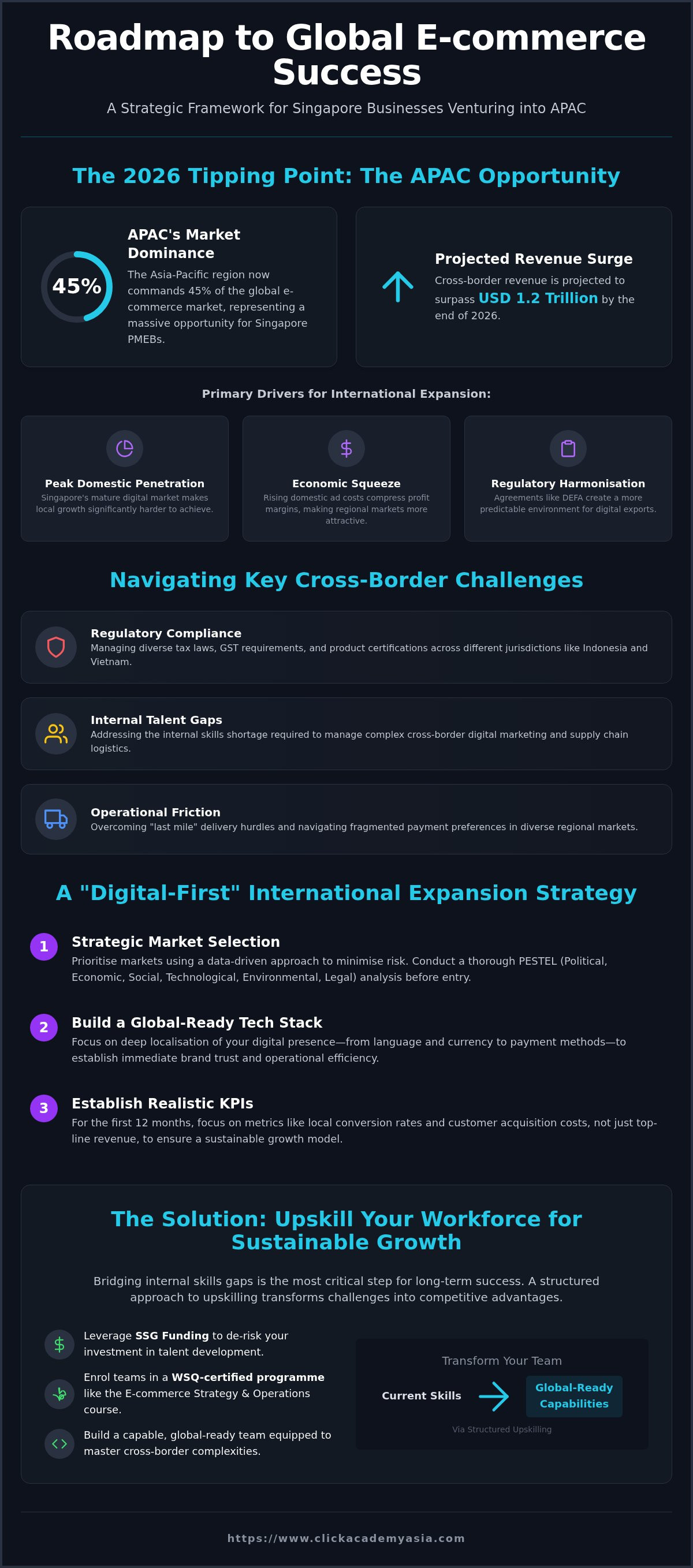
Did you know that the Asia-Pacific region now commands 45% of the global e-commerce market, with cross-border revenue projected to surpass USD 1.2 trillion by the end of 2026? For Singapore PMEBs, these figures represent a massive opportunity that's becoming impossible to ignore as domestic markets reach saturation. You've likely felt the pressure of rising customer acquisition costs and the headache of managing complex regional regulations across ASEAN. It's a common struggle where the desire for growth is often dampened by a visible internal skills gap.
Implementing a successful international e-commerce expansion strategy requires more than just a digital presence; it demands a team capable of managing cross-border complexities. You'll discover how to build a resilient framework for market entry while leveraging SSG funding and WSQ upskilling to future-proof your workforce. We'll examine the shift toward the unified EDGE grant scheme and the impact of the ASEAN Digital Economy Framework Agreement. By the end, you'll have a clear roadmap to turn regional complexity into a distinct competitive advantage for your business.
Table of Contents
Assessing the 2026 Global Landscape for Your International E-commerce Expansion Strategy
Developing a robust international e-commerce expansion strategy in 2026 requires a sophisticated, multi-layered approach to cross-border trade. For Singapore PMEBs, this year represents a critical tipping point where looking beyond domestic borders is no longer optional. Local market saturation and the relentless climb of customer acquisition costs have made the home market increasingly competitive, forcing brands to seek growth in larger regional territories. This transition involves more than just shipping products; it requires a deep understanding e-commerce principles applied across diverse regulatory environments.
Several factors have converged to make 2026 the definitive year for Singaporean businesses to scale internationally. We have identified three primary drivers for this shift:
Peak Domestic Penetration: Singapore's digital market has reached a maturity level where organic local growth is significantly harder to achieve.
Economic Squeeze: Rising costs in domestic digital advertising have compressed profit margins, making regional markets with lower acquisition costs more attractive.
Regulatory Harmonisation: The finalisation of regional trade agreements has created a more predictable environment for Singapore-based digital exports.
The APAC Opportunity: Why Singapore Brands Are Scaling
The surge of the digital middle-class in Southeast Asia and Australia offers a massive untapped reservoir for Singaporean brands. Singapore acts as the primary regional hub for APAC digital trade, providing a strategic and logistical base for expansion into these high-growth zones. Trade agreements like the European Union-Singapore Digital Trade Agreement (EUSDTA) and the upcoming ASEAN Digital Economy Framework Agreement (DEFA) are facilitating smoother digital exports by standardising data flows and payment protocols. In 2026, cross-border e-commerce is defined as the tech-enabled, seamless exchange of goods across digital frontiers, governed by these new harmonised regional trade standards.
Identifying Market Entry Barriers for Professionals
Common pain points for PMEBs include the fear of regulatory divergence in complex markets like Indonesia or Vietnam. However, the shift from traditional physical retail to platform-based global selling has lowered many of the legacy barriers to entry. Success now depends on a structured "Strategy & Planning" mindset rather than the ad-hoc tactics used in previous years. Professionals must navigate several key challenges to ensure sustainable growth:
Regulatory Compliance: Managing varying tax laws, GST requirements, and product certifications across different jurisdictions.
Talent Gaps: Addressing the internal skills gap required to manage complex cross-border digital marketing and logistics.
Operational Friction: Overcoming "Last Mile" delivery challenges and fragmented payment preferences in regional markets.
Bridging these gaps is possible through the WSQ framework, which provides the structured upskilling required to master these global complexities. By leveraging SSG funding, Singapore businesses can de-risk their expansion and build a team capable of long-term success in the regional digital economy.
Developing a Robust International E-commerce Expansion Strategy
For Singapore SMEs, an international e-commerce expansion strategy shouldn't be an expensive gamble. A "Digital-First" model allows you to test markets with minimal capital expenditure before committing to local infrastructure. This approach leverages the lower barriers of entry provided by global platforms while maintaining the agility needed to pivot. By following a structured 5-step framework, you can ensure your regional entry is both calculated and scalable.
Before launching into a new territory, you've got to conduct a thorough PESTEL analysis. This evaluates the Political, Economic, Social, Technological, Environmental, and Legal factors that will impact your operations. It's critical to set realistic KPIs for your first 12 months, focusing on local conversion rates and customer acquisition costs rather than just top-line revenue. This data-backed foundation helps mitigate the risks of regulatory divergence mentioned earlier.
Step 1: Data-Driven Market Selection and Analysis
Don't guess where your customers are; let the numbers lead the way. Use Google Trends and Analytics to identify regional clusters with high search volume for your specific product categories. A strategic matrix helps you compare "high-potential" markets against "high-competition" ones to find your sweet spot. For a deeper dive into identifying these opportunities, check out [Internal Link: Advanced Keyword Research Strategies: A 2026 Masterclass for Digital Professionals]. Refining your eCommerce digital strategy through intent data reduces the risk of entering a saturated market blindly.
Step 2: Choosing Your Entry Mode
You've got three main paths for entry. The "Marketplace First" approach using platforms like Amazon or Shopee provides immediate traffic but limits your brand control. Conversely, a Direct-to-Consumer (DTC) model via your own website offers superior data ownership but requires higher initial marketing spend. The "Hybrid Model" is the 2026 gold standard for PMEBs.
This hybrid approach uses marketplaces for initial reach while building a DTC presence for long-term customer loyalty. Managing these storefronts in-house ensures you retain agility and control over the customer experience. If you're looking to refine these skills, our E-commerce Strategy & Operations course provides the practical toolkit needed to manage this transition effectively. It's about finding the right balance between third-party reach and first-party data.
Optimising Digital Infrastructure for Cross-Border Success
Scaling beyond Singapore requires a tech stack that does more than just process orders. Your international e-commerce expansion strategy must integrate social commerce channels directly into your back-end operations. By 2026, platforms like TikTok Shop and Shopee Live aren't just additives; they're primary discovery hubs for regional consumers. Failing to sync these with your central inventory management leads to stockouts and damaged brand reputation.
A global-ready infrastructure also demands a shift toward AI-driven personalisation and dynamic pricing. These tools allow you to adjust offerings in real-time based on local demand and competitor activity. By building a modular digital ecosystem, you can add new regional storefronts without rebuilding your entire foundation. This agility is what separates market leaders from those who struggle with technical debt during expansion.
Localization Strategies Beyond Language
Don't confuse simple translation with deep localization. Cultural localization adapts your brand voice, imagery, and pricing structures to align with local sensibilities and purchasing power. For mobile-first markets in the APAC region, your user experience (UX) must be lightning-fast and designed for small screens from the ground up. Consider this checklist for your regional assets:
Visual Audit: Ensure marketing assets reflect local diversity and cultural norms to build immediate trust.
Mobile Optimisation: Prioritise thumb-friendly navigation and fast loading times for 4G/5G networks.
Search Visibility: Implement local SEO and SEM to ensure your brand appears in regional search queries.
Navigating Cross-Border Logistics and Payments
Fragmented geography in markets like Indonesia creates unique "Last Mile" challenges that require local expertise. You need a logistics partner capable of navigating complex terrain and local customs to ensure reliable delivery. Diversifying your payment gateways is equally vital for conversion, as regional consumers frequently bypass credit cards in favour of digital wallets and "Buy Now Pay Later" (BNPL) options. Integrating advanced marketing analytics into your infrastructure is essential to track cross-border ROI across every digital touchpoint from social discovery to final delivery.
Building this technical foundation ensures your expansion is based on hard evidence rather than optimistic projections. You can empower your team to manage these complex systems by leveraging WSQ-certified training in marketing analytics and digital strategy. This ensures your human capital is as ready for growth as your digital infrastructure, allowing you to scale with confidence.
Upskilling Your Workforce for Global Market Entry
Most international expansion projects fail not because of poor products, but because of internal talent gaps. An effective international e-commerce expansion strategy requires a team that can interpret cross-border data and manage regional digital advertising in-house. Without these skills, your business remains overly dependent on external vendors who may not align with your long-term vision. Investing in your people is the most sustainable way to de-risk your entry into new territories. If you are exploring international training and consulting resources to help realise your growth ambitions, check out Full Potential.
PMEBs in Singapore must transition from being domestic marketing leads to international strategy directors. This shift involves mastering high-level planning over ad-hoc execution and understanding how to harmonise regional operations. The WSQ framework provides a structured pathway for this professional evolution, ensuring your leadership team can navigate the complexities of global digital trade. It's about moving from managing campaigns to orchestrating entire market entries.
Singaporean citizens and Permanent Residents can access significant SSG-subsidised training to offset upskilling costs. Corporate leaders can further utilise the SkillsFuture Enterprise Credit (SFEC) to fund group training for their entire marketing department. You can explore our specific modules in the [Internal Link: Mastering the 2026 Landscape: WSQ Digital Marketing Courses in Singapore] to find the right fit for your team's expansion needs. These subsidies make high-level consultancy-grade training accessible for every Singapore-based enterprise.
The ROI of a Certified E-commerce Team
Building an internal team grounded in the WSQ "Strategy & Planning" pillar dramatically reduces your reliance on expensive external agencies. This self-sufficiency often leads to faster pivot times and more accurate cross-border ROI tracking because your team owns the data. Achieving Google and GA4 certifications provides your staff with the global credibility needed to manage international accounts with confidence. These certifications act as a universal language for digital excellence across the APAC region.
Future-ready skills like search automation and advanced GA4 analytics are non-negotiable for 2026. Empowering your staff with these competencies ensures your international e-commerce expansion strategy is executed with precision rather than guesswork. Secure your team's spot in our next WSQ Digital Marketing Strategy & Planning intake to start building your internal powerhouse today.
Scaling Your Business Through WSQ-Certified Training
Executing a high-level international e-commerce expansion strategy demands a shift from conceptual planning to operational excellence. ClickAcademy Asia’s E-commerce Strategy & Operations course is designed as the primary tool for Singaporean businesses ready to bridge this gap. This WSQ-certified programme doesn't just discuss theory; it provides a hands-on framework for managing regional storefronts, logistics, and cross-border customer service. By equipping your team with these practical competencies, you ensure your expansion is sustainable and profit-driven.
The curriculum is structured to guide PMEBs through every stage of the journey, from initial market entry to complex operational scaling. You'll learn how to optimise supply chains across fragmented markets and implement tech stacks that support multi-currency transactions. Unlike generic online tutorials that offer surface-level advice, our mentor-led approach provides direct access to industry experts. This ensures your team receives feedback grounded in real-world regional challenges, rather than just academic concepts.
Why ClickAcademy Asia for International Strategy?
With a 15-year track record since our establishment in 2011, we've positioned ourselves as a premier destination for specialised professional education in Singapore. Our status as a Google Certification partner ensures that our curriculum stays aligned with the latest digital standards and platform updates. Our trainers aren't just educators; they're practitioners who've managed regional brands and navigated the exact regulatory hurdles you face. For senior management, our "Digital Transformation for Leaders" module offers the strategic oversight needed to steer large-scale international initiatives.
Next Steps: From Strategy to Execution
Your journey toward regional leadership starts with a clear understanding of your current internal capabilities. HR managers can begin by auditing their team's digital skills to identify where the WSQ framework can provide the most immediate impact. We offer customised corporate programmes tailored to your specific industry needs, ensuring your cohort learns in a context that's directly applicable to your business goals. These quick wins allow you to build momentum while leveraging SSG funding to de-risk your talent investment.
Don't let a skills gap stall your regional growth. Start by reviewing our [Internal Link: ClickAcademy Asia Sales/Marketing courses] to explore the WSQ-funded tracks that will power your next phase of expansion. By investing in practical mastery today, you're not just training staff; you're building the foundation for a dominant regional presence.
Mastering Your Regional Growth in 2026
The path to scaling beyond Singapore requires a balanced approach that combines strategic data with a highly skilled workforce. You've seen how a "Digital-First" entry mode and a robust international e-commerce expansion strategy can mitigate risks while capturing high-intent regional clusters. By prioritising deep localisation and modern social commerce channels, your brand can build lasting trust in fragmented markets across the APAC region.
Success isn't just about the platforms you use; it's about the people operating them. As an Official Google Certification Partner with WSQ-certified training modules, ClickAcademy Asia is trusted by PMEBs across 30+ countries to deliver practical excellence. We're here to help you navigate the complexities of digital trade with confidence and technical mastery.
Equip your team with the strategic skills to scale globally through our WSQ-funded E-commerce Strategy courses. It's time to turn your global aspirations into a tangible, high-revenue reality for your business.
Frequently Asked Questions
What are the most common mistakes in an international e-commerce expansion strategy?
Underestimating localisation and failing to upskill the internal team are the most frequent pitfalls. Many businesses rely on a "one-size-fits-all" approach that ignores cultural nuances and regional regulations. Another error is neglecting data-driven market selection, which leads to entering saturated markets blindly. A successful international e-commerce expansion strategy requires a team that understands both technical infrastructure and regional consumer behaviour to ensure long-term growth.
How can Singapore companies use SSG funding for e-commerce training?
Singapore companies can access SSG funding through the WSQ framework by enrolling employees in accredited modules like our E-commerce Strategy & Operations course. This funding significantly reduces out-of-pocket costs for citizens and Permanent Residents. Additionally, eligible firms can utilise the SkillsFuture Enterprise Credit (SFEC) to further offset training expenses for group cohorts. This ensures your workforce remains competitive while managing expansion budgets effectively and building a future-ready team.
What is the best entry mode for a Singapore SME looking to sell in Australia?
The "Hybrid Model" is often the most effective path for the Australian market. This involves using established marketplaces like Amazon Australia to gain immediate visibility and trust while simultaneously building a Direct-to-Consumer (DTC) site. Australia's mature digital ecosystem rewards brands that provide a seamless mobile experience and clear shipping policies. This dual approach allows you to capture marketplace traffic while owning your long-term customer data and brand identity.
Is it better to use a marketplace like Amazon or build a standalone DTC site for expansion?
Using a combination of both is the 2026 gold standard for regional growth. Marketplaces provide a ready-made audience and logistical support, which is ideal for testing new territories quickly. However, a standalone DTC site is essential for brand building and data ownership. We recommend starting with a marketplace to validate demand before scaling your own digital storefront to maximise your long-term international e-commerce expansion strategy and profit margins.
How much does it cost to train a team in WSQ Digital Marketing Strategy?
The net cost for WSQ training depends on the specific subsidy bracket of each participant. Singaporean citizens and Permanent Residents are eligible for significant SSG subsidies, which cover a large portion of the enrollment fees. Companies should check their eligibility for the SFEC to further reduce costs. For exact pricing and subsidy calculations for your team, it's best to contact us directly for a customised corporate training quote tailored to your needs.
What digital marketing skills are most in demand for global e-commerce in 2026?
Proficiency in GA4 analytics, search automation, and social commerce are the most critical skills for 2026. Teams must be able to interpret complex cross-border data to optimise ROI across multiple regional storefronts. Mastery of search engine marketing (SEM) and SEO is also vital for maintaining visibility in competitive global markets. These competencies allow PMEBs to move from ad-hoc tactics to a structured, scalable expansion framework that delivers measurable results.
Can I use SkillsFuture credits for international e-commerce courses?
Individual Singaporeans can use their SkillsFuture Credit to pay for the out-of-pocket fees of WSQ-certified e-commerce courses. This applies to various modules within our curriculum, including E-commerce Strategy & Operations. For corporate training, employers can also leverage the SkillsFuture Enterprise Credit to support their staff's professional development. This makes upskilling an affordable reality for both individual professionals and growing enterprises looking to lead in the regional digital economy.


Comments