
How to Use Generative AI to Write High-Converting Ad Copy

For SaaS Google Search campaigns, generative AI for writing high-converting ad copy works best as a drafting partner: with product, audience and campaign details, it can produce 10-20 ad copy variants in under 30 seconds. That speed helps you explore more angles, but it doesn’t make every draft persuasive, accurate or ready to publish.
It’s easy to see the appeal: writing multiple headlines and descriptions takes time, while generic copy can blur what sets your software apart. A stronger approach is to give AI a clear brief, use a copywriting framework to shape the message, then edit each draft for brand voice, proof points and search intent.
This guide shows you how to build that process for Google Search ads in Singapore. You’ll learn how to brief AI for SaaS, apply frameworks such as PAS and AIDA, refine claims and calls to action, and test variations to find what resonates with your audience. The goal isn’t to hand over your judgement, but to use AI to generate better options and put your expertise to work.
Table of Contents
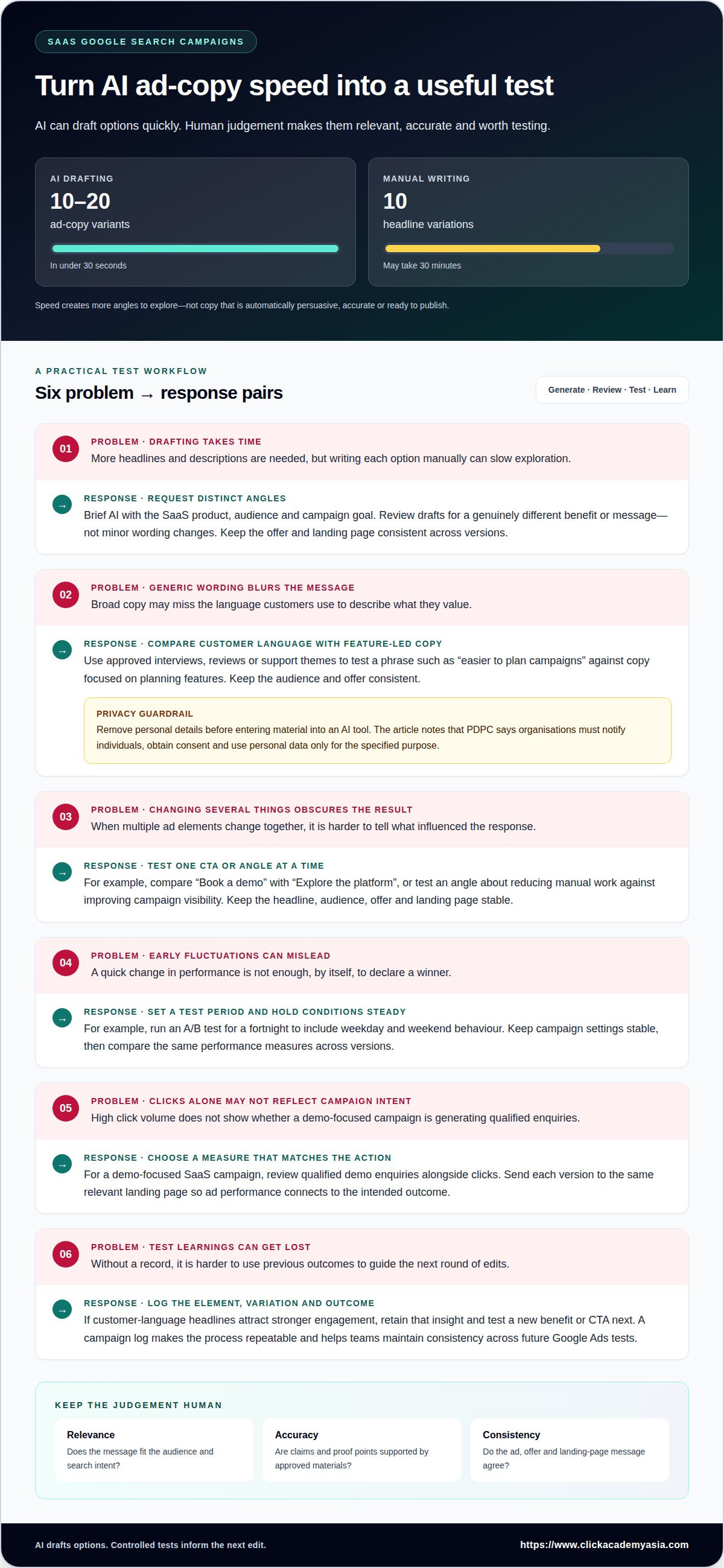
How does AI Google Ads copy creation compare to manual writing?
AI can speed up drafting, while human judgement shapes relevance, accuracy and campaign strategy. Compare variations through controlled tests rather than assumptions about which writing method works best.
Generate Ad Copy VariationsGive an AI tool your SaaS product details, audience and campaign goal, then request distinct headline and description variations. It can produce 10-20 ad copy variants in under 30 seconds; without AI, writing 10 headline variations may take 30 minutes. Review each draft for a genuinely different benefit or message, rather than minor wording changes. Keep the offer and landing page consistent across versions.
Test Voice-of-Customer CopyUse customer language from approved interviews, reviews or support themes to create a test variation. Compare it with a concise, feature-led version, keeping the audience and offer consistent. For example, if customers describe a SaaS tool as “easier to plan campaigns”, test that phrase against copy focused on its planning features. Remove personal details before entering material into an AI tool. The Personal Data Protection Commission (PDPC) says organisations must notify individuals, obtain consent and use personal data only for the specified purpose.
Compare Calls to Action and AnglesTest one call to action or persuasion angle at a time, such as “Book a demo” against “Explore the platform”. Pair each action with a clear message, such as reducing manual work or improving campaign visibility. Keep the headline, audience, offer and landing page stable while testing the CTA. This makes the comparison more useful than changing several elements at once, which obscures what influenced the response.
Set a clear test period before launching variations. For example, run an A/B test for a fortnight to include weekday and weekend behaviour. Keep campaign settings stable during that period, then compare the same performance measures across versions. Avoid declaring a winner based on an early fluctuation. Consistent conditions make results easier to interpret.
Choose a primary measure that matches the campaign’s intended action. For a demo-focused SaaS campaign, review qualified demo enquiries alongside clicks rather than treating click volume as the sole measure of success. Check that each version sends people to the same relevant landing page. This connects ad performance to the outcome the campaign is designed to achieve.
Use each test result to shape the next iteration. If customer-language headlines attract stronger engagement, retain that insight and test a new benefit or CTA in the next round. Record the tested element, variation and outcome in a campaign log. This creates a repeatable optimisation process and helps teams maintain consistency across future Google Ads tests.
What Is an AI Ad Copy Generator?
An AI ad copy generator turns a prompt into draft headlines and descriptions using the product and campaign details you provide. For stronger results, brief it on the audience, offer, proof points and brand voice, then tailor the language and examples to Singapore’s market.
Prompt for On-Brand DraftsGive the tool a concise brand voice guide before requesting copy. Specify preferred wording, sentence style, tone and phrases to avoid, then include the audience, offer and campaign objective. For example, request search ad headlines for a project-management platform aimed at Singapore SMEs, using a direct, practical tone. Ask for distinct messaging angles, not repeated claims with swapped adjectives.
Prepare the evidence before drafting. List the product’s verified capabilities, customer benefits and supporting proof points, then separate these from ideas that still need substantiation. A prompt could say, “Write descriptions using only these three confirmed features.” This boundary helps prevent an AI tool from inventing performance figures, integrations or customer results to make copy sound more persuasive.
Define the audience and offer precisely. Replace “businesses” with a useful segment, such as Singapore finance teams seeking clearer expense workflows. State what the campaign promotes and what action readers should take, such as booking a product demonstration. Specific inputs help the tool produce relevant messaging rather than broad descriptions that could apply to any software.
Review every claim and urgency cue before launch. Confirm that product capabilities, offer terms and proof points match approved materials. Use scarcity only when a real limit exists, such as an actual end date or limited capacity. Avoid invented phrases like “only a few places left”; urgency without a genuine reason can mislead prospects and weaken brand trust.
Adapt Copy Across Platforms and MarketsAdapt each draft to the platform while preserving the core brand voice. Keep the product promise consistent across Google Search ads, landing pages and social campaigns, then adjust the wording for each audience and placement. For Singapore, use locally familiar examples and language suited to the intended audience. Don’t assume one English-language draft fits every market or language group.
Use a repeatable editing workflow: generate, review, revise and approve. Compare each draft with the voice guide, remove unsupported claims, and check that the final headline, description and landing-page message agree. Keep approved copy as a reference for future prompts. Teams building this process into their marketing practice can develop relevant skills through ClickAcademy Asia WSQ Content Marketing Strategy.
PAS, AIDA, BAB, and 4 U's copywriting frameworks
Use a copywriting framework to give AI a clear structure, then judge each draft against your campaign goal. The same SaaS offer can produce different headlines when the prompt changes its persuasive angle.
Apply PAS when your target audience recognises a specific problem. Ask AI to state the problem, intensify its practical impact, then present your software as a solution. For campaign-planning SaaS, the sequence might move from scattered planning, to missed handovers, to a shared workspace. Check that the problem feels accurate, not exaggerated.
Choose AIDA when the ad needs to guide readers towards an action. Prompt for attention with a relevant headline, interest with a product benefit, desire with a credible outcome, and action with a direct CTA. For example, a reporting platform could move from fragmented data to clearer campaign decisions. Keep each stage concise enough for a search ad.
Use BAB to contrast the reader’s situation before and after using the product. Describe the current challenge, show the desired state, then connect the two through a product capability. A SaaS finance tool might contrast manual expense tracking with a more organised review process. Ask AI to make the bridge explicit without promising an outcome the product cannot support.
Use the 4 U’s to assess headlines: useful, urgent, unique and ultra-specific. Prompt AI to draft versions that make a clear reader benefit, give a legitimate reason to act, distinguish the offer and name a concrete feature. Remove urgency without a genuine basis. This framework helps teams assess copy quality, rather than treating catchy wording as proof of performance.
For agencies and freelancers, save reusable prompts by client, audience and platform. Include approved claims and brand guidance, then generate several framework-led angles for review. A dedicated AI copywriter may focus on ad formats, while a broader writing platform may support varied content tasks. Compare tools by output control, collaboration and fit with your workflow, not by labels alone.
Assess free and paid AI copywriting options against the work you need done. Test the same SaaS brief in each platform and compare headline relevance, editing effort, export options and team workflow. A free option may suit occasional drafting; a paid plan may better fit recurring team use if its features justify the cost. Teams developing a stronger framework for content decisions can explore [Internal Link: ClickAcademy Asia WSQ Content Marketing Strategy].
Iterating on AI drafts and humanising the final copy
Use a review workflow to turn AI drafts into accurate, audience-focused ads, not finished copy. For Singapore campaigns, review claims and platform requirements before launch. The Personal Data Protection Commission (PDPC) says organisations must notify individuals, obtain consent and use personal data only for the specified purpose.
Iterate on AI DraftsRevise one element at a time, such as the benefit, opening phrase or call to action. If a SaaS headline says “Simplify your work”, ask the model for a clearer version tied to a real product feature. Compare the new draft with the original while keeping the audience and offer stable. This makes each edit purposeful and helps prevent the meaning from shifting between versions.
Humanise Copy Through EditingRead each ad aloud and replace language your customers wouldn’t naturally use. Change phrases such as “optimise operational efficiencies” to a specific, plain-English benefit when the product supports that claim. Keep the brand voice consistent, but vary sentence rhythm so headlines don’t sound like templated model output. A human editor should preserve useful ideas while removing stiff wording and unnecessary modifiers.
Use campaign evidence to decide what to refine next. Review search terms, landing-page behaviour and the outcomes your campaign tracks. If a headline attracts clicks but few relevant enquiries, examine whether its promise matches the landing page. Update the message around a confirmed customer need rather than adding stronger claims just to attract attention. Record the change and its reason in the testing log.
Check every factual claim against product documentation or approved materials. Verify named features, integrations, customer results, offer terms and comparisons with other products. Remove unsupported superlatives such as “the fastest” unless evidence substantiates them. Treat urgency the same way: an end date or capacity limit must be real. Human oversight protects prospects from misleading language and helps preserve brand credibility.
Limit sensitive information in prompts and review what the AI tool receives. Use anonymised examples instead of customer names, email addresses or identifiable support conversations. The PDPC’s guidance requires organisations to notify individuals, obtain consent and use personal data only for its specified purpose. Keep prompts focused on audience needs and approved messaging, not private customer records or confidential account details.
Set a final approval step before publishing any AI-assisted ad. Have a reviewer confirm that the headline, description, landing page and actual offer agree, then check spelling, tone and platform requirements. Keep the approved version and its supporting evidence together, so future edits have a reliable reference. Teams strengthening this capability can develop practical skills through [Internal Link: ClickAcademy Asia WSQ Digital Advertising].
AI-generated Google Search ad copy for SaaS
For SaaS, effective Google Search ads connect a specific search intent to a clear product benefit. Build AI output around the query, the software’s actual capability and the next step.
Start with the search intent behind each ad group. Separate queries about a problem, such as “automate campaign reporting”, from product-comparison searches. Ask the AI writer for a distinct message for each intent. A single generic ad can miss whether someone wants a solution, a feature or a vendor shortlist.
Give the model a compact product brief. Include the SaaS category, target user, primary use case, verified features and desired action. For a reporting platform, specify whether it combines campaign data or creates dashboards. This detail steers the output towards relevant benefits instead of unsupported capabilities.
Translate each feature into a benefit without changing its meaning. A scheduling feature might support a message about planning work in one place. Ask for headlines that express the benefit plainly, then descriptions that add context. Avoid claiming the software saves time or improves results unless evidence supports that outcome.
Build the ad around a credible proof point. If a draft says, “Reduce campaign planning time by 40%”, treat it as a claim requiring evidence, not ready-to-publish copy. Ask the writer to create an alternative based only on documented features. Specific proof can make advertising more useful, but invented numbers can undermine trust.
Match the ad’s promise to its landing page. If the headline promotes automated reporting, send visitors to a page explaining that capability. Check that the page supports the same product terms, audience and call to action. For Singapore campaigns, use examples and terminology familiar to the intended local business audience.
Review the assembled Google Search ad, not just its headlines in isolation. Read the available combinations for repeated phrases, conflicting benefits and unclear calls to action. A headline about saving time paired with a description about team visibility may work only if the landing page connects both benefits. Remove combinations that muddy the offer.
Use campaign findings to shape the next brief. Compare meaningful outcomes, such as qualified enquiries, with the intent and message each ad addressed. Record which product benefit and search theme shaped the result. This gives the next AI prompt a stronger strategic foundation than simply asking for more versions.
To strengthen the skills behind search campaign planning and ad evaluation, explore Google Ads Search Certification.
ClickAcademy Asia
ClickAcademy Asia helps marketing professionals build the strategic skills behind effective AI-assisted advertising. Turn to its training when your team needs to strengthen campaign planning, refine messaging or connect paid search with broader digital marketing goals.
Its offerings include WSQ Digital Marketing Strategy & Planning, WSQ Content Marketing Strategy, WSQ Search Engine Optimization (SEO) and WSQ Search Engine Marketing (SEM). These programmes support practical learning across strategy, content and search, helping teams apply stronger judgement when developing and assessing ad copy.
For professionals looking to develop these capabilities, explore the training that best fits your learning priorities. Contact ClickAcademy Asia to discuss your digital marketing development needs.
Build the judgement behind better AI-assisted advertising
The next step is to make thoughtful ad development part of your team’s everyday practice. As generative AI for writing high-converting ad copy becomes part of your workflow, the advantage will come from people who can connect audience insight, sound strategy and careful review.
ClickAcademy Asia supports that development through WSQ Digital Marketing Strategy & Planning, WSQ Content Marketing Strategy and WSQ Search Engine Optimization (SEO). These learning pathways can help marketing professionals strengthen the broader skills that inform campaign decisions, from shaping useful messaging to understanding how advertising fits into a digital strategy.
Whether you’re building your own capability or developing a team, choose learning that connects practical application with your business priorities. Contact ClickAcademy Asia to discuss your digital marketing learning needs and take a confident next step.
Frequently Asked Questions
What makes ad copy effective?
Effective ad copy matches the searcher’s need with a relevant, believable reason to act. For a SaaS product, a headline might name the specific task it supports, while the description explains who benefits and what happens next. Keep the ad consistent with its landing page, and avoid promises the product cannot substantiate. Clear language and a useful next step make the message easier to assess.
Why Use AI for Ad Copywriting?
AI helps marketers explore message directions quickly, especially when a campaign serves different buyer needs. For example, a software company can ask for drafts addressing a team manager’s reporting challenge and an executive’s need for visibility. That gives a writer material to assess rather than requiring a blank-page start. Human review remains essential for deciding which ideas fit the product, evidence and audience.
How do you use AI and voice of customer data to write better copy?
Group customer feedback by theme before prompting, such as onboarding friction, reporting needs or collaboration concerns. Remove names and identifying details, then provide a short, representative excerpt as language guidance. Ask the model to reflect the customer’s meaning without inventing a quotation or claiming every user shares that view. For example, distinguish comments from new users from feedback by long-term customers.
How does voice of customer research improve AI copywriting?
Voice-of-customer research shows copywriters how customers describe their needs, rather than relying only on internal product language. It can reveal that users care about clearer handovers, not a feature’s technical label. Compare themes across interviews, reviews and support feedback before using them in prompts. Treat isolated comments as useful examples, not proof that an entire audience shares the same view.
What should I review before publishing generated ads?
Review the complete ad as a prospect would see it, including the headline, description, destination page and offer details. Confirm that the advertised feature exists, the call to action works, and the page explains the same benefit. Check that no draft includes private customer information or an invented endorsement. In Singapore, the Personal Data Protection Commission (PDPC) says organisations must notify individuals, obtain consent and use personal data only for the specified purpose.
Which generative AI tools are best for writing high-converting ad copy?
The best fit depends on your team’s workflow, not a tool’s marketing label. A workflow for generative ai for writing high-converting ad copy should account for prompt control, approved product information and how easily reviewers can edit drafts. A SaaS team should also consider who can access campaign inputs and how reviewers handle sensitive material. Test the same brief across shortlisted tools, then assess accuracy and editing effort before adopting one.
How can AI-generated ad copy improve conversion rates, and what evidence supports the claims?
Generative ai for writing high-converting ad copy can support performance when it helps teams develop relevant messages and test them against real audience behaviour. It doesn’t prove that copy alone caused a change in conversion rate. Compare results from controlled campaign tests, track the intended outcome, and record other changes that could affect performance. Treat a strong result as evidence for that campaign context, not a universal promise.
How should AI ad copy be tested and optimised with A/B testing?
Set a clear hypothesis before launching a test, such as whether a benefit-led headline attracts more qualified enquiries than a feature-led one. Keep the audience, offer and destination consistent, and change only the copy element under study. Decide how you’ll judge the result before reviewing performance. If the test runs during a promotion or major campaign change, note that context when interpreting the outcome.



Comments