
How to Run a Marketing Campaign Post-Mortem That Drives Growth

A campaign’s headline result rarely explains the whole story. To learn how to run a marketing campaign post-mortem, bring the team together within 5-10 business days of campaign close, or wait until lagging pipeline and revenue KPIs stabilise. Review the original goals, execution, results, creative assets and team processes, then turn the findings into clear actions rather than a list of problems.
It’s natural to start by asking whether a campaign met its targets. A useful review goes further: it connects performance data with customer feedback and team insights to show what to repeat, what to change and why. This guide explains who to involve, what evidence to prepare and how to keep the discussion constructive. It also offers a practical report structure covering campaign context, results, lessons, decisions and action items, each with an owner, deadline and measure of success. The goal is to make every review a working tool for better planning, sharper execution and more informed investment in the next campaign.
Table of Contents
What should be included in a campaign post-mortem analysis?
Build the review around campaign goals, execution, results, creative assets and team processes. Compare evidence, investigate causes and turn the discussion into prioritised actions with owners and deadlines.
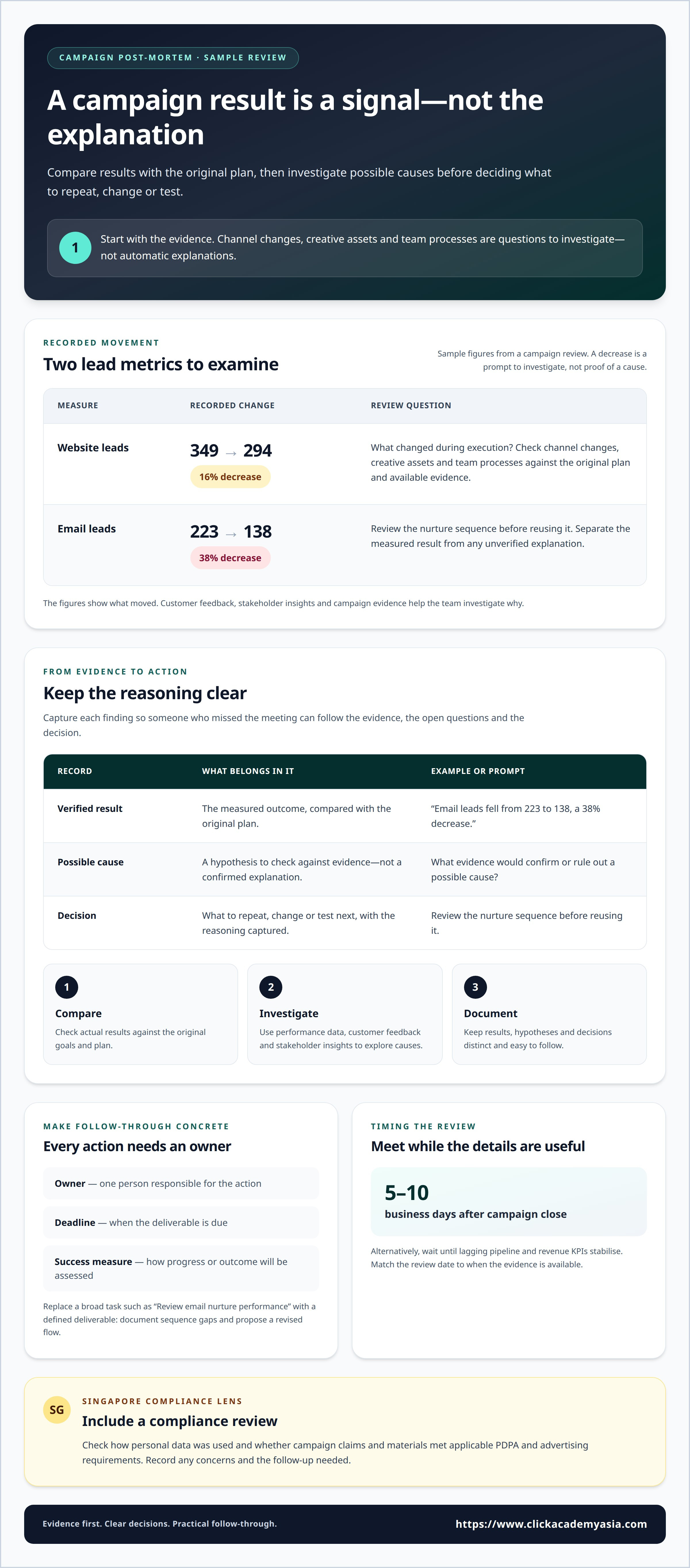
For campaigns in Singapore, include a compliance review alongside performance analysis. Check how personal data was used and whether campaign claims and materials met applicable PDPA and advertising requirements. Record any concerns and the follow-up needed.
Identify What Worked and FailedAsk what met its target, what missed, and what changed during execution. Compare results with the original plan, then examine performance data, customer feedback and stakeholder insights for possible causes. For example, a sample review recorded website leads falling from 349 to 294, a 16% decrease. Ask whether channel changes, creative assets or team processes help explain the movement, rather than blaming individuals.
Document Findings as TakeawaysTurn each finding into a clear takeaway that links evidence to a decision. Document the campaign context, result, likely cause and implication, so someone who missed the meeting can understand the reasoning. For example: “Email leads fell from 223 to 138, a 38% decrease; review the nurture sequence before reusing it.” Separate verified results from hypotheses, and note what evidence would resolve open questions.
Prioritise Actions and Assign OwnersPrioritise actions by how closely they relate to campaign goals, the scale of the issue and whether the team can address it. Assign one owner to each action, set a deadline and define a measure of success. “Review email nurture performance” is too broad; “email lead owner documents sequence gaps and proposes a revised flow” gives the team a clear deliverable. Record dependencies and review progress regularly.
Refine Marketing StrategiesUse the meeting’s evidence to decide what to repeat, change or test in the next plan. Preserve successful messages and assets, while adjusting channels or processes linked to weak results. For instance, a 38% decrease in email leads should prompt investigation before the team repeats the same nurture approach. Record the strategy decision and its rationale, then compare the next campaign’s results against the relevant goal.
Close the review by sharing documented takeaways with relevant participants and scheduling follow-up on action items. This is how to run a marketing campaign post-mortem: ask focused questions, capture evidence and possible causes, assign practical next steps, then apply the lessons to the next strategy.
Meaning and purpose of a post-mortem analysis
A campaign post-mortem is a structured analysis of performance, decisions and causes, not simply a verdict on success or failure. Use it to understand how channels, creative choices and external conditions shaped results, then update future plans based on evidence.
Connect channel performance to campaign goals. Compare each channel’s contribution with the objective it was intended to support. Review impressions, clicks, conversions, qualified leads and cost per acquisition together. High click volume alone does not show whether a channel delivered useful outcomes. Use analytics and project management software to bring performance charts, campaign timelines and decision notes into one review. This gives everyone a shared view of what happened and when.
Assess creative, offers and tests in context. Compare the assets and offers used across channels, then examine available A/B test results. Ask whether a message attracted attention, prompted action and reached the intended audience. Separate observed results from assumptions: if one creative performed better, record its audience, placement and offer. That context helps the team decide whether the learning applies to another campaign or needs to be tested again.
Trace causes before labelling a failure. Map key changes against the campaign timeline, including landing-page updates, stock availability, competing activity and delivery interruptions. Treat these as prompts for investigation, not automatic explanations. Ask what evidence supports each possible cause and note alternative explanations. A performance drop that coincides with a website change deserves investigation, but timing alone does not prove the change caused it.
Use shared tools to preserve the analysis. Store metric definitions, charts, campaign dates and decisions in a central project record. Project management software can support documentation, data visualisation and progress tracking, helping the team connect outcomes with earlier decisions. Keep the original plan alongside actual results, and label data sources clearly. This makes later comparisons more consistent and prevents the team from treating different definitions of a conversion as equivalent.
Turn evidence into a strategy update. Close the analysis by identifying what to repeat, what to revise and what needs another test. For example, keep a strong message while testing its offer separately, rather than changing both at once and losing the learning. Record the decision and the metric that will show whether the adjustment worked. Teams looking to build confidence in measurement can explore our ClickAcademy Asia Marketing Analytics & Insights resources to strengthen campaign analysis.
Scheduling a review while project details are fresh
Set the review date around campaign close, matching its timing to the evidence available. A well-timed review preserves team recollections without forcing decisions before delayed results have settled.
Schedule the Review PromptlyBook the post-mortem within 5-10 business days of campaign close, while execution details remain fresh. If pipeline or revenue KPIs lag, wait until those measures stabilise before drawing firm conclusions. For a short campaign, hold the review within a week; for a larger one, run a quick launch review first, then a fuller review after the first reporting window closes.
Connect Debriefs with Campaign ReviewsUse the project debrief to capture execution details, then connect them to campaign results. Ask channel leads what changed during delivery and compare their accounts with the campaign timeline. This helps distinguish process issues, such as a delayed asset handover, from performance issues. Keep both discussions connected, but allow delayed metrics time to mature before finalising findings.
Make the conversation inclusive and blameless. Invite the campaign owner, channel leads, creative or content leads, analytics partners and people responsible for the next campaign. Assign a neutral moderator to keep the discussion focused and make room for quieter participants. Send questions in advance, such as “Which handover slowed execution?” and “What should change next time?” Focus on processes and shared causes, not individual performance.
Review execution while memories are specific. Walk through the campaign timeline and ask where actual delivery differed from the plan. For example, if an approval delayed a landing page, note when the delay occurred, which teams depended on that page and how the workflow could improve. Invite an honest account from each contributor, then separate observed events from assumptions. A neutral moderator can redirect blame towards process questions.
Set a repeatable cadence for ongoing work. For always-on campaigns, schedule monthly or quarterly retrospectives instead of waiting for a formal end date. Use each discussion to review current performance, recent changes and outstanding action items. After a major campaign ends, hold a focused review. For annual planning, use findings from across the year to shape the next year’s goals. Keep the format consistent while adapting questions to each campaign’s objectives.
Close by recording agreed findings and action items in a shared location. A follow-up review can track whether process changes were implemented and whether they improved the next campaign.
What is a project postmortem meeting?
A project post-mortem meeting brings campaign contributors together to compare intended goals with actual outcomes. Use a consistent format to review timelines, understand causes and agree on an action plan.
Compare Outcomes with GoalsStart with the campaign objective and the KPI agreed before activity began. Compare planned and actual outcomes using the same metric definitions and reporting period. If the goal was qualified leads, impressions or clicks alone do not prove success. Record whether the objective was achieved, partly achieved or missed, then discuss what the result means for the next campaign. This keeps the meeting anchored in the original purpose.
Set goals and KPIs before evaluating performance. Revisit the campaign brief to confirm the intended audience, desired action and business outcome. A brand awareness campaign and a lead-generation campaign need different measures, so assess each against its own objective. For every KPI, record its definition, data source and target in the planning document. This context helps the team distinguish a genuine performance gap from a reporting mismatch.
Evaluate Timelines and Root CausesPlace key campaign milestones beside their actual completion dates, then identify where delivery differed from the plan. Check whether approvals, asset production or landing-page changes affected dependent tasks. Ask what happened, what evidence supports the explanation and whether another cause contributed. For example, a late creative approval may have delayed launch, but the meeting should also examine the approval workflow before identifying it as the root cause.
Separate outcomes from explanations. Record a missed KPI as a result, then label possible causes as hypotheses until evidence supports them. Compare platform reports, campaign records and team accounts before deciding what influenced performance. If participants disagree, note both interpretations and identify what information would clarify the issue. This approach supports an honest discussion without turning an unexpected outcome into an individual failure.
End with decisions that shape the next plan. Summarise what worked, what needs adjustment and what the team will test next. Convert each decision into an action with an owner, deadline and measure of success. For example, if unclear audience targeting contributed to weak lead quality, assign someone to review audience criteria before the next brief is approved. Teams building this planning capability can explore [Internal Link: ClickAcademy Asia Content Marketing Strategy].
Marketing campaign post-mortem evaluation report template
Use a consistent report format to connect campaign context, actual performance and decisions. Keep each point concise enough for the next team to put into practice.
Record the campaign context. Start with the campaign name, dates, owner, objective, target audience, channels and creative assets. Add links to the brief, reporting dashboard and key materials. These details help future readers understand what the team planned and which activity the findings cover.
Compare planned and actual performance. List each KPI beside its target, actual result, variance and data source. Include relevant measures such as impressions, clicks, conversions, qualified leads and cost per acquisition. A sample scorecard can flag metrics more than 15% off target for discussion. State the reporting period and metric definitions, so future reviews compare like with like.
Explain spend and delivery. Compare actual spending with the original budget, and record unforeseen expenses. Add planned and actual milestone dates to show where delivery changed. For channel analysis, flag combinations using over 20% of budget while producing below-average MQL conversion. Treat the flag as a prompt for investigation, then document what the evidence shows about efficiency and causes.
Capture findings and decisions. Summarise what worked, what fell short and what the team learned. For each finding, connect the evidence to its likely cause and the decision made during the discussion. Keep facts separate from assumptions. For example, state “landing-page conversion decreased after the redesign” only when reports support that sequence, then record whether the team will test a change or investigate further.
Turn recommendations into an action plan. Give every action an owner, deadline and measure of success. “Improve lead quality” needs a defined next step, such as reviewing audience criteria, and a way to assess the change. Record the decision, implementation timeline and follow-up date. Share the report with participants, then review progress regularly so recommendations are acted on.
Make the template useful next time. Store meeting minutes, quantitative results, budget analysis, timeline notes and supporting links together. Add a short executive summary with key insights and specific recommendations. Use the same core fields across campaigns while adapting KPIs to each objective. This structure helps teams retrieve past decisions and apply relevant lessons without assuming every campaign needs identical measures.
Strengthen the measurement skills behind clearer campaign reports through marketing analytics training.
ClickAcademy Asia
ClickAcademy Asia helps marketers strengthen the skills behind clear campaign planning, measurement and review. Its WSQ Digital Marketing Strategy & Planning and WSQ Marketing Analytics & Insights courses are relevant for teams that need to connect campaign objectives with useful metrics. For teams refining messaging and content, WSQ Content Marketing Strategy supports stronger planning and execution.
Build the capability to turn campaign findings into better-informed decisions and practical next steps. If you’d like to explore learning options for yourself or your team, contact ClickAcademy Asia.
Make Each Review a Starting Point
A campaign review can shape more than the next launch. Carry its lessons into planning conversations across teams, so decisions do not stay with the people who attended one meeting. Record what changed and why, agree on the actions to carry forward, and make the notes easy for new contributors to use.
Knowing how to run a marketing campaign post-mortem is one part of building that discipline. Teams also need strategic, content and measurement skills to interpret results and make stronger decisions. ClickAcademy Asia offers WSQ Digital Marketing Strategy & Planning, WSQ Content Marketing Strategy and WSQ Search Engine Optimization (SEO) to support professional development in these areas.
Choose a learning focus that fits your team’s priorities, apply it to the next campaign cycle, and review whether the changes improve results. Contact ClickAcademy Asia today to equip your team through WSQ-funded training tracks. With a deliberate review habit and practical skills, your marketers can carry useful lessons forward and keep improving their work.
Frequently Asked Questions
Which metrics matter most?
Prioritise metrics that reflect the campaign objective and the next business step. For lead generation, review qualified leads, conversion rates, cost per lead and progression into sales conversations. For awareness, assess reach, impressions and engagement alongside downstream signals. Include channel-level results and audience segments. A dashboard showing high clicks but few qualified enquiries points to a different issue than weak reach across channels.
Who should attend?
Invite people who can explain campaign decisions or act on the findings. This usually includes the campaign lead, channel specialists, creative contributors and an analytics partner. Add sales or customer-facing colleagues when lead quality or customer response needs interpretation. Keep attendance focused: each participant should bring relevant evidence, explain a decision or own a follow-up. A decision-maker can help resolve questions about resources or priorities.
What is a marketing campaign post-mortem and what should it achieve?
It’s a structured review of a completed campaign, designed to improve future decisions rather than assign blame. The discussion should clarify the gap between intended and actual outcomes, identify explanations supported by evidence and agree what to change or retain. A useful result is a concise record the next campaign team can apply, such as a revised audience assumption or a creative approach to test.
When should you conduct a campaign post-mortem and who should attend?
Schedule the review within 5-10 business days after campaign close, or once lagging pipeline and revenue KPIs stabilise. For ongoing activity, use a monthly or quarterly retrospective instead of waiting for a final end date. Invite contributors whose work shaped delivery, plus colleagues responsible for the next campaign. If results are still maturing, hold an early execution debrief and revisit performance later.
What data and KPIs should you collect before a campaign post-mortem?
Collect the approved campaign brief, KPI definitions, channel reports, spend records, timeline and customer or sales feedback. Include impressions, clicks, conversions, qualified leads and acquisition costs when relevant to the objective. Record the reporting period and data source for each figure. For example, distinguish form submissions from sales-qualified leads so the meeting does not treat different funnel stages as equivalent.
How do you compare campaign results with goals, benchmarks, and attribution data?
Compare actual results with the original target using the same KPI definition, time period and channel scope. Add a benchmark only when its audience, market and measurement method are comparable. Review attribution settings separately: a channel may receive more or less credit under different models. Note these limits in the report, then consider multiple indicators, such as conversion quality and cost, before changing investment.
How do you calculate campaign ROI, ROAS, CAC, and cost per lead?
Use consistent cost and outcome definitions. ROI is (attributed revenue minus campaign cost) divided by campaign cost; ROAS is attributed revenue divided by advertising spend. CAC is acquisition costs divided by new customers acquired, while cost per lead is campaign spend divided by leads generated. State which costs and attribution window each calculation includes, or comparisons between campaigns may be misleading.
What post-mortem template or agenda can marketing teams use?
Use a report that covers campaign context, objectives, KPI targets, actual results, spend, timeline, analysis, decisions and supporting evidence. In the meeting, set the purpose, review results, discuss what helped or hindered delivery, then agree on next steps. Keep a decision log alongside the report. For example, record a proposed landing-page test with its rationale, owner and success measure so the next team can follow through.



Comments