
A B2B Digital Marketing Strategy for Smarter Targeting

What if your B2B marketing plan focused less on doing more and more on reaching the right accounts with the right message? A practical b2b digital marketing strategy framework connects your growth goals to audience insight, buying intent, account priorities and coordinated execution, so each activity has a clear purpose.
It’s easy to see why teams spread effort across multiple channels: buyers research, compare and involve colleagues before making a decision. But activity alone doesn’t show whether marketing is helping the business move towards its goals. A clear framework gives your team a way to decide what to measure, which opportunities deserve attention and how marketing and sales can work from shared priorities.
In this guide, you’ll learn how to define your ideal B2B audience, use data to understand buying signals and prioritise accounts. You’ll also see how to plan campaigns across channels, match content to buyer needs and measure progress against business objectives. The focus is practical: build a strategy your team can put into action, learn from and refine.
Table of Contents
How do I start data-driven marketing in a B2B company?
Start with the company’s growth plan, then define marketing’s contribution. If leadership prioritises entering a new market, campaigns should attract qualified prospects there, not simply increase general website traffic. Connect the company’s vision and mission to that priority by clarifying which customers you serve, what value you offer and which measurable outcome signals progress. A B2B digital marketing strategy framework keeps those decisions connected.
Set revenue-aligned goals before choosing channels or building reports. For example, agree with sales on what qualifies a lead, then track how marketing-sourced leads progress to opportunities and revenue. Choose KPIs that match the objective: lead conversion rate can reveal funnel performance, while marketing-sourced revenue can show contribution to growth. Define the data each measure requires before setting up tracking, so reports answer a specific business question.
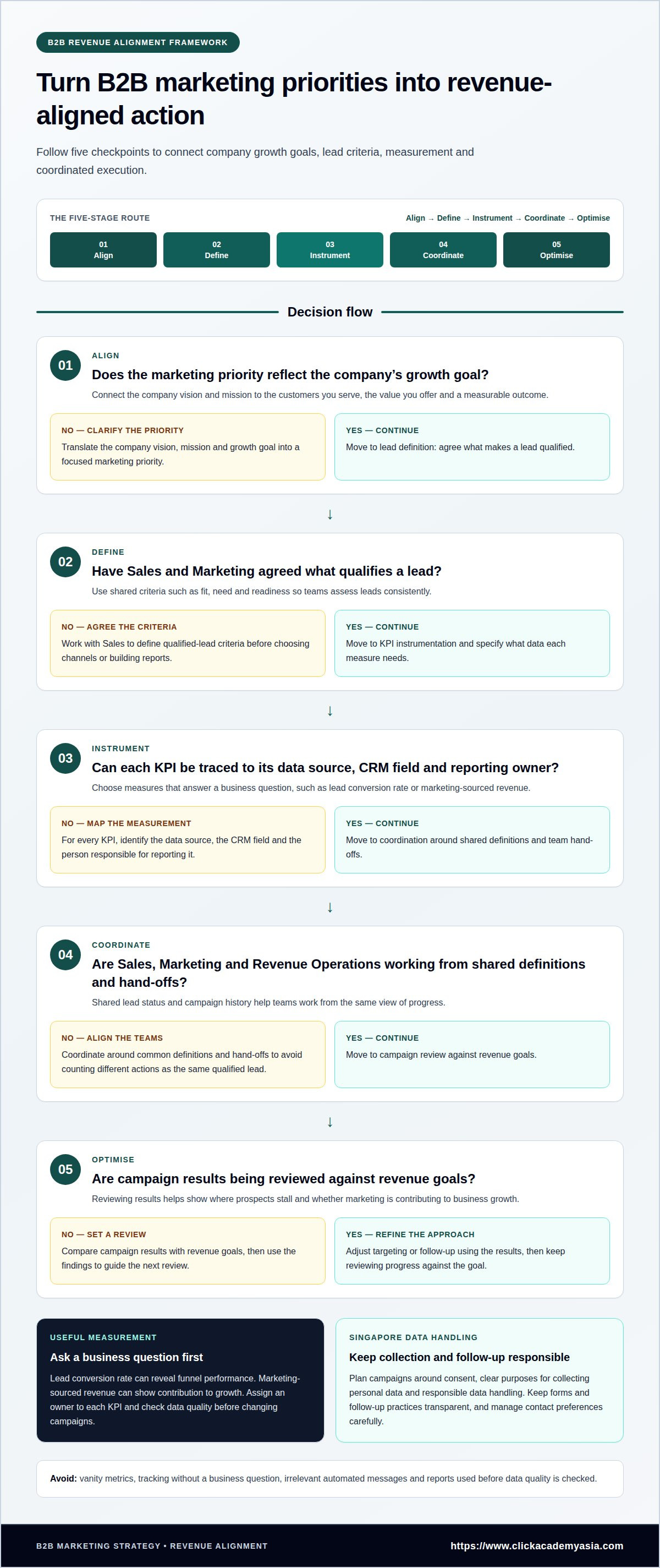
Use this five-stage B2B Revenue Alignment Framework to turn priorities into action:
Align: Translate the company vision, mission and growth goal into a marketing priority.
Define: Agree with sales on qualified-lead criteria, such as fit, need and readiness.
Instrument: Map each KPI to a data source, CRM field and reporting owner.
Coordinate: Connect sales, marketing and revenue operations around shared definitions and hand-offs.
Optimise: Review campaign results against revenue goals, then adjust targeting or follow-up.
For example, if the priority is expansion into a new industry, marketing can attract relevant organisations, sales can assess fit, and revenue operations can standardise pipeline reporting. This coordination prevents teams from counting different actions as the same qualified lead. It also shows where prospects stall along the buyer journey. A practical B2B digital marketing strategy framework makes those shared measures part of campaign planning.
In Singapore, plan B2B campaigns around consent, clear purposes for collecting personal data and responsible data handling. Keep collection forms and follow-up practices transparent, and manage contact preferences carefully.
CRM and marketing automation tools can record interactions, segment contacts and trigger follow-up when agreed behaviours occur. Use shared CRM definitions so sales and marketing see the same lead status and campaign history. Ongoing skills development helps teams use these tools well and apply insights consistently.
Avoid vanity metrics, tracking data without a business question and automating irrelevant messages. Assign an owner to each KPI and check data quality before using reports to change campaigns. Regularly reviewing results and building data skills helps teams refine their approach over time.
How do I identify my B2B target audience and buyer personas?
Define target accounts through an ideal customer profile (ICP), then identify the people involved in each purchase. Build buyer personas around their roles, priorities and barriers, and map the buying committee’s influence on the decision. Continuous learning helps marketing and sales teams develop the research, analysis and communication skills to share a clear view of whom to reach and what matters to them.
Start the ICP with closed-won deals from the previous 6-12 months. Look for patterns in industry, company size, business needs, buying triggers and customer value. For example, an enterprise marketing automation ICP might focus on SaaS businesses with more than 100 employees. Treat this as a hypothesis, then compare it with sales feedback and current opportunities. Ongoing training in customer research and data analysis helps teams refine the profile when strong customers share different characteristics.
Personas add the human context an ICP cannot provide. A marketing leader may care about qualified demand, while a finance stakeholder may focus on justifying the investment. Capture each person’s goals, objections, preferred information and role in approval. Then shape a value proposition that connects your offer to a specific business need. Through continuous learning, teams can strengthen their messaging skills: awareness content can explain the problem, while evaluation content can show how your approach addresses it.
Connect audience definitions to lead generation and acquisition metrics. Track form submissions and ad click-through rates during awareness, then qualified leads, content engagement and demo requests as prospects assess their options. Develop teams’ measurement and optimisation skills through regular learning, and compare conversion across audience segments to see which messages attract suitable buyers, not simply more responses. Pair these measures with customer acquisition cost and marketing-sourced revenue to assess commercial contribution.
Use customer and market insight to identify growth opportunities. Review which segments convert, which needs remain underserved and where current customers show interest in related solutions. Continuous learning in customer insight and retention equips teams to create useful content and follow-up around customers’ ongoing goals, not just new sales. A practical cycle is to define the ICP, test campaigns with a focused segment, analyse engagement and conversion, then update targeting. This connects acquisition and retention to the same understanding of customers.
Account-based marketing and target account prioritisation
Account-based marketing (ABM) focuses resources on selected organisations instead of treating every lead alike. To make it work, teams need ongoing skills development in account research, data interpretation and cross-functional planning. Start with the ideal customer profile, then assess accounts by business fit, potential value and buying signals. This creates a shared shortlist for sales and marketing, helping both teams build visibility with the stakeholders most likely to shape a purchase.
Use evidence from closed-won deals to identify useful account patterns. Prioritise organisations that closed in under 90 days, engaged across more than one channel within 30 days, or increased spending within six months. Train teams to interpret these signals alongside fit and business needs, rather than relying on activity alone. An account showing activity without a relevant problem may deserve less attention than a strong-fit organisation showing clear intent.
Next, group accounts by priority and match effort to opportunity. Build your team’s ability to plan tailored research, role-specific content and coordinated sales outreach for high-priority accounts. For a broader group, use targeted campaigns to test which needs and messages prompt meaningful engagement, then share the findings across sales and marketing. Track account-level outcomes such as meetings, opportunity progression and deal velocity, rather than counting individual clicks alone.
ABM also connects with influencer marketing because business purchases involve multiple voices. Train teams to map the buying committee by identifying decision-makers, evaluators, users and advisers, then learn what each needs to assess. A technical evaluator, for example, may need implementation details, while a senior sponsor needs a clear business case. Relevant industry voices can add perspective through expert content or events, but should address the account’s real questions rather than serve as decoration.
Practise coordinating interactions across channels so teams can respond consistently. If a priority account engages with a webinar and later visits product pages, sales can follow up with material suited to that interest. Marketing can reinforce the message with targeted content, while account owners share context and next steps. In 2026, 86% of B2B marketers considered personalised 1:1 marketing essential for success, making relevance a clear planning priority.
Review account priorities regularly as engagement and commercial context change. Develop teams’ skills in comparing progress across tiers, checking whether the right stakeholders are engaging, and adjusting the plan when signals shift. This ongoing learning keeps ABM focused on measurable account outcomes instead of an oversized list that stretches sales and marketing too thin.
Nonlinear buyer journeys and buying intent
Model the B2B buyer journey as changing needs, not a fixed funnel. A prospect may discover a problem through search, compare options, consult colleagues, then pause. LinkedIn B2B Institute’s 95-5 rule holds that 95% of B2B buyers are not in-market at any given time. Consistent awareness content can build familiarity before purchase intent emerges, while continuous learning helps teams adapt their messaging as buyer needs change.
Buying committees make the journey less predictable. Forrester research puts the average number of stakeholders influencing a B2B buying decision at 13. It also reports that 30% of Millennial and Gen Z B2B buyers include 10 or more external influencers. Map each persona’s role, questions and concerns, then equip teams to provide information that helps stakeholders evaluate the decision together.
A technical evaluator may search for integration details, while a finance leader considers business impact. A user might read a practical guide before discussing the solution internally. These are different paths through the same journey. Ongoing training helps teams organise content around each persona’s needs, not just a presumed sequence of funnel stages.
Buying intent helps teams respond to active interest without treating every signal as a sales-ready lead. Train teams to look for patterns across channels, such as repeated visits to comparison content or engagement with a product-focused webinar. A CRM such as HubSpot can help organise contact activity and follow-up. Equip teams to interpret signals alongside account fit and persona context, since a single interaction may not reveal readiness.
A useful SEO and content approach supports awareness, consideration and evaluation. At the awareness stage, publish educational pages that answer problem-focused search queries. At consideration, offer comparisons, expert guidance or case examples to clarify possible approaches. At evaluation, make detailed product information and demonstrations easy to find. Continuous learning helps teams apply buying-intent insights to relevant pages that answer the questions buyers are already asking.
Because prospects may revisit earlier questions, connect content across stages. Link an introductory guide to a deeper comparison, then offer a clear next step for readers assessing solutions. Train teams to tailor lead nurturing to persona, funnel stage and behaviour, rather than sending every contact the same sequence. A webinar attendee and a pricing-page visitor, for example, may need different follow-up.
Review journey data with sales to identify unanswered questions and stalled decisions. If several stakeholders engage with different content, prepare follow-up that addresses their shared concerns. Continuous learning helps teams turn buying-intent signals into useful context and apply those insights to keep the experience relevant across the channels and stages each committee member chooses.
Go-to-market execution planning
A go-to-market plan turns strategy into coordinated actions, owners and measures, but capable teams bring it to life. Build the skills to plan, execute and improve campaigns through continuous learning. Begin with one business objective, such as generating qualified demand for a new service in Singapore, then develop your team’s skills in audience research, buyer needs and channel selection. A B2B digital marketing strategy framework gives staff a practical structure to apply and refine as they learn.
Equip your team to choose channels based on audience behaviour and campaign goals. Build their skills in comparing SEO, email, social media and paid media by their role in the buyer journey, engagement quality and contribution to pipeline. For example, trained staff can use SEO to support ongoing discovery and a LinkedIn lead-generation campaign to capture interest in a specific offer.
There is no universal budget split or typical cost that suits every B2B campaign. Develop your team’s ability to allocate resources according to the objective, audience size, channel requirements, content production effort and expected contribution to measurable outcomes. A team testing a new market can apply these skills to research and run a focused campaign, then shift resources towards channels producing qualified opportunities.
Train staff to build an execution calendar around four stages: pre-launch research and content creation, launch activity, nurture and follow-up, then post-campaign analysis. A 30-day close window can provide an example planning period, with clear tasks for each stage. For instance, staff can prepare a role-specific webinar and landing page before launch, then coordinate email, social and paid promotion during launch.
Develop your team’s marketing automation skills so they can connect these activities. Staff can learn to configure a CRM workflow that assigns campaign responses, triggers relevant follow-up after a webinar and routes qualified contacts to sales. Train marketing, sales and revenue operations teams to agree on lead status and ownership, so they interpret campaign results consistently. Automation skills should help teams deliver timely, relevant communication, not send every contact the same sequence.
Finally, teach staff to align reporting with each campaign stage. They can track website visits and ad click-through rate for awareness, demo requests and sales-qualified leads for consideration, then win rate and deal velocity for outcomes. Review these measures with sales after each campaign, identify where prospects drop away and use the findings to build skills and improve the next plan. This continuous learning makes the B2B digital marketing strategy framework a repeatable execution process, not a one-off launch.
ClickAcademy Asia
ClickAcademy Asia is a relevant next step when your team needs to strengthen its B2B marketing capability. Its training supports professionals and organisations developing the skills to plan campaigns, create useful content and apply digital channels with purpose. It can be particularly useful when teams understand their business priorities but need a clearer way to translate them into day-to-day marketing decisions.
WSQ Digital Marketing Strategy & Planning is relevant for marketers who need to connect business objectives with audience choices, channel decisions and measurement. Learners can develop a more structured approach to planning, linking each activity to a defined marketing goal. A team entering a new segment, for example, can use this learning to shape audience selection, campaign planning and performance review.
WSQ Content Marketing Strategy can help teams make content more purposeful across buyer needs and decision stages. Learners can develop a strategic approach to choosing topics, formats and content roles, rather than producing assets without a clear audience or objective. A team might use this learning to plan educational material for early research and more detailed content for prospects comparing solutions.
For marketers looking to strengthen organic search capability, WSQ Search Engine Optimisation (SEO) covers skills relevant to making useful content easier to discover. Teams can apply SEO principles to align web pages with audience questions and make search a considered part of broader marketing activity. This is a practical fit when organic visibility needs to support a wider acquisition plan.
WSQ Search Engine Marketing (SEM) can build capability in paid search planning and execution. It helps marketers consider how paid search can reach people actively researching relevant solutions and how to assess campaigns against clear objectives. Learning in both SEO and SEM can help teams understand the distinct roles of organic and paid search in their channel mix.
These courses cover different areas of marketing practice, from strategic planning to content and search. Individuals can focus on a skill gap, while teams can build shared knowledge for more consistent execution. Match learning priorities to the capabilities your organisation needs to strengthen.
If you’re ready to develop your team’s capabilities through WSQ-funded training, explore the ClickAcademy Asia Sales and Marketing courses today.
Frequently Asked Questions
What Is a B2B Marketing Framework?
A B2B marketing framework is a structured way to connect business objectives with audience choices, marketing activities and performance measures. It helps teams decide what to do, why it matters and how they will assess progress. For example, a business entering a new sector can use a framework to connect its target market, campaign plan, sales hand-offs and pipeline measures, keeping execution focused on a shared commercial objective. Developing these skills through continuous learning helps teams apply the framework consistently and adapt it as needs change.
How often should I review my B2B marketing strategy?
Review your B2B marketing strategy at least once a year, and evaluate activities quarterly in dynamic markets. A quarterly review can reveal changing buyer behaviour, channel performance or shifts in sales priorities before the annual planning cycle. Bring marketing and sales data into the discussion, then document what to continue, stop or test. Build review skills through ongoing learning so the team can turn findings into decisions, not simply update a dashboard or report.
What Is B2B Digital Marketing?
B2B digital marketing uses online channels to promote products or services to other businesses. It can include search content, email, social media, paid advertising and webinars, selected according to audience needs and business goals. For example, a software provider might publish a guide that answers an operational question, then use a webinar to explain its approach. Continuous learning helps teams improve these skills and support business buyers as they research and evaluate options.
What distinguishes B2B marketing from B2C marketing?
B2B marketing addresses business purchases, where decisions often involve multiple stakeholders, complex needs and longer evaluation processes. B2C marketing typically addresses individual consumers making personal purchases. A B2B campaign may need to equip a user, technical evaluator and senior decision-maker with different information about one solution. Ongoing skills development helps teams tailor messages to each role and coordinate with sales to guide an opportunity towards a decision.
What role does data analytics play in B2B marketing?
Data analytics helps marketers understand which audiences engage, where prospects progress or stall, and how campaigns contribute to business outcomes. A team might compare landing-page visits with demo requests, then examine which sources generate qualified opportunities. Analytics can also reveal measurement gaps, such as missing campaign-source fields in a CRM. Continuous learning in analytics helps teams use findings to make specific decisions, such as refining a message or reallocating effort, rather than collecting metrics without a purpose.
Which KPIs are particularly relevant in B2B marketing?
Choose KPIs based on the objective, industry and strategy, rather than relying on a universal scorecard. Useful measures include lead conversion rate, cost per lead, customer acquisition cost, marketing-sourced revenue, pipeline velocity and customer lifetime value. For an awareness campaign, website traffic and ad click-through rate can help assess reach and response. Ongoing learning helps teams select and interpret KPIs, while opportunity progression and win rate offer a closer view of commercial impact for a revenue-focused programme.



Comments