
How to Prepare Marketing Data, Teams and Skills for AI Adoption

AI adoption looks different across marketing disciplines. A workflow that helps a content team research ideas may not suit campaign analysis, where data quality and human review matter as much as speed.
That is why preparing a marketing team for AI adoption takes more than choosing a tool. Understand your data and workflows, appoint a leader to guide change, and give people practical ways to build confidence with AI. The goal is not to automate every task. It is to identify where AI can support sound marketing decisions while keeping accountability clear.
This guide explains how to assess readiness, choose an AI adoption lead and plan change in manageable stages. You’ll also learn how to build shared knowledge and adapt AI use across research, campaign planning, content, automation and performance analysis. With a clear plan, your team can move from scattered experiments to purposeful, measurable use.
Table of Contents
Assessing organisational data, infrastructure and workforce readiness
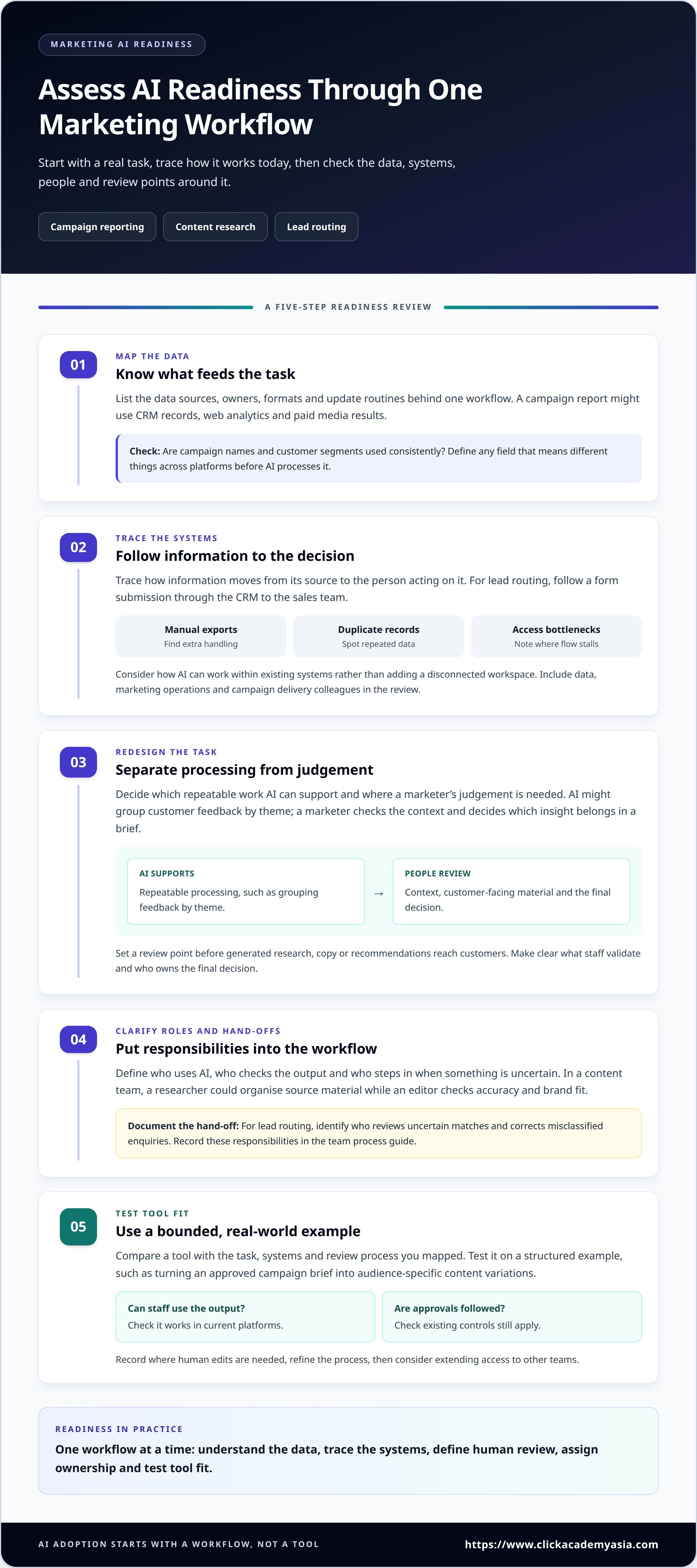
Map the data behind one marketing task. Choose a workflow such as campaign reporting or content research. List its data sources, owners, formats and update routines. A campaign report, for example, might draw on CRM records, web analytics and paid media results. Check whether teams use consistent campaign names and customer segments. If a field means different things across platforms, define it before an AI tool processes the data. Finding these gaps early is a practical first step in preparing a marketing team for AI adoption.
Test whether your infrastructure supports that workflow. Trace how information moves from its source to the person making a decision. For lead routing, follow a form submission through the CRM to the sales team. Identify manual exports, duplicate records and access bottlenecks. Decide how AI can work within existing systems instead of adding a disconnected workspace. Include the people responsible for data, marketing operations and campaign delivery in the review.
Redesign tasks around human-AI collaboration. Separate repeatable processing from work that requires judgement. AI might group customer feedback by theme, while a marketer checks the context and decides which insight belongs in a brief. Set a review point before generated research, copy or recommendations reach customers. Update briefs and approval steps to show what AI produces, what staff validate and who owns the final decision. This makes preparing a marketing team for AI adoption a workflow decision, not just a software rollout.
Integrate AI into team roles and hand-offs. Add responsibilities to the workflow, not just to a tool account. In a content team, a researcher could use AI to organise source material while an editor checks accuracy and brand fit. For lead routing, define who reviews uncertain matches and corrects misclassified enquiries. Document these hand-offs in the team’s process guide so staff know when to intervene and where to record changes.
Select tools against real workflow requirements. Compare each AI tool with the task, systems and review process you have mapped. Test it on a structured example, such as turning an approved campaign brief into audience-specific content variations. Assess whether staff can use the output in current platforms and follow existing approval controls. Start with one bounded workflow, record where human edits are needed, then refine the process before extending access to other teams.
Does the person leading AI adoption need to be technical?
The adoption lead needs marketing expertise and the authority to change workflows, not technical credentials. They should connect AI use to campaign goals, team operations and clear quality standards.
Marketing teams need practical skills in prompt writing, critical evaluation, data interpretation and brand judgement. Build staff confidence through guided practice with generative AI: draft a campaign brief, review the output, then improve it against agreed criteria.
Choose a lead who can translate strategy into daily work. Select a marketer who understands how campaigns move from brief to approval and delivery. Give them authority to set priorities, clarify responsibilities and resolve workflow issues. They do not need to build AI systems. They need to judge where an AI-powered task fits, when staff must review results and how teams will learn from each use.
Start with structured education and a practical example. Use an initial team overview lasting 30-60 minutes to explain the purpose, boundaries and expected review process. Then build the preparation and training phase across 1-2 weeks. For example, have content staff use generative AI to create campaign variations from an approved brief, then assess accuracy, tone and audience fit.
Recruit change champions across marketing operations. Ask respected colleagues from areas such as content, analytics and campaign management to test agreed use cases. Their role is to share useful prompts, demonstrate review habits and surface obstacles early. Schedule 1-2 hours a week for team training and tool testing, so practice becomes part of the foundation rather than an optional extra.
Address concerns with clear safeguards and follow-up. Invite employees to raise questions about role changes, output quality and accountability before launch. Explain which tasks AI may support and which decisions remain with people. Set quality standards for fact-checking, brand voice and approvals, then schedule reinforcement training 2-3 weeks after initial implementation to review real examples and correct gaps.
Marketing teams should redesign workflows around AI by defining its tasks, setting quality standards, training staff and maintaining accountability. A Storyblok post states that 72% of marketers feel overwhelmed by rapid change and evolving technology.
AI adoption strategy versus implementation plans
Build an adoption plan by setting a long-term direction, then sequencing practical marketing projects. Decide where AI can support business goals, which use cases to test and how to measure results.
Define the Adoption StrategyEstablish the strategic direction before selecting projects. Set out what marketing teams want AI to improve, such as research quality, campaign planning or reporting speed. An AI adoption strategy typically has a 12-36 month timeframe. A strategy for preparing a marketing team for AI adoption should connect that direction to brand priorities, customer needs and the future role of automation.Make sure the strategy covers people, data, workflows and accountability, not just software. Avoid treating every experiment as a separate direction. If the goal is more relevant content, for example, define how audience insight, editorial review and campaign measurement work together. This gives teams a shared basis for deciding where AI belongs.
Create an Implementation PlanTurn the strategy into a sequence of testable projects. Choose 2-3 high-impact, lower-risk examples, then define the task, owner, tools, review process and success indicators for each. For preparing a marketing team for AI adoption, a project-specific implementation plan usually runs for weeks to months, rather than covering the strategy’s longer horizon.Pilot one or two tools against a defined marketing task before expanding use. Set a baseline, such as time spent preparing a campaign brief, and record changes during the pilot. Include staff training, workflow updates and review responsibilities in the plan. For teams of 10 or more people, implement in phases so each group can learn before wider rollout.
Plan Implementation Across MarketingMap use cases to each marketing function. Research teams might use AI to group customer feedback, while campaign planners explore message options. Content teams can test draft variations, and analysts can use AI to flag anomalies in performance data. Match each task with appropriate human review and a clear measure of value.Plan consulting and implementation costs around the work required, rather than a generic tool estimate. Costs can depend on integrations, data preparation, staff training, workflow redesign and ongoing support. Ask project leads to separate these areas in the implementation plan. Review results against agreed indicators before adding tools or expanding access across marketing.
Continuous learning and shared knowledge
Shared platforms and regular learning help teams use AI consistently. The steps below turn individual discoveries into reusable knowledge and a stronger data foundation.
Establish Shared AI EnvironmentsSet up a shared environment for approved AI work. Give marketing teams a consistent place to access tools, prompts, examples and review guidance. Organise materials by task, such as campaign analysis or content research, so staff can find relevant practices quickly. Define who maintains each resource and how updates are recorded. Avoid separate, undocumented workspaces that keep useful learning isolated within one team.
Create shared definitions for marketing data. Agree on common terms for campaign names, audience segments and performance measures. For example, document what counts as a qualified lead before using AI to analyse lead trends. Store definitions alongside the relevant data source and record who owns updates. This gives AI-assisted analysis a consistent foundation and helps colleagues interpret results across platforms.
Set Up Continuous LearningSchedule a monthly AI show-and-tell. Ask team members to demonstrate one prompt, workflow or test result, then explain where human review improved the output. Capture the example, its intended use and any limitations in a shared knowledge space. Teams using AI tools access information and knowledge 42% faster, making well-organised learning resources useful beyond the person who first created them.
Turn each shared example into a repeatable practice. After a show-and-tell, assign an owner to update the relevant prompt or process guide. A campaign analyst, for instance, could document how they used AI to summarise performance patterns, including the checks needed before sharing findings. Invite colleagues to test the revised approach and record useful changes. This creates a feedback loop rather than a static collection of tips.
Use monthly AI show-and-tell sessions as a working forum where marketing team members share tips and test results. Encourage presenters to explain the task, the choices they made and what they would adjust next time. Leave room for questions and invite colleagues to suggest another way to test or apply the example. Close by identifying which ideas are ready to document and which need further review. This keeps the discussion practical and turns individual contributions into material the wider team can revisit.
Does AI adoption in marketing mean the same thing across all disciplines?
No. Measure AI integration separately across research, campaign planning, copywriting, workflow automation and performance analysis. Each discipline needs relevant indicators because tool use alone does not show business value.
Define the intended outcome for each marketing discipline. For research, measure whether AI helps identify useful themes in customer feedback. For campaign planning, assess whether teams can compare channel or message options before committing budget. For copywriting, track review effort and adherence to brand standards. Set a baseline for each task so later comparisons reflect actual changes, not assumptions.
Choose three to five indicators for every AI implementation. Combine adoption measures, such as how often staff use the tool, with workflow and outcome measures. A content team might track drafts reviewed, editing time and campaign engagement. An analytics team could measure anomaly detection and the time needed to explain a performance change. Keep indicators closely tied to the original use case.
Review usage at 30 and 90 days. Compare tool usage across those checkpoints, then investigate where adoption differs between teams. Low use may point to a poor workflow fit, unclear guidance or outputs that need too much correction. Strong usage still needs scrutiny: check whether AI-assisted work meets the same quality standards and reaches its intended audience.
Connect integration measures to business outcomes. Record whether AI changed turnaround time, planning accuracy, campaign performance or another defined result. Separate AI’s contribution from other changes, such as a new channel mix or revised creative. McKinsey reports that 39% of organisations have seen an enterprise-level EBIT impact attributable to AI, so measure outcomes rather than assuming value from adoption alone.
Calculate ROI using the full cost and outcome picture. Compare measurable benefits, such as time saved or improved campaign results, with implementation, training and tool costs. Use the same timeframe and scope on both sides of the calculation. If an AI-supported workflow is faster but requires substantial editing, include that review effort before deciding whether to expand it.
ClickAcademy Asia
ClickAcademy Asia offers marketing courses to help professionals strengthen the skills behind thoughtful AI adoption. Structured learning can be useful when your team has identified capability gaps and needs to connect its marketing knowledge with new ways of working. The right learning path depends on whether your priority is planning, content, search visibility or paid campaigns.
WSQ Digital Marketing Strategy & Planning helps marketers connect business objectives with channel decisions and measurement. It can build the strategic context for evaluating where AI fits into marketing activity. This broader perspective is useful when leaders align learning priorities across roles or decide which capabilities the team should develop next.
For content-focused teams, WSQ Content Marketing Strategy develops skills for planning around audience needs and content objectives. These foundations can help marketers shape clearer briefs and assess whether AI-assisted material serves its intended purpose. The course supports stronger strategic judgement without treating generated content as a substitute for human expertise.
Teams responsible for search can consider WSQ Search Engine Optimisation (SEO) and WSQ Search Engine Marketing (SEM). These courses cover distinct areas of search marketing, helping professionals build knowledge suited to their responsibilities. Teams can use that discipline-specific understanding to make informed decisions about search activity and evaluate AI-generated suggestions against their objectives.
As a practical next step, connect learning choices to the work your team needs to deliver:
Identify the marketing capability that needs strengthening.
Match learning to the team’s responsibilities and priorities.
Apply the learning to a current marketing task or decision.
Review how the new capability supports your team’s wider direction.
These actions make AI adoption part of capability building: clarify the priority, choose relevant learning and apply it to real work. To develop your team through WSQ-funded training tracks, contact ClickAcademy Asia and discuss which marketing courses fit your team’s learning needs.
Frequently Asked Questions
What is an AI adoption strategy?
An AI adoption strategy sets long-term decisions about how an organisation will use AI, develop skills and manage change. It connects business priorities with suitable use cases, governance and workforce needs. For example, a retailer might use AI to support product discovery while keeping pricing and customer commitments under human control. The strategy guides decisions across projects rather than describing a single tool rollout.
How should a company assess AI readiness in its marketing team?
Assess readiness by examining one real marketing task from input to final decision. For a campaign report, check whether source data is accessible, whether staff understand the metrics and whether someone can review AI-generated findings. Identify who owns the process and how errors are corrected. This task-based assessment helps distinguish a skills gap from a data or workflow issue, so the next step addresses the actual obstacle.
Which AI tools are most useful for marketing teams, and how do they compare?
The most useful tool depends on the task. Generative AI can help draft or reshape text, analytics tools can surface patterns in campaign data, and automation tools can move routine information between workflow stages. Compare options by output quality, fit with existing platforms, review effort and control over data access. A content team and a performance team may need different capabilities, even within the same organisation.
What marketing tasks should be automated with AI, and which need human oversight?
Automate repeatable tasks with clear inputs and outputs, such as tagging feedback themes, preparing report summaries or sorting routine enquiries. Keep human oversight for decisions that affect customers, including final claims, sensitive audience targeting, budget changes and public responses. AI can draft a reply to a complaint, for example, but a staff member should check the context and approve it before sending.
What are the risks of using AI in marketing, including accuracy, bias, and data privacy?
Key risks include inaccurate claims, biased recommendations, exposure of sensitive information and content that misrepresents a brand. A tool can produce convincing text from incomplete inputs, so reviewers should check important facts against approved sources. Bias can enter through unbalanced data or assumptions in a prompt. Set limits on the information staff may enter, and clarify who is responsible for review before AI-assisted work reaches customers.
What Singapore PDPA rules apply to using customer data with AI marketing tools?
Singapore’s PDPA is relevant when an AI marketing workflow handles personal data. Before using a tool, map what information it receives, the intended purpose, who can access it, where it is stored and whether it is shared onward. Apply the organisation’s privacy notices, consent or other applicable basis, retention controls and vendor safeguards. Have the data protection lead review the specific workflow before customer records enter prompts.
How can a marketing team measure the ROI of AI adoption?
Measure ROI by comparing the value of a defined outcome with the full cost of achieving it. For example, assess whether AI-assisted reporting reduces staff time while maintaining accuracy, then include tool, integration, training and review effort in the cost calculation. Compare results with a pre-adoption baseline and account for other campaign changes. A faster process alone does not demonstrate value if quality or business results decline.
What change-management strategies help marketing teams overcome resistance to AI?
Reduce resistance by explaining what will change, what remains a human responsibility and how staff can raise concerns. Invite employees to test a contained use case, then gather feedback on workload, quality and role impact. A respected colleague can demonstrate practical uses and share lessons with peers. For example, start with internal campaign research before using AI for customer-facing content, then use feedback to refine guidance.



Comments