
How to Develop a Partner Co-Marketing Program That Tracks ROI

A co-marketing campaign can lose momentum before its first asset is published if partners are unclear about who owns the next step. Developing a partner co-marketing programme starts with a shared audience, complementary contributions and a written plan for communication and measurement. Co-marketing brings organisations together to create and promote content for an audience they have in common.
It is easy to focus on the campaign idea and leave the operating details until later. But clear roles, agreed messaging and timely updates help partners stay aligned as the work moves from planning to launch.
This guide explains how to build a practical programme: define partner responsibilities, align campaign choices with your channel strategy, set rules for eligible budgets and keep communication moving. You will also learn how to track outcomes such as leads, cost per lead and campaign contribution, so both partners can review what worked and make better decisions for the next initiative.
Table of Contents
Measuring and tracking partner marketing ROI
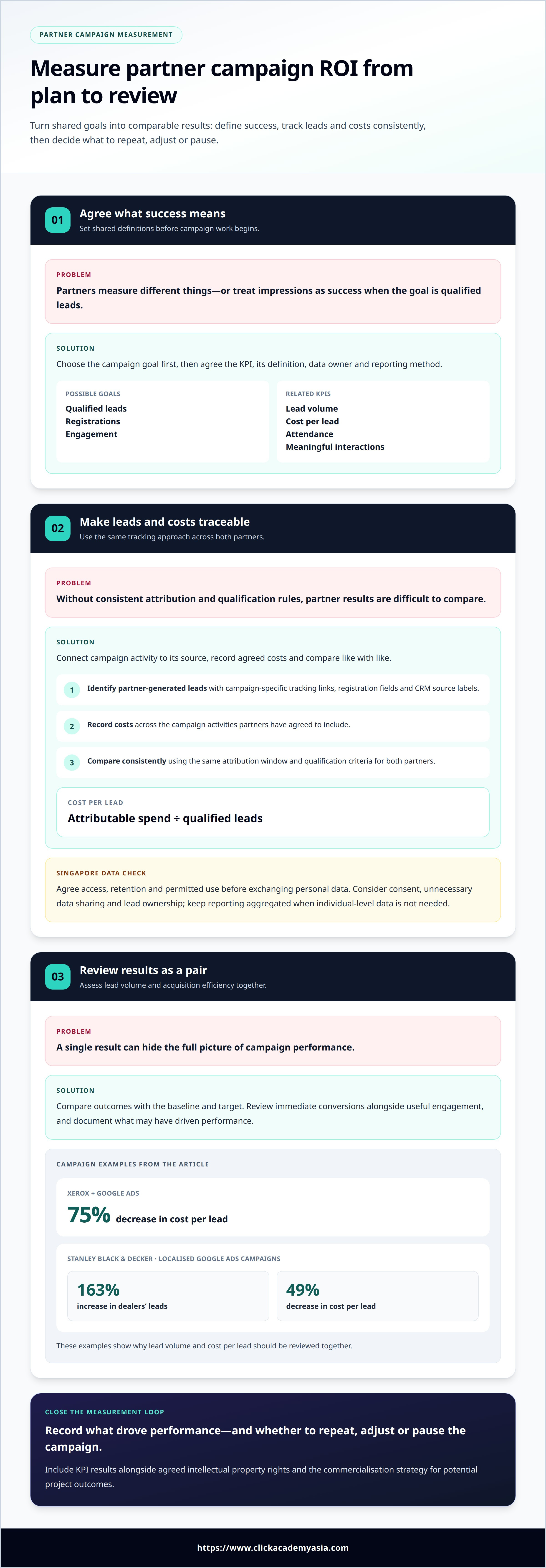
Build ROI tracking into the campaign plan, from agreed goals to lead attribution and cost review. When developing a partner co-marketing programme, use shared definitions so partners assess performance consistently.
Set goals and KPIsChoose a campaign goal first, such as qualified leads, registrations or engagement. Then set KPIs tied directly to it, including lead volume, cost per lead, attendance or meaningful interactions. To identify partners, assess audience fit, complementary expertise and willingness to contribute measurably. Recruit organisations whose strengths support the campaign objective, rather than choosing partners for reach alone.Record each KPI’s definition, data owner and reporting method before launch. Avoid treating impressions as success when the agreed goal is qualified leads.
Track leads, costs, and engagementUse campaign-specific tracking links, registration fields and CRM source labels to identify partner-generated leads. Record costs across agreed campaign activities, then calculate cost per lead by dividing attributable spend by qualified leads. Track engagement through registrations, attendance, content interactions and follow-up responses. Compare like with like by using the same attribution window and qualification criteria for both partners.In Singapore, common risks include unclear consent, excessive data sharing and disagreements over lead ownership. Agree on access, retention and permitted use before exchanging personal data, and have each organisation review its applicable privacy and legal obligations. Keep reporting aggregated when individual-level data is unnecessary.
Assess co-marketing successCompare results with the baseline and target, then assess both immediate conversions and useful engagement. Xerox’s partner Google Ads campaign recorded a 75% decrease in cost per lead. Stanley Black & Decker’s localised Google Ads campaigns recorded a 163% increase in dealers’ leads and a 49% decrease in cost per lead. These examples show why lead volume and acquisition efficiency should be reviewed together.A disciplined approach to developing a partner co-marketing programme documents what drove performance, such as audience fit, messaging or channel choice, and whether to repeat, adjust or pause the campaign. According to Enterprise Singapore, partners should agree in advance on intellectual property rights and the commercialisation strategy for potential project outcomes. Include those terms in the review alongside KPI results.
Agreeing the message and partner contributions
Before drafting campaign assets, align both organisations on the audience, core message and work each team will deliver. A shared plan keeps contributions clear from the first draft through final approval.
Define the shared audience and message. Ask each partner to describe the customer group the campaign serves, the problem it addresses and the next action it encourages. For example, a software vendor and implementation partner might focus on helping operations leaders evaluate a specific workflow challenge. Agree on one central message, then explain how each organisation’s expertise supports it.Set boundaries for claims, product descriptions and customer examples. This prevents conflicting explanations across a joint landing page, webinar invitation and sales follow-up.
Assign contributions by team and deliverable. Name an owner for each asset, approval and distribution task. One partner might provide a subject-matter expert, while the other prepares the registration page and coordinates email promotion. Record who supplies the source material, who edits it and who gives final approval.Confirm each commitment with the team responsible for delivering it. Do not promise a speaker, customer story or sales follow-up on behalf of colleagues who have not agreed. A contribution table makes shared effort visible across the partner ecosystem.
Agree how the message supports selling. Map the campaign message to the questions sales teams hear from customers. Ask partner-facing leaders to review the proposed talking points and flag claims that need evidence. Capture useful insights from sales conversations, then turn them into clear content rather than unsupported product promises.For example, a joint webinar can explain a shared customer challenge, show each partner’s role and give attendees a relevant next step. Keep each organisation’s contribution distinct while presenting the combined offer as a coherent solution.
Document approvals and measures of completion. Create a concise agreement covering the message, deliverables, named owners, approval stages and publication timing. Add practical delivery measures, such as whether the agreed landing page, email copy and presentation are ready by their campaign milestones.Separate completion measures from performance metrics. Publishing every agreed asset confirms execution, while audience response shows how the campaign performed. Review the final copy together so both partners approve the messaging before it reaches customers.
Alignment with channel strategy
For B2B partners, LinkedIn, email marketing and webinar platforms tend to drive high-quality engagement. Co-hosted webinars and roundtables can generate leads and build thought leadership, so choose formats suited to your shared audience.
Map the campaign to a channel objective. Start with the commercial role the campaign should play: building awareness, supporting sales conversations or generating qualified opportunities. For example, a joint webinar can introduce a solution, while a partner email can move an existing audience towards registration.A useful test when developing a partner co-marketing programme is whether each activity supports a wider channel priority. If the priority is revenue from existing accounts, an educational roundtable for those customers may fit better than broad awareness content.
Choose channels around audience behaviour. Use LinkedIn, email and webinar platforms for B2B campaigns when they match the shared audience’s habits. A campaign aimed at senior decision-makers might combine a LinkedIn announcement with a co-hosted roundtable and follow-up email.Do not select a channel simply because one partner already uses it. Compare audience fit, campaign purpose and each partner’s ability to distribute the message there. Use channels both parties can support with relevant content and timely follow-up.
Define responsibilities across the channel. Assign internal owners for promotion, lead handling and sales follow-up before launch. For a webinar, one partner could manage registration and reminders, while the other provides a subject-matter speaker and answers technical questions.Document where leads go after registration and who follows up. Clear responsibilities help prevent duplicate outreach and connect campaign activity with existing partner sales processes. Agree how each team will report outcomes to the other.
Build assets that support the full journey. Plan a consistent set of materials for each chosen channel, such as a landing page, email copy, LinkedIn posts and a sales follow-up message. Adapt the format to the platform while keeping the central value proposition consistent.Connect each asset to a relevant next action. A webinar invitation should lead to registration, while a post-event email can direct attendees to a suitable sales conversation. Teams developing a partner co-marketing programme can review channel performance and revenue contribution together, then refine the next campaign.
Co-marketing budgets and eligible activities
Set budget rules before campaign execution so both parties know what the support covers. A co-marketing agreement should document its purpose, partner commitments, eligible activities, budget, approval process and evidence required for reimbursement.
Set a budget linked to channel revenue. A common starting budget for an IT vendor’s co-marketing programme is 2 to 5 per cent of channel revenue. Treat this as a planning reference, then assess the campaign objective, audience size and partner contribution before allocating funds.For example, an initiative supporting a priority reseller may need a different allocation from a broad awareness campaign. Record the funding period, allocation method and approval owner so each party can plan execution clearly.
Define eligible activities in practical terms. List campaign costs that qualify, such as a co-hosted webinar, research report or roadshow event. B2B marketing campaigns can involve several related companies, so specify which parties may participate and how each activity supports the shared audience.State what the budget excludes, too. Clear examples help partners distinguish campaign delivery from routine operating costs, reducing disagreements when they submit evidence. Tie each eligible activity to a defined objective, such as registrations or distribution of a research report.
Match funding to the work and audience. Allocate support according to agreed responsibilities, expected reach and execution effort. A partner producing a research report may need funding for research and design, while a webinar may require resources for the platform, speaker and promotion.In a wider partner ecosystem, avoid dividing funds equally by default. Compare each party’s role, access to the intended audience and ability to deliver the agreed campaign assets. Document the rationale for the allocation so partners understand how decisions were made.
Set approval and evidence requirements. Specify who approves a proposed activity, what documentation partners must submit and how completed work is recorded. For a roadshow, evidence might include the event plan, approved promotional materials and a post-event summary.Use a simple claim checklist with required fields, submission steps and a named reviewer. Keep approval steps proportionate to the activity: a small email campaign should not require the same documentation as a multi-party event. Review budget use against campaign outcomes before planning the next allocation.
Communicating with co-marketing partners
Clear communication keeps shared work moving from campaign planning through follow-up. Set a reliable channel for decisions, updates and emerging opportunities.
Establish partner communicationAgree on a primary contact for each organisation and a regular meeting rhythm tied to campaign milestones. For a co-hosted webinar, schedule check-ins around speaker confirmation, registration launch and post-event follow-up. Use these touchpoints to surface delays early and keep both parties accountable.Keep a concise shared record of the campaign’s purpose, commitments, evidence, open questions and next review. After each meeting, record an owner and due date for every action. This gives partners one dependable reference instead of scattered email threads, especially when marketing, sales and subject-matter teams share the work.Set an expected response time for routine requests. Vendors are advised to answer standard co-marketing requests within five business days. Send partners a quarterly update covering available funds, campaign assets and programme changes, so teams can plan upcoming activity with current information.
Set up management technology and processesUse a shared project workspace, campaign calendar and communication channel to coordinate deliverables. A calendar can show the webinar date, email launch and social media posts, while a task board assigns each asset to a named owner. Keep approved copy and creative materials in one accessible place.Agree how each partner will share announcements with its email lists and social media followers. For example, set the publication date, approved wording, audience and tracking link for each post. This makes the combined promotion visible and helps teams spot missed placements before launch.Connect communication with execution. Use a consistent process for submitting requests, approving assets and escalating delays, then record decisions in the shared campaign log. A marketing lead can own approvals, while the partner contact coordinates distribution and flags changes to timing or messaging.Close each campaign with a documented review and next steps. Summarise completed work, engagement evidence, unresolved questions and lessons for the next opportunity. When partners review the same record, they can distinguish shared effort from individual contributions and carry useful learning into future campaigns.
Treat audience-sharing plans as communication commitments, not just distribution tasks. Co-marketing partners can combine their audiences by sending announcements to each partner’s email lists and sharing them with their social media followers. Confirm who is responsible for each announcement, and keep the approved message, intended audience and publication timing visible to everyone involved. This helps both teams understand how their contributions fit together and reduces the risk of one partner expecting promotion that was never agreed.
Keep the conversation open as announcements are prepared and shared. Partners can flag changes to wording or timing through the agreed channel, then update the shared record so every team is working from the same plan. After distribution, discuss what was completed and any remaining questions alongside the campaign evidence already gathered. This creates a clear handoff from planning to follow-up and gives partners a practical basis for coordinating future promotion.
ClickAcademy Asia
ClickAcademy Asia helps marketing teams build the skills behind measurable partner campaigns. Turn to structured training when teams need a clearer approach to planning, creating content, selecting channels or interpreting results. These capabilities support better-informed decisions across partner activity, from campaign briefs to performance reviews.
For teams shaping their overall approach, WSQ Digital Marketing Strategy & Planning develops relevant strategic foundations. WSQ Content Marketing Strategy supports teams that need to plan useful, consistent material for shared audiences. These courses fit when campaign ideas exist but teams need stronger methods for turning them into coordinated marketing plans and assets.
Channel execution may call for more focused learning. WSQ Search Engine Marketing (SEM) builds skills in paid search planning and execution, while WSQ Search Engine Optimisation (SEO) supports understanding of organic search. Consider these courses when partners are contributing to digital campaigns and teams need to make more informed channel decisions. The right focus depends on the capabilities the work requires.
Measurement also depends on people who can interpret campaign evidence and use it to guide the next decision. Training in marketing strategy, content and digital channels can help teams connect campaign objectives with execution and review. For leaders, this is a practical way to build shared understanding across marketing colleagues and partner-facing teams, rather than treating each collaboration as a one-off activity.
Before choosing a learning focus, identify the capability gap affecting the programme. Is the challenge setting strategy, developing campaign content, managing search activity or evaluating results? A clear answer helps you choose training that supports the work ahead. Teams can then apply those skills to improve planning, coordinate contributions and review outcomes more consistently.
For organisations in Singapore, structured upskilling can help marketing professionals build practical capabilities alongside their responsibilities. Explore relevant WSQ-funded training tracks based on your team’s needs and the campaigns it supports. To discuss how to equip your team with these skills, contact ClickAcademy Asia today.
Frequently Asked Questions
What is co-marketing?
Co-marketing is a collaboration in which two or more organisations jointly create or promote something for an audience they share. For example, a software company and a consultancy might publish a practical guide combining product knowledge with implementation advice. Each partner contributes expertise and helps distribute the campaign. The approach works best when the organisations serve compatible customer needs without making conflicting claims.
In short: How should a business approach a co-marketing plan?
Start with a specific audience need, then choose a partner whose expertise adds value. For example, a cybersecurity provider and a risk consultancy could develop a briefing for business leaders. Agree on the intended outcome, each party’s contribution, how the activity will reach customers and how results will be reviewed. Keep the initial plan focused enough for both teams to execute reliably.
Ready to Build a Co-Marketing Programme That Drives Real Results?
Begin by identifying a campaign opportunity that matters to both partners and their customers. Select a format suited to the topic, such as a joint expert briefing or shared research report. Before production starts, align the teams on audience, claims, responsibilities and follow-up. After launch, review audience response and sales feedback together, then use those observations to shape the next collaboration.
What is a partner co-marketing programme and what are its benefits?
A partner co-marketing programme is a structured arrangement in which a vendor works with one or more resellers or managed service providers on joint promotion. It can help partners reach relevant audiences through shared expertise and distribution. For instance, a vendor can explain a product capability while a reseller adds customer context. The programme also gives both organisations a clearer basis for coordinating future campaigns.
How do you plan a joint campaign and assign roles between partners?
Turn the campaign idea into a brief that names the audience, message, deliverables and decision-makers. Then assign an owner to each task, such as drafting the invitation, supplying an expert speaker or preparing a follow-up resource. For a joint customer guide, specify who contributes research, edits the copy and approves publication. This makes gaps visible before production begins.
How should partners share campaign costs, leads, and marketing data?
Agree on cost allocation and lead handling before promotion begins. Partners might split a shared production expense or assign costs according to each party’s agreed contribution. Define what makes a lead relevant, which organisation follows up and what campaign information each receives. Limit shared data to what the collaboration needs, clarify access and permitted use, and use aggregated reporting when individual-level details are unnecessary.
How do you measure and optimise partner co-marketing campaign performance?
Review campaign results against the objective, then look for differences between audience segments, channels and follow-up approaches. For example, compare which source brought prospects who requested a sales conversation, not only which source drove the most clicks. Ask sales teams what questions those prospects raised, and use their feedback to refine the message or format. Tie changes to observable results so the next campaign builds on evidence.



Comments