
How to Coach Sales Reps by Finding the Root Cause

A missed target is a signal to investigate, not a diagnosis. Effective coaching underperforming sales reps starts by finding where performance is breaking down, using call reviews, CRM activity and sales-stage data before deciding what feedback or support will help.
It’s tempting to focus on the quota gap, but effective coaching looks beyond the result to the behaviours and conditions behind it. This guide shows you how to distinguish a skills gap from issues with motivation, process or data, then discuss the evidence without making feedback personal.
You’ll also learn how to turn your diagnosis into a focused coaching plan, set clear KPIs the rep can influence and follow up on progress. The aim is practical: help your sales rep build capability and confidence while giving you a clearer basis for measuring improvement.
Table of Contents
What's the first thing I should do when a sales rep is underperforming?
Start by diagnosing the gap, not labelling the rep. When coaching underperforming sales reps, review quota results, sales activity and specific examples before choosing how to help.
Diagnose Quota and Performance GapsCompare the rep’s results with their quota, previous performance and relevant team patterns. For example, a rep at 52% of quota after two quarters, against a team average of 94%, needs a closer diagnosis than a quota comparison alone can provide. Set aside about an hour to review the gap with the rep, then identify which sales behaviours may explain it.Check whether the shortfall is isolated or widespread. If only 40% of the team attains quota, examine shared targets, processes and lead quality before treating the issue as an individual failure.
Track Performance with Sales ToolsGather CRM activity, call records and sales-stage data before deciding what to coach. Compare actions such as follow-ups and meeting progression with outcomes at each stage, then identify where opportunities stall. A dashboard can reveal a pattern, while deal notes and call examples help explain what the numbers mean.Use consistent definitions and the same review period when comparing results. Incomplete or inconsistent CRM updates can distort the pipeline picture, so distinguish recorded activity from observed performance.
Distinguish Coaching, Training, and ManagementUse coaching to help a rep reflect on specific deals and improve a skill through feedback and practice. Use training to teach a skill or process. Performance management, meanwhile, sets expectations, documents results and addresses ongoing gaps.Match the response to the cause: a skill gap calls for practice, while unclear expectations call for clearer direction. Motivation may also affect results, so hear the rep’s perspective before drawing a conclusion.
Agree on one observable behaviour to practise, then review progress against relevant sales-stage evidence. Focus feedback on the action and its effect, not the rep’s character. Assess improvement against the agreed behaviour and adjust support if the original diagnosis proves wrong.
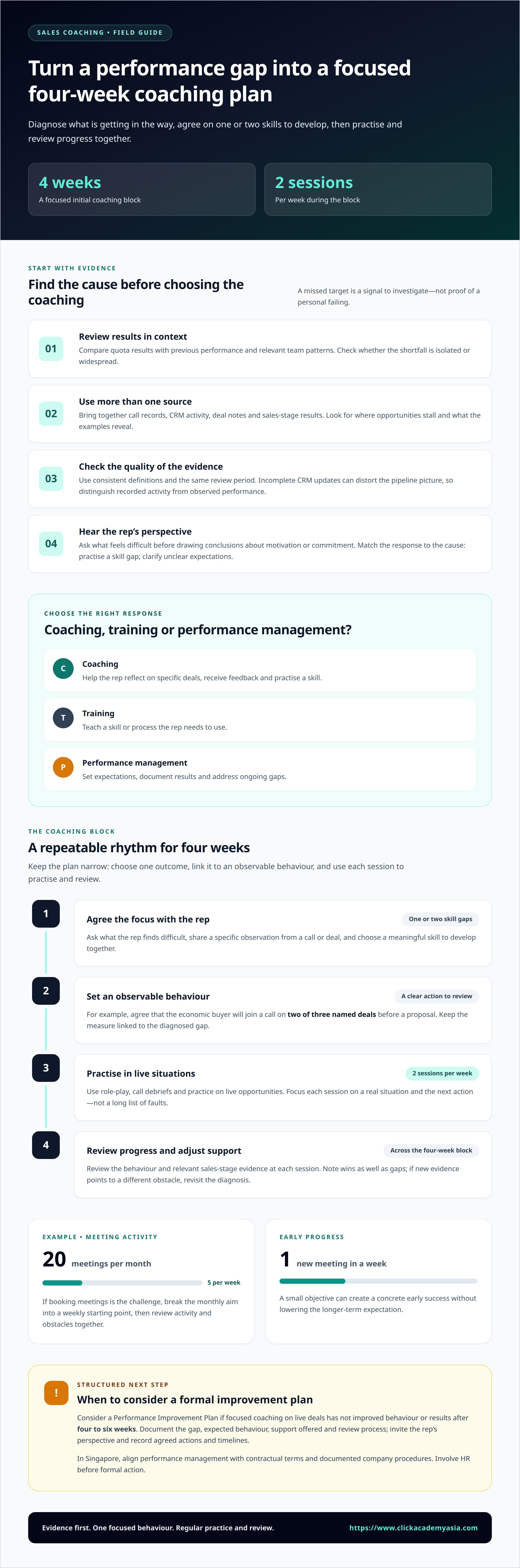
Consider a formal Performance Improvement Plan if focused coaching on live deals has not improved behaviour or results after four to six weeks. Treat it as a structured next step, with clear expectations, support and review points, not as a surprise consequence. In Singapore, align performance management with the employee’s contractual terms and documented company procedures. Involve HR before formal action so the process reflects applicable employment requirements.
How do I coach an underperformer without damaging their confidence?
Ask the rep about their challenges, then discuss specific behaviours and agree on one or two skills to develop. A practical cadence is two coaching sessions per week during a four-week block. Focus each session on a live situation and the next action.
Choose Coaching Techniques and CadenceBegin by asking what the rep finds difficult, then share a specific observation from a call or deal. Use role-play, call debriefs and practice on live opportunities to build skills while recognising strengths. Focus on one or two meaningful skill gaps instead of presenting a long list of faults.Schedule two sessions per week throughout the initial four-week coaching block. Session length depends on the deal and skill being practised, so prioritise useful feedback and a clear action over a fixed duration.
Co-Create a Personalised Development PlanBuild the plan with the rep, not for them. Agree on the skill to practise, the action they will own and when you will review its effect. If booking meetings is the challenge, a rep aiming for 20 meetings per month could begin with five meetings per week, then review the activity and obstacles together.Make progress visible by noting wins as well as gaps. A small objective, such as securing one new meeting in a week, can create a concrete early success without lowering the longer-term expectation.
Create a Focused Four-Week Coaching PlanChoose one outcome for the four-week block and link it to an observable behaviour. For example, agree that the economic buyer will join a call on two of three named deals before a proposal. Practise the relevant conversation, review progress at each session and adjust support if new evidence points to a different obstacle.Avoid assigning eight issues for the rep to fix in one month. A narrow focus gives both managers and reps a clearer way to assess practice, progress and confidence.
Build a Sales Performance Improvement PlanIf coaching has not led to improvement, document the performance gap, expected behaviour, support offered and review process. Discuss the plan with the rep, invite their perspective and record agreed actions and timelines. Keep measures relevant to the role and the original diagnosis.Before formalising next steps, examine whether the compensation plan rewards the intended behaviour. For instance, a structure that rewards closed deals but overlooks early qualification may encourage rushed opportunities. Clarify priorities and raise concerns about plan design through the appropriate internal process.
Managers looking to master the art of coaching underperforming sales reps can strengthen their leadership capabilities by exploring ClickAcademy Asia Sales/Marketing courses.
Separating presenting problems from underlying causes
A missed target is the presenting problem, not proof that the rep caused it. Trace the evidence to its source before choosing a response.
Diagnose the Underlying CauseStart with one specific performance gap, such as stalled pipeline opportunities or missed follow-ups. Ask the rep what happened, then use the Five Whys method: ask “why?” repeatedly to move from the visible result towards its cause. For example, a missed follow-up may stem from unclear ownership rather than a lack of effort.Group possible causes into skills, motivation, process or data. If several reps face the same issue, investigate shared systems and expectations before focusing on one person.
Distinguish Skill Gaps from Other CausesObserve the behaviour behind the result before deciding that the rep needs more practice. A skill gap may be evident when a rep consistently struggles to qualify a buyer or explain value, even when the process and data are clear. Coach and practise that behaviour; don’t treat every weak outcome as a capability problem.If motivation may be a factor, discuss what is affecting the rep’s engagement rather than assuming intent. For a process issue, trace handovers or approval steps. For a data issue, check whether CRM records accurately reflect the pipeline.
Separate observations from interpretations in your notes. “The buyer’s next step wasn’t agreed” describes an observable call outcome; “the rep lacks commitment” assigns a motive. Bring the first statement to a coaching discussion and ask what the rep noticed. This makes room to test explanations instead of turning a missed target into a character judgement.Revise your explanation if it doesn’t fit the evidence. A rep who misses a follow-up after a CRM handover may need a clearer process, while one who repeatedly avoids buyer questions may need targeted practice.
Prioritise the cause that explains the most repeated evidence, then address it before adding more coaching goals. In one example, a manager saw 20 issues after a rep missed quota. Treating all 20 as separate problems would scatter attention; look for a shared cause, such as unclear qualification criteria, that could explain several behaviours.Review the pipeline after making a focused change. If opportunities still stall at the same point, revisit the diagnosis and ask what the evidence suggests now. If the pattern shifts, keep working on the cause that changed it.
Using call reviews, CRM activity, and sales-stage data
Combine call evidence, CRM records and stage conversion data to see where deals lose momentum. Review the evidence together before choosing a coaching action.
Review three recent calls from open or recently lost deals at the stage where performance drops. Listen for buyer cues about timing, decision-makers, budget or next steps. Compare the rep’s response with what the buyer said, rather than judging delivery style alone. Look for a repeated pattern in at least two of the three calls before settling on a diagnosis.
Debrief each call within 48 hours, while the details are still easy to recall. Ask the rep what they heard, what they intended to do and what they would change next time. Then offer one specific observation, such as a missed buying signal or an unclear agreed action. Trained human assessors disagreed on 18% of individual call scores when marking the same calls, so anchor feedback in observable moments.
Compare the call pattern with CRM activity and sales-stage movement. Check whether the rep consistently records decision-makers, next steps and follow-up dates. Examine where opportunities stall rather than relying on total pipeline value. For example, a rep may create opportunities at a healthy pace but struggle to secure buyer commitment before proposals.
Compare conversion rates at each stage with the team’s results. In one example, a representative won about one in six deals after proposal, while the team won one in three. That contrast points to a stage-specific gap worth investigating. Review proposal calls and CRM notes for missing buyer needs, unclear value or absent decision criteria before setting a new activity target.
Review quota and commission rules alongside the evidence. Confirm which outcomes the plan rewards, when credit is assigned and whether shared deals affect the rep’s recorded results. A rep may prioritise quick closures if incentives favour immediate wins over qualified pipeline development. Discuss the plan’s practical effect with the rep, then compare their actions with its stated measures.
Turn the findings into a focused practice action and track its effect in the next relevant deals. If buyers repeatedly ask about implementation, for instance, practise a concise response and review whether later calls secure a clear next step. Record call evidence, CRM activity and stage movement together. This creates a more useful coaching record than quota alone and helps distinguish a skill issue from a process or measurement problem.
Setting and communicating sales KPIs
Set KPIs that connect the diagnosed performance gap to actions the rep can influence. A useful measure defines the expected result, its evidence source and how leaders will review progress.
Choose a KPI that matches the diagnosed gap. If discovery calls fail to establish buyer needs, track whether the rep records those needs and confirms them with the buyer. If opportunities stall after proposals, focus on agreed decision steps instead of adding an unrelated activity target. The KPI should make the desired behaviour visible.
Balance outcome measures with leading indicators. Quota attainment and closed revenue show results, but don’t explain the actions behind them. Pair an outcome measure with a relevant behaviour, such as the quality of qualification notes or follow-up completion. This gives the rep something specific to practise while leaders monitor whether sales results change.
Define each measure in plain terms. State what counts, where the evidence sits and who records it. For example, define a completed follow-up as a dated CRM entry tied to a buyer’s agreed next step, not simply an email sent. Shared definitions reduce inconsistent reporting and prevent a KPI from rewarding activity without purpose.
Explain the reason and invite the rep’s perspective. Show how the KPI addresses the observed gap, then ask what might block the action. A target tied to decision-maker engagement should clarify which opportunities count and what evidence demonstrates progress. If territory conditions, lead quality or handovers affect delivery, account for those factors before judging results.
Set a review rhythm and adjust based on evidence. Use one-to-ones to discuss progress, wins and obstacles, not just dashboard totals. Compare CRM records and sales-stage movement with the agreed KPI, then decide whether to continue, refine or replace the measure. If activity improves but outcomes remain flat, investigate the next constraint instead of automatically raising the target.
Check that the KPI cannot be met through low-value activity. A high number of logged calls may look productive while buyer conversations and qualified opportunities remain weak. Review a sample of call notes alongside the measure, and recognise quality as well as volume. Clear KPIs guide coaching; they shouldn’t replace judgement about customer progress.
Strengthen your team’s ability to set and act on performance measures through [Internal Link: ClickAcademy Asia Sales Leadership courses].
ClickAcademy Asia
ClickAcademy Asia supports professional development with practical training in digital strategy and marketing. If your diagnosis points to gaps between marketing activity, lead quality and sales outcomes, WSQ Digital Marketing Strategy & Planning can help teams build a clearer understanding of how these elements connect. Related courses include WSQ Content Marketing Strategy, WSQ Search Engine Optimisation (SEO) and WSQ Search Engine Marketing (SEM).
These programmes are most relevant when sales performance depends on stronger coordination with digital marketing, rather than individual sales coaching alone. For team development, [Internal Link: Contact ClickAcademy Asia].
Build the capability behind better coaching
Improving sales performance is also a leadership capability: managers need to interpret evidence, develop people and connect sales activity with how the business attracts and serves customers. Coaching underperforming sales reps is more effective when leaders keep building these skills across the wider team, not only during performance conversations.
ClickAcademy Asia offers professional learning through WSQ Digital Marketing Strategy & Planning, WSQ Content Marketing Strategy and WSQ Search Engine Optimisation (SEO). These programmes help teams strengthen their marketing knowledge around lead generation and customer journeys, giving sales and marketing colleagues a shared foundation for collaboration.
Choose learning priorities that fit your team’s capability gaps, then apply them in planning, customer conversations and coaching. Contact ClickAcademy Asia to equip your team through WSQ-funded training tracks. Keep developing the skills that help managers coach with clarity and lead with confidence.
Frequently Asked Questions
How do I tell the difference between a skill gap and a mindset issue?
A skill gap appears when a rep struggles with a specific sales behaviour, even when expectations are clear and suitable opportunities are available. A mindset concern may show as reluctance to attempt a behaviour the rep can already demonstrate. Test the distinction with a realistic practice scenario, then ask what feels difficult. Don’t treat hesitation as proof of poor attitude: confidence, unclear priorities or past customer responses may influence behaviour.
How long does it take to turn around an underperforming rep?
The timeline depends on the cause and the change required. A focused sales skill may improve within a few weeks when the rep practises consistently and applies feedback to live opportunities. Changes in confidence or mindset can take months and require sustained psychological safety. Review behaviour rather than waiting for quota outcomes alone, since deal cycles and customer decisions can delay visible results.
What Really Drives Sales Performance?
Sales performance reflects more than individual effort. A rep needs relevant skills, clear expectations, usable data, workable processes and opportunities that fit the target market. Leadership also shapes performance through coaching, territory decisions and incentive design. For example, a team may struggle to qualify leads when marketing handovers lack useful customer context. Examine how these factors interact before deciding motivation alone explains weak results.
How do you diagnose why a sales rep is underperforming?
Begin with a specific result, then trace the events that preceded it. If proposals stall, for example, compare buyer requirements, approval steps and follow-up commitments across affected deals. Ask the rep to explain their decisions before offering your interpretation. Compare the pattern with team results too: a shared drop may point to a process or market issue, while a recurring individual behaviour may call for targeted support.
Which sales KPIs should be used to assess rep performance fairly?
Use measures that reflect both results and relevant behaviours, such as revenue alongside qualified opportunities or buyer-agreed next steps. Assess performance in light of the rep’s role, territory, lead sources and sales-cycle conditions. A raw activity count can mislead if one rep handles complex accounts while another works shorter cycles. Define each measure consistently, then use customer and CRM evidence to interpret the numbers.
How can managers coach sales reps using call reviews and role-play?
Choose a call moment tied to a clear development goal, such as responding to a buyer’s concern about implementation. Ask the rep what they noticed before sharing your observation. Then replay the moment through role-play, try a different response and discuss its likely effect. In the next relevant customer conversation, review whether the rep applied the practice and how the buyer responded.
How can managers motivate an underperforming sales rep without damaging morale?
Speak privately and ask what is making the work difficult before proposing solutions. Recognise a specific strength, then agree on an achievable action that gives the rep ownership. For example, if a rep handles customer objections well but delays follow-up, acknowledge their questioning skill and plan a prompt next-step message. Avoid public comparisons with colleagues, which can shift attention from learning to embarrassment.
When should a sales rep be placed on a formal performance improvement plan or let go?
Consider a formal plan if focused coaching on live deals has not improved behaviour or results after four to six weeks. Set out the gap, expectations, support and review process, and discuss the evidence with the rep. A plan should not automatically determine dismissal. Before making any employment decision in Singapore, involve HR and follow the employment contract and relevant organisational procedures.



Comments