
How to Deal With a Boss Who Doesn't Understand Marketing

To understand how to deal with a boss who doesn't understand marketing, connect each recommendation to a business priority your boss values, such as revenue, customer retention, or reducing risk. Explain who the idea targets, what outcome it aims to achieve, how you’ll measure progress, and what decision or support you need. Lead with evidence and a practical next step, not marketing jargon.
It can be frustrating when a campaign is judged only by immediate sales or useful data seems to have little influence on decisions. Your boss may be weighing uncertainty, budget, or competing priorities, so make both the potential value and the risks easy to assess.
This article shows you how to translate marketing activity into business outcomes, present metrics with context, and handle objections constructively. You’ll also learn to set expectations, propose a manageable test, and build a more effective working relationship, even when you and your boss measure success differently.
Table of Contents
How to deal with a boss who doesn't understand marketing
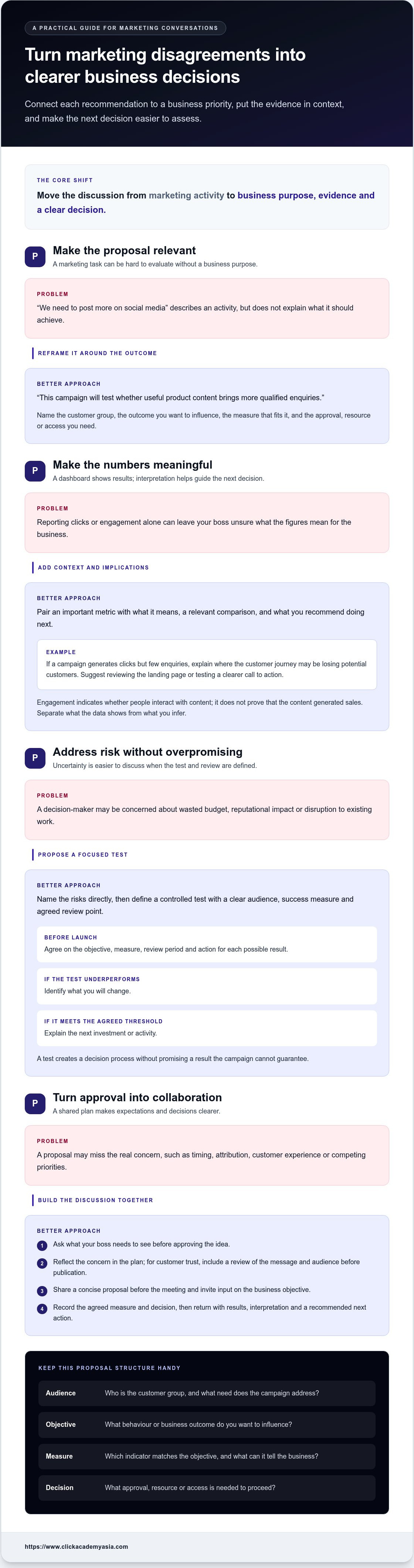
A practical approach to how to deal with a boss who doesn't understand marketing starts with the decision your boss needs to make. Your role is to connect the proposed activity to a business priority, explain how you’ll assess it, and make the next step clear. For example, replace “We need to post more on social media” with “This campaign will test whether useful product content brings more qualified enquiries.” The second version gives your boss a purpose to evaluate, not just a marketing task.
Translate the idea into business terms
Before presenting a campaign, prepare a short case that answers four questions: who it targets, what it aims to change, how you’ll measure progress, and what decision you need. Keep the explanation relevant to the business. A social media proposal, for instance, could focus on reaching a defined customer group and supporting consideration, rather than listing posting frequency or platform features.
Audience: Name the customer group and the need your campaign addresses.
Objective: State the behaviour or business outcome you want to influence.
Measure: Choose indicators that match the objective, such as qualified enquiries for lead generation.
Decision: Specify the approval, resource, or access required to proceed.
This structure helps your boss judge the proposal against its purpose. It also keeps the conversation focused when terms such as reach, engagement, or conversion rate need explaining. Define each metric in plain English and show what it can tell the business. For example, engagement indicates whether people interact with content, but it doesn’t prove that the content generated sales.
Give metrics context, not just a dashboard
A dashboard presents results; your interpretation helps someone decide what to do next. Pair each important metric with its meaning, a relevant comparison, and its implications. If a campaign generates clicks but few enquiries, explain where the customer journey may be losing potential customers. Then suggest a specific follow-up, such as reviewing the landing page or testing a clearer call to action.
Don’t present return on investment as a simple dollar-for-dollar calculation when the objective extends beyond immediate sales. A campaign may support customer awareness, repeat consideration, or long-term customer value. Explain which outcomes can be observed now and which require more time or a different measurement approach. Separate what the data shows from what you infer, so your boss can see the basis for your recommendation.
Address risk with a focused test
A decision-maker may be concerned about wasted budget, reputational impact, or disruption to existing work. Name those risks directly instead of treating objections as resistance. Then propose a small, controlled test with a defined audience, a clear success measure, and an agreed review point. For example, a limited content experiment can help assess audience response before you expand the campaign.
Set expectations before launch. Agree on the objective, the measure, the review period, and what action follows each possible result. If the test underperforms, identify what you’ll change; if it meets the agreed threshold, explain the next investment or activity. This turns an uncertain proposal into a decision process without promising a result the campaign cannot guarantee.
Make the discussion collaborative
Ask what your boss needs to see before approving the idea. Their answer may reveal a concern about timing, attribution, customer experience, or competing priorities. Reflect that concern in the plan. For example, if protecting customer trust is the priority, include a review of the message and audience before publication.
Share a concise proposal before the meeting, so your boss can prepare questions.
Invite input on the business objective, rather than asking only for approval.
Record the agreed measure and decision in a follow-up note.
Return with results, interpretation, and a recommended next action.
Clear, consistent reporting builds a shared understanding of marketing decisions. Over time, each proposal can draw on previous tests, customer responses, and agreed priorities. That evidence gives you a stronger basis for discussion and helps your boss assess marketing as a series of deliberate business choices.
Make the value explicit when you present an idea, and keep your social media case clear and well supported. Show return on investment without treating it as a dollar-for-dollar comparison. A decision-maker may also focus on risks to the company, so explain relevant uncertainties alongside the meaning and context of the data.
ClickAcademy Asia: WSQ Digital Marketing Strategy & Planning
ClickAcademy Asia offers WSQ Digital Marketing Strategy & Planning for professionals who want to strengthen their marketing decision-making and explain their strategic rationale clearly. It can be a relevant next step when you need to connect audience needs, channel choices, objectives, and measurement in a coherent plan instead of presenting disconnected campaign tactics.
Choose learning that matches the gap you need to address. WSQ Content Marketing Strategy can strengthen your approach to content planning, while WSQ Search Engine Optimization (SEO) and WSQ Search Engine Marketing (SEM) focus on distinct search channels. Developing this knowledge can help you assess proposals more confidently and contribute clearer recommendations in discussions with business leaders.
Contact ClickAcademy Asia to explore the training that best fits your marketing development goals.
Build a stronger marketing partnership
Knowing how to deal with a boss who doesn't understand marketing is an ongoing leadership skill. For your next discussion, agree on the business priority, document the decision, and use the outcome to sharpen your next recommendation. These habits help turn individual conversations into a more consistent way of working together.
Keep building the capabilities that help you and your team connect marketing choices to business goals. ClickAcademy Asia offers WSQ-funded training, including WSQ Digital Marketing Strategy & Planning, WSQ Content Marketing Strategy, and WSQ Search Engine Optimization (SEO), to support that development.
Contact ClickAcademy Asia to discuss marketing training for your team. Put the next practical step in motion and strengthen your team’s confidence in its marketing decisions.



Comments