
Agile project management for marketing and how teams work

Agile project management for marketing teams offers a flexible way to organise work, review progress and respond to changing priorities. It connects day-to-day tasks with campaign goals while leaving room to learn and adapt.
Marketing plans can shift as customer needs, campaign performance and business priorities evolve. A practical approach helps teams make clearer decisions and keep work aligned without treating every plan as fixed.
This guide explains Agile principles, potential benefits and adoption challenges, then considers whether the approach suits your team. Use it to assess how Agile could support your marketing goals.
Table of Contents
What is Agile Project Management for Marketing?
Agile organises marketing work into manageable cycles or continuous workflows, then adjusts priorities based on progress and feedback. To put it into practice, set a goal, choose a framework, prioritise work and review results regularly.
Agile Marketing Methodologies
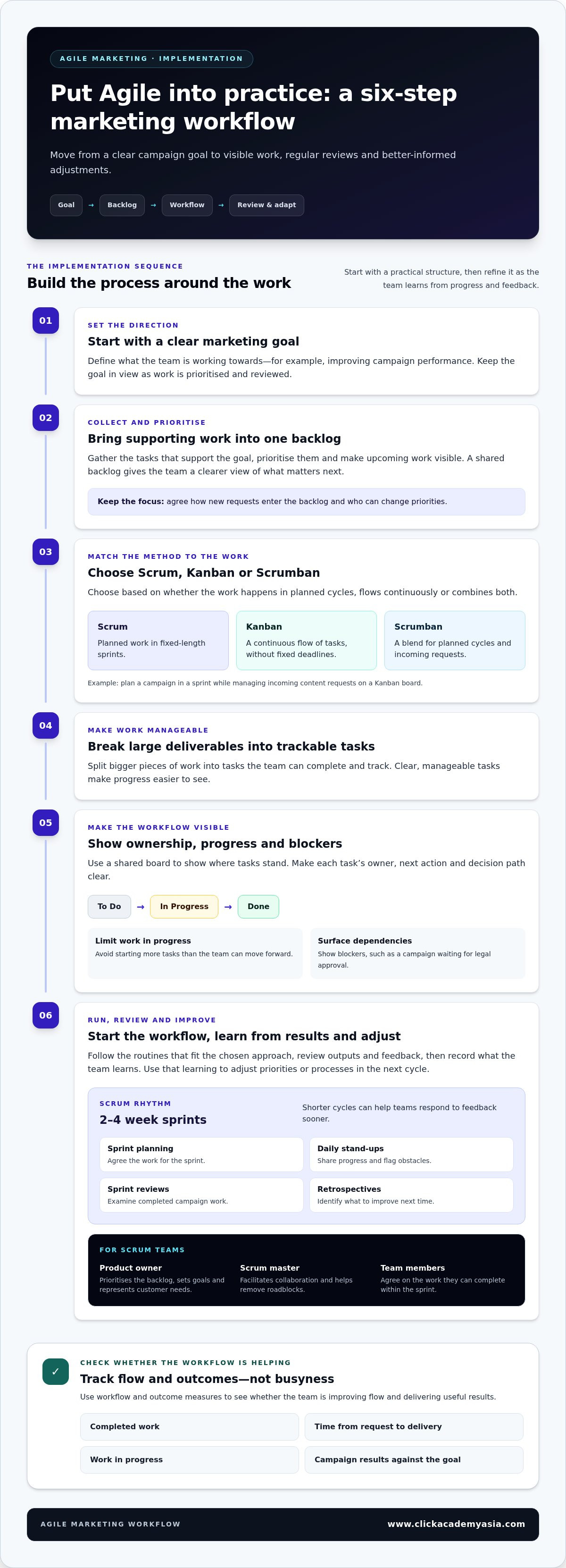
Scrum, Kanban and Scrumban structure marketing work in different ways. Scrum groups planned work into fixed-length sprints; Kanban visualises a continuous flow of tasks; Scrumban combines elements of both. For example, a team could plan a campaign in a sprint while handling incoming content requests on a Kanban board.
The right method makes priorities and bottlenecks easier to see. A board can track tasks through “To Do,” “In Progress” and “Done,” while a clear marketing backlog keeps upcoming work visible. Work-in-progress limits help teams avoid starting more tasks than they can move forward.
Scrum Roles and Ceremonies
Scrum uses defined roles and recurring ceremonies to coordinate work during each sprint. A product owner prioritises the backlog, sets goals and represents customer needs; a Scrum master facilitates collaboration and helps remove roadblocks. Team members agree on the work they can complete within the sprint.
Common ceremonies include sprint planning, daily stand-ups, sprint reviews and retrospectives. A marketing stand-up helps the team share progress and flag obstacles; a review examines completed campaign work, while a retrospective identifies what to improve next time. Scrum sprints for marketing teams can last 2-4 weeks, with shorter cycles helping teams respond to feedback sooner.
Choosing an Agile Approach
Choose between Scrum, Kanban and Scrumban based on the work your marketing team actually handles. Scrum suits teams able to commit to fixed-length sprints and defined roles. Kanban suits continuous workflows without fixed deadlines, such as ongoing content production. Scrumban can work well when teams need planned cycles but also face unplanned requests.
Agile also includes approaches such as Lean, which focuses on reducing waste, improving flow and maximising customer value. Extreme Programming (XP) is another Agile approach associated with software development practices. Marketing teams do not need to adopt software practices wholesale; they can use relevant techniques alongside Scrum or Kanban to suit their campaign process.
Implementing Agile Step by Step
Begin with a clear marketing goal, such as improving campaign performance, then gather the supporting work in one backlog. Prioritise tasks and choose Scrum, Kanban or Scrumban based on whether the work happens in cycles, flows continuously or combines both. Break large deliverables into trackable tasks the team can complete.
Make ownership and workflow visible, then start using the chosen approach. Scrum teams plan a sprint and hold regular check-ins; Kanban teams move work across board stages and manage work in progress. Review outputs and feedback, record what the team learns, then adjust priorities or processes in the next cycle. This makes Agile practical without treating the first plan as fixed.
Agile adoption challenges and cross-team agreements
Agile adoption can stall when priorities shift, work remains hidden or other teams use different processes. Clear agreements help an Agile team stay focused while coordinating hand-offs across departments.
Measure success with workflow and outcome KPIs. Track completed work, time from request to delivery, work in progress and campaign results against the goal. These measures show whether the team is improving flow and delivering useful outcomes, rather than simply staying busy.
Team Focus and Visibility
Team focus and visibility mean making priorities, ownership and active work easy to see. A shared workflow helps team members spot bottlenecks and avoid starting competing tasks. For example, a board can show that a campaign is waiting for legal approval, rather than making it appear that marketing work has stalled.
Frequent priority changes can fragment attention and reduce productivity. Agree how new requests enter the backlog, who can reprioritise them and which existing work moves aside. Review work in progress together. If too many tasks are active, pause lower-priority items before adding another campaign.
Communication and Accountability
Communication and accountability give each task a clear owner, next action and decision path. Cross-team agreements should define what marketing needs from sales, product or leadership, and what each team receives in return. For a campaign launch, agree who supplies product details, who approves copy and who confirms creative assets are ready.
Record decisions and dependencies in a shared workflow rather than scattering them across messages. Short check-ins can surface blockers, while written updates preserve context for team members who cannot attend. Make changes visible and assign follow-up actions so collaboration stays practical instead of becoming a series of status meetings.
Managing Remote Agile Teams
Remote Agile management relies on visible work and deliberate communication, not constant monitoring. Teams can use shared boards and online channels such as Slack, Teams or Zoom to coordinate progress. Record decisions beside the relevant task so colleagues working at different times can understand what changed and what needs attention.
Set expectations for response channels, hand-offs and escalation before work begins. Use live meetings for decisions that need discussion, then document outcomes for the whole team. This balance supports iterative collaboration without making every update a meeting. For managers building stronger planning habits, marketing strategy and planning skills can help connect team priorities with business goals.
Agile project management principles and history
Agile grew from software development, but its principles also help marketing teams manage changing priorities and stakeholder feedback. The history matters because it explains why Agile favours adaptation and useful outcomes over rigid processes.
Agile Marketing Origins
Agile marketing draws on Lean manufacturing techniques used by Japanese automotive companies in the 1970s and 1980s. Software developers formalised the Agile Manifesto in 2001, creating a foundation that teams beyond software later applied to their work.
For marketers, the practical lesson is to improve work flow instead of adding process for its own sake. A team planning a product launch, for example, can release campaign elements incrementally and use audience feedback to shape the next piece.
Agile Values and Principles
The Agile Manifesto sets out four values: individuals and interactions over rigid processes, working products over extensive documentation, customer collaboration over fixed contracts, and responding to change over following a set plan. These values help stakeholders decide what to do when campaign assumptions change.
These values do not mean abandoning plans or documentation. A marketing team can document a launch brief, then revise channel priorities when customer feedback changes the picture. The principle is to let useful evidence guide decisions rather than treating the original plan as untouchable.
In practice, Agile principles become repeatable habits. Teams plan a short cycle, deliver a useful increment, review the result and adjust the next cycle. A Kanban board can make the workflow visible, while a retrospective helps the team choose a process change to test next.
Gather feedback from customers and internal stakeholders. For example, a content team can review engagement signals alongside input from sales, then refine its next set of topics. The goal is not to chase every comment, but to weigh evidence against the campaign goal and make a considered adjustment.
Agile also depends on sustainable work. Teams working at 100% capacity all the time have little room for urgent requests or unexpected problems, increasing the risk of burnout, attrition and reduced crisis response. Leave capacity for changes, and use work-in-progress limits to keep active commitments realistic.
These principles can guide everyday decisions without requiring a complete process redesign. Start by making one workflow visible, agreeing how stakeholders give feedback and reviewing what changed after each cycle. Improvement stays iterative: test a manageable adjustment, observe its effect, then decide what to do next.
Benefits and suitability of Agile for marketing
Agile can help marketing teams respond to changing customer feedback, test ideas earlier and adjust campaign priorities. In Singapore, teams can adapt the workflow to local business practices by agreeing approval steps and building relevant internal reviews into campaign planning.
Benefits for Marketing Teams
Agile techniques give teams a continuous way to learn from campaign activity and improve their next decision. Rather than waiting until every asset is complete, a team can test a campaign element, review its performance and adjust the next release.
This approach can make work clearer for everyone. A shared goal connects daily tasks to business outcomes, while regular reviews show whether the work is producing useful results. For example, a team can compare audience responses to campaign messages, then shift its next content focus based on what it learns.
Agile Suitability for Marketing
Agile suits marketing work where customer needs, channel performance or stakeholder input may change during delivery. It is useful for campaigns that benefit from iterative testing, such as refining landing-page content or adjusting a sequence of social posts.
Agile may be less suitable when work depends on fixed approvals, tightly controlled messaging or deliverables that cannot be released in stages. These constraints do not rule it out: teams can retain required approval gates while planning flexibly around them. The method should fit the work, not force every task into the same cadence.
For Singapore teams, incorporate applicable company and regulatory review into the workflow before campaign materials go live. Identify who owns each approval, what evidence reviewers need and how feedback returns to the team. This keeps iteration practical while respecting obligations relevant to the campaign, audience and channel.
Agile’s value also depends on choosing measures that match the goal. A campaign focused on awareness needs different performance indicators from one designed to generate qualified enquiries. Agree on the objective first, then review relevant audience responses and business results at each meeting. Use the findings to decide what to continue, change or stop.
Consider team capability as well as campaign type. Agile needs people who can prioritise, interpret performance information and collaborate across functions. If the team struggles to connect channel activity with strategic objectives, developing its planning and measurement skills can make the approach more effective. Marketing analytics and insights skills can support clearer campaign decisions.
Start with one workflow where feedback can inform the next action, rather than changing every process at once. Set a clear goal, define review points and make decisions visible to everyone. After each cycle, assess whether the team delivered useful work, learned something actionable and maintained a manageable workload. Keep helpful practices and adjust those that add friction.
Agile project management for marketers
Marketing work combines audience insight, creative judgement and commercial objectives. Applying Agile means translating strategy into coordinated decisions across channels. The central task is connecting customer needs with business goals without treating each channel as an isolated activity.
Start with the audience and intended outcome. For a service launch, a marketing team might map what prospective customers need to understand before considering the offer. That map can guide the message, content format and channel choice, giving creative and performance specialists a shared strategic reference.
Make the campaign brief useful across disciplines. Include the audience, proposition, desired action, brand requirements and measurement approach. A designer can understand the message behind an asset, while a media specialist can see how its placement supports the same objective. Clear context reduces conflicting interpretations and avoidable rework.
Choose channels based on how people encounter information, not simply which platforms the team already uses. A campaign may need a search-led explanation for people actively seeking answers, alongside social content that introduces the proposition to a broader audience. The mix depends on customer intent, available content and each channel’s role.
Marketers also need to distinguish useful signals from misleading ones. A rise in clicks, for example, does not by itself show whether a message attracted the intended audience or supported the business objective. Define what evidence would indicate progress before interpreting performance, and consider the context behind each measure.
Creative consistency is another practical challenge. Assets for search, social and email may differ, but each should express the same core proposition. A message framework can clarify which claims, tone and visual cues must remain consistent while leaving room to adapt execution for each channel.
Marketing leaders can strengthen this strategic foundation by developing their team’s content planning capability. Comprehensive training in ClickAcademy Asia content marketing strategy can help professionals connect audience needs, editorial choices and business priorities when shaping a marketing programme.
Finally, define how marketing decisions connect with commercial teams. Sales may hear objections that inform messaging, while customer support may spot recurring questions that call for clearer content. Agree which insights matter to the shared objective and how those teams contribute, so marketing reflects real customer interactions.
The key for marketers implementing agile project management for marketing teams is to manage the connections between audience, proposition, channels and commercial goals. This strategic perspective helps the team make coherent choices, even when different specialists own separate parts of the work.
ClickAcademy Asia: WSQ Digital Marketing Strategy & Planning
ClickAcademy Asia’s WSQ Digital Marketing Strategy & Planning helps marketing professionals strengthen the strategic thinking behind campaign priorities and decisions. It can be a useful next step when your team understands Agile processes but needs to connect day-to-day marketing work more clearly with business objectives.
For specific capability gaps, WSQ Content Marketing Strategy, WSQ Search Engine Optimization (SEO) and WSQ Search Engine Marketing (SEM) provide focused learning in those disciplines. Stronger planning and channel knowledge can help marketers contribute more effectively to team priorities and campaign reviews.
Explore the training options that match your team’s learning goals, or visit ClickAcademy Asia’s website to find out more.
Turn your next campaign into a learning opportunity
Choose a capability your team wants to strengthen, then connect it to a real marketing challenge. A focused learning goal helps professionals apply new knowledge to better decisions on future campaigns.
Build your team’s practical skills through [Internal Link: ClickAcademy Asia WSQ-funded training tracks]. Identify the capability that would make the greatest difference to your team’s work, then take the next step towards developing it.
Frequently Asked Questions
Can software help manage agile teams?
Project management software can make tasks, owners, dependencies and decisions visible in one shared workspace. A marketing team could use a board to track a campaign brief from drafting through review and publication, while recording approval blockers against the relevant task. Choose tools that support your workflow without adding unnecessary admin. Software helps organise collaboration, but people still need to agree on priorities and update work consistently.
How does this apply to marketing?
Marketing teams apply Agile by organising campaign work around a clear objective, then using performance feedback to guide decisions. For example, a team launching a webinar could coordinate its landing page, email content and social promotion, then adjust follow-up messaging based on audience response. Specialists can work towards one outcome while refining the campaign as it unfolds.
So how do you leverage user stories in agile marketing?
Write user stories to describe a marketing need from the audience’s point of view. For example: “As a first-time visitor, I want a clear guide to the service, so I can decide whether it fits my needs.” Use the story to align content, design and measurement around the reader’s need. Define what a useful result looks like before work begins, so reviews assess value rather than personal preference.
What is Kanban?
Kanban manages continuous work by showing tasks as they move through workflow stages. A marketing board might use columns for incoming requests, ready, in progress, review and complete. Each card should identify an owner and the next action. Teams can also limit work in progress, helping them finish existing tasks before opening more.
What is Scrum?
Scrum is an Agile framework that organises work into fixed-length iterations called sprints. The team agrees on a sprint goal, selects work towards it and reviews the result at the end. In marketing, a sprint might focus on preparing a campaign’s launch assets. The product owner guides priorities, while the Scrum master helps the team follow the process and address obstacles.
What’s the difference between Agile and waterfall?
Waterfall generally plans work through sequential stages, with later work depending on earlier stages being completed. Agile breaks delivery into smaller increments and uses feedback to shape what happens next. A campaign with fixed approvals and deliverables may need more upfront planning; where audience response can guide later content, iterative delivery can make adjustments easier.
What is agile project management for marketing teams?
Agile project management for marketing teams is a way to organise and review marketing work in response to goals, progress and feedback. It can use Scrum, Kanban or a combination that suits the team’s workflow. A practical starting point is to define the audience and campaign outcome, then make related tasks and dependencies visible so contributors can coordinate.
What are the benefits and limitations of agile marketing?
Agile marketing can help teams learn from campaign feedback, make priorities visible and adjust work as conditions change. It also requires active coordination: frequent changes without clear decision rights can disrupt delivery, while approvals or dependencies can limit progress. Agile is most useful when teams can review evidence and act on it. For tightly fixed deliverables, retain necessary controls and adapt only the flexible parts.


Comments