
How to create a sales playbook around goals, audience, and objections

A sales playbook shouldn’t be a polished document that sits unread in a shared folder. It should help your team make better decisions in real sales conversations. Creating a sales playbook from scratch starts with a clear purpose: define the outcomes you want, the buyers you serve and the guidance your representatives need to move deals forward.
A sales playbook brings your sales approach together in one practical resource. It can outline buyer profiles, sales-stage guidance, useful questions, tools and responses to common objections, giving the team a consistent foundation without forcing every conversation into a script.
The challenge is deciding what belongs in the playbook and what your team needs most. This guide shows you how to plan its goals, audience and scope, then document and practise objection responses. You’ll also learn to build a useful first version around real sales conversations, gather input across the business and refine the playbook as your sales approach evolves.
Table of Contents
What is a sales playbook?
A sales playbook is a practical guide to how your team moves a buyer through a sales conversation. It connects buyer context, messaging, discovery questions, sales stages, tools and objection responses, helping representatives find relevant guidance as they manage the pipeline.
Define the buyer and situation. Make each play specific to a persona, segment, use case or vertical, rather than writing one script for every prospect. For example, a play for an operations leader evaluating workflow software should cover that buyer’s priorities, the relevant use case and the questions that reveal fit. This context helps representatives adapt their messaging to the conversation.
Connect buyer personas to sales plays. A persona describes a buyer’s role, goals, challenges and decision criteria; a sales play turns that information into actions for a particular situation. For a finance leader concerned about implementation effort, the play might prompt discovery about existing systems, then guide the representative towards relevant proof and next steps. Keep assumptions separate from evidence drawn from customer conversations.
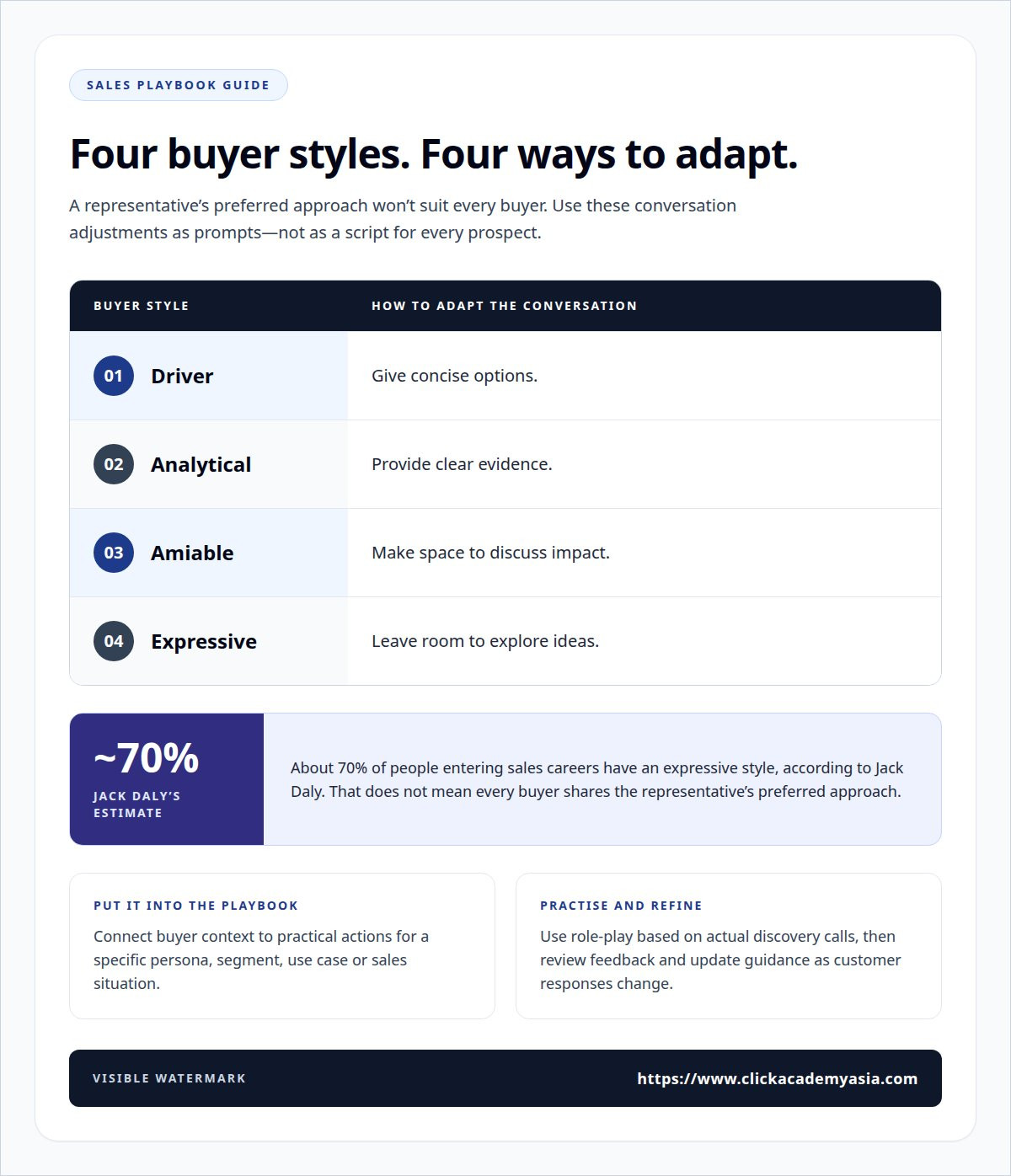
Adapt conversations to personality styles. Jack Daly describes four styles: driver, expressive, analytical and amiable. He estimates that about 70% of people entering sales careers have an expressive style, but a representative’s preferred approach won’t suit every buyer. Coach reps to listen for cues, then adjust: give a driver concise options, an analytical buyer clear evidence, an amiable buyer space to discuss impact, and an expressive buyer room to explore ideas.
Make the playbook usable in the moment. Organise guidance around sales stages and common scenarios, such as first discovery, a product demonstration or a stalled decision. Include prompts, approved tools and examples of effective messaging, not pages of generic advice. A representative handling a stalled opportunity should be able to locate a relevant action without searching an entire manual.
Build in Singapore compliance checkpoints. Sales outreach and customer communications in Singapore may involve the Personal Data Protection Act (PDPA), its Do Not Call provisions and the Spam Control Act. Set out how representatives should handle personal data, contact preferences and commercial messages, and route uncertain cases through the organisation’s compliance process.
Train reps and keep guidance current. Use onboarding to introduce each play, then practise it through role-play based on actual discovery calls and objections. Assign an owner to review feedback, revise outdated messaging and issue each update clearly, so representatives know which guidance to use.
Avoid common playbook mistakes. A generic script, an oversized document or advice disconnected from real sales conversations can make guidance hard to use. Keep each play tied to a buyer and situation, test it with representatives, and revise it when customer responses or the sales process change.
Backward planning from sales goals
Start with the result your sales strategy needs to deliver, then work backwards to the pipeline and actions required. When creating a sales playbook from scratch, use the document to connect each target with specific behaviours, rather than treating templates as a substitute for a clear plan.
Set Sales Goals
Set a measurable sales goal that reflects the business priority, such as revenue, new-customer growth or retention. Then check how the target fits the sales department’s capacity, current pipeline and sales cycle. An example team sets a minimum win-rate goal of 25% and pipeline coverage of 3.0x. Avoid giving representatives targets that lack a clear link to the wider strategy.
Choose KPIs
Choose KPIs that show whether sales activity is moving the goal forward. A revenue target is an outcome; pipeline creation, qualified opportunities and progression between stages can reveal the work behind it. For the example team, compare the 25% win-rate goal with actual closed deals and assess pipeline coverage against 3.0x. Avoid tracking activity that cannot inform a decision or prompt a useful coaching conversation.
Work back from the outcome. Translate the organisation’s sales goal into team and individual responsibilities. If the priority is revenue growth, identify which customer segments, products or sales motions contribute. Keep the target period consistent across plans and reports, so representatives and managers assess performance against the same timeframe.
Map the sales funnel. Document how an opportunity moves from initial contact through qualification, proposal and close. For each stage, define the evidence required to progress, such as a confirmed business need or an agreed next meeting. This helps managers spot where deals stall instead of relying only on a final revenue figure.
Connect KPIs to playbook actions. Link each measure to a behaviour the playbook can support. If qualified opportunities are lacking, add guidance for prospecting and discovery. If deals stall after proposals, include steps for confirming decision criteria and agreeing follow-up. Review whether the chosen action addresses the underlying gap before adding another metric.
Use the numbers to guide updates. Compare actual results with targets during regular pipeline reviews, then record what the team learns. A playbook update should respond to a pattern, such as repeated delays at one stage, rather than a single unusual deal. Keep the relevant template aligned with the revised sales process, and explain the change in team coaching.
Build capability alongside the process. Targets only help when representatives can carry out the required sales behaviours. A manager can use role-play to practise discovery, qualification and next-step conversations against the playbook. Teams strengthening those skills can explore ClickAcademy Asia Sales and Marketing courses as a practical complement to goal setting.
Defining the playbook’s audience and scope
A sales playbook is a working guide that helps a sales team handle specific buyers and situations. Define its audience and boundaries before drafting sections, so each page supports a clear purpose instead of trying to serve everyone.
Choose the primary users. Decide whether the playbook serves new representatives, experienced account executives, sales managers or a specific team. For example, an onboarding guide for new hires needs process explanations and call prompts, while a manager’s guide may focus on coaching and deal reviews. If several groups need different guidance, define their shared needs and separate role-specific material.
Define the target audience. Select the buyer group the playbook will help representatives engage. Describe relevant roles, business needs, decision criteria and buying situations using customer evidence. A playbook aimed at procurement leaders, for instance, might prioritise vendor evaluation and approval steps; one aimed at department heads may focus on operational impact. Keep the profile specific enough to guide action.
Set a minimum viable scope. Start with one target audience, a few sales stages, common objections, frequently used buyer assets and repeated coaching moments. This gives the sales team a manageable first version to test. Avoid covering every product, market and edge case at once; each additional section should help a representative perform a defined task.
Choose the sales stages to include. Map the stages your team actually uses, from initial qualification to decision and follow-up. For each section, clarify its function: what the representative needs to learn, do or provide at that point. A discovery section might include preparation prompts and questions, while a proposal section could explain how to connect the recommended solution to the buyer’s stated priorities.
Prioritise practical benefits. A focused playbook can improve consistency, make guidance easier to find and give managers a shared basis for coaching. These benefits depend on usable content, not page count. Include templates or assets only when they support a specific step, such as preparing a meeting or summarising agreed next actions. Remove material that doesn’t help the reader move a deal forward.
Set boundaries and ownership. State what the playbook covers, what belongs in another resource and who maintains each section. For example, the sales team may own qualification guidance while product specialists contribute accurate feature explanations. Record a review process alongside the content, so changes to positioning, tools or customer needs prompt a relevant update rather than leaving outdated instructions in circulation.
Documenting and practising objection responses
Objections reveal where buyers need more clarity before moving forward. Document them alongside the sales process, then practise responses that help representatives understand concerns rather than recite scripts.
Record Objection ResponsesReview recent sales calls and group recurring objections. Brutal Marketing recommends reviewing 30-50 sales calls to identify common objections. Group them by theme, such as price, timing, implementation or decision authority, then note the sales stage where each appears. This gives the team a practical framework based on real conversations, not assumptions about buyer hesitation.
Practise Objection ResponsesUse realistic role-play to practise listening and responding. Pair representatives and have one person raise an objection drawn from a call review. The seller should clarify the concern, respond with relevant evidence and agree on a next step. Coach for a useful conversation, not a perfect script: an answer that ignores why the buyer is hesitant won’t move the discussion forward.
Write each response as a flexible guide. For every objection, document the buyer’s concern, questions to uncover its cause, a response framework and a suitable next action. For example, if a buyer says, “We’re happy with our current provider,” prompt the representative to ask what is working well and where improvement matters. Make clear that sample wording is not mandatory dialogue.
Connect objections to the sales methodology. Record the stage where each concern tends to arise and what the representative should establish before progressing. A pricing objection during discovery may signal unclear value, while the same concern during a proposal review may call for a closer look at scope. Align the guidance with the team’s actual qualification and decision process.
Prepare for patterns without overloading the playbook. Brutal Marketing observes that 80% of sales drop-off usually rests on 5-7 typical objections. Use that pattern to prioritise recurring concerns, while keeping less frequent but important cases accessible. Jack Daly recommends preparing for at least 15 objections, so build a broader response bank without placing every scenario in the main workflow.
Document the process and update it with evidence. Specify where representatives record objections, how managers coach responses and how the team shares effective examples. Review call notes and customer feedback to spot changes in buyer language. If a response repeatedly causes confusion, revise its discovery prompts or supporting evidence, then practise the updated version in team coaching.
A playbook works best when objection guidance supports the sales process at the moment it is needed. Connect each response to a buyer concern, a sales stage and a clear next action.
Steps for creating a sales playbook
Build the playbook from real sales activity, then test and refine it before wider use. A CRM can organise customer and deal information, while a shared, searchable knowledge base can host playbook guidance. Choose tools that fit your team’s workflow and make the current version easy to find.
Set the build team and purpose. Bring sales, marketing, product, HR and leadership perspectives together. Agree what the playbook must help representatives do, such as qualify opportunities or prepare for negotiation. Assign a manager to coordinate decisions and keep the team focused on practical guidance, not a document that tries to capture every company process.
Review how the team sells now. Start by listening to the last 10 sales calls, then review 20-30 calls to document existing practices. Note the questions representatives ask, the moments buyers hesitate and the actions that move opportunities forward. Compare effective approaches across different representatives instead of assuming one person’s style represents the whole sales team.
Build buyer profiles with marketing. Use market research and existing customer data to develop two to three ideal customer profiles. Capture the traits that shape a sales conversation, including buyer priorities, use cases and decision processes. Then map each profile to relevant plays, so a representative can select guidance for the customer and situation in front of them.
Organise the content around the sales motion. Combine foundations, stage guidance and activation. Explain the company’s sales methodology and how it supports business goals and values. Arrange practical instructions by sales stage, from qualification through proposal and negotiation, and document which tools representatives must use and which are available.
Draft a focused first version. Prioritise the plays, prompts and buyer assets representatives use regularly. Add examples of effective messaging, discovery questions, objection responses and clear next steps. Keep instructions short enough to use during active deals; label templates and supporting resources so sellers can find them without searching through unrelated sections.
Pilot, gather feedback and refine. Test the first version with a small group before expanding it. Collect feedback from sales representatives and customers through interviews or surveys, then revise unclear or impractical guidance. Track which sections people use and where deals still stall, so each update addresses an observed need.
Make ownership part of the rollout. Tell the team where the playbook lives, who maintains each section and how changes are communicated. Schedule reviews when the sales process, tools or customer needs shift. A manager can reinforce adoption through coaching and call reviews, helping the playbook support team growth rather than become a static file.
Equip your team to apply these steps with [Internal Link: ClickAcademy Asia Sales/Marketing courses] that build capability in real sales conversations.
Use a CRM to organise customer and deal information, and a shared, searchable knowledge base to host the playbook. Choose tools that fit your team’s workflow and make the current version easy to find.
ClickAcademy Asia
ClickAcademy Asia helps professionals strengthen the marketing knowledge that supports clear, consistent sales messaging. If your playbook needs better alignment between sales conversations and the content buyers use to assess solutions, WSQ Content Marketing Strategy and WSQ Digital Marketing Strategy & Planning can help build relevant strategic skills.
These programmes can help teams develop a stronger shared understanding of customer needs, content and campaign strategy. Apply that learning to sharpen buyer-focused messaging and improve how sales and marketing support the customer journey, while keeping your playbook grounded in your organisation’s sales process.
For a practical next step in developing your team’s capabilities, contact ClickAcademy Asia to discuss its WSQ training options.
Build the capability behind the playbook
Creating a sales playbook from scratch is only the start. Assign an owner to update it, use team feedback to refine the guidance and develop the skills needed to apply it consistently. These actions help keep the playbook connected to the way your team works.
ClickAcademy Asia offers WSQ-funded training tracks, including WSQ Digital Marketing Strategy & Planning and WSQ Content Marketing Strategy, to build practical capabilities that support sales and marketing collaboration. Equip your team with relevant skills and contact ClickAcademy Asia to discuss WSQ-funded training.
Keep learning, put new skills into practice and help your team move forward with confidence.
Frequently Asked Questions
What are sales plays?
Sales plays are repeatable actions for handling a specific sales situation. For example, a re-engagement play might prompt a representative to review the prospect’s last interaction, share a relevant update and ask whether priorities have changed. It should also clarify the intended outcome, such as confirming a meeting or closing the opportunity. Treat the play as a guide to sound judgement, not a script that overrides the buyer’s response.
What’s included in a playbook?
A practical playbook can include sales-stage guidance, buyer information, discovery prompts, qualification criteria, approved tools and examples of customer communications. Add a contents page, a named section owner and a clear way to identify the current version. For instance, a representative preparing for a demonstration should be able to find the preparation checklist and relevant customer evidence without searching through unrelated material.
What is a sales playbook and what should it include?
A sales playbook is an operational reference that helps representatives make consistent decisions across customer interactions. Beyond scripts and process guidance, include examples of effective execution, such as a useful discovery summary or a clear follow-up message. Specify where representatives can find supporting information and how they should handle unusual situations. This makes the playbook useful during live work, not just onboarding.
What steps are involved in creating a sales playbook from scratch?
Start by agreeing on the business problem the playbook should address, then gather examples from current sales work. Decide which users and situations it should support, draft guidance around actual stages, and ask representatives to test it on active opportunities. Capture anything they could not find or apply. Revise those sections, assign ongoing ownership and communicate updates, so the playbook evolves through use rather than remaining a one-off document.
How do you define an ideal customer profile and buyer personas for a sales playbook?
An ideal customer profile describes the type of organisation that is a strong fit; a buyer persona describes a person involved in its purchase. Use customer and market evidence to identify factors such as business needs, role, decision influence and reasons to act. For a buying committee, distinguish the end user’s priorities from the finance approver’s concerns. This helps representatives tailor discovery without treating every contact as the same buyer.
How should a sales playbook document the sales process and qualification criteria?
Describe each stage by its purpose, the actions expected and the evidence needed to progress. For example, an opportunity might qualify for a proposal only after the buyer’s problem, decision process and agreed next step are recorded. Define these criteria in observable terms, then align them with CRM fields or review practices. Avoid vague labels such as “strong interest,” which representatives may interpret differently.
What sales scripts, email templates, and objection-handling examples should a playbook include?
Include adaptable examples for common moments: an opening message, a meeting confirmation, a post-discovery recap and a response to a frequent concern. Explain the purpose and key points for each, then provide sample wording representatives can personalise. For an objection about timing, a useful example might prompt them to ask what is driving the delay before suggesting a next step. Avoid templates that make unsupported claims or sound impersonal.
How do you choose sales KPIs and targets for a sales playbook?
Choose measures that connect business outcomes with actions the sales team can influence. Pair a result, such as closed revenue, with indicators that explain progress, such as qualified opportunities or stage movement. Define each KPI’s calculation, reporting period and owner so the team interprets it consistently. Set targets using the organisation’s plans and sales capacity, then use review discussions to decide whether coaching or process changes are needed.



Comments