
How Customer Research Shapes Digital Marketing Strategy

Better marketing starts with better questions, not more campaigns. Customer research for a digital marketing strategy means setting a clear objective, gathering relevant data, and using what customers say and do to understand their motivations, define useful segments, and choose suitable channels. It gives your team a practical basis for decisions instead of relying on assumptions.
It’s easy to focus on campaign activity and still be unsure whether your message reaches the right people or addresses what matters to them. Research connects customer needs with marketing decisions, from the content you create to the channels you prioritise.
In this guide, you’ll learn how to set focused research objectives, combine surveys, tests, and analytics, and interpret customer behaviour without treating every buyer alike. You’ll also see how to turn findings into useful audience segments and channel choices for the Singapore market. The aim is a strategy your team can explain, measure, and refine with confidence.
Table of Contents
Choosing effective marketing channels
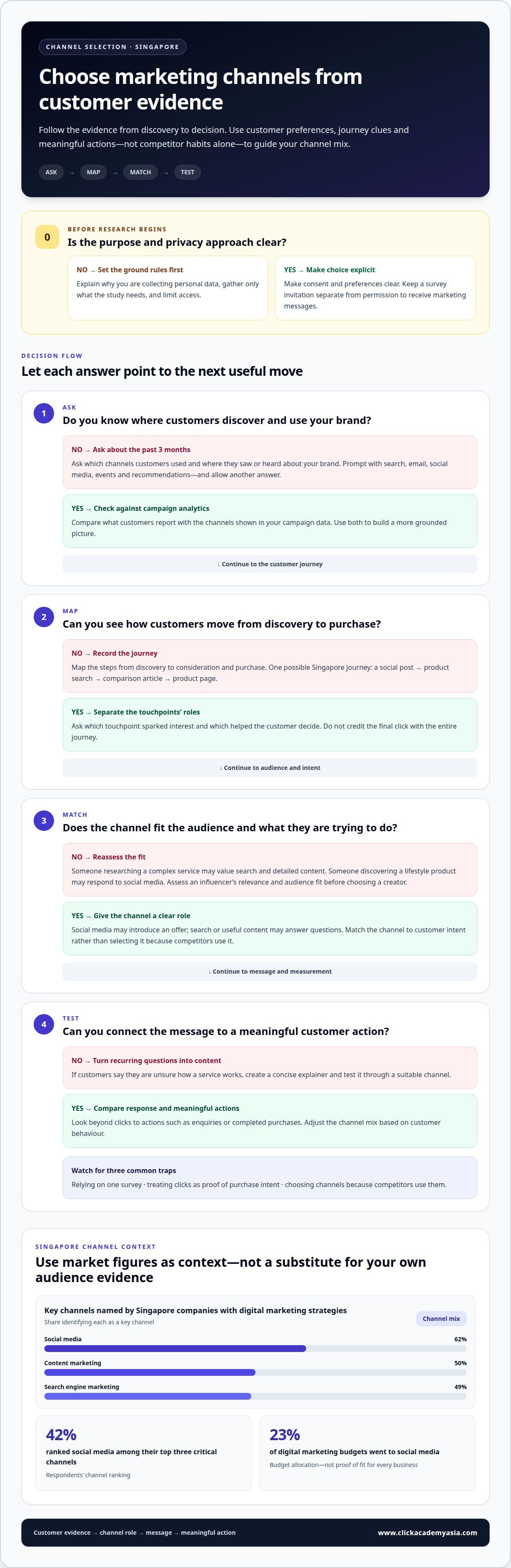
Start with privacy and purpose. For Singapore research, explain why you’re collecting personal data, gather only what the study needs, and limit access. Make consent and preferences clear before inviting participants to research or sending promotional follow-ups. For example, separate a survey invitation from permission to receive marketing messages. This gives participants a clear choice and keeps research focused on its stated purpose.
Ask where customers actually discover and use your brand. Invite customers to name the channels they used and where they saw or heard about your brand in the past 3 months. Include search, email, social media, events, and recommendations as prompts, while allowing another answer. Then compare responses with campaign analytics. Singapore companies with digital marketing strategies identify social media (62%), content marketing (50%), and search engine marketing (49%) as key channels. These figures are useful context, not a substitute for your own audience evidence.
Map the customer journey across channels. Record how a person moves from discovery to consideration and purchase. A Singapore customer might first see a social media post, search for product details, read a comparison article, then visit a product page. Ask which touchpoint sparked their interest and which helped them decide. This reveals channel roles: social media may introduce an offer, while search or useful content answers questions. Avoid crediting the final click with the entire journey.
Match channel choices to audience and intent. Compare stated preferences with the task customers are trying to complete. Someone researching a complex service may value search results and detailed content; someone discovering a lifestyle product may respond to social media. Influencer marketing can help reach younger audiences who use social platforms, but assess relevance and audience fit before choosing a creator. In Singapore, 42% of respondents ranked social media among the top three critical channels, while social media received 23% of digital marketing budgets. Budget patterns don’t prove fit for every business.
Turn findings into messages, then test them. Translate recurring customer questions into content that answers them directly. If interviewees say they’re unsure how a service works, create a concise explainer and test it through a suitable channel. Common mistakes include relying on one survey, treating clicks as proof of purchase intent, or choosing channels because competitors use them. Compare response and meaningful actions, such as enquiries or completed purchases, then adjust the channel mix based on customer behaviour.
Companies consider influencer marketing especially important for reaching younger audiences because a high percentage of people in those age brackets use social media. By the 2020s, marketers were using influencer marketing alongside paid social media display advertisements to promote products and engage potential consumers. 85% of Singapore’s population were estimated to be social media users.
Collecting survey, test, and analytics data
Choose the right method for each question. Use surveys to understand stated preferences, interviews to explore reasons, and analytics to observe behaviour. For example, a survey can ask what customers expect from a product page, while analytics show whether visitors reach it. Match the method to the decision you need to make. A short research plan can list the question, data source, owner, and intended action.
Write survey questions that lead to useful answers. Ask about one topic at a time, using plain language and neutral wording. Instead of asking whether a new offer is “excellent”, ask which feature matters most and why. Include an open-response question to capture details you hadn’t anticipated. Before wider distribution, test the survey with a colleague to spot confusing wording, missing answer choices, or questions that don’t support a decision.
Test one meaningful change at a time. Compare two versions of a landing-page headline, email subject line, or call to action. Keep the audience and other page elements consistent so the tested change is easier to interpret. For example, test a benefit-led headline against a product-feature headline, then compare completed enquiries rather than clicks alone. Record the test question and success measure before launch to avoid picking a winner after seeing the results.
Connect analytics to customer actions. Define useful events in platforms such as Google Analytics 4, including product-page views, form submissions, or completed purchases. Check that each event reflects a meaningful step, not just activity. Then compare patterns by traffic source, device, or landing page. A spike in visits without enquiries may indicate a mismatch between an advert’s promise and the page content, rather than a problem with reach.
Bring the evidence together and measure impact. Combine survey responses, test results, and analytics to see whether customer insights changed a marketing decision. Compare the chosen outcome before and after the change, such as qualified enquiries or completed purchases. Track investment alongside results, and note other campaign changes that could affect performance. This makes the contribution of research clearer without treating correlation as proof of cause. 72% of high-performing marketing teams analyse performance in real time, making timely review a practical discipline.
Turn findings into a repeatable process. Keep a shared record of the question, audience, data source, result, and next action. For example, if a test improves form completion but attracts less suitable enquiries, refine the form or message before scaling. Assign an owner to review the evidence and schedule the next measurement. Teams building this capability can explore practical marketing analytics learning through ClickAcademy Asia as part of their professional development.
Segmenting and targeting customer groups
Use research insights to group customers by meaningful differences, then tailor marketing to each group. For example, HR managers and employees may need different information about the same workplace software.
Segment Customer GroupsGroup customers by a shared need, behaviour, or decision-making role. A workplace software company could distinguish HR managers comparing platforms from employees seeking help with a specific task. Check whether each group has a clear need your marketing can address. Avoid relying on one factor, such as age or job title, when behaviour or buying context better explains the difference.
Target Customer GroupsSelect groups whose needs align with the product and campaign objective. For example, a software provider might target HR managers researching onboarding tools with content about implementation and team adoption. Check that the group is reachable through your chosen channels and that the message reflects its priorities. Avoid targeting every segment at once, as limited focus can make campaign learning harder to interpret.
Choose useful segmentation variables. Combine details that explain what customers need and how they decide. A business-to-business team might consider organisation type, role in the purchase, current solution, and key challenge. A consumer brand might examine product usage, repeat-purchase behaviour, and reasons for choosing one option. Use each variable only when it helps distinguish needs or inform a marketing decision.
Build segments from evidence. Compare survey answers, interview themes, and behavioural patterns to find groups with consistent needs. For instance, customers who repeatedly visit a product comparison page may be evaluating alternatives, while existing customers may be seeking guidance on advanced features. Treat these patterns as useful signals, not proof of intent. Check whether the same group appears across multiple sources.
Give each segment a practical description. Summarise its need, buying context, likely barrier, and relevant proof point. A profile such as “HR leaders at growing firms who need a clearer onboarding process” is more actionable than “professionals aged 30 to 50”. Add an example customer question, such as “How will this fit our current workflow?” This helps content teams create messages grounded in real concerns.
Review segments as customer needs change. Track whether campaigns attract the intended group and prompt meaningful actions, such as a product enquiry or repeat purchase. If a segment responds to feature explanations but not pricing content, revisit its decision stage and information needs. Refresh assumptions when customer behaviour changes rather than keeping a profile simply because it shaped an earlier campaign.
Setting campaign research objectives
Give each research project a clear decision to support. A focused objective helps teams select relevant questions, evidence, and success measures.
Start with the business decision. Identify what the campaign needs to change before choosing research methods. For example, a Singapore retailer might need to understand why product-page visitors leave without enquiring. That decision points to questions about product information, trust, or purchase barriers. Avoid broad objectives such as “learn more about customers”, because they don’t identify an action the team can take.
Translate the decision into a measurable objective. State the audience, desired outcome, and measure in one sentence. For example, a company could aim to increase sales by 20% through a campaign aimed at a defined customer group. Treat that figure as the objective, then identify the research needed to inform the campaign. Keep the goal connected to a business result, rather than relying only on impressions or social media reactions.
Separate research questions from campaign targets. A target describes the result; a research question explains what the team needs to learn. If the target is higher sales, useful questions might explore which product benefits matter most or what prevents a purchase. Focus on questions the campaign can influence. Asking about unrelated preferences creates extra data without helping the team improve its message, audience, or channel plan.
Choose measures that reflect the customer journey. Select indicators for the stages the campaign is designed to affect. A search campaign might track relevant visits and completed enquiries, while a retention campaign could examine repeat purchases. Pair an outcome measure with an earlier signal, such as product-page engagement. This helps the team see where progress slows instead of judging every campaign by a single metric that misses customer behaviour.
Set a baseline and review point. Record current performance before changing the campaign, using the same metric and reporting method for later comparisons. For example, if the team plans to improve enquiry completion, document the existing rate and the page or audience involved. Decide when the first review will happen and who will interpret the results. Without a baseline, a later increase or decline has no clear reference point.
Document assumptions and next actions. Note what the team believes about customer needs, then identify evidence that could support or challenge each assumption. A campaign might assume that buyers need clearer delivery information; research can test that belief before new content is produced. Record how each possible finding would change the campaign. This keeps the objective practical and prevents research from ending as a report without a decision attached.
Understanding audience behaviour and purchase motivations
Customer actions show where interest grows, stalls, or turns into a purchase. Research should uncover both observable behaviour and the reasons behind it.
Understand Audience BehaviourTrace the steps customers take before and after buying, using a specific product or service as your reference. For example, note whether shoppers view product details, compare options, read reviews, or return later to complete an order. Check where they pause or leave, then ask what they were trying to resolve. Avoid treating a page view or click as proof of purchase intent.
Identify Purchase MotivationsAsk customers what prompted their decision, what alternatives they considered, and what nearly stopped them. A Singapore customer might choose a service for convenience, confidence, suitability, or perceived value. Separate the first reason they mention from supporting evidence, such as a review or clear product explanation. Customers may buy the same product for different reasons, so one advertising message may not fit an entire audience.
Use questions that reveal the decision context. Ask about a recent purchase rather than general preferences. Questions such as “What were you looking for?” or “What helped you decide?” encourage customers to recall specific actions. Follow up with “What made that useful?” to uncover the underlying motivation. For a home appliance, a customer might cite quiet operation, then explain that it matters because they work from home.
Compare what customers say with what they do. Review interview answers alongside relevant behaviour, such as repeat visits, saved products, or abandoned forms. If customers describe delivery details as important but leave before opening that information, make it easier to find. Look for patterns across multiple interactions. A single unusual journey can suggest a question, but it shouldn’t define the whole audience.
Connect motivations to message choices. Match each substantiated motivation with a clear benefit and useful proof. For customers seeking convenience, explain the steps involved; for those seeking confidence, provide evidence such as product specifications or customer feedback. Keep the message consistent with what the offer delivers. Test different messages against meaningful actions, such as enquiries or completed purchases, rather than relying only on engagement.
Turn findings into content your team can apply. Record each audience’s trigger, concern, decision evidence, and preferred explanation. A content team could use those notes to shape a product guide, while an advertising team adapts its headline to a specific motivation. To build these practical capabilities, explore content marketing and digital advertising training [Internal Link: ClickAcademy Asia Content Marketing Strategy and Digital Advertising courses].
ClickAcademy Asia
ClickAcademy Asia helps professionals and teams build the skills to turn customer research into clearer digital marketing decisions. If your team needs to strengthen its approach, WSQ Digital Marketing Strategy & Planning supports planning across objectives, audiences, and channels. WSQ Content Marketing Strategy, WSQ Search Engine Optimization (SEO), and WSQ Search Engine Marketing (SEM) develop related skills for applying research to content and search activity.
These programmes are relevant when your team has customer data but needs a more structured way to use it in campaigns. They also suit professionals building confidence in digital marketing planning or refining their existing practice. To explore which learning option fits your team’s needs, contact ClickAcademy Asia.
Build a stronger research practice
Make customer research a regular part of planning, not a one-off task before a campaign. As your market, customer expectations, and business priorities shift, revisit the assumptions behind your messages and decisions. A disciplined approach to customer research for a digital marketing strategy helps your team turn fresh evidence into more relevant work over time.
Building that capability takes practical skills in planning, content, and search. ClickAcademy Asia offers WSQ Digital Marketing Strategy & Planning, WSQ Content Marketing Strategy, and WSQ Search Engine Optimization (SEO). Teams can strengthen these skills through WSQ-funded training tracks suited to their development needs.
Consider which research or marketing skill would make the clearest difference to your next project, then take a deliberate step towards strengthening it. Contact ClickAcademy Asia to discuss your needs [Internal Link: ClickAcademy Asia courses] and explore a suitable learning direction for your team. With stronger skills and a customer-informed approach, your next marketing decisions can start from clearer insight.
Frequently Asked Questions
What is customer research in a digital marketing strategy?
It’s the process of learning what customers need, notice, and consider before making marketing decisions. Customer research for a digital marketing strategy can combine direct feedback with observed behaviour. For example, a homeware retailer could ask why shoppers compare cookware, then review which product details they view. The findings help the team shape its offer, information, and communication around real customer needs rather than internal assumptions.
What customer research methods work best for digital marketing?
The best method depends on what you need to learn. Use interviews to explore a customer’s reasoning, surveys to compare preferences across respondents, and analytics to see what visitors do online. A software business investigating trial drop-offs could interview users about confusing steps, then test a clearer sign-up page. Combining methods helps distinguish a customer’s explanation from patterns in actual behaviour.
How do you create customer personas using research data?
Build a persona from recurring research patterns, not a fictional character’s biography. Group evidence around customer goals, decision context, barriers, and information needs. For example, a meal-delivery business might identify customers who prioritise quick weekday dinners and need clear delivery details. Include a representative quotation only when it reflects repeated feedback, and label assumptions separately so teams don’t mistake guesses for research findings.
How can businesses in Singapore collect customer feedback and research data?
Businesses in Singapore can gather feedback through post-purchase forms, customer interviews, support conversations, and website analytics. For example, a retailer could invite recent buyers to comment on the online checkout, then compare feedback with checkout completion patterns. Explain the purpose before collecting personal information, ask only for details needed for the research, and keep feedback separate from promotional messages unless customers have agreed to receive them.
How do you use customer research to choose digital marketing channels?
Choose channels by matching customer discovery habits with the information they need at each decision stage. For example, if customers use search to compare technical specifications, search content may help them assess options; if they discover a product through social posts, social media may support awareness. Check channel analytics against customer feedback, and prioritise channels that help the intended audience take a meaningful next step.



Comments