
How to Build an Effective Upskill Marketing Team Training Program in 2026

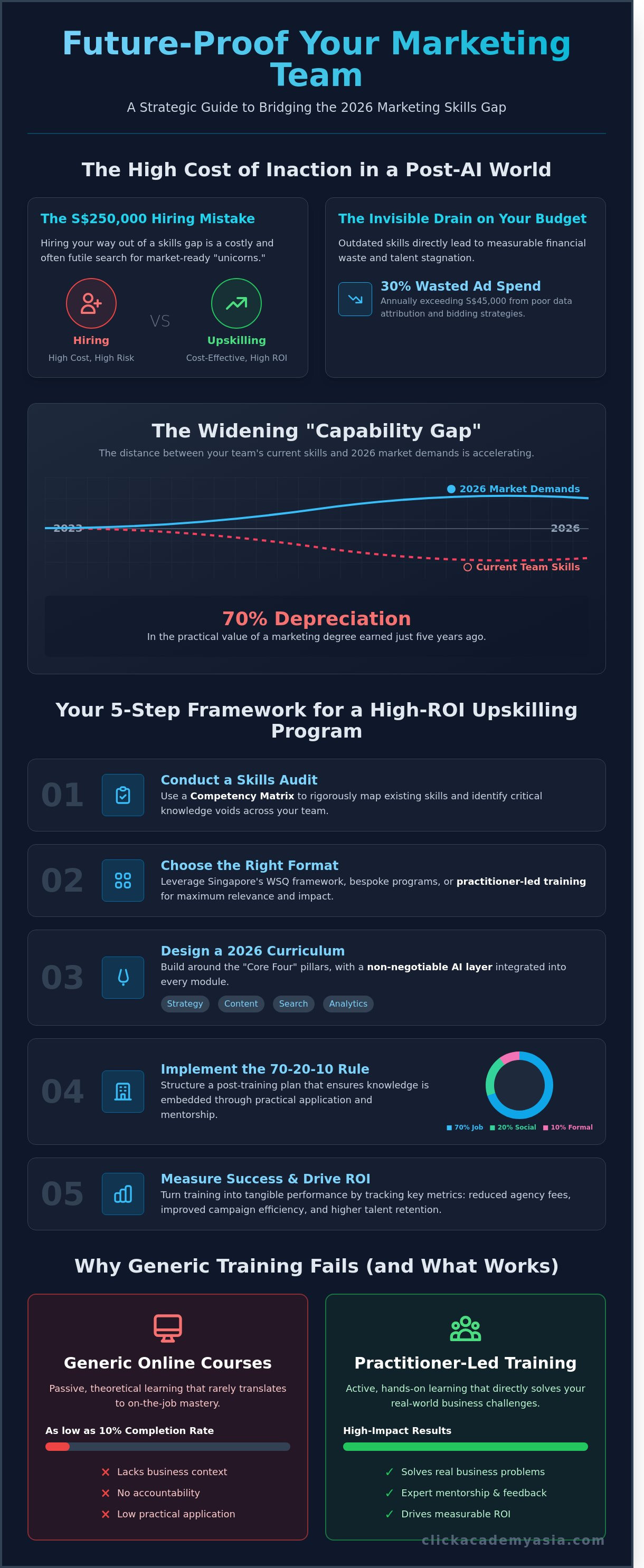
Hiring your way out of a skills gap is a S$250,000 mistake that most Singaporean firms can no longer afford in 2026. It is far more cost-effective to transform the talent you already have than to hunt for unicorns in a hyper-competitive market. You are likely seeing your team struggle to keep pace with rapid AI shifts while your external agency fees continue to drain your quarterly budget. It is a common frustration, but it is one that a strategic approach to professional development can solve.
In this guide, you will learn exactly how to build a high-impact upskill marketing team training program that drives measurable ROI and reduces your reliance on expensive consultants. We will move beyond theory to focus on practical, practitioner-led strategies that empower your staff to master complex 2026 tech shifts. You will discover how to conduct a rigorous capability audit and design a curriculum that ensures your team remains future-proof. Let's look at how you can turn your department into a self-sufficient powerhouse that retains its best talent through world-class growth opportunities.
Key Takeaways
Identify the "Capability Gap" between your current team’s expertise and 2026 market demands to ensure your brand remains competitive and agile.
Master the use of Competency Matrices to conduct a thorough skills audit, pinpointing exactly where your department needs to bridge technical or soft-skill voids.
Discover how to leverage Singapore’s WSQ framework and practitioner-led training to build a cost-effective upskill marketing team training program that delivers measurable ROI.
Explore the "Core Four" curriculum-Strategy, Content, Search, and Analytics-and learn why an integrated AI layer is now non-negotiable for every module.
Apply the 70-20-10 rule of learning to create a post-training action plan that successfully translates classroom theory into high-performance, on-the-job results.
Table of Contents The Capability Gap: Why Your Upskill Marketing Team Training Program is Urgent in 2026 Conducting a Marketing Skills Audit: Identifying Your Knowledge Gaps Choosing the Right Format: WSQ, Bespoke, or Internal Mentorship? Designing Your 2026 Curriculum: Essential Modules for Marketing Teams Implementing and Measuring Success: Turning Training into Performance
The Capability Gap: Why Your Upskill Marketing Team Training Program is Urgent in 2026
Your marketing team is likely running on an expired operating system. By 2026, the distance between current staff competencies and market requirements has widened into a "Capability Gap" that threatens core business stability. This gap isn't just a minor inconvenience; it's a structural deficit. A traditional marketing degree earned five years ago has depreciated by nearly 70% in practical value. The platforms, privacy laws, and consumer behaviours that defined the early 2020s have been replaced by a landscape that demands technical fluency over basic digital literacy.
We've transitioned from "digital-first" strategies to "AI-augmented" operations. If your team still spends forty hours a month on manual data entry or basic copywriting, you're subsidising inefficiency. The cost of inaction is measurable in Singapore dollars. For a mid-sized firm in Singapore, poor data attribution and outdated bidding strategies can lead to a 30% waste in ad spend, often exceeding S$45,000 annually. Beyond the balance sheet, the lack of a structured upskill marketing team training program leads to talent stagnation. Top performers in the 2026 market don't stay at companies where their skills go to die; they migrate to organisations that value lifelong learning as a competitive advantage.
The 2026 Marketing Landscape: AI, Data, and Privacy
The standard skill set has been completely redefined by the total deprecation of third-party cookies and the maturation of GA4. Marketers in 2026 must be part-data scientist and part-ethicist. With Singapore's PDPA regulations becoming more stringent, handling first-party data is no longer just a "tech task" for the IT department. Your team must master three core pillars to remain effective:
This increased responsibility for data also puts them on the front lines of cybersecurity. A data breach originating from a marketing tool can be just as damaging as any other, making human risk management a crucial part of any upskilling program. Training platforms like AwareGO specialize in this area, helping to ensure your creative team doesn't become an accidental security liability.
Strategy: Moving from reactive posting to predictive, AI-driven campaign planning.
Execution: Mastering prompt engineering and automated workflow orchestration.
Analytics: Interpreting complex data sets to find the "why" behind the "what."
Modern Marketing Upskilling is the continuous process of aligning human creativity with machine efficiency.
Why Generic Training Fails Your Corporate Goals
Most companies attempt to bridge the gap with "off-the-shelf" online courses. These programmes typically suffer from completion rates as low as 10% because they lack context and accountability. A video tutorial might provide a fleeting moment of awareness, but it rarely leads to mastery. There is a massive functional difference between watching a demonstration on YouTube and participating in a practitioner-led workshop where you apply concepts to your actual business challenges.
To see a genuine return on investment, your upskill marketing team training program must move beyond theory. It requires an environment where experts who are currently active in the industry can mentor your staff through real-world scenarios. This is why ClickAcademy Asia focuses on practitioner-led excellence. We ensure that the shift from "knowing" to "doing" is seamless, turning your marketing department from a cost centre into a sophisticated engine of growth that is ready for the complexities of 2026.
Quick Takeaway:
The capability gap is widening. Waiting until 2027 to address skill deficits will cost your brand more in lost market share than the price of any training programme. Master the shift to AI-augmentation now or risk total irrelevance in the Singaporean market.
Conducting a Marketing Skills Audit: Identifying Your Knowledge Gaps
You wouldn't launch a high-budget campaign without a data-backed strategy. Designing a professional development plan requires the same level of precision. Choosing an upskill marketing team training program requires more than a gut feeling; it demands a clear understanding of where your team stands today versus where the industry will be in 2026. A 2023 Salesforce report revealed that 70% of employees do not feel they have the digital skills needed for the next decade, making a formal audit your first priority.
Start by implementing a "Competency Matrix" to map out roles across your department. This framework allows you to list essential functions like data storytelling or CRM management against every team member. Use a 1-5 proficiency scale where 1 represents "No Knowledge" and 5 represents "Expert Practitioner." This visual "gap map" quickly highlights if your department is top-heavy with theorists or lacking technical executioners. Integrating a marketing skills gap audit into your quarterly review process ensures that your training budget is spent on high-impact areas rather than generic courses.
Don't rely solely on spreadsheets. Interview your team about their daily "friction points." These are the tasks that take three hours instead of thirty minutes because of technical hurdles. These conversations often reveal "Silent Gaps," which are skills your team believes they possess but are actually based on outdated practices. For example, a team member might claim SEO expertise while still relying on 2019 keyword-stuffing tactics that no longer align with modern search algorithms. Identifying these blind spots is essential before committing to any long-term training commitment.
Technical Skill Assessment: The Hard Metrics
Audit your team's proficiency in technical execution by looking at hard metrics within SEO, SEM, and Social Media Analytics. Can your specialists explain the "why" behind a drop in organic traffic, or do they just report the numbers? In the current climate, AI literacy is the most urgent technical metric. Test your team’s ability to prompt effectively and ethically. A practitioner who can use generative AI to accelerate content ideation while maintaining brand safety is worth significantly more than one who avoids the technology. This data becomes the foundation for your upskill marketing team training program, ensuring you focus on modern tools that drive S$ ROI.
Soft Skill Assessment: The Strategy Levers
Soft skills are often the "Strategy Levers" that determine whether a technical execution succeeds. Evaluate your team on critical thinking, emotional intelligence, and stakeholder management. While technical tools change every six months, the ability to synthesise complex data into a coherent plan remains constant. Industry experts predict that "Marketing Strategy & Planning" will be the most critical soft skill for leaders by 2026. ClickAcademy Asia’s WSQ courses are designed to bridge the gap between these two assessment areas, combining technical mastery with the strategic oversight needed in the Singapore market. If you notice your managers struggle to defend budgets to the C-suite, prioritise stakeholder management training.
Summary:
An effective audit uses competency matrices, identifies silent gaps through interviews, and balances hard technical metrics with strategic soft skills.
Next Step:
Review your team's most recent campaign performance and identify three technical tasks that caused delays. Use these as the starting point for your training search. Explore
to see how expert guidance can close your specific gaps.
Choosing the Right Format: WSQ, Bespoke, or Internal Mentorship?
Selecting the delivery method for your team is just as vital as the curriculum itself. You must decide between the broad perspectives of public workshops and the laser focus of private corporate cohorts. Public workshops are excellent for individual contributors who benefit from networking with peers at different firms. However, private sessions allow your staff to dissect real company data and internal challenges that stay behind closed doors. This privacy often leads to more honest discussions about current departmental weaknesses.
If your goal is to upskill marketing team training program participants on a specific technical tool, a 3-day intensive bootcamp is your best bet. These high-pressure environments force rapid skill acquisition. Conversely, if you're grooming future CMOs, a 6-month certification pathway provides the strategic depth they need. The choice depends entirely on your timeline. Do you need a fix for next month's campaign, or are you building a foundation for the next three years?
The Power of WSQ-Certified Training in Singapore
The Workforce Skills Qualifications (WSQ) framework represents the gold standard for professional development in Singapore. These aren't just attendance certificates; they're rigorous assessments mapped to national industry standards. When your team completes a WSQ module, you know they've met specific competency benchmarks vetted by SkillsFuture Singapore. This adds immediate credibility to your marketing department's internal capabilities.
The financial logic is equally compelling. Eligible Singaporean SMEs can access subsidies that cover 90% of course fees, while larger enterprises typically receive 70% funding. This significantly lowers the barrier to high-quality education. ClickAcademy Asia stands as a premier provider of these certified modules, delivering practitioner-led sessions that move beyond theory. By leveraging these grants, you can transform your entire digital department for a fraction of the usual market rate.
Bespoke Corporate Training for Regional Teams
Standardised courses often fall short when your team operates across diverse markets like Malaysia, Indonesia, and Vietnam. A bespoke upskill marketing team training program allows you to customise the curriculum to your specific industry, whether it's B2B manufacturing or high-growth e-commerce. You can align the training with your specific product launch cycles and regional KPIs. This ensures the content is immediately relevant to every attendee, regardless of their location.
Training your entire team together creates a "shared vocabulary" that eliminates communication silos. When everyone uses the same frameworks for conversion optimisation or programmatic bidding, projects move faster. Consider these benefits of a tailored regional approach:
Contextual Relevance: Modules are adjusted to reflect local consumer behaviours in Southeast Asian hubs.
Consistent Standards: Your Jakarta team and Singapore team apply the same data-driven methodologies.
Strategic Alignment: The trainer acts as a consultant, helping you solve actual business bottlenecks during the session.
Logistical Efficiency: Synchronised training dates prevent the staggered knowledge gaps that occur with individual enrolments.
For teams managing regional hubs, this consistency is the difference between a fragmented strategy and a unified brand voice. It's about ensuring your lead in Manila and your analyst in Ho Chi Minh City are reading from the same playbook. Practical mastery requires more than just watching a video; it requires a mentor who understands the specific nuances of the Asian digital landscape.
Designing Your 2026 Curriculum: Essential Modules for Marketing Teams
To stay competitive in the Singaporean market, your upskill marketing team training program must move beyond basic digital literacy. By 2026, the gap between simply "doing marketing" and driving measurable business growth will widen significantly. A robust curriculum focuses on the "Core Four" pillars: Strategy, Content, Search, and Analytics. However, these aren't isolated silos. Every module requires an integrated "AI for Marketing" layer that treats generative tools as a standard teammate rather than a novelty.
Effective training balances "Quick Win" skills, like mastering AI prompt engineering for ad copy, with "Deep Work" capabilities like long-term brand positioning. This ensures your team delivers immediate value while building the strategic muscle needed for sustainable ROI. Data-driven decision-making must be the heartbeat of every function; if a tactic can't be measured against a business-critical KPI, it doesn't belong in the 2026 playbook.
The Strategy & Planning Foundation
Every team member needs to grasp the "Big Picture" of the customer journey to avoid fragmented campaigns. In 2026, success depends on moving away from siloed channel management toward a unified approach. Omnichannel Strategy is the seamless orchestration of touchpoints to drive conversion. This ensures that a customer's interaction on social media feels identical to their experience on your website or in-store. Training should focus on mapping these journeys to identify friction points before they impact your S$ bottom line.
A critical component of this journey is mastering the initial interaction; some expert consultancies like 3 Second Selling build their entire methodology around capturing a customer's attention in this crucial opening window.
Execution Excellence: Search, Content, and Social
Modern SEO has evolved. It’s no longer about stuffing keywords; it’s about answering user intent and appearing in AI-driven search results. Content marketing is shifting from high-volume production to high-value authority. Your team must learn to produce deep-dive insights that AI cannot replicate. In the social sphere, the focus is now on community engagement and social commerce. By 2026, social platforms will function as primary search engines for 40% of Gen Z users, making social-first conversion skills essential for any upskill marketing team training program.
Analytics and Insights: The ROI Engine
Your team must move past "Vanity Metrics" like likes or impressions to focus on business-critical KPIs such as Customer Acquisition Cost (CAC) and Lifetime Value (LTV). Mastery of GA4 and marketing automation tools is mandatory to track these accurately. To achieve this level of technical proficiency, encourage your staff to look for professional certificates that offer deep-dives into these technical areas. This practitioner-led approach ensures your team doesn't just see numbers, but understands the story they tell about your business health.
Ready to transform your department into a high-performance unit? Explore our practitioner-led training modules today.
Implementing and Measuring Success: Turning Training into Performance
The final session of your upskill marketing team training program isn't the finish line; it's the starting block. Real growth happens when theory meets the daily grind. Without a structured post-training action plan, up to 70% of new knowledge can vanish within 24 hours. To prevent this, you need to bridge the gap between the classroom and the campaign dashboard immediately.
Success relies on the 70-20-10 rule of learning. This framework suggests that your team gains 10% of their knowledge from formal coursework, 20% from social interactions and feedback, and a massive 70% from hands-on experience. Your role is to facilitate that 90% of informal learning. ClickAcademy Asia serves as your strategic partner here, providing the practitioner-led insights that make that 10% of formal education powerful enough to fuel the rest.
Ensuring Knowledge Transfer to the Workplace
Knowledge transfer doesn't happen by accident. It requires a culture of transparency and experimentation. You should organise weekly "Lunch and Learn" sessions where participants teach specific modules to the rest of the team. This reinforces the learner's understanding while scaling the expertise across your entire department at no extra cost.
Safety is also vital for innovation. Set up "Sandbox" environments where your team can test new AI prompts or SEO strategies without risking live client budgets or your brand's reputation. This might involve a S$500 monthly "innovation fund" for testing new ad platforms. Management must actively reinforce these new workflows. If a team member learns to automate reporting but is still forced to use manual spreadsheets, the training investment is wasted.
Measuring the ROI of Your Training Investment
You cannot manage what you do not measure. To prove the value of your upskill marketing team training program, you must set clear Learning KPIs before the first lesson begins. Track hard metrics like a 15% reduction in Cost Per Acquisition (CPA) or a 20% increase in lead conversion rates over a six-month period. Efficiency is another major indicator; if your team can now execute a programmatic campaign in four hours instead of eight, your ROI is already climbing.
Don't ignore the human element. High-quality training is a powerful retention tool. Monitor your employee engagement scores and turnover rates. LinkedIn research shows that 94% of employees would stay at a company longer if it invested in their career development. In the competitive Singaporean market, keeping your top talent can save you thousands in recruitment costs and lost productivity.
Summary of Key Steps:
Apply the 70-20-10 rule to focus on on-the-job application.
Host peer-to-peer sessions to distribute knowledge quickly.
Measure CPA and efficiency to quantify financial impact.
Track retention rates as a marker of team satisfaction.
Choosing ClickAcademy Asia means you aren't just buying a course; you're investing in a long-term evolution. Our partnerships with Google, Meta, and the Digital Marketing Institute ensure your team learns to global standards while staying grounded in regional nuances. We help you design a roadmap that transforms potential into performance.
Ready to future-proof your department? Book a consultation with ClickAcademy Asia to design your custom corporate training roadmap and start seeing tangible results today.
Future-Proof Your Marketing Talent for 2026 and Beyond
The window to bridge the capability gap is closing. By 2026, the divide between high-performing teams and those lagging behind will be defined by their ability to master emerging tech and data-driven strategy. Start by conducting a rigorous skills audit. This ensures your upskill marketing team training program prioritises specific weaknesses rather than generic needs. Focus on curriculum modules that blend technical proficiency with creative agility.
Success isn't just about finishing a course. It's about seeing a measurable lift in your conversion rates and campaign ROI. Since 2011, ClickAcademy Asia has helped thousands of professionals navigate these shifts as a WSQ-certified training provider. As an official Google Certification Partner, we deliver practitioner-led workshops grounded in real-world case studies. You don't just learn the theory; you apply it to your specific business challenges immediately.
Stop reacting to trends and start leading them. Build a culture of continuous learning that keeps your brand ahead of the curve. Empower your team with practitioner-led training from ClickAcademy Asia today. Your team's growth is the most reliable investment you'll make this year.
Frequently Asked Questions
How much does a corporate marketing training program cost in Singapore?
Corporate marketing training in Singapore typically ranges from S$800 to S$3,500 per participant for a standard two-day workshop. For a bespoke, practitioner-led session tailored for a team of 10, you should budget between S$12,000 and S$15,000. These rates vary based on the complexity of the modules and whether the curriculum includes global certification fees.
Can we use SkillsFuture credits or WSQ funding for our marketing team training?
Yes, your company can significantly reduce out-of-pocket expenses by leveraging WSQ funding and SkillsFuture Enterprise Credits (SFEC). Eligible Singapore-registered companies can receive up to 70% funding for WSQ-accredited courses, making high-level digital transformation much more accessible. It's best to check your company's grant eligibility on the Enterprise Job Portal before enrolling to maximise your savings.
How long does it take to see results from a marketing upskilling program?
You'll generally see tactical improvements, such as better campaign optimisations or faster workflow execution, within 30 days of completion. A comprehensive upskill marketing team training program typically delivers a measurable return on investment within 3 to 6 months as the team refines their strategic approach. Long-term success is often marked by a 25% increase in lead quality or a reduction in customer acquisition costs.
Is it better to train my existing team or hire new digital specialists?
Training your existing staff is often the smarter choice, as it costs roughly 20% of the total expense required to recruit and onboard a new specialist. Your current team already possesses deep institutional knowledge and understands your brand's unique voice, which a new hire would take months to learn. Upskilling also improves employee morale and can increase staff retention rates by over 30%.
What are the most in-demand marketing skills for 2026?
The most critical skills for 2026 will include AI-driven content orchestration, predictive data analytics, and advanced omnichannel customer journey mapping. Marketers will also need to master privacy-first data collection methods to navigate a landscape without third-party cookies. We focus our curriculum on these forward-thinking competencies to ensure your team remains competitive in a shifting market.
Does ClickAcademy Asia offer training for teams outside of Singapore?
We provide comprehensive training solutions for marketing teams across Southeast Asia, including Malaysia, Indonesia, and Vietnam. Our sessions are delivered through high-energy virtual classrooms or on-site workshops at your regional offices. Because we partner with global giants like Google and Meta, the quality and relevance of our training remain consistent across all geographical borders.
How do we ensure our team actually uses the skills they learn in a workshop?
To ensure knowledge retention, we recommend implementing a "72-hour rule" where staff must apply one new technique to a live project within three days of training. Choosing an upskill marketing team training program that is practitioner-led is also vital, as it focuses on real-world tools rather than abstract theory. We provide post-course toolkits and audit templates to help your team transition from the classroom to the office seamlessly.
What is the difference between a marketing bootcamp and a certification course?
A marketing bootcamp is an intensive, high-speed sprint lasting 3 to 5 days that focuses on mastering a specific tactical skill. A certification course follows a more academic, structured curriculum that concludes with a formal exam from an industry-recognised body. While bootcamps are excellent for immediate problem-solving, certifications build long-term professional authority and ensure your team meets global standards.


Comments