
How to Build a Marketing Experimentation Framework for Growth

A marketing test can win more clicks and still fail to move the business forward. Building a marketing experimentation framework means connecting each test to a clear objective, a meaningful business metric and a decision you’re prepared to act on.
Teams often want to test landing pages, emails and user journeys before scaling a change. But without a clear hypothesis and a reliable way to assess results, experiments can generate activity without useful learning. A disciplined process helps you understand what changed, for whom, and whether the outcome justifies another iteration.
This guide walks through the practical steps: set an objective, form a testable hypothesis, choose a primary metric, design a fair comparison and decide in advance when to stop, continue or scale. You’ll also see how digital marketing and user experience tests can help teams make better-informed growth decisions in Singapore.
Table of Contents
Choosing Metrics That Matter to the Business
Choose metrics that connect each experiment to a business goal. Across channels and audiences, prioritise the measure that reflects the outcome you want, not simply the easiest number to report.
Align Metrics With Business GoalsStart with the business decision the experiment should inform. For a sales goal, track completed purchases or qualified leads, not clicks alone. For retention, measure repeat engagement or returning customers. Define one primary measure before results arrive. Use secondary measures to explain the outcome, not to replace a disappointing primary result. This keeps the team focused on its original objective.
Adapt Metrics Across Channels and AudiencesChoose measures that fit the channel and audience behaviour. For a search campaign, qualified leads can show whether intent translates into demand. For social media, track useful actions such as completed enquiries, not reach alone. First-time visitors and returning customers may respond differently to the same offer. Segment results where relevant, and compare like with like.
Set a baseline before launching the test. In an email experiment, record the current click-through rate and subsequent conversions. A subject line may earn more opens but fewer qualified visits. The baseline helps show whether the change improved the business outcome. Keep the measurement window and audience definition consistent across the control and variation.
Separate the primary metric from diagnostic measures. For a landing page, completed sign-ups could be primary; form starts and page exits can help explain performance. Choose indicators that map to the customer journey. Don’t let an encouraging secondary result override a primary metric that missed its objective.
Check whether the result could change a business decision. A conversion-rate lift matters more when it brings valuable customers, rather than low-intent traffic. Compare acquisition measures with lead quality or downstream sales. Measurement confidence remains a challenge: only 29% of marketers are confident in their approach to measurement. A clear metric plan makes each test easier to interpret.
Conversion metrics can also make the value of an experiment easier to communicate. Mandy Schnirel states that a 0.5% boost in website conversion is another sales representative a company does not need to hire. She says that for many organisations, increasing the website conversion rate from 2% to 2.5% can unlock seven-figure gains in pipeline. These examples show why teams should connect a change in conversion to its business meaning, rather than report the percentage movement without context. Before a test begins, agree on how the primary measure will inform a decision, such as whether to keep, revise or stop a change. Make sure the result can be interpreted alongside lead quality and downstream outcomes, so a rise in conversions is not treated as proof of value on its own.
Page performance can also be a useful diagnostic when conversion is the primary outcome. Studies have tied a 100-millisecond reduction in page load time to roughly a 1% lift in conversion. Treat that relationship as a reason to examine speed when results change, not as a substitute for measuring the outcome that matters to the business. Define one primary measure before results arrive, and use secondary metrics to explain results rather than replace a failed primary outcome. When the evidence is mixed, the team can use the diagnostics to identify what to investigate next while keeping the original business objective intact.
Deciding Whether to Continue or Stop an Experiment
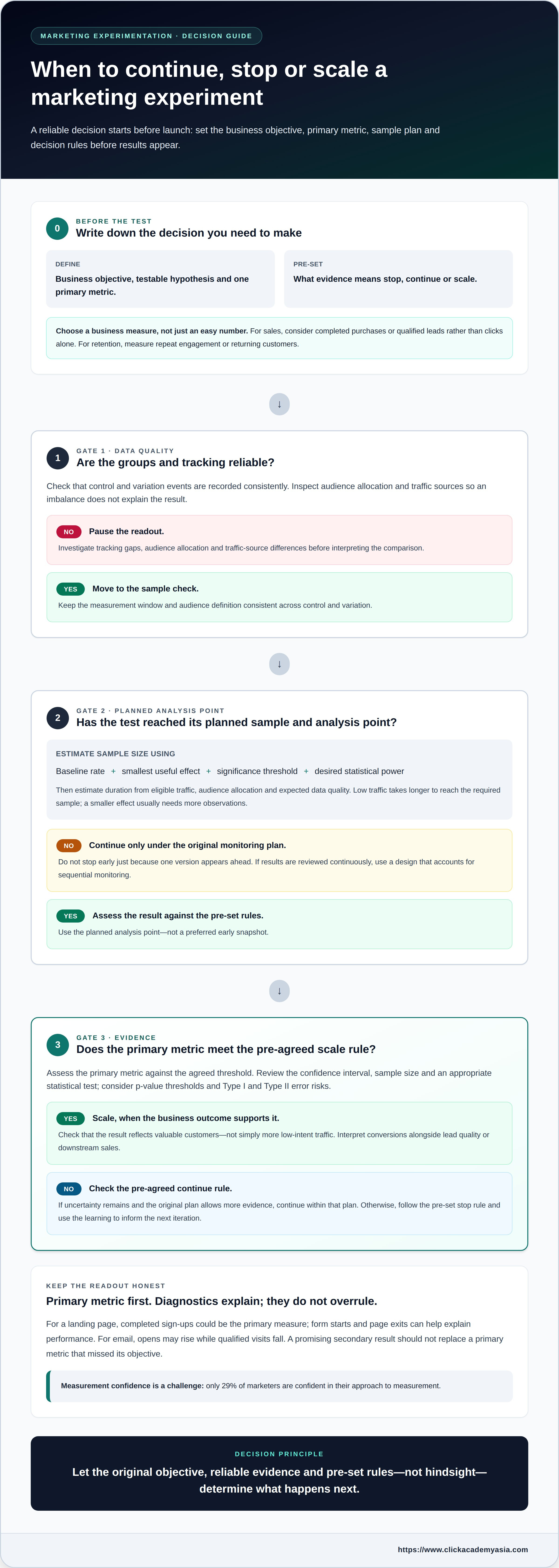
Estimate sample size using the baseline rate, smallest useful effect, significance threshold and desired statistical power. Then estimate duration based on eligible traffic and allocation. Low traffic takes longer to reach the required sample.
Set stop and scale rules before launch. Write down what evidence would justify stopping, continuing or scaling. For a landing-page test, define the minimum improvement in completed enquiries that would support rollout. Record the primary metric and decision rule before results appear. This prevents a promising secondary measure from replacing a failed primary outcome.
Calculate the sample requirement before setting a finish date. Use the baseline conversion rate, minimum detectable effect, significance threshold and desired power. A smaller effect usually requires more observations to distinguish it from random variation. Estimate duration from eligible traffic, then account for the audience split and expected data quality.
Review analytics for data quality first. Check that control and variant events are recorded consistently. In a sign-up test, compare submitted forms with analytics events to spot tracking gaps. Also inspect audience allocation and traffic sources. If one group receives a different mix of visitors, the comparison may reflect that imbalance rather than the tested change.
Assess the result against the pre-set threshold. Review the primary metric alongside its confidence interval, sample size and an appropriate statistical test. A higher observed conversion rate alone does not prove a reliable win. Consider p-value thresholds and the risks of Type I and Type II errors before deciding. If uncertainty remains, continue only under the original monitoring plan.
Avoid stopping early because one variant looks ahead. Repeatedly checking results and stopping when a preferred version leads can increase the chance of a false conclusion. Use a design that accounts for sequential monitoring if results are reviewed continuously. Otherwise, wait until the planned sample and analysis point before making a decision.
Turn an inconclusive or unsuccessful result into a decision. Check the analytics, practical constraints and team’s experience. Ask whether another iteration is worth the time, money and effort. A weak result may point to a confusing offer or audience mismatch. Record that learning, adjust one element and define fresh stop and scale rules for the next test.
Digital Marketing and User Experience Tests
Test one change at a time, from campaign creative to page layout. Define the audience, comparison and intended effect before launch.
Design Controls and RandomisationRandomly assign eligible visitors to a control or variant. Keep the offer, channel and measurement period consistent, changing only the element under test. For a fictional landing-page test, split 20,000 eligible visitors equally between both versions. Compare conversion rates and assess sample size, confidence intervals and suitable statistical tests before drawing conclusions.
Choose Tools and PlatformsMatch tools to the test, traffic and reporting needs. Analytics platforms can track outcomes, while testing tools manage versions and assignment. A spreadsheet can document simpler tests; a dashboard can show live experiments by funnel step and channel. Platform costs vary by product, usage and features, so compare the capabilities you need rather than assuming every team needs an enterprise tool.For Singapore teams, Google Analytics (GA4) can support measurement when configured for the chosen outcomes.
Address Privacy and Data ProtectionDesign each test around clear consent, transparent notices and limited personal data. Restrict access to experiment records, use aggregated reporting where practical, and set a retention approach before launch. For Singapore campaigns involving personal data, involve the appropriate privacy lead and align collection and use with applicable data-protection obligations. Avoid collecting sensitive details without a clear need.
Document and Share Experiment FindingsRecord the hypothesis, audience, control, variant, dates, metric and decision in one shared experiment log. Include tracking changes and known limitations so another team can interpret the result. Review findings with marketing, analytics and product colleagues. For example, share whether a higher click rate also led to completed enquiries, not just more visits.
Test practical changes, then inspect their downstream effect. Airbnb listings with professional photos received more than twice as many bookings. An Airbnb interface test opening listings in a new tab reportedly increased bookings by 3 to 4%. Treat these examples as prompts, not universal predictions. Avoid changing several elements together, stopping early after a favourable result, or ignoring tracking errors. Each can obscure what caused the outcome.
Formulating Hypotheses and Objectives
Start with a business decision, then frame a testable explanation. A clear hypothesis connects the proposed change to an outcome and a way to assess it. Building a marketing experimentation framework starts with this decision, not a preferred tactic.
Name the decision the experiment will inform. For a major brand campaign, the decision might be whether the creative merits investment. Make the objective specific: learn whether it increases qualified visits or enquiries. Avoid objectives such as “improve marketing”, which don’t define a result the team can evaluate.
Describe the opportunity in observable terms. Identify a customer behaviour or performance gap. For example, visitors may reach a product page but leave before viewing its features. Use analytics, customer feedback or campaign results to explain why this behaviour deserves attention. Separate the observed problem from assumptions about its cause.
Write a cause-and-effect hypothesis. Use a format such as: “If we change X for audience Y, metric Z should change because of reason R.” For example, adding a concise feature comparison may help first-time visitors choose a product. A rationale makes the claim testable instead of presenting a preference as strategy.
Choose the intervention and comparison. Specify the independent variable, such as a headline or offer, and the outcome you will observe. Keep other elements stable where possible. For a conference-booth concept, test the message with a defined audience before committing to the full event plan. Record potential blockers, including limited traffic or unclear tracking.
Define success before launching. Select a primary success metric that matches the objective, then set the minimum useful change and statistical significance threshold. For a lead-generation test, focus on qualified enquiries, not impressions alone. This gives the team a consistent basis for interpreting results and limits decisions driven by attractive but irrelevant numbers.
Check feasibility and risk. Estimate the available audience, test duration and required resources. Consider whether seasonality, overlapping campaigns or a small eligible audience could distort results. As you build a marketing experimentation framework, match the planning effort to the scale and complexity of each test.
Write down the learning the team needs. State what each possible outcome would mean for the next decision. If the hypothesis fails, the result can still reveal whether the issue lies in the message, audience or offer. A short experiment brief keeps stakeholders aligned on the objective, method and interpretation.
How Do You Design Valid Marketing Experiments with Control Groups and Randomisation?
Build a fair comparison by defining who qualifies, what changes and what stays constant. Assign participants consistently, then compare outcomes using the same method.
Define the unit and eligible population. Decide whether the experiment applies to visitors, accounts, regions or campaign periods. For a landing-page test, include visitors who meet the same eligibility rules. Exclude audiences that cannot receive either version. Clear eligibility prevents mismatched groups and makes the final result easier to interpret.
Separate the variables before launch. Name the independent variable you will change, such as an advert headline. Define the dependent variable you will measure, such as completed enquiries. Record control variables that should remain stable. Note possible moderators, such as device type, and mediators, such as a form completion step.
Keep a true control group. Show the control group the existing experience, then expose the experimental group to one planned change. If a campaign tests new creative and a new landing page simultaneously, the cause of any effect becomes unclear. Isolate changes unless the design deliberately tests their interaction.
Randomise assignment where practical. Use a consistent random process to allocate eligible participants. Avoid assigning visitors by convenient traits, such as arrival time, because those traits may relate to behaviour. Check that assignment remains stable across devices and return visits. If groups differ in important ways, investigate before interpreting outcomes.
Choose the design to fit the channel. Website tests can randomise individual visitors; geographic tests compare distinct areas. A pharmaceutical company ran a regional adaptive experiment for 16 weeks, varying promotional activity. Regional designs need comparable markets and careful tracking of outside influences. Match the method to audience reach and campaign structure.
Plan sample size and analysis in advance. Estimate the required sample using baseline performance, the smallest useful effect and desired statistical power. Set significance thresholds before results arrive. Select a suitable statistical test and consider confidence intervals, Type I errors and Type II errors. This helps prevent a chance fluctuation from being mistaken for evidence.
Protect the test from contamination. Keep overlapping campaigns, promotions and tracking changes visible in the experiment record. If a visitor sees both versions, flag the exposure and apply the planned analysis rule. Review group sizes and event tracking during the test without changing the design in response to early results.
Interpret the comparison, not just the winner. Compare outcomes across groups, then assess uncertainty and practical importance. A variant can lead without supporting a reliable conclusion. Document exclusions, missing data and deviations so the team understands what the experiment can and cannot establish.
ClickAcademy Asia
ClickAcademy Asia offers practical training for teams that want to make experimentation a consistent marketing capability. Its WSQ courses support professionals in developing the planning, content, channel and measurement skills behind better-designed tests. Consider training when experiments are ad hoc, teams struggle to connect results with business goals, or campaign decisions lack a shared method.
Choose learning that fits your team’s identified capability gap. The relevant course depends on whether the challenge lies in strategic planning, content development, search or paid campaign execution. Training supports professional development; the team still applies its learning to its own objectives, data and experiment design.
WSQ Digital Marketing Strategy & Planning suits teams building a more structured approach to objectives, channel choices and marketing priorities. It is relevant when experiments happen without a clear link to broader strategy.
WSQ Content Marketing Strategy may fit when the test concerns content themes, audience needs or the role of messaging in the customer journey. It can help marketers plan content with a clearer strategic purpose.
WSQ Search Engine Optimization (SEO) is relevant when teams want to explore organic search performance, page relevance or how content supports discovery. It gives marketers a focused learning path for search-related decisions.
WSQ Search Engine Marketing (SEM) may be useful when experiments involve paid search campaigns, including how campaign choices relate to marketing objectives. It helps teams build skills in this specific channel area.
For example, a team testing different search messages may need to align campaign planning with content and measurement. A team reviewing organic landing-page performance may have a different learning need. Matching training to the actual gap helps professionals build relevant skills instead of treating every marketing challenge as the same problem.
Leaders and HR decision-makers can also use these course areas to shape a focused development plan. Identify the decisions staff need to make, the channels they manage and the evidence they need to interpret. Then select learning that supports those responsibilities and gives the team a stronger foundation for future experiments.
To discuss relevant learning for your team, contact ClickAcademy Asia.
Frequently Asked Questions
What is the Marketing Experimentation Process?
The marketing experimentation process is a repeatable cycle for turning an uncertain decision into evidence and action. A team identifies a business challenge, designs a controlled test, collects results and decides what to do next. For example, before changing a campaign everywhere, a team can test the proposed change with a defined audience. The learning should inform a clear next decision, not sit unused in a report.
What is a marketing experimentation framework?
A marketing experimentation framework is the shared system a team uses to plan, govern and learn from tests. It sets expectations for who approves experiments, how evidence is recorded and how results inform future campaigns. For example, a central experiment register can help marketing, product and analytics teams see which ideas are being tested, what they aim to learn and whether a similar test has already been run.
What steps are involved in building a marketing experimentation framework?
Start by agreeing how experiments support business decisions, then establish a common brief for each test. Include the problem, audience, proposed change, measurement approach, owner and decision date. Set a review process for data quality and findings, and store outcomes where relevant teams can find them. For example, a campaign team can use the same brief format as a website team while tailoring the test details to its channel.
How should marketing teams prioritise experiments and choose hypotheses?
Prioritise experiments that address a meaningful business problem and can produce useful evidence. Compare the potential value of the decision with the effort, available audience and feasibility of running a fair test. Build hypotheses from observed friction, such as repeated questions about a product feature, rather than personal preference. If several ideas compete, choose the one that resolves the most consequential uncertainty with the clearest path to learning.
Which marketing metrics and statistical methods should experiments use?
Choose a metric that reflects the outcome, such as completed purchases for ecommerce or qualified enquiries for lead generation. Match the statistical method to the metric, experiment design and data distribution; a proportion-based conversion outcome differs from a continuous measure such as order value. Review sample size, confidence intervals and significance thresholds together. Also consider Type I and Type II errors, since either can lead to a poor decision.



Comments