
How to Build a Competitive Intelligence Function Teams Can Use

A competitive intelligence function can collect a steady stream of information and still leave teams unsure what to do next. Learning how to build a competitive intelligence function means starting with decisions, not dashboards: identify a focused group of competitors, investigate the questions that matter, and turn findings into clear actions.
It’s sensible to want broad market coverage, but trying to monitor everything can make useful signals harder to spot. A more practical starting point is to track 3 to 5 direct competitors and focus research on one or two business-critical areas, then expand as the team’s needs and capacity grow.
This guide explains how to build a competitive intelligence function: set up the process, identify direct and emerging competitors, and prioritise useful sources. You’ll learn how to share insights with sales, marketing, product and leadership teams, and assess whether the programme is moving beyond reactive requests to support strategic decisions. The goal is a repeatable approach that helps colleagues make informed choices, not simply a larger collection of competitor facts.
Table of Contents
Identifying direct, indirect, emerging, aspirational and perceived competitors
Which sources should you prioritise first for competitive intelligence research?
How do you package insights into a competitive intelligence report teams will use?
Building and assessing competitive intelligence programme maturity
How do you start a competitive intelligence function?
A practical starting point for how to build a competitive intelligence function is to identify the decisions teams need to make. Then choose tools that help departments collect, organise and share evidence, rather than investing in software before priorities are clear.
Choose Tools for the Intelligence ProcessMap the workflow first: collect competitor signals, analyse them, share findings and connect insights to action. Then choose tools for specific tasks, such as monitoring, news aggregation, analysis and distribution. The function also needs research skills, sound judgement and clear communication. Compare tools against the work they must support, and avoid features the team won’t use. Costs vary by platform and requirements, so define the scope before comparing plans.
Centralise Intelligence in a RepositoryCreate one searchable repository for organised intelligence, source details and analysis. Tag entries by competitor, topic and date, and record what each signal could mean for the business. For example, file a product announcement with its source and the team’s assessment. Set access and ownership rules so colleagues can contribute without creating scattered or conflicting records. A shared repository gives the process a consistent foundation.
Use Automation in Intelligence ToolsAutomate repetitive collection and alerts for priority competitors, news and market changes, but assign someone to assess each signal. Automation can speed up monitoring; it can’t decide whether an announcement changes a strategic choice. Test alerts against real team questions and remove noisy feeds. Share useful findings through channels colleagues already use, such as internal chat, email or meetings, and store important analysis in the repository.
Plan the Function Around Available ResourcesStart with one or two business-critical areas and a manageable set of direct competitors; expand as capacity grows. Small teams can review signals weekly and publish one or two recurring outputs. For teams considering how to build a competitive intelligence function on a limited budget, prioritise tools that solve an immediate collection or sharing problem, then add capabilities as needs emerge. In Singapore, handle personal information according to applicable data-protection and confidentiality requirements, and use legitimate, authorised sources. The workflow is collect, analyse, share and act.
Identifying direct, indirect, emerging, aspirational and perceived competitors
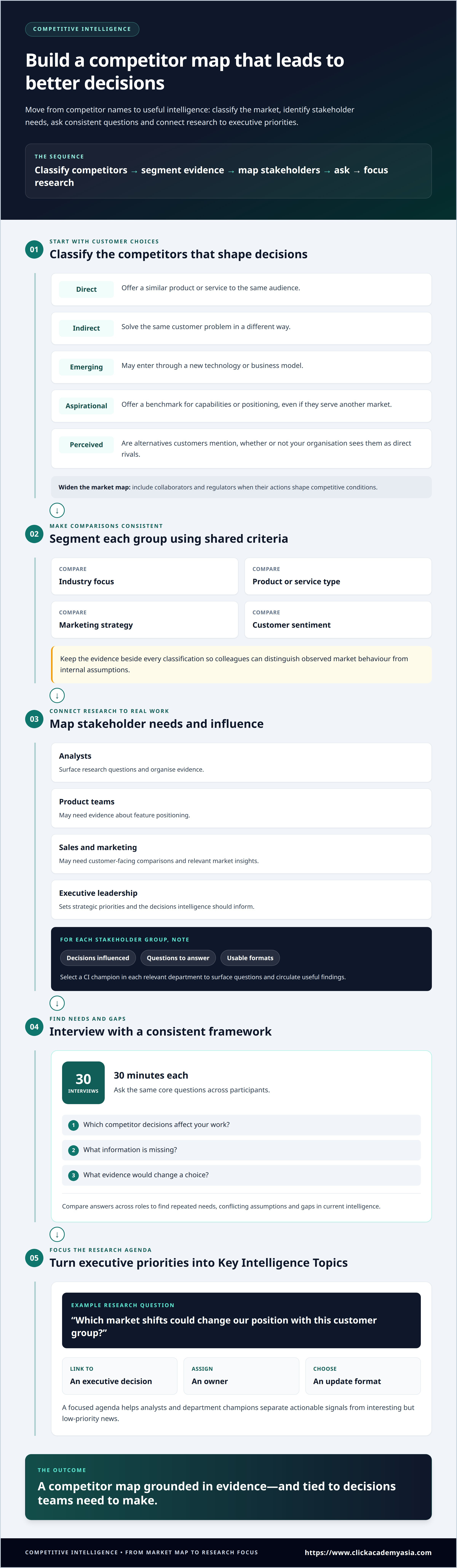
Build a competitor map around customer choices and strategic questions, not company names alone. This helps stakeholders see who can influence your position, where to focus analysis and which teams need each insight.
Classify competitors by how they affect customer decisions. Direct competitors offer a similar product or service to the same audience. Indirect competitors solve the same customer problem differently. Emerging competitors may enter through a new technology or business model. Aspirational competitors offer a useful benchmark for capabilities or positioning, even if they serve another market. Perceived competitors are the alternatives customers mention, whether or not your organisation considers them direct rivals. Include collaborators and regulators in the wider market map when their actions shape competitive conditions.
Segment each group using consistent criteria. Record industry focus, product or service type, marketing strategy and customer sentiment. For example, a Singapore business could compare providers serving the same audience, then note differences in their offers and messaging. Keep evidence beside each classification so colleagues can distinguish observed market behaviour from internal assumptions.
Map stakeholders and their influence. Identify analysts, product teams, the sales team, marketing and executive leadership. Note which decisions each group influences, the questions it needs answered and the format it can act on. A sales team may need customer-facing comparisons; product teams may need evidence about feature positioning. Select a CI champion in each relevant department to surface questions and circulate useful findings.
Interview stakeholders with a consistent framework. Conduct thirty interviews, each lasting 30 minutes, and ask the same core questions across participants. Ask which competitor decisions affect their work, what information is missing and what evidence would change a choice. Compare answers across roles to find repeated needs, conflicting assumptions and gaps in current intelligence.
Translate executive priorities into Key Intelligence Topics. Ask leaders which external changes could affect strategic choices, then frame each as a researchable question. For example: “Which market shifts could change our position with this customer group?” Link every topic to an executive decision, an owner and an appropriate update format. This gives analysts a focused agenda and helps champions separate actionable signals from interesting but low-priority news.
Which sources should you prioritise first for competitive intelligence research?
Prioritise sources by the decisions they can inform, not by how much information they produce. Start with critical questions, then match each one to reliable internal or external evidence.
Assess Information NeedsTranslate a business decision into a specific research question before opening software or collecting material. For example, if leaders are considering a positioning change, define what customer or competitor evidence could affect that choice. Start monitoring one or two business-critical areas, then record the decision, information gap and intended audience. This keeps research focused and helps the team assess whether each source adds decision-useful evidence.
Choose Internal and External SourcesPair internal sources with external evidence to compare what customers and teams experience against market activity. Sales conversations, customer feedback and support themes can reveal recurring objections; competitor websites, products, announcements, social media engagement and content show how rivals present their offers. Prioritise 3 to 5 companies for tracking; they typically account for 80% of useful tracking. In Singapore, collect information ethically: use public or authorised sources, respect privacy and confidentiality, and don’t misrepresent your identity or bypass access controls. Follow applicable laws and organisational policies.
Gather Competitor and Market InformationCollect evidence against a defined question, and log the source, date and relevant market context. A competitor’s product page may make a feature claim; its announcement may explain the launch, while customer responses offer another perspective. Compare these signals with your campaign results and customer conversations. Check whether separate sources support an interpretation before treating it as a meaningful shift. This strengthens analysis and reduces the risk of mistaking promotional language for verified market behaviour.
Map Competitive Information FlowsTrace how a signal moves from its source to the person making a decision. Map who collects and analyses it, which departments need it and where it should go. A pricing change, for example, may call for a sales summary, while a product shift belongs in planning discussions. Store the evidence in an internal repository, then send concise updates through each audience’s usual channels. Review missed hand-offs and adjust the route when useful insights arrive too late.
How do you package insights into a competitive intelligence report teams will use?
Start with the decision each audience needs to make, then shape the report around relevant evidence and implications. Common mistakes include collecting information without prioritising it, presenting assumptions as facts, and sharing findings without a clear business action.
Define the Intelligence AgendaAsk leadership which decisions matter over the next 12-18 months, then turn them into research questions. A question such as “Could a competitor’s new offer affect our position?” gives analysts a defined purpose. Rank topics by their implications for strategy, deals or risk, and set an owner and review cadence for each. Avoid an agenda built around whatever market intelligence happens to arrive; it should enable timely choices across the organisation.
Tailor Insights to AudiencesMatch each deliverable to the reader’s role and decision. Sales teams need concise, field-ready comparisons for customer conversations, while product teams need evidence to inform roadmap choices and market positioning. Leadership may need a one-slide summary linking an event to its implications. Include the source, date and confidence level for each finding, and distinguish observed facts from analysis. Avoid sending every department the same long report without context or a clear next step.
Embed Intelligence in Decision-MakingBuild intelligence into existing business routines instead of relying only on email or chat. Include relevant findings in business reviews, product roadmaps, planning sessions and leadership updates. For a competitor launch, state what changed, why it matters and which decision it could affect. Separate short-term tactical insights from longer-term strategic analysis, since they serve different audiences and schedules. Assign someone to bring the evidence to the meeting where the decision will be made.
Measure Intelligence Through OutcomesTrack whether reports inform decisions, support deals or help teams respond to risks. Record examples such as a sales conversation informed by a battlecard, a roadmap discussion prompted by market evidence, or a leadership choice adjusted after a competitor move. Weekly digests can maintain awareness, while quarterly strategy updates connect external shifts to internal choices. Review which deliverables are used and what decisions follow. Don’t judge the function by report volume alone; assess the relevance and practical influence of its intelligence.
Building and assessing competitive intelligence programme maturity
Understand the current programme during the first 30 days. Map existing monitoring, requests, reports, owners and tools before changing the operating model. For example, trace how a product announcement reaches product teams, who assesses its implications and whether anyone uses the analysis. This baseline helps clarify how to build a competitive intelligence function around existing workflows, rather than assumptions. A function can answer information requests for one to three years yet still lack the mandate, repeatable process and leadership backing needed for long-term success.
Assess strengths, weaknesses and gaps during the first 60 days. Review the quality, relevance and timeliness of evidence, rather than counting alerts or documents. Test recent outputs: did they answer a business question, reach the right team and support a decision? Check whether sources are recorded, analysis is separated from assumptions, and monitoring covers agreed priorities. These checks show where the programme needs clearer ownership, stronger methods or better access to an intelligence tool.
Set a focused mandate and practical operating rhythm. Define the decisions the function supports, its priority audiences and its recurring deliverables. A focused programme might provide product teams with evidence for roadmap discussions while giving leadership concise updates on market shifts. Establish who owns each activity and how stakeholders contribute. Keep the scope manageable, then expand as the function builds capacity and earns trust.
Choose a platform to support the process, not replace it. Match the platform or intelligence tool to actual needs, such as organising evidence, sharing analysis and tracking follow-up. A central system is useful only when teams can find relevant material and owners keep it current. Pair technology with trained contributors, agreed methods and leadership encouragement. Coordinated training helps employees understand their roles and use monitoring outputs consistently.
Use the first 90 days to improve adoption and set expectations. Agree what the programme will deliver, who will use it and how feedback will shape future work. As you decide how to build a competitive intelligence function, review whether product teams use intelligence in planning and leaders consider it in strategic discussions. Mature the function through observable behaviours, not higher report volumes. Adjust the mandate as business priorities and team capacity evolve.
ClickAcademy Asia
ClickAcademy Asia can support teams that need stronger digital marketing knowledge to interpret competitive intelligence. Research can reveal what competitors publish, how they position offers and which channels they use. Teams need the skills to assess those signals in context, connect them to business priorities and make informed recommendations. ClickAcademy Asia’s WSQ-funded digital marketing courses can help build that shared foundation across marketing, sales and leadership.
Consider digital marketing training when colleagues monitor online activity but need a clearer framework for interpreting it. Choose a course based on the team’s work: developing strategy, assessing content, improving search visibility or understanding paid search. These skills support digital market analysis; they don’t replace the research process, evidence standards or stakeholder alignment described above.
Relevant options include:
WSQ Digital Marketing Strategy & Planning for teams strengthening strategic digital marketing decisions.
WSQ Content Marketing Strategy for professionals assessing content approaches and audience relevance.
WSQ Search Engine Optimisation (SEO) for teams examining organic search visibility and content discoverability.
WSQ Search Engine Marketing (SEM) for professionals working with paid search activity and campaign strategy.
Training is most useful when the intelligence function has identified a capability gap linked to its research priorities. A team tracking competitors’ content, for example, may benefit from stronger content strategy knowledge, while colleagues analysing search activity may need a firmer grounding in SEO or SEM. Align learning with the decisions your teams make, so new knowledge can inform their day-to-day work.
For HR leaders and managers, connect training needs with the function’s operating model. Identify which teams interpret market signals, where digital marketing knowledge could strengthen their analysis, and how they can apply learning in existing planning discussions. This keeps professional development focused on the organisation’s priorities rather than training for its own sake.
ClickAcademy Asia’s WSQ digital marketing courses offer a relevant learning pathway for teams building those capabilities. Contact ClickAcademy Asia to explore WSQ-funded training tracks for your team.
Frequently Asked Questions
What is competitive intelligence and how does it help a business?
Competitive intelligence is the structured use of information about competitors and markets to inform business decisions. It helps teams assess customer alternatives, identify changes in positioning and prepare for possible market shifts. If customers repeatedly compare two service features, for example, a business can investigate whether the difference affects its offer or sales conversations. The value comes from applying evidence to choices, not simply collecting competitor updates.
How can CI tools improve the efficiency of the intelligence process?
Competitive intelligence tools can reduce manual work by gathering relevant updates, organising findings and routing alerts to the right people. A team might tag updates by competitor and topic, then filter for product launches before a planning meeting. Tools work best when the team sets clear monitoring priorities and reviews automated results. Without oversight, duplicate alerts and irrelevant mentions can consume time rather than improve efficiency.
How do you turn raw competitor signals into a competitive intelligence analysis?
First, record what happened and where the information came from. Then assess whether the signal is credible, compare it with other evidence, and explain its possible implications for your organisation. A new competitor feature is a signal; analysis asks which customers might value it and whether it changes a business decision. Separate confirmed details from interpretation, and make the recommended next step clear.
How should you set up a competitive intelligence framework that stays usable?
Make the framework simple enough for colleagues to follow in routine work. Give each research question an owner, define how to record evidence, and specify who receives the resulting insight. Use a consistent template that captures the finding, source, business implication and suggested action. Review the framework with users after real projects, then remove fields or steps that add effort without improving decisions.
What does a “culture of competitive intelligence” mean?
A culture of competitive intelligence exists when people across the organisation contribute relevant observations and use insights in their work. A customer-facing colleague might flag a recurring competitor claim, while a manager considers its relevance during planning. Leadership helps establish this behaviour by making room for evidence in discussions and recognising useful contributions. The aim is informed collaboration, not treating every market comment as a confirmed trend.
Who should be involved in a competitive intelligence programme?
Involve the people who encounter market evidence and those who make decisions based on it. Analysts can coordinate research; sales and customer support can share field observations; marketing can interpret competitor messaging; and product teams can assess implications for the offer. Executive leaders set priorities and use strategic findings. Assign clear responsibilities so contributors know what to submit, who evaluates it and which decisions the intelligence should inform.
What does a competitive intelligence function do?
A competitive intelligence function turns relevant market and competitor information into useful decision support. Its work can include receiving research questions, collecting evidence, assessing significance and communicating findings to stakeholders. It can also track whether insights influenced a plan or prompted follow-up research. After a competitor changes its offer, for example, the function can clarify what changed and help the relevant team decide whether further analysis is needed.
How to define the scope and objectives of a competitive intelligence programme?
Start by naming the decisions the programme should support, then define the markets, competitors and topics it will monitor. An objective might be to help a product team assess changing customer needs, rather than track every competitor activity. Specify who uses each output and how to judge its usefulness. Revisit the scope when business priorities change, so research stays relevant instead of expanding without purpose.


Comments