
Growth Marketing for Singapore Subscription Businesses

More sign-ups can disguise a subscription growth problem. For Singapore businesses, growth marketing for subscription-based businesses means looking beyond acquisition to see whether customers activate, stay and deepen their relationship with the service. A strong campaign can bring people in, but disconnected marketing, product and customer teams may miss the points where subscribers lose interest.
You’re right to question whether more acquisition spend is the answer. Sustainable growth depends on improving the whole customer journey, using shared measures that connect sign-ups to lasting subscriber value. Start by identifying where people disengage, then run focused experiments that address the cause.
This article explains how acquisition, activation, retention and expansion work together, and how to prioritise measurable tests for your business model. It also covers the digital marketing planning and analytics skills teams need to collaborate and make better decisions, including capabilities developed through Singapore’s WSQ framework. You’ll find a practical way to connect lifecycle strategy with action.
Table of Contents
Why growth marketing for subscription-based businesses must begin with the customer lifecycle
How subscription growth works across acquisition, activation, retention and expansion
Which subscription growth levers should teams compare before investing?
How to prioritise and measure growth marketing experiments for subscriptions
Build the skills to put subscription growth marketing into practice in Singapore
Why growth marketing for subscription-based businesses must begin with the customer lifecycle
For subscription businesses in Singapore, pressure to grow recurring revenue can make new sign-ups feel like the clearest measure of progress. But acquisition alone doesn’t show whether customers receive enough value to stay, or whether the cost of serving them is sustainable. Growth marketing for subscription-based businesses is coordinated, measurable work across acquisition, activation, retention and expansion, aimed at improving the customer relationship over time.
A rising subscriber count can sit alongside weak engagement, cancellations or high service demands. Recurring revenue is not the same as retention, and neither automatically proves profitability. Teams also need to understand revenue quality, delivery costs and customer behaviour. A useful definition is simple: subscription growth marketing connects each stage of the customer journey to measurable value for both the subscriber and the business.
For a concise introduction to related growth methods, see Growth Hacking. The video below offers one founder’s perspective on building a subscription business. Treat it as an illustration, not a benchmark or universal playbook.
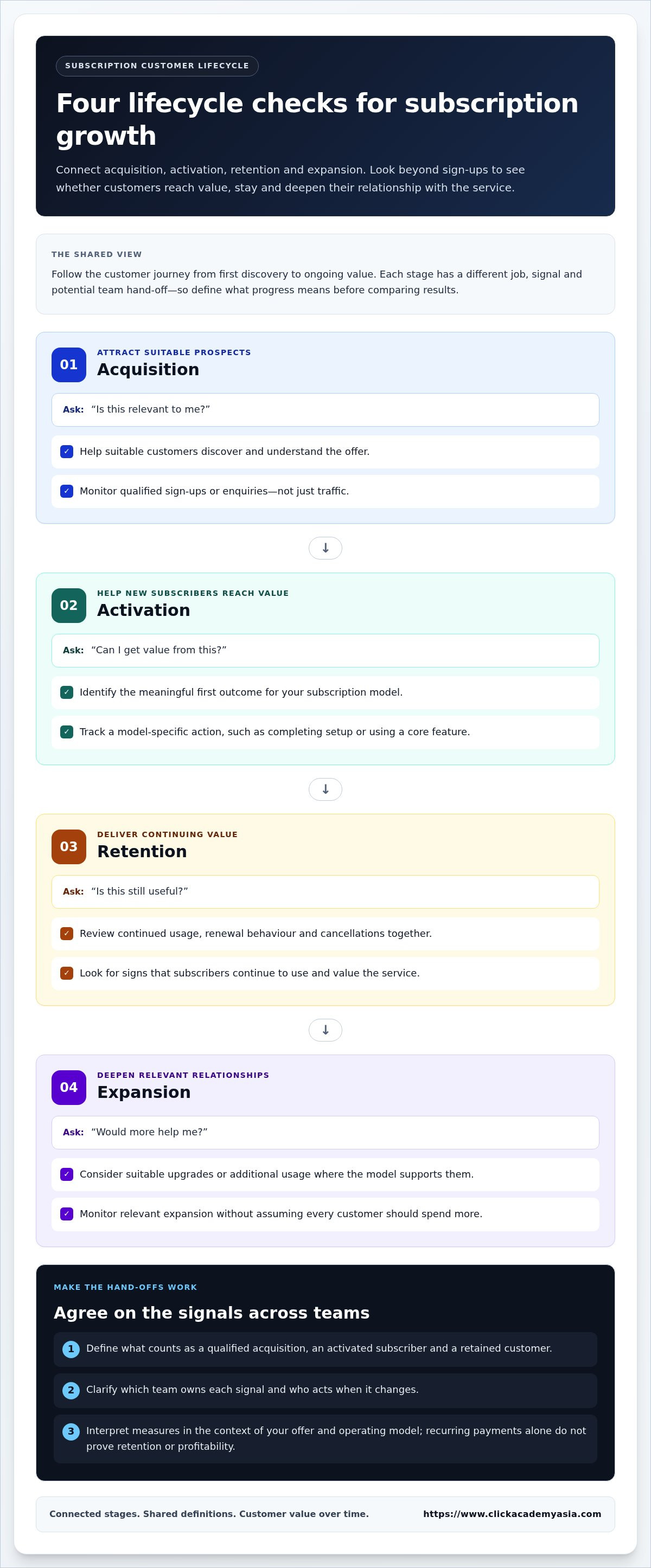
To make the framework practical, follow the customer from first discovery to ongoing value. Each stage raises a different question, produces different signals and may involve different teams. Marketing, product and business leaders can use this shared view to spot hand-off gaps, agree on priorities and avoid optimising an isolated metric at the expense of the subscriber experience.
What makes subscription growth different from one-off customer acquisition?
A one-off purchase may complete the relationship at checkout. A subscription begins a continuing relationship: customers need to receive value after joining, while the business needs to deliver that value consistently. Illustration, not a benchmark: someone discovers a meal-planning service, subscribes, struggles to set preferences, then stops using it. Acquisition succeeded, but activation and ongoing value did not. The journey shows why conversion alone can’t tell the whole story.
Recurring payments describe a revenue pattern, not a guarantee that subscribers will remain or that the service is profitable. Review retention alongside customer engagement, cancellations, revenue and the resources required to serve subscribers. Interpret the measures in the context of your offer and operating model.
Which lifecycle stages should a growth team examine?
Use four connected stages as a starting point, then define them around your subscription model:
Acquisition: How do suitable customers discover and consider the offer?
Activation: What early action signals that a new subscriber is reaching value?
Retention: What shows that subscribers continue to use and value the service?
Expansion: Where might an existing relationship deepen through greater usage, an upgrade or an additional offer?
These stages aren’t separate departments or a one-size-fits-all sequence. A consumer media subscription and a business software subscription may need different activation signals, service touchpoints and expansion paths. Use the lifecycle framework to compare growth levers, select experiments and identify the planning and analytics capabilities needed to act on what you learn.
How subscription growth works across acquisition, activation, retention and expansion
Each lifecycle stage has a distinct job, and the hand-offs matter just as much. Marketing may attract the right audience, but product, customer support and sales help turn initial interest into an experience customers continue to value. For teams practising growth marketing for subscription-based businesses, shared definitions make it easier to trace where progress stalls instead of treating each department’s metrics as the full picture.
Acquisition: Help suitable prospects discover and understand the offer. Ask, “Is this relevant to me?” Monitor qualified sign-ups or enquiries, not just traffic.
Activation: Help new subscribers reach a meaningful first outcome. Ask, “Can I get value from this?” Track a model-specific action, such as completing setup or using a core feature.
Retention: Deliver value that gives customers a reason to continue. Ask, “Is this still useful?” Review continued usage, renewal behaviour and cancellations together.
Expansion: Identify relevant ways to deepen value where the model supports them. Ask, “Would more help me?” Monitor suitable upgrades or additional usage without assuming every customer should spend more.
“Lifecycle stages need shared definitions before teams compare results, or the same customer journey can look like success to one team and a problem to another.” Agree on what counts as a qualified acquisition, an activated subscriber and a retained customer. Then clarify which team owns each signal and who acts when it changes.
How do acquisition and activation create a strong start?
Channel and message fit shape who signs up. A campaign promising a specific outcome may attract customers with that need, while a broad message can create expectations the service doesn’t meet. Pass the campaign promise and sign-up source to product and customer teams so onboarding reinforces what the customer expected.
Activation means reaching a meaningful first experience, not simply creating an account or making a payment. Review customer data to find where onboarding stalls and how long subscribers take to reach that first outcome. Product teams can investigate friction, while support teams can surface recurring questions.
How do retention and expansion support sustainable growth?
Retention grows from continued value and relevant engagement, not a constant stream of promotions. Analyse voluntary cancellations separately from failed payments: one may point to unmet needs or poor fit, while the other signals a payment issue. Combining them can hide distinct causes and lead to the wrong response.
Expansion may involve a suitable plan change, greater usage or complementary value, if the model supports it. Sales and customer teams can help identify a need; product and marketing can make the next step clear. For Singapore teams building shared planning and measurement skills, digital marketing and analytics training can support more consistent collaboration.
Illustration, not a benchmark: a business subscribes to a reporting platform after seeing a campaign about faster insights. If setup is confusing, the team may never reach its first useful report; retention then weakens, and an upgrade is unlikely to fit. Following this journey helps teams see how a weak stage can constrain later growth.
Which subscription growth levers should teams compare before investing?
There’s no universal ranking of acquisition, onboarding, retention, referral and expansion. The right lever depends on the customer problem, the subscription model and the stage where progress is constrained. Before committing budget, team capacity or attention, compare options against a clear objective and evidence of the problem.
A growth tool is a capability; strategy is the decision about which customer problem to solve with it, for whom and how success will be measured. A platform feature may automate a message or support referrals, but it can’t determine whether that intervention fits subscribers’ needs.
Use the table to frame a discussion, not to assign fixed ownership across every business. In growth marketing for subscription-based businesses, the same lever can require different teams depending on the product and how customers use it.
Should a subscription business prioritise acquisition or retention?
Start with the diagnosed constraint, not a default preference. If new subscribers arrive but struggle to experience value, increasing acquisition may bring more people into the same friction. If the experience is strong but few suitable prospects discover it, channel reach or message fit may need attention first.
Use cohort analysis to investigate these patterns. A cohort is a group of subscribers who share a starting point, such as joining in the same month or through the same campaign. Comparing cohorts’ activation, engagement and cancellations can reveal whether outcomes differ by source or onboarding experience. Interpret the pattern alongside customer feedback and business context.
How should teams assess channels, loyalty and platform features?
Compare channels by audience fit, subscriber quality, measurement and the work required to operate them. Assess referral or loyalty mechanics by asking whether they reward behaviour that reflects real customer value, rather than simply adding an incentive that may not fit the service.
Subscription platforms may offer tools for managing referrals, engagement or cancellations, but features are not a growth plan. Treat vendor claims as context, then test whether a capability addresses your diagnosed constraint and can be measured with your own data. Teams looking to sharpen planning and measurement can explore digital marketing and analytics training to strengthen their decision-making.
How to prioritise and measure growth marketing experiments for subscriptions
A disciplined experiment starts with a customer or business constraint, not a tool someone wants to try. For subscription teams, growth marketing for subscription-based businesses means linking each test to a clear hypothesis, a relevant signal and a decision. This makes results easier to interpret across marketing, product and customer teams.
Define the constraint. Pinpoint where progress appears to stall, using customer feedback and journey data rather than assumption.
Form a hypothesis. State what change you expect to influence which behaviour, and why.
Select a signal. Choose a measure closely connected to the behaviour, plus a longer-term outcome to monitor.
Set up the test. Define the audience, change, measurement window and decision rule before launch.
Review the evidence. Check data quality, relevant segments and possible confounding changes.
Decide what follows. Adopt, adapt, stop or investigate further, then record the reason.
For example, if new subscribers are not reaching a useful first experience, a team might test clearer onboarding guidance with a defined audience. A leading indicator could be completion of the relevant setup step; a longer-term outcome could be continued use or renewal behaviour. An early signal helps teams learn sooner, but it doesn’t replace the outcome the business ultimately cares about.
Which metrics help teams diagnose subscription growth?
Conversion measures movement from a defined prospect action to subscription. Activation tracks a meaningful early customer outcome. Retention describes continued subscription or use over a stated period, while churn records subscriber or revenue loss according to a defined method. Customer acquisition cost relates acquisition spending to the customers acquired; customer lifetime value estimates value across the customer relationship, based on the business’s chosen assumptions.
These terms aren’t useful for comparison unless teams agree on formulas, inclusion rules and reporting periods. Use cohorts, groups of customers sharing a defined starting point, to inspect how behaviour changes over time or across acquisition sources. Treat differences as questions to investigate, not proof of cause or industry benchmarks.
How can teams turn experiment results into the next decision?
Record the hypothesis, observed result, measurement limitations and follow-up action in a shared experiment log. If a test is inconclusive, check whether the audience was suitable, the signal was captured consistently and the observation window matched the behaviour being studied. The result may still expose a tracking gap or sharpen the next hypothesis.
GA4 can support analysis when relevant events are configured and validated; it won’t automatically capture every subscription action or business outcome. Teams building measurement capability can review foundational web analytics setups to guide their tracking strategies. To strengthen practical planning and analytics skills, explore digital marketing and analytics training with ClickAcademy Asia.
Build the skills to put subscription growth marketing into practice in Singapore
A lifecycle plan only creates value when a team can diagnose a constraint, choose a suitable response and interpret what happens next. That calls for connected capabilities across strategy, channel execution, content, measurement and cross-functional communication. For Singapore organisations, developing these skills helps marketing, product, customer and business leaders turn customer evidence into coordinated decisions.
What capabilities help a team execute a subscription growth plan?
Match capability development to the work the team needs to do. Strategic planning helps define the customer problem, objectives and measures; channel knowledge helps teams reach relevant audiences; content skills help align messages with expectations; analytics helps interpret signals; and communication skills support clear hand-offs between functions.
For example, if data suggests subscribers are leaving during onboarding, a team needs more than reporting access. It must be able to check how events are defined, understand where customers encounter friction, develop a relevant response and agree who will assess the result. Analytics training can build confidence in reading evidence, while shared planning practices help marketing and product teams translate findings into practical action.
No single course, platform or certification guarantees commercial growth. Learning is most useful when it strengthens a team’s ability to ask better questions, choose appropriate measures and apply insights to its own customer journey. Set a practical learning objective, such as improving experiment briefs or making lifecycle reporting more consistent, then connect it to the team’s day-to-day work.
How can Singapore teams connect growth priorities with professional learning?
Use the growth plan to identify the skill gap. Teams strengthening strategic direction may benefit from WSQ Digital Marketing Strategy & Planning. Where the priority is interpreting campaign and customer data, WSQ Marketing Analytics & Insights or Google Analytics (GA4) Training may be more relevant. The aim is to build complementary capability, not to assume every team needs the same training.
Structured digital marketing learning gives professionals a foundation for planning, execution and measurement. Explore digital marketing courses in Singapore to find learning options that align with your team’s priorities, including relevant WSQ training. For organisations, connecting shared learning with real work helps marketing and analytics colleagues develop a common language for discussing performance.
WSQ sits within Singapore’s skills development ecosystem, with SkillsFuture Singapore (SSG) supporting workforce learning. Funding eligibility and terms depend on current requirements, so review the latest SSG information when planning training. Include the relevant requirements in your decision before enrolling.
Bring the process together: identify the lifecycle capability your team needs, select learning that addresses that gap, then apply it to a real planning or measurement challenge. If you’re ready to strengthen your team’s strategy and analytics skills, explore ClickAcademy Asia’s professional training options and take the next step towards more confident, evidence-informed growth decisions.
Turn your next growth decision into a team capability
Make your next step specific: choose a customer challenge, assign an owner and identify the capability your team needs to address it. That gives growth marketing for subscription-based businesses a practical foundation, with learning tied to work your team can apply and evaluate.
Professionals can focus on the skills they need to contribute with greater confidence. Leaders can align colleagues around a shared development priority, then give them an opportunity to apply what they learn to a real business challenge.
ClickAcademy Asia offers public courses and customised corporate group training, including WSQ digital marketing and analytics options. Explore relevant WSQ training tracks and review current funding eligibility and terms as part of your training plan.
Strengthen your team’s digital marketing strategy with ClickAcademy Asia. Take a clear next step towards building the skills your team needs to make more considered growth decisions.
Frequently Asked Questions
Can growth marketing work for both subscription products and subscription services?
Yes, growth marketing for subscription-based businesses can apply to both products and services. The principles are useful wherever customers pay for ongoing access or delivery, but the experience and measures will differ. A software provider might study whether users complete a key workflow, while a meal subscription service could examine delivery preferences and repeat selections. Choose signals that reflect how customers receive value from your specific offer.
Is customer acquisition or retention more important for a subscription business?
Neither is always more important; prioritise the area that currently limits healthy growth. If customers who join quickly disengage, review onboarding and the experience before increasing acquisition activity. If subscribers remain but few suitable prospects discover the offer, improve reach or message relevance. Compare customer groups by sign-up source and joining period, then interpret the pattern alongside feedback, service costs and your business objectives.
How can a subscription business reduce involuntary churn?
Start by identifying how often subscribers leave after a payment issue, then review the steps between a failed payment and account cancellation. Make payment details easy to update, communicate clearly about an issue, and use available billing settings to manage retries or reminders. Track recovery separately from voluntary cancellations. Review the process for confusing messages or avoidable friction, and handle payment data responsibly.
What is a good activation metric for a subscription business?
A good activation metric captures the first action that demonstrates a subscriber has begun receiving the offer’s core value. For a language-learning service, that might be completing an initial lesson; for a business tool like WarpSend, it could be completing a first high-speed data transfer. Validate the choice by checking whether customers who take that action tend to continue using the service. Treat it as a useful signal, not proof of future retention.
Can a subscription business grow without adding another marketing channel?
Yes. A business can look for improvements within its existing journey before expanding channel activity. For example, clarify the value proposition on a landing page, refine onboarding messages for different customer needs, or make it easier for existing subscribers to use a useful feature. Choose one friction point, make a focused change and assess the result using consistent customer and business measures. More channels aren’t automatically the best next move.
How should subscription businesses evaluate a free trial?
Assess a free trial by looking beyond the number of people who start it. Track whether trial users reach a meaningful product experience, convert to paid subscriptions and continue using the service after conversion. Compare these outcomes across relevant customer groups, and consider the support effort and service costs involved. Also examine whether the trial attracts suitable customers or mainly people seeking temporary access. The right evaluation depends on the offer and its economics.
Does WSQ training cover growth marketing for subscription-based businesses?
WSQ training can build relevant capabilities in digital marketing planning and analytics that professionals can apply to subscription growth challenges. For example, WSQ Digital Marketing Strategy & Planning supports strategic planning skills, while WSQ Marketing Analytics & Insights focuses on interpreting marketing information. These skills can help teams make more informed decisions, but training alone doesn’t guarantee commercial results. Review current course details and SSG funding eligibility and terms before enrolling.


Comments