
Gaining Respect from the Sales Team in Singapore: A Practical Guide

What if the quickest way to earn the sales team’s respect isn’t to offer more advice, but to make their next customer conversation easier? In Singapore, gaining respect from the sales team starts with understanding what sellers face and showing that your contribution helps them move work forward.
Colleagues may question recommendations that feel detached from customer realities. Cross-functional discussions can become defensive, especially when roles and ownership aren’t clear. You don’t need to take over the sales process to build credibility. Listen carefully, follow through and bring useful commercial insight.
This guide shares practical ways to strengthen trust: learn the team’s priorities, connect your ideas to customer needs, communicate constructively and deliver consistently. You’ll also see how continuous learning can sharpen commercial awareness and collaboration. The aim is to make each interaction more valuable for sellers and customers, and build working relationships that last.
Table of Contents
Gaining respect from the sales team in Singapore starts with understanding what earns trust
Build sales-team credibility by learning the customer journey and commercial priorities
Compare trust-building behaviours with habits that undermine respect
Use a practical action plan to earn respect from the sales team
Sustain sales-team respect through shared growth and practical skills development
Gaining respect from the sales team in Singapore starts with understanding what earns trust
Professional respect isn’t granted by job title, seniority or airtime. It’s built when colleagues can rely on your judgement, see the value of your contribution and feel that you recognise their expertise. One useful definition is: workplace respect is the trust people develop through dependable actions, thoughtful communication and regard for one another’s knowledge. This practical view aligns with the broader idea of Understanding Respect, while keeping the focus on what colleagues can observe at work.
Respect also isn’t the same as popularity or agreeing with every proposal. Sales colleagues may value a direct challenge if it tests an assumption or improves a customer recommendation. The difference lies in how you raise it: ask about the evidence, explain the customer or commercial risk, and invite the seller’s perspective. A louder voice may win a moment; a considered contribution can improve the decision.
What does respect from sales colleagues look like in practice?
Look for observable signs of professional trust, not guesses about someone’s personality. Colleagues may involve you earlier in planning, seek your input on a customer issue, share responsibility for a deliverable or act on your recommendations. No single signal proves respect, but a consistent pattern of inclusion and shared ownership suggests your contribution is useful.
Respectful disagreement keeps the work, not the person, at the centre. For example, if a proposed presentation focuses on a feature the buyer hasn’t prioritised, explain the mismatch and ask what the customer has said matters most. The aim isn’t to take control of the sales conversation. It’s to help the team make a clearer, more relevant decision together.
Why does sales credibility depend on understanding the customer?
Customer priorities shape what a seller should discuss, when to follow up and which recommendation is practical. Advice that ignores budget considerations, decision-making needs, implementation demands or timing can sound disconnected, even if it is well intentioned. Credibility grows when your input reflects the buyer’s situation rather than an internal preference alone.
Before offering recommendations, learn the team’s sales cycle and listen for recurring buyer concerns. Ask how colleagues identify a qualified opportunity, what typically delays a decision and what information customers need at each stage. A recommendation to add detail, for instance, is more useful when you know whether the buyer needs technical reassurance, a clearer business case or a simpler next step.
Use these questions to build customer context without stepping on sales ownership:
What outcome is the customer trying to achieve?
What concern or constraint is shaping the decision?
What would help the seller move the conversation forward?
Those answers help you contribute with precision. Over time, gaining respect from the sales team becomes less about proving your authority and more about showing that your work supports sound decisions for customers and colleagues.
Build sales-team credibility by learning the customer journey and commercial priorities
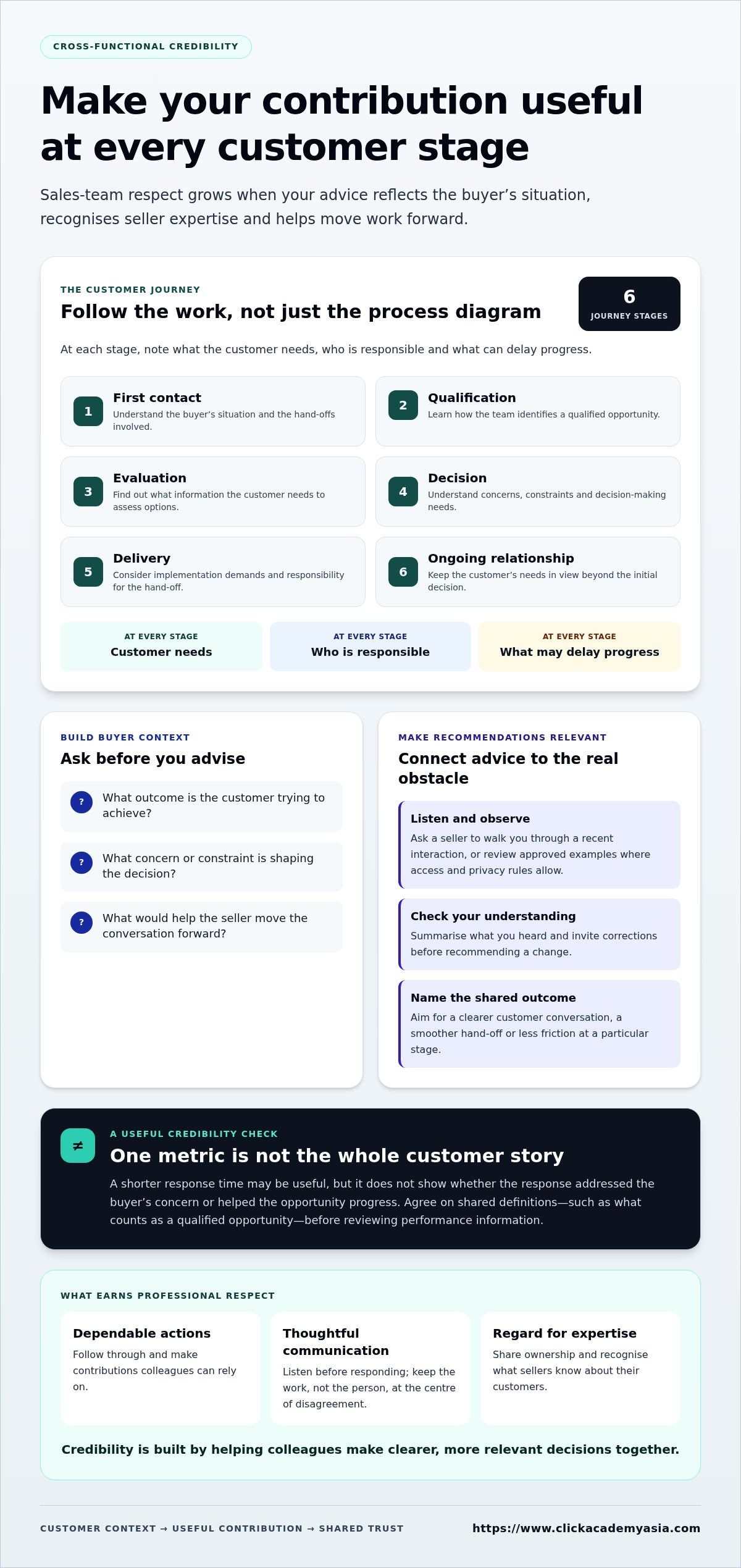
Credible cross-functional advice starts with the path a customer actually takes, not a process diagram viewed from another department. Sellers balance customer needs with internal hand-offs, timing and commercial priorities. Map the journey from first contact through qualification, evaluation, decision, delivery and the ongoing relationship. At each stage, note what the customer needs, who is responsible and what can delay progress.
Customer context makes advice credible because it connects recommendations to the buyer’s needs and the seller’s next practical step. That principle complements the Building Blocks of Trust in the Workplace, where credibility and respect are part of how colleagues build trust. Before suggesting a new process, understand how the team defines a qualified opportunity, records customer objections and decides that an opportunity has moved forward.
How can you learn the sales team’s day-to-day realities?
Start with observation and focused questions. If access and privacy rules allow, listen to customer calls or review approved examples; otherwise, ask a seller to walk you through a recent interaction. Find out where buyers need more information, which hand-offs create delays and what details are often missing. Then summarise what you heard and invite corrections before making recommendations.
That final step matters. A seller may clarify that an apparent delay reflects a customer’s internal approval process, not a slow follow-up. Checking your understanding prevents an incomplete observation from becoming a new rule that adds work without addressing the real obstacle.
How do you connect your contribution to sales priorities?
Translate an idea into an outcome the team can assess together: a clearer customer conversation, a smoother hand-off or less friction at a particular stage. Agree on shared definitions before reviewing performance information. For example, confirm what counts as a qualified opportunity and what the team means by pipeline progress, so colleagues are discussing the same thing.
Avoid treating a single metric as a complete measure of sales effectiveness or customer value. A shorter response time may be useful, but it doesn’t show whether the response addressed the buyer’s concern or helped the opportunity progress. Combine relevant measures with context from sellers and customers, then test a targeted improvement before proposing a broader process change.
Map: Record customer needs, owners and hand-offs at each journey stage.
Ask: Explore recurring friction before offering a solution.
Reflect: Play back what you understood and let sales colleagues correct it.
Align: Define shared terms and agree how an improvement will be assessed.
This approach makes gaining respect from the sales team a practical exercise in commercial understanding, not guesswork. Continued development in sales communication and leadership can also help teams build a common language. Explore sales and leadership training to support that shared capability.
Compare trust-building behaviours with habits that undermine respect
Good advice can still fall flat if it arrives with interruption, blame or assumptions about what the sales team should have done. Trust is shaped not only by the recommendation, but by how you reach it and what you do afterwards. Confidence is what you project; credibility is what colleagues learn to expect from your consistent actions.
Use this comparison to check how your everyday conduct may land. The same disagreement can either strengthen a working relationship or make colleagues less willing to involve you next time.
Builds trust
Weakens trust
Listen:
Let the seller explain the customer context before responding.
Interrupt:
Jump in with a solution before understanding the concern.
Share ownership:
Agree who will handle each next step and keep colleagues informed.
Blame:
Focus on who caused a problem instead of how to resolve it.
Use evidence:
Explain the customer feedback or information behind your recommendation.
Assume:
Treat a hunch about the buyer or sales process as established fact.
Be candid:
Disagree respectfully and recognise the seller’s customer knowledge.
Perform agreement:
Say yes in the meeting, then fail to follow through.
Which everyday actions help sales colleagues trust you?
Before a discussion, clarify its purpose, the customer or opportunity involved, and the decision the group needs to make. Keep recommendations concise: state what you propose, why it matters and who owns the next step. Credit sales colleagues when their insight shapes the solution, and tell them promptly if a change affects timing, responsibilities or the customer conversation.
What behaviours can make even good advice easy to dismiss?
Prescribing a fix before learning the context can make useful expertise sound disconnected. So can criticising a sales outcome without understanding factors such as changing customer priorities, decision timing or a hand-off between teams. Excessive jargon adds friction, while missed commitments undermine confidence. Avoid reflexive agreement, too: if you see a genuine risk, explain it clearly rather than agreeing to keep the conversation comfortable.
Direct disagreement needn’t diminish sales expertise. For example, you might say, “I see why this approach fits the customer discussion. Could we also consider whether the buyer needs more detail on implementation before deciding?” This recognises the seller’s context, explains the concern and opens a practical discussion. If you commit to reviewing a draft or providing information, meet the agreed deadline, or flag a change early.
These small choices make gaining respect from the sales team less about presenting yourself as the expert and more about being a dependable partner. Prepare, speak plainly, share responsibility and follow through. Colleagues can then assess your contribution through evidence they see in the work, not confidence alone.
Use a practical action plan to earn respect from the sales team
Trust grows through work colleagues can see and rely on, not a single polished meeting. A practical plan helps you move from listening to a specific improvement, while keeping sales ownership and customer needs in view. Start small, agree how you’ll work together and deliver what you commit to.
Use this sequence to turn good intentions into consistent collaboration:
Listen before proposing. Ask sales colleagues what they need from cross-functional partners and where collaboration tends to break down. Invite examples, and avoid defending your team or suggesting a fix before you understand the issue.
Reflect what you heard. Summarise the concern neutrally, then check your interpretation. For example: “It sounds as though customer questions are reaching the team without enough product context. Have I understood that correctly?” This gives colleagues room to clarify what’s happening.
Choose one improvement together. Make it specific and manageable, such as agreeing on the information needed in a hand-off or setting a clear process for sharing changes that affect a customer conversation. A focused improvement is more useful than a broad promise to “support sales”.
Agree how you’ll work. Clarify who owns each task, how colleagues prefer to communicate and when updates are needed. Choose a practical sign of progress together, such as whether the hand-off includes the agreed details. Treat it as a shared indicator, not a complete measure of sales effectiveness.
Deliver, then review together. Complete your part by the agreed time. At the review, ask what helped, what created friction and what should change next. Keep the discussion focused on the process and customer impact, not on assigning blame.
A modest commitment is a useful first test. If you agree to provide a concise customer-facing summary for a hand-off, deliver it in the format and timeframe you agreed. If circumstances change, communicate early and reset expectations rather than letting colleagues discover the delay themselves.
Sales colleagues may also challenge your recommendation. Treat that response as information, not a personal rejection. Ask what customer evidence or operational constraint is behind the concern, then separate the business issue from your proposed solution. You might revise the recommendation, suggest a limited test or explain why you think the original approach still addresses the need. Stay curious and specific; defensiveness makes it harder to reach a sound decision together.
There’s no shortcut. Gaining respect from the sales team depends on repeated follow-through, openness to feedback and improvements that make shared work easier. To build those habits across a team, explore professional sales training that develops practical communication and collaboration skills.
Sustain sales-team respect through shared growth and practical skills development
Respect is easier to sustain when collaboration becomes part of how a team works, rather than depending on one person’s effort. Managers can help by setting clear expectations for hand-offs, decision-making and respectful disagreement. When colleagues know who owns a task, when to involve one another and how to raise a concern, they have a stronger basis for working through customer challenges together. For leaders seeking to refine how they guide these interactions, executive coaching from Simon Lead LLC can help enhance essential leadership capabilities.
How can managers reinforce mutual respect across teams?
Make expectations practical and visible. Agree what information a hand-off should include, who makes which decisions and how colleagues should flag a difference of opinion. Recognise collaborative contributions alongside individual results, such as a well-managed hand-off or timely input that helped a customer conversation progress. In regular check-ins, discuss specific examples and agree on a useful next action rather than relying on general praise or criticism.
Feedback works best when it’s timely, specific and focused on behaviour a colleague can change. Instead of saying, “You need to collaborate better,” a manager could say, “The project update arrived after the sales discussion, so the team couldn’t use it with the customer. Let’s agree when those updates need to be shared.” This identifies the impact, clarifies the expectation and gives both teams a constructive next step.
When can sales training support stronger working relationships?
Professional sales training can give colleagues a shared foundation in customer-centred communication, commercial awareness and practical execution. Learning together can help teams discuss buyer needs more clearly, prepare for objections and coordinate responsibilities across customer touchpoints. Training develops useful skills, but it doesn’t guarantee respect or resolve every working relationship on its own.
Managers can reinforce learning by reviewing both commitments and capability needs. Ask whether agreed hand-offs are happening, what feedback colleagues have received and where communication still creates friction. If a commitment was missed, focus on its effect and how to prevent a repeat. If a new skill is needed, identify the work situation where it would make a difference, then support practice and follow-up.
In Singapore, teams can include WSQ training in a broader approach to workforce development. ClickAcademy Asia offers WSQ courses in areas including Digital Marketing Strategy & Planning, SEO and Marketing Analytics & Insights. Keep the discussion focused on the capabilities the team wants to strengthen, such as customer understanding, sales communication or shared execution.
Sustained progress comes from learning, applying new skills and reviewing how collaboration feels in practice. ClickAcademy Asia’s Sales Training and Sales Leadership programmes can help build practical capability across your team. Explore professional sales training and team development to take the next step.
Turn collaboration into a capability you keep building
Make stronger collaboration part of your team’s development rather than leaving it to individual goodwill. Choose a practical skill to strengthen together, such as customer-focused communication or clearer coordination across sales hand-offs, and create opportunities to apply it in real work. Respect grows through continued practice; training can support capability, but it doesn’t guarantee how colleagues will respond.
For professionals and corporate teams, ClickAcademy Asia offers Sales Training and Sales Leadership, including customised corporate training. Its WSQ courses support development in areas such as digital marketing strategy and planning. With a shared commitment to learning and follow-through, gaining respect from the sales team becomes a goal you can work towards through everyday actions.
Explore ClickAcademy Asia’s Sales Training and Sales Leadership to equip your team with practical skills and strengthen sales collaboration.
Frequently Asked Questions
Can you earn respect from the sales team without having a sales background?
Yes. Your value may come from expertise the sales team doesn’t have, such as analysing information, improving a process or understanding a product in depth. Build enough sales fluency to collaborate effectively: learn the terms colleagues use and ask how your specialism fits their work. Be clear about where your knowledge is strongest, and avoid presenting an opinion outside your expertise as a sales recommendation.
How do you gain respect from sales colleagues when you are not their manager?
Build influence through professional judgement, not authority. Offer colleagues choices and explain the implications of each, rather than trying to direct their decisions. For instance, if a request has competing deadlines, outline what can be delivered now and what would need to move. This helps sellers make informed trade-offs while showing that you understand their priorities and take your own responsibilities seriously.
What should you do if the sales team dismisses your ideas?
Don’t keep pushing the same proposal without understanding the decision. Ask whether the team has ruled it out or simply can’t act on it now, then clarify what conditions might make it relevant later. If the decision is final, acknowledge it and move on. Reopen the discussion only if new information or a material change gives colleagues a concrete reason to reconsider.
How can you disagree with a sales representative without damaging the relationship?
Make the trade-off explicit. Separate what you know from what you’re interpreting, then explain the possible benefits and risks of each option. For example, a faster approach may save time but leave a customer question unanswered. Invite the representative to weigh those consequences against their understanding of the situation, and agree how the decision will be communicated to others involved.
How can managers encourage respect between sales and other teams?
Managers can make cross-functional understanding part of onboarding, so new colleagues learn how their role connects to sales before a difficult hand-off occurs. They can also recognise people who raise a risk early, share useful context or help resolve a customer issue across team boundaries. Recognition should explain the behaviour and its impact, giving others a clear example to learn from.
How can you tell whether your relationship with the sales team is improving?
Choose a small set of indicators that reflect the specific relationship you want to strengthen. For example, note whether cross-team requests arrive with enough context to act on, or whether decisions need fewer rounds of clarification. Ask colleagues for a candid view of what has become easier and what still causes frustration. Look for a pattern across different interactions, rather than judging progress by one meeting.


Comments