
Digital Marketing Strategy Workshop for Marketers

What’s the point of a marketing strategy if it never shapes the work? A well-designed digital marketing strategy workshop connects customer analytics to decisions teams can act on, helping marketers move from insight to execution instead of stopping at a plan.
Strategy can feel disconnected from day-to-day marketing. Teams gather data, discuss channels and set targets, yet still need a clear way to turn those inputs into focused priorities. The value lies in linking each step: understand customers, shape a strategy, apply it to a practical project and define KPIs that guide delivery.
This article explains how that learning journey works, what participants can apply in their roles and how to assess whether a workshop fits a team’s needs. You’ll see how customer analytics informs strategy, how practical projects make concepts usable, and how KPI selection supports consistent execution. The result is a clearer picture of how to build a strategy that guides real marketing decisions.
Table of Contents
Data-driven marketing and customer analytics
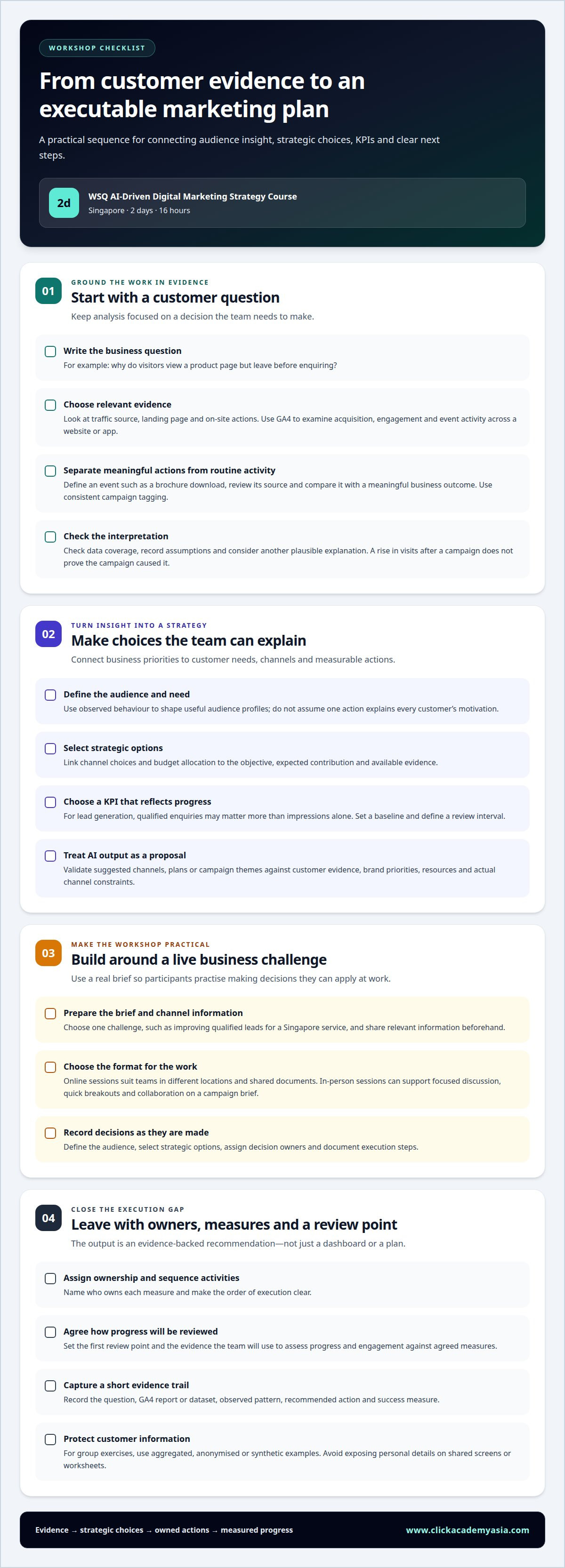
Data-driven marketing uses evidence to guide decisions about audiences, messages and channels. Start with a business question, such as why visitors view a product page but leave before enquiring. Then identify data that could explain the pattern, including traffic source, landing page and on-site actions. This keeps analysis tied to a decision instead of producing reports without a purpose.
Customer analytics examines how identifiable or grouped customers interact with a business; consumer analytics can also explore broader behaviours, preferences and market segments. For example, a Singapore retailer might compare repeat purchases across customer groups, then test whether email or search brings more qualified visits. Keep each profile useful: connect observed behaviour to a clear audience need, and avoid assuming that one action explains every customer’s motivation.
Google Analytics 4 (GA4) can help marketers examine acquisition, engagement and event activity across a website or app. In a practical exercise, define an event such as a brochure download, review its source, then compare that action with a meaningful business outcome. Separate key events from routine page views, and use consistent campaign tagging so channel comparisons remain interpretable. A course exercise can then turn one finding into an application: recommend a channel adjustment and explain what evidence supports it.
For Singapore workshops, privacy and consent are important considerations when using customer data. Use aggregated, anonymised or synthetic examples for group exercises, and avoid exposing personal details on shared screens or worksheets. If a team uses live customer records, it should account for its applicable data-protection responsibilities before the session. This keeps the workshop focused on analysis without turning real customer profiles into unnecessary training materials.
Common workshop risks include choosing metrics before defining the business question, treating correlation as proof of cause, and building profiles from incomplete data. Reduce these risks by documenting the question, checking data coverage and recording assumptions beside each finding. For instance, a rise in visits after a campaign does not prove the campaign caused the increase. Before recommending action, participants should consider another plausible explanation.
A useful output is a short evidence trail: the question, GA4 report or dataset, observed pattern, recommended action and success measure. This gives marketers a practical understanding of digital performance and helps them explain decisions to colleagues. It also makes the workshop’s outcome visible: participants leave with a reasoned recommendation, not merely a dashboard screenshot.
Recommendations should link the observed pattern to a testable next step, with a measure that can show whether the change helped. The WSQ AI-Driven Digital Marketing Strategy Course in Singapore runs for 2 days and 16 hours, giving participants time to practise turning evidence into marketing decisions.
Digital marketing strategy development and execution
A useful strategy links business priorities to customer needs, channel choices and measurable actions. Develop it step by step, then assign owners to carry out each decision.
KPI Development and Budget Allocation
Start with a business objective, then choose a KPI that reflects progress towards it. For a lead-generation campaign, qualified enquiries may matter more than impressions alone. Set a baseline, define a review interval and record who owns each measure. Allocate budget according to strategic priority, expected contribution and available evidence, then leave room to adjust investment as channel performance changes.
Workshop Formats and Duration
Online workshops suit teams in different locations and make shared documents easy to update. In-person sessions can support focused discussion, quick breakouts and direct collaboration on a campaign brief. Choose the format based on participant access, the work required and how decisions will be recorded. Allow enough time to meet the workshop objectives, from setting priorities to agreeing actions, without extending discussion beyond useful decisions.
Workshop Planning and Execution Steps
Build the session around one live business challenge, such as improving qualified leads for a Singapore service. Share the brief and relevant channel information beforehand. During the workshop, define the audience, select strategic options, assign decision owners and record execution steps. Close by agreeing the first review point and the evidence participants will use to assess progress.
AI tools can help draft a plan by organising audience insights, suggesting channel approaches or structuring campaign themes. Treat each output as a proposal, not a decision. Validate recommendations against customer evidence, brand priorities, available resources and actual channel constraints. For example, reject a suggested content schedule if the team lacks the capacity to produce it consistently.
Career development comes from applying knowledge to meaningful decisions. Marketers can build skills by presenting a rationale, defending KPI choices and explaining how budget priorities connect to customer outcomes. A portfolio case could show the original objective, selected channels, execution plan and subsequent learning. These steps help professionals demonstrate strategic judgement, not just familiarity with platforms.
KPIs and actionable metrics
A strategy workshop should produce a defined objective, selected KPIs, channel priorities and an action plan. It should also assign owners and set out how the team will review progress.
A KPI measures progress towards a specific business objective; an actionable metric helps explain what to do next. For example, an e-commerce team might track completed purchases as a KPI, then examine product-page visits and checkout abandonment to identify friction. Social media engagement can indicate audience response, but it needs context: compare it with the campaign’s goal, audience and intended next step.
Build each measure around the objective, not the dashboard. If the goal is qualified enquiries, define what makes an enquiry qualified, select a relevant conversion event and agree who reviews it. Then record the baseline, data source and review method. These fundamentals help prevent a team from celebrating higher reach when the intended outcome is stronger sales conversations.
The Trend-to-Action Framework turns an observed pattern into a decision. First, name the trend, such as declining engagement on a social media series. Next, investigate possible causes, including format, topic and audience response. Then choose an action, such as testing a new content angle, and specify the metric that will show whether it helped. This sequence connects observation to execution.
Action-learning projects let participants apply the framework to a real marketing challenge. A team might review a campaign’s channel results, identify an underperforming audience segment and propose a revised message. The project should end with a recommendation, supporting evidence, an owner and a review point. That output demonstrates how participants interpret metrics and make practical decisions.
Keep reporting focused. A concise scorecard can connect each objective to its KPI, supporting metrics, data source, owner and next action. For example, if email clicks rise but qualified enquiries do not, the team can inspect the landing page and offer before increasing campaign activity. This makes the scorecard a decision tool, rather than a collection of disconnected figures.
A strong workshop deliverable also captures assumptions and learning. Record why the team selected a channel, what evidence informed the choice and which result would prompt a change. This decision trail helps marketers explain recommendations to colleagues and refine the strategy as new results emerge. Participants leave with a usable framework, not just a list of metrics.
For learners applying these principles, a recommendation should make clear which objective it serves, what evidence supports the channel choice and which result would justify adjusting the approach. The course’s A2 individual project presentation requires at least 2 channel strategy recommendations. Framing each recommendation around a business objective and relevant measures can help show how the team moves from interpreting results to choosing an action, rather than simply reporting performance.
When reviewing the project, keep the reasoning behind each recommendation visible: connect the proposed channel to the intended outcome and identify the evidence that informed the decision. This also gives learners a way to demonstrate practical use of metrics. Eligible learners in Singapore can receive up to 70% course fee funding for this course.
Digital marketing strategy execution
A strategy becomes executable when each priority has an owner, a deadline and a defined output. For a Singapore retailer, a plan to increase online enquiries might require a landing page, search campaigns and follow-up content. Map those tasks before launch, then identify dependencies. The campaign cannot send useful traffic to a page that is unfinished or unclear.
Translate each strategic choice into a working brief. Specify the target audience, customer problem, message, channel, required asset and approval owner. For example, a service campaign might need a search ad, a matching landing page and a clear enquiry form. Assigning these deliverables to named roles helps teams choose work they can complete, rather than approving ideas without the capacity to deliver them.
Sequence work around its dependencies. A campaign calendar can show when research, creative development, review and launch happen. Allow time to check links, mobile layouts, tracking tags and form submissions. A test enquiry before launch can reveal a broken form or missing confirmation message. These practical checks protect the customer journey and give the team a reliable starting point.
Brief: Record the audience, objective and offer in a one-page campaign document.
Prepare: Confirm each asset, channel owner and approval step before production starts.
Launch: Test the customer journey, tracking and campaign settings before activation.
Review: Compare early engagement and conversion signals with the campaign objective.
Execution also needs a decision rhythm. Set a review meeting around the campaign’s activity, rather than waiting until the final report. If a Singapore audience clicks an advertisement but leaves the landing page, inspect message alignment, page clarity and load experience. Change one meaningful element at a time, document the reason and observe what happens next.
Keep teams aligned with a shared action log. For each task, record its owner, due date, status and blocker. If a product expert must approve a claim before publication, make that dependency visible in the calendar. A weekly review can then resolve delays, redistribute work or adjust sequencing without losing sight of the original objective.
The execution gap often appears after a workshop, when decisions lack ownership or operational detail. Close it with a launch-ready plan: campaign brief, channel schedule, asset list, responsibilities and review criteria. This turns strategic intent into coordinated work and gives marketers a clear way to execute, learn and refine the next campaign.
How to plan and run a digital marketing strategy workshop step by step?
Start with a business decision the team needs to make, not a broad discussion about marketing. For example, a Singapore retailer might need to improve online sales from a specific product category. Use that challenge to shape the agenda, activities and final deliverables.
Define the outcome. Write one clear objective, such as choosing channels for a new service launch. Specify the decisions participants must make and the document they should produce. A focused outcome keeps the session from becoming a general review of every marketing activity.
Select participants. Invite people who bring relevant customer, channel and operational knowledge. A campaign may require input from marketing, sales, customer service and product teams. Give each participant a clear role, such as decision-maker, subject expert or note-taker.
Prepare the working materials. Share a brief with the business challenge, audience profile and existing campaign information. Include relevant customer feedback, channel results and constraints. For example, note that a proposed campaign depends on a landing page that the web team must build.
Set a practical agenda. Arrange activities in decision order: clarify the audience, explore strategic options, assess resources and agree priorities. Allocate time to each activity and include a short break. Keep discussions tied to the brief by capturing unrelated questions for later review.
Facilitate decisions. Use a shared board or document to record options, evidence and open issues. Ask participants to explain why they favour a channel or message. If the group cannot resolve a choice, record the decision owner and information needed to move forward.
Close with ownership. Convert each priority into a task, named owner and next action. A campaign plan might assign copy, creative, landing-page updates and tracking checks to different roles. Confirm dependencies before the session ends.
After the workshop, circulate the decision record and action plan while the discussion remains clear. Include selected priorities, rejected alternatives and the reasons behind each choice. For a campaign targeting Singapore customers, the record might explain why the team chose search over another channel and which audience need shaped its message.
Schedule a follow-up review around the agreed work, not an arbitrary presentation. Check whether tasks are progressing, identify blockers and record changes to the plan. This turns workshop decisions into coordinated marketing activity and gives the team a practical record for future planning.
ClickAcademy Asia
ClickAcademy Asia is a natural next step for marketers who want to strengthen the skills behind their strategic decisions. Its training helps professionals build knowledge in planning, content, search and campaign execution, then apply that learning at work. The right starting point depends on the challenge: setting an overall direction, sharpening a channel skill or aligning a team around marketing priorities.
For marketers who need a structured approach to setting objectives, choosing channels and connecting plans to action, WSQ Digital Marketing Strategy & Planning is a relevant option. It suits teams looking to build a clearer strategic foundation, rather than focusing only on individual campaign tasks. That foundation can support better-informed decisions across marketing activities.
Other learning options address more focused areas of practice:
WSQ Content Marketing Strategy suits professionals developing a more deliberate approach to content planning.
WSQ Search Engine Optimisation (SEO) relates to improving a team’s understanding of search visibility and organic discovery.
WSQ Search Engine Marketing (SEM) supports marketers building knowledge of paid search strategy and campaign management.
These options can be considered individually or as part of a broader development plan. For example, a marketing team might first strengthen strategic planning, then build specialist capability in content or search. A professional seeking to take on wider responsibility may benefit from connecting channel knowledge with a clearer understanding of business objectives, customer needs and performance measures.
The practical value of training comes from applying new knowledge to real decisions. A marketer can use a planning framework to assess a campaign brief, explain why a channel fits its audience and connect the activity to its intended outcome. Managers can also use what they learn to support consistent conversations about priorities, execution and the skills their teams need to develop.
In short, identify capability gaps, choose relevant training and apply learning at work. Equip your team through WSQ-funded training tracks; you can reach out to ClickAcademy Asia to discuss learning options that fit your goals.
Frequently Asked Questions
Need more course info?
Start by identifying the work challenge you want training to address, such as planning a product launch or improving channel coordination. Then compare that need with the course outline and intake details. A short list of questions about your role, current responsibilities and intended learning outcome can make a course discussion more focused and useful.
What is covered in a digital marketing strategy workshop?
Course coverage depends on the learning objective and selected programme. Before enrolling, review the course outline for topics, activities and assessment requirements relevant to your goals. If you want practical application, look for opportunities to work through a business scenario or develop a plan you can adapt to your organisation. This helps you judge whether the programme’s scope matches your current responsibilities.
Who should attend a digital marketing strategy workshop?
These courses can suit professionals who contribute to marketing decisions, including campaign planning, channel coordination or performance reviews. Someone new to strategy may use the learning to build a stronger foundation, while an experienced marketer may want to formalise their approach. Managers can also consider whether the skills align with team responsibilities and upcoming business priorities.
Which workshops are available in Singapore?
Relevant options include WSQ Digital Marketing Strategy & Planning, WSQ Content Marketing Strategy, WSQ Search Engine Optimisation (SEO) and WSQ Search Engine Marketing (SEM). To choose between them, consider whether your immediate development need is broad planning, content, organic search or paid search. Course outlines and intake details can help you compare each option’s focus.
How to measure the results of a digital marketing strategy workshop?
Set a learning objective before attending, then identify evidence that would show progress afterwards. For example, assess whether you can explain the rationale behind a channel recommendation or create a clearer campaign brief. You can also discuss the learning with your manager and agree how to apply it to an upcoming project. Contact ClickAcademy Asia to discuss your learning goals.



Comments