
Defending Your Brand Against a New Market Entrant in Singapore

A new market entrant doesn’t automatically justify a price war. For Singapore businesses, defending your brand against a new market entrant starts with evidence, not a rushed promotion that could weaken the value customers already recognise.
The pressure to respond quickly is real. You may be weighing whether the competitor is attracting your customers, changing expectations or simply adding noise to a crowded market. A measured response begins by separating genuine shifts in customer behaviour from short-term reactions.
This article shows you how to assess a new competitor, choose a response that fits your brand positioning and track whether it’s working. You’ll learn which customer, competitor and performance signals to monitor, when to adjust your approach and how to build your team’s strategic and analytical capabilities. Relevant WSQ training can help teams strengthen those capabilities and make more confident decisions as the Singapore market evolves.
Table of Contents
Why a New Market Entrant Can Challenge Your Brand in Singapore
Imagine a Singapore-based brand noticing a new competitor promoting an alternative to the same customer group. The instinct may be to match its offer or launch a discount immediately. A more resilient response is to examine where the entrant overlaps with your business, what customers are doing differently and which parts of your position genuinely need attention.
Brand defence means protecting customer preference, trust and your strategic position, not preventing every rival from attracting attention. An entrant might raise expectations around convenience, service or choice, prompt customers to reconsider what they buy, or intensify competition for a particular buying occasion. Its effect can be meaningful even if the offer looks different on the surface.
A genuine competitive threat is an entrant whose offer overlaps with your customers’ needs and is supported by evidence of changing consideration, behaviour or business performance. Visibility alone is market noise. This distinction keeps defending your brand against a new market entrant focused on customer value rather than competitor activity for its own sake. It also helps clarify which existing strengths give customers a reason to choose you, a useful lens on Competitive Advantage.
What makes a new entrant a meaningful competitive threat?
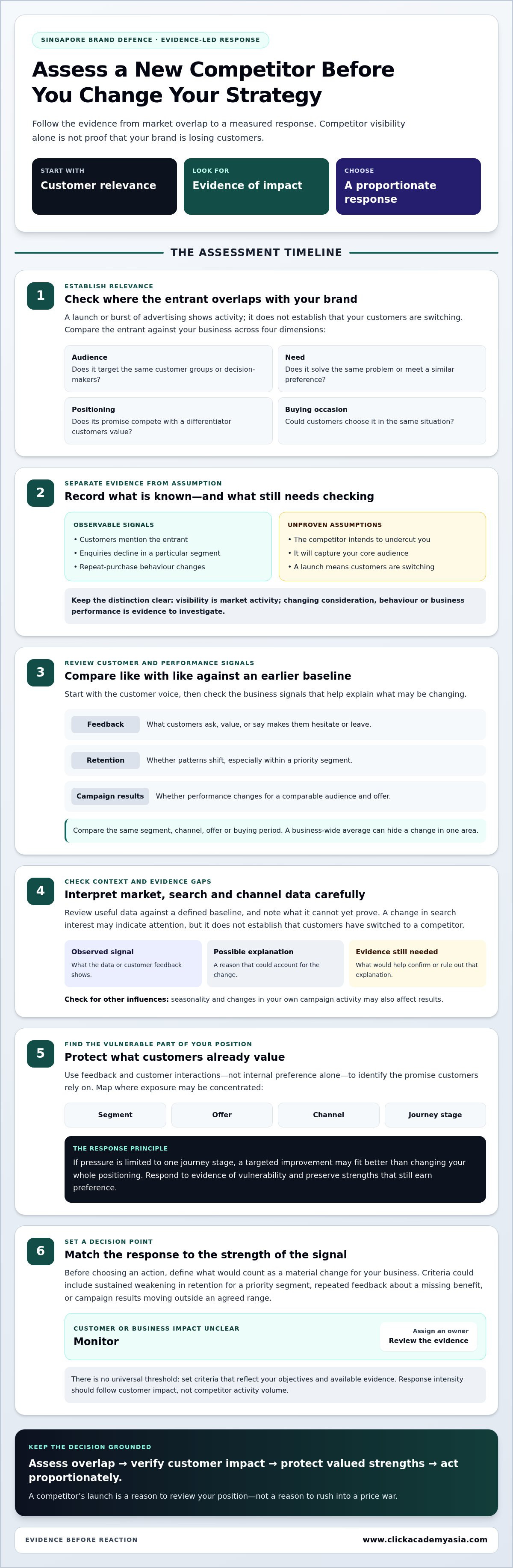
Start with relevance, then look for evidence. A launch, press mention or burst of advertising shows that a competitor is active; it doesn’t prove your customers are switching or considering a different choice. Compare the entrant with your brand across four dimensions:
Audience: Does it target the same customer groups or decision-makers?
Need: Does it solve the same problem or satisfy a similar preference?
Positioning: Does its promise compete with a differentiator customers value in your brand?
Buying occasion: Could customers choose it in the same situation, or is it serving a separate use?
Then separate observable signals from assumptions. A customer mentioning the entrant, a decline in enquiries from a particular segment or a change in repeat-purchase behaviour are signals to investigate. Claims that the competitor intends to undercut you or capture your core audience remain assumptions until evidence supports them.
Which parts of your brand position need protecting?
Identify the promise customers rely on and the differentiators they value, using feedback and customer interactions rather than internal preference alone. Map where exposure might be concentrated: a particular segment, offer, channel or step in the customer journey. For instance, an entrant may compete for first-time buyers through a simpler offer while your established customers continue to value expertise or dependable service.
That distinction matters. If the pressure is concentrated in one journey stage, a targeted improvement may be more appropriate than changing your whole positioning. Protecting trust also means avoiding a response that confuses customers or weakens the promise they already associate with your brand. Respond where evidence points to vulnerability, and preserve the strengths that still earn preference.
How to Decide Whether to Defend Your Brand or Adapt
A competitor’s launch is a reason to review your position, not a decision to retaliate. For Singapore businesses, a clear assessment helps distinguish a temporary change in attention from a shift that could affect customer preference or commercial priorities. Use the same sequence each time so urgent discussions are grounded in comparable evidence.
Response intensity should follow evidence of customer impact, not the volume of competitor activity. That principle gives your team room to choose between monitoring, adapting and active defence, rather than treating every move as a direct challenge.
Which signals should your team assess first?
Begin with the customer voice. Review recent feedback alongside an earlier baseline, noting what customers ask about, why they choose your brand and what reasons they give for leaving or hesitating. Then check retention patterns and campaign performance where available. Compare like with like: the same customer segment, channel, offer or buying period, rather than relying on a business-wide average that could conceal a change in one area.
Next, assess whether the entrant is relevant to the customers and needs you serve. Review useful market, search and channel data against a defined baseline, and record gaps in the evidence. For example, a change in search interest may indicate attention, but it doesn’t establish that customers have switched to a competitor. Seasonality or a change in your own campaign activity may also affect results.
Keep three columns in your assessment: observed signal, possible explanation and evidence still needed. This simple discipline helps decision-makers separate what the data shows from what the team suspects about a rival’s intentions or impact.
When is a response better than continued monitoring?
Set decision criteria before choosing a response. Define what would count as a material change for your business, such as a sustained weakening in retention for a priority segment, repeated customer feedback about a missing benefit or campaign results moving outside an agreed range. The threshold should reflect your objectives and available evidence, not an invented universal benchmark.
Then match the action to the strength and scope of the signal:
Monitor when the entrant is visible but customer or commercial impact remains unclear. Assign an owner and a review date.
Adapt when evidence points to a specific unmet need or friction point your brand can address without changing its core promise.
Defend actively when credible, repeated signals show a priority customer group or strategic position is under pressure.
For each option, weigh the cost and potential consequences of action against the risk of waiting. A broad promotion, for instance, may affect customer expectations beyond the segment where the issue appeared. Set a review point with a named owner, the evidence to revisit and a decision to make. Monitoring should lead to a decision, not become indefinite delay.
Teams looking to improve how they interpret customer and campaign signals can build those capabilities through professional marketing skills training.
Compare Brand Defence Strategies Beyond Price Cuts
A discount is visible and easy to launch, but it may address the wrong problem. If customers don’t understand your difference, a lower price won’t clarify your brand promise. If a service journey is frustrating, a promotion may attract attention without fixing the experience. The stronger response is the one that addresses why customers might reconsider, while protecting the value your brand aims to represent.
Use this comparison to match each option to a specific objective. Choose measures that reflect that objective so your team can see whether a response is helping, rather than simply generating activity.
When can stronger positioning or customer experience help?
Clarify the promise when customer feedback suggests a communication gap, not a price objection. Test whether buyers can describe the benefit and whether they value it before investing in a new message. For experience improvements, use customer feedback and behavioural evidence to pinpoint friction, such as a confusing information step or a difficult route to purchase. Change the relevant part of the journey, then check whether the intended behaviour improves.
When might a promotion or offer be appropriate?
Use an incentive only when it has a defined audience, objective and evaluation period. Before launch, record a comparable baseline and consider effects on margin, brand perception and repeat behaviour, not just immediate response. Search demand can also reveal how customers express a need and what intent sits behind a query; advanced keyword research strategies can help teams investigate those signals. Compare results with the baseline while accounting for other changes that may have influenced them.
For defending your brand against a new market entrant, choose the least disruptive strategy that addresses the evidence. A promotion can have a role, but it shouldn’t become the automatic answer to competitive pressure.
Build a Measurable Response Plan for a New Competitor
A response can lose momentum when marketing, sales and customer-facing teams act on different assumptions. Give the work a clear owner, a testable hypothesis and a review point. This turns defending your brand against a new market entrant into a managed business decision, rather than a set of disconnected campaign activities.
How should the team organise its response?
Nominate one person to coordinate the plan and agree who contributes evidence, approves decisions and delivers each action. Marketing can manage channel activity, sales and service teams can share customer questions, and leadership can confirm the business priority and acceptable trade-offs. Keep the customer-facing message consistent, even if each team uses different channels.
Before launch, record the trigger for action, the evidence behind it, any assumptions, the chosen response and the behaviour you expect from customers. For example: “If we clarify this benefit for prospective buyers, more of the right audience should progress from product-page visits to enquiries.” That statement gives the team something specific to test, without treating an expected result as a certainty.
How can you tell whether the response is working?
Choose a small group of indicators linked directly to the hypothesis. A positioning response might track whether customers understand the offer, alongside qualified enquiries. A customer-journey improvement might track completion at the affected step and subsequent repeat behaviour. Avoid collecting a long list of metrics that no one will use to make a decision.
Compare results with a pre-response baseline and, where useful, the relevant customer segment or channel. Separate leading signals, such as engagement or consideration, from later commercial outcomes, such as conversion or retention. A positive movement in one measure doesn’t automatically prove the competitor caused the original change or that your response caused the improvement. Note other campaign, channel or market changes that may have influenced the result.
Set a review cadence that fits the action and the pace at which its chosen indicators can provide useful evidence. At each review, decide whether to:
Continue if the response is progressing towards its objective without unacceptable trade-offs.
Adjust if the intended audience is responding differently than expected or a key measure remains unchanged.
Stop if evidence shows the approach isn’t addressing the problem or its costs outweigh its value.
Record the decision and the next review point. This creates accountability and stops teams defending an ineffective tactic simply because they have already invested in it. For a stronger measurement foundation, marketing analytics with GA4 can help teams build their understanding of digital performance data.
Equip your team to plan and measure marketing responses with WSQ digital marketing training.
Strengthen Brand Defence Through Singapore-Based Marketing Skills
A sound response depends on more than a strategy document. Your team needs the judgement to interpret market signals, the confidence to assess customer and campaign data, and the communication habits to turn evidence into coordinated action. Continuous learning can build these capabilities over time, but it can’t guarantee a particular competitive outcome.
That matters for defending your brand against a new market entrant: the team must be able to distinguish a meaningful shift from a passing signal, agree what the evidence means and choose a response that supports business priorities. These are practical skills that can strengthen decision-making across marketing, sales and customer-facing functions.
Which team capabilities support a stronger defence?
Start with strategic planning. Teams need to connect customer needs, competitor activity and business objectives before committing resources. Analytics confidence is just as important: staff should be able to interpret customer and campaign performance, question data limitations and avoid treating a change in one metric as proof of cause. Shared evidence only helps when teams understand it consistently.
Cross-functional communication completes the picture. Marketing may spot shifts in search or campaign behaviour, while customer-facing colleagues hear questions and concerns directly. A common way to share those observations helps leaders weigh them together, align messaging and decide what to test next.
How can WSQ training support practical readiness?
In Singapore, the WSQ framework provides a structured context for developing workplace skills. ClickAcademy Asia offers WSQ Digital Marketing Strategy & Planning for teams building a more disciplined approach to market assessment and response planning. Related training in SEO and Marketing Analytics & Insights can strengthen understanding of digital visibility and performance measurement.
SkillsFuture Singapore (SSG) funding supports eligible WSQ-accredited training. Employers should consider applicable requirements when planning workforce development. ClickAcademy Asia’s WSQ digital marketing courses can help teams develop capabilities relevant to their training needs.
Make the learning practical by connecting it to a current business challenge. Teams can practise assessing a competitor’s relevance, selecting suitable customer and performance indicators, and presenting a recommendation that explains both the evidence and its limitations. That gives managers a clearer view of capability gaps and helps staff apply new thinking to their work.
Equip your team to make more informed marketing decisions through digital marketing training. Stronger skills won’t remove competitive pressure, but they can help your people respond with greater clarity, consistency and confidence.
Prepare Your Team for the Next Market Shift
A new competitor can change the questions customers ask, but your team’s response doesn’t have to be reactive. Make customer evidence part of routine planning, test clear ideas and share what you learn across the business. These habits can help your organisation make considered choices as the Singapore market evolves.
Defending your brand against a new market entrant is an ongoing leadership discipline, not a one-off campaign. ClickAcademy Asia supports practical marketing capability through professional training. Equip your team to connect strategy with day-to-day decisions and build learning into how your organisation adapts.
Take a practical next step by exploring WSQ Digital Marketing Strategy & Planning to develop your team’s strategic marketing skills. Build the capabilities to approach future competitive challenges with greater clarity and confidence.
Frequently Asked Questions
Should a brand always respond when a new competitor enters the market?
No. A competitor’s arrival doesn’t automatically call for a public response or campaign change. If its offer serves a different need, a visible reaction may distract customers or give the entrant attention without protecting your business. Keep an internal watchlist, note any relevant customer questions and decide what evidence would prompt action. This keeps defending your brand against a new market entrant proportionate to the actual risk.
How can a brand compete with a new entrant without lowering prices?
Make it easier for customers to recognise and experience your value. For example, explain what is included in your offer, provide useful guidance before purchase, or make a common service interaction more straightforward. Gather feedback to check which improvements customers actually notice. Clear proof of value can help customers compare on more than price, while protecting the expectations associated with your brand.
What is defensive marketing?
Defensive marketing is the planned use of marketing activity to protect customer preference and a brand’s position as competitive pressure changes. It can include reinforcing a relevant benefit, improving communication with existing customers or addressing a specific weakness in the customer experience. It isn’t simply copying a rival, criticising its offer or launching discounts. The aim is to sustain customer value while responding selectively to credible risks.
How do you measure whether a brand defence strategy is working?
Choose measures that reflect the intended customer behaviour, then review them against a suitable pre-campaign baseline. If the aim is to reassure existing customers, examine feedback and repeat behaviour among that group, not just total website visits. Track a guardrail as well, such as complaints or margin where relevant. Consider seasonality and other activity before linking a change to the campaign.
Can a new market entrant make an established brand stronger?
Yes. A new option can expose customer needs your brand hasn’t addressed or make a previously overlooked strength more visible. Use the moment to revisit customer conversations, check whether your offer remains relevant and identify changes worth testing. The goal isn’t to imitate the entrant. It’s to learn what has changed in the market and use that insight to improve your own customer proposition.
What skills should a marketing team develop to respond to a new competitor?
Build skills in strategic planning, customer research, digital channel analysis and measurement. Team members should be able to explain why a signal matters, assess its limitations and communicate findings clearly to colleagues in sales and customer service. In Singapore, WSQ Digital Marketing Strategy & Planning can support structured planning capability, while SEO and marketing analytics training can strengthen the team’s ability to interpret digital demand and performance.


Comments