
Customer Success and Retention Mastery: A Strategic Guide for 2026

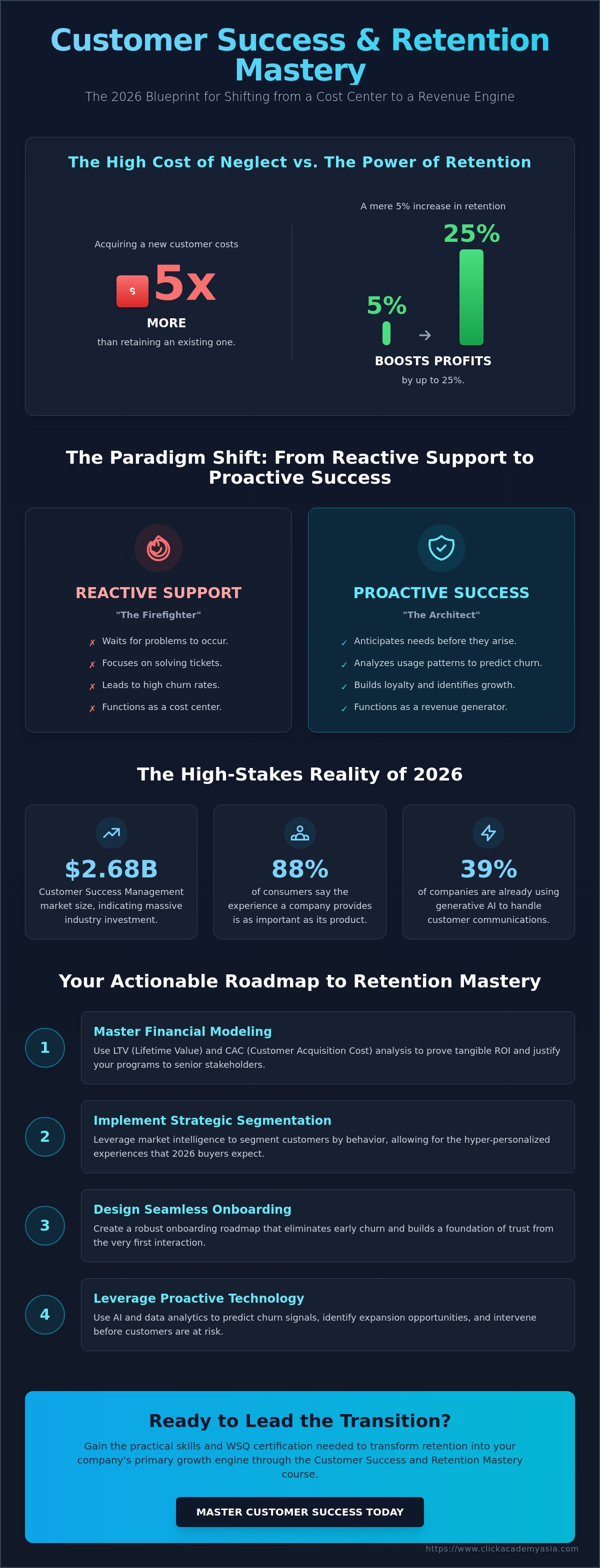
Why are you still spending five times more to acquire new leads when a 5% increase in customer retention can boost your profits by up to 25%? It's a common frustration for leaders in Singapore who see high churn rates eroding their hard-won gains. You know that reactive support isn't enough, yet quantifying the ROI of your success programmes often feels like guesswork. By focusing on Customer Success and Retention Mastery, you can stop "firefighting" and start treating retention as the rigorous financial discipline it actually is.
We'll show you how to transform basic support into a high-impact success engine that drives measurable revenue and secures long-term loyalty. This guide provides the tools to master LTV modelling and create actionable retention roadmaps that impress stakeholders. We'll walk through the strategic shifts needed for 2026, including how to leverage AI for proactivity and secure a WSQ certification to advance your career.
Key Takeaways
Shift from reactive firefighting to a proactive growth model that treats customer retention as a core financial discipline.
Master LTV modelling and CAC analysis to prove the tangible ROI of your success programmes to senior stakeholders.
Use market intelligence to segment customers by behaviour, allowing you to deliver the hyper-personalised experiences 2026 buyers expect.
Design a seamless onboarding roadmap that eliminates early churn and builds a foundation of trust from the very first interaction.
Gain the practical skills and WSQ certification needed to lead this transition through the Customer Success and Retention Mastery course.
Table of Contents Defining the 2026 Customer Success and Retention Landscape Core Frameworks: Analysing Lifetime Value and ROI Strategic Segmentation and Market Intelligence Building an Actionable Customer Success Roadmap Master Customer Success and Retention with ClickAcademy Asia
Defining the 2026 Customer Success and Retention Landscape
In 2026, the line between product and service has vanished. High churn rates aren't just a nuisance; they're a direct threat to your bottom line. Traditional customer support often waits for the phone to ring. In contrast, modern customer success anticipates needs before they become problems. This shift requires a deep understanding of customer success methodologies to transform your team from a cost centre into a revenue generator.
Retention is now the primary engine for growth in B2B and subscription models. Research shows that keeping an existing customer costs five times less than finding a new one. By mastering the principles of Customer Success and Retention Mastery, you'll learn to use data-driven market intelligence to identify expansion opportunities. It's about moving from a reactive mindset to a strategic one where every interaction is an opportunity for growth.
To better understand how to scale these efforts for maximum impact, watch this helpful video:
The Customer Success Management market has reached USD 2.68 billion in 2026. This growth isn't accidental. It reflects a world where 88% of consumers say the experience a company provides is as important as its products. Companies are no longer just selling software or services; they're selling outcomes. If your customer doesn't see value, they won't just complain; they'll leave. This reality has turned retention into a high-stakes financial discipline that requires precise ROI modelling and constant market analysis.
The Evolution from Support to Success
Reactive support is like firefighting. You're simply putting out blazes as they occur. Proactive success is about building fire-resistant structures that prevent problems before they start.
A high-impact CSM doesn't just solve tickets; they analyse usage patterns to predict which customers might leave. They look for signals like declining login rates or reduced feature adoption. This analytical approach allows for early intervention, often months before a contract renewal date. It's a role that demands a blend of empathy and technical data literacy.
Why Professional Certification Matters
For PMEBs in Singapore, earning a certification in Customer Success and Retention Mastery is about more than just a title. It provides the authority to lead high-value conversations using the WSQ framework, which ensures your training is grounded in real-world application. When you choose a practitioner-led institution like ClickAcademy Asia, you're learning from experts who have managed retention at scale. This professionalisation helps you secure your place in a market where 39% of companies are already using generative AI to handle customer communications.
Core Frameworks: Analysing Lifetime Value and ROI
Numbers don't lie. If you want to achieve Customer Success and Retention Mastery, you must speak the language of the boardroom. That language is finance. Many leaders focus heavily on Customer Acquisition Cost (CAC), which is the total spend required to convince a potential customer to buy. However, in 2026, the real winners are those who master Customer Retention Cost (CRC) and Lifetime Value (LTV) modelling.
LTV is a prediction of the total net profit attributed to the entire future relationship with a customer. It isn't just a vanity metric; it's a tool for strategic prioritisation. By calculating LTV, you can identify which segments deserve high-touch engagement and which should be managed through automated, AI-driven workflows. This financial literacy allows you to move away from "gut feelings" and toward data-backed decisions that protect your company's margins.
The Economics of Customer Retention
Retaining a customer is consistently five times cheaper than acquiring a new one. When we talk about "churn," we're simply describing the rate at which customers stop doing business with you. High churn is a leaky bucket that drains your marketing budget and kills your growth. To plug this leak, you need robust customer retention strategies that focus on early intervention.
A quick win for any team is to monitor "time-to-value." If a customer doesn't see a tangible benefit within their first 30 days, their churn risk skyrockets. By identifying these high-value accounts early through usage signals, you can deploy proactive outreach before they even consider leaving. Refining these financial skills is a core part of how we train modern leaders to think strategically about their accounts.
Justifying Your Success Budget
Securing a budget for customer success requires more than just showing "happy" customers. You need to present retention metrics to the C-suite as a direct contributor to revenue. Link your engagement scores directly to renewal rates and expansion opportunities. For instance, show how a 5% increase in retention has historically boosted profits by up to 25% in similar industries.
Use your data to prove that customer success isn't a cost centre; it's a profit centre. When you can demonstrate that your retention programme saved $500,000 in potentially lost revenue last quarter, the board will be much more likely to approve your next initiative. This level of Customer Success and Retention Mastery ensures you are seen as a vital strategic partner rather than just an operational lead.
Strategic Segmentation and Market Intelligence
Knowing your customer's name and industry is no longer enough to prevent churn. In 2026, 67% of consumers expect brands to automatically adjust content and outreach based on their current context. To meet this demand, you must move beyond basic records and embrace sophisticated market intelligence. This involves gathering real-time data on competitor movements and shifting industry standards to ensure your value proposition remains the most attractive option on the table.
Achieving Customer Success and Retention Mastery requires you to identify gaps in the current marketplace before your competitors do. By analysing why customers leave rivals, you can refine your own service to address those specific pain points. This proactive approach turns market intelligence into a defensive shield for your existing revenue and an offensive tool for expansion.
Tools for Market Intelligence
Conducting a thorough competitive analysis is the first step toward staying relevant. Don't just look at their pricing; look at their onboarding speed and support responsiveness. You can find reliable market data through usage patterns, industry benchmarks, and direct feedback from your "lost" leads. In 2026, market intelligence is defined as the real-time synthesis of competitor shifts and customer intent data to predict and prevent churn before it happens.
Targeting and Prioritisation
Effective segmentation in 2026 goes deeper than simple demographics. You need to utilise psychographic and behavioural data. Psychographic segmentation involves categorising customers based on their values and motivations, while behavioural data tracks exactly how they interact with your product. This allows you to create a high-impact "at-risk" list that prioritises accounts based on two factors:
High-Value, High-Risk: These are your top-tier accounts showing signs of declining engagement. They require immediate, high-touch human intervention.
Low-Engagement, High-Potential: These customers haven't fully integrated your tool into their workflow but have the budget for expansion.
Stable Champions: Your most loyal users who can be leveraged for case studies and referrals.
By aligning your retention solutions with these specific segments, you ensure your resources are spent where they will generate the highest ROI. This level of strategic targeting is a hallmark of Customer Success and Retention Mastery. It ensures that your team isn't just busy, but is actively moving the needle on your most important financial metrics.
Building an Actionable Customer Success Roadmap
Execution is where most retention strategies fail. You've already segmented your audience and analysed the financial costs, but now you need a day-to-day plan that your team can actually follow. A high-impact roadmap starts with a seamless onboarding process. Since 88% of consumers value the experience as much as the product, those first 90 days are your best chance to prove value. If you don't get it right immediately, you're just waiting for the contract to expire.
Building trust requires more than just automated emails. In 2026, 75% of consumers still prefer speaking to a human for complex or sensitive issues. Your roadmap should balance AI efficiency with personalised human touchpoints. Loyalty initiatives shouldn't be limited to simple discounts; instead, focus on exclusive access or early feature releases. This creates a sense of partnership rather than a mere transaction. It's a key component of Customer Success and Retention Mastery.
When customers show signs of "at-risk" behaviour, such as declining login rates, your re-engagement strategy must be swift. In 2026, AI-driven churn management platforms have reported churn reductions of up to 25% by identifying these red flags early. Use these insights to trigger a specific outreach sequence that addresses the customer's likely pain points before they decide to leave.
Mapping the Customer Journey
Visualising the journey helps you identify "moments of truth." These are the specific interactions where a customer decides to stay or go. Use journey maps to align your Sales, Marketing, and Product teams so everyone is working toward the same goal. When your internal teams are aligned, you eliminate the friction that often leads to early churn. This cross-functional clarity ensures that the promises made during the sales cycle are actually delivered during the success phase.
Measurement and Optimisation
You can't manage what you don't measure. Set up analytics dashboards that track real-time engagement rather than just monthly logins. Use constant feedback loops to refine your strategy. If a particular onboarding step is causing a drop-off, fix it immediately rather than waiting for an annual review. Continuous improvement is the only way to stay ahead in a market where 67% of customers want their experience adjusted based on their current context.
To start building your own high-performance roadmap and master these frameworks, explore the practitioner-led training programmes at ClickAcademy Asia.
Master Customer Success and Retention with ClickAcademy Asia
Transitioning from a reactive support role to a strategic success engine isn't something you can achieve through trial and error alone. It requires a structured approach and recognised credentials that prove your value to the boardroom. By joining the Customer Success and Retention Mastery - https://www.clickacademyasia.com/course/customer-success-and-retention-mastery programme, you'll gain the specific skills needed to lead these initiatives in 2026. This isn't just about theory; it's about practical application that drives measurable ROI.
Achieving Customer Success and Retention Mastery - https://www.clickacademyasia.com/course/customer-success-and-retention-mastery is about more than just managing accounts; it's about mastering the financial discipline of retention. We've spent years refining our curriculum to meet the needs of the modern Singapore market. Our focus is on empowering PMEBs to move beyond the basics of relationship management and into the realm of financial modelling and strategic growth.
Why Learn with ClickAcademy Asia?
ClickAcademy Asia is a premier destination for digital education in the region. We've partnered with global giants like Google, Meta, and the Digital Marketing Institute to ensure our training meets international standards. You'll learn from practitioner-led sessions where experts share real-world experience rather than just textbook definitions. This ensures your education is grounded in what actually works in the current market.
Our agile and results-driven approach helps you future-proof your career in a landscape where 39% of companies are already integrating AI into their customer success workflows. You'll leave the course with a toolkit of frameworks you can implement on your very first day back at the office. If you're looking to broaden your expertise across other areas of growth, you can also Explore our full range of WSQ Digital Marketing courses.
Enrolment and Funding Information
The course is designed for professionals who are at least 21 years old, have a diploma, and possess at least one month of sales experience. Funding through SkillsFuture Singapore (SSG) makes this professional advancement highly accessible. Here is the breakdown of the investment required for Singapore Citizens and PRs:
Singapore Citizens (40+) & SMEs: Only pay $429 after the 70% Mid-career Enhanced Subsidy.
Singapore Citizens (21 to 39) & PRs: Pay $649 after the 50% SSG funding.
SkillsFuture Credit: You can use your credits to offset the remaining course fees.
NTUC Members: Receive 50% unfunded course fee support, capped at $500 per year via UTAP.
Companies sponsoring their employees can also benefit from Absentee Payroll at a rate of $4.50 per hour. This structured support ensures that both individuals and businesses can prioritise long-term retention without a heavy financial burden. Take the next step in your professional journey and Enrol in the Customer Success and Retention Mastery course today.
Secure Your Strategic Edge in 2026
Transitioning into a strategic success role means moving beyond the help desk and into the heart of revenue growth. You now have the frameworks to calculate LTV with precision and map out customer journeys that eliminate friction. By focusing on proactive segmentation and human-centric trust, you ensure your brand remains the preferred choice in an increasingly competitive landscape. It's about turning every customer interaction into a measurable financial win.
Achieving Customer Success and Retention Mastery - https://www.clickacademyasia.com/course/customer-success-and-retention-mastery is the most effective way to future-proof your career. Our WSQ-certified curriculum offers practitioner-led training from regional experts who have managed retention at scale. With up to 70% SSG funding available for eligible learners, this high-impact education is more accessible than ever before.
Your path to professional excellence starts with a single decision to invest in your skills. Master your retention strategy and enrol in the Mastery Course now. We're ready to help you lead the future of customer success in Singapore and beyond.
Frequently Asked Questions
What is the difference between customer support and customer success?
Customer support is reactive; customer success is proactive. While support focuses on solving immediate technical issues or "firefighting," success teams anticipate customer needs to prevent problems before they start. The goal of success is to drive measurable growth and ensure the customer achieves their desired outcomes, turning the relationship into a long-term partnership rather than a series of transactions.
Is the Customer Success and Retention Mastery course eligible for SkillsFuture Credit?
Yes, Singapore Citizens aged 25 and above can use their SkillsFuture Credit to offset the course fees. This applies to both the opening credit and any top-ups you've received. It's a great way to reduce your out-of-pocket expenses while gaining a WSQ-certified qualification that's recognised across the industry.
How much SSG funding can I receive for this WSQ course?
Singapore Citizens aged 40 and above, or those sponsored by SMEs, are eligible for 70% SSG funding, leaving only $429 payable. For Singapore Citizens under 40 and PRs, the funding is 50%, which makes the payable amount $649. These subsidies are designed to help PMEBs in Singapore upskill without a heavy financial burden.
Who should attend the Customer Success and Retention Mastery programme?
This course is designed for Customer Success Managers, Account Managers, and Operations Heads who want to move into a more strategic role. If you're currently in a sales or support capacity and have at least one month of experience, the Customer Success and Retention Mastery - https://www.clickacademyasia.com/course/customer-success-and-retention-mastery programme will give you the tools to lead high-level retention initiatives.
What are the key learning outcomes of this retention course?
You'll learn to transform reactive support into a high-impact success engine that drives ROI. The curriculum covers LTV modelling, the creation of actionable retention roadmaps, and strategic customer segmentation. By the end of the sessions, you'll be able to use market intelligence to identify gaps in the marketplace and build trust-based relationships that last.
Can I apply for this course as a self-sponsored individual?
Yes, self-sponsored Singapore Citizens and PRs are welcome to apply and are eligible for the same SSG funding levels as company-sponsored staff. You just need to be at least 21 years old and hold a diploma or equivalent. Many individuals use their SkillsFuture Credit or PSEA to cover the remaining fees, making the path to mastery very affordable.
What kind of certification will I receive upon completion?
Upon successful completion, you'll receive a WSQ Statement of Attainment (SOA). This is a nationally recognised certification in Singapore that validates your competency in customer success and retention strategies. It serves as a powerful signal to employers that you possess the practical, practitioner-led skills needed to manage high-value accounts in a competitive landscape.
How does customer success impact Lifetime Value (LTV)?
Customer success directly increases LTV by extending the lifespan of the customer relationship. When you proactively help a client see value, they stay longer and are more likely to expand their contract. Since keeping a customer costs five times less than finding a new one, this focus on Customer Success and Retention Mastery - https://www.clickacademyasia.com/course/customer-success-and-retention-mastery can boost your company's profits by up to 25%.


Comments