
Cookieless World: 2026 Marketing Guide for Singapore PMEBs
- ClickAcademy Asia

- 1 day ago
- 11 min read
Many Singaporean marketers breathed a sigh of relief when Google paused its mandatory cookie phase-out, but that comfort is a dangerous illusion. With Safari and Firefox already blocking third-party tracking and the PDPC issuing S$1.7 million in penalties in 2025, the privacy-first era is already here. You've likely noticed your Customer Acquisition Cost (CAC) creeping up while your GA4 privacy settings feel like a technical minefield. It's exhausting trying to keep pace with evolving PDPA regulations, which is why preparing for a cookieless world marketing workshop is now a leadership mandate rather than a technical choice.
This guide shows you how to transform your data anxiety into a genuine competitive advantage. You'll learn to master the shift from third-party reliance to high-value first-party data strategies that actually convert. We'll explore how to build a robust data roadmap, secure WSQ certifications that boost your professional standing, and utilise SSG funding to offset your training costs. By the end of this article, you'll have a clear path to future-proof your career and your brand's digital presence in Singapore.
Table of Contents
Why Signal Loss is the Biggest Threat to Singaporean Digital Strategy in 2026
Evaluating the Best Preparing for a Cookieless World Marketing Workshop: Key Modules
Maximising SSG Funding and WSQ Credits for Your Marketing Team’s Upskilling
Future-Proof Your Brand with ClickAcademy Asia’s WSQ-Certified Training
Why Signal Loss is the Biggest Threat to Singaporean Digital Strategy in 2026
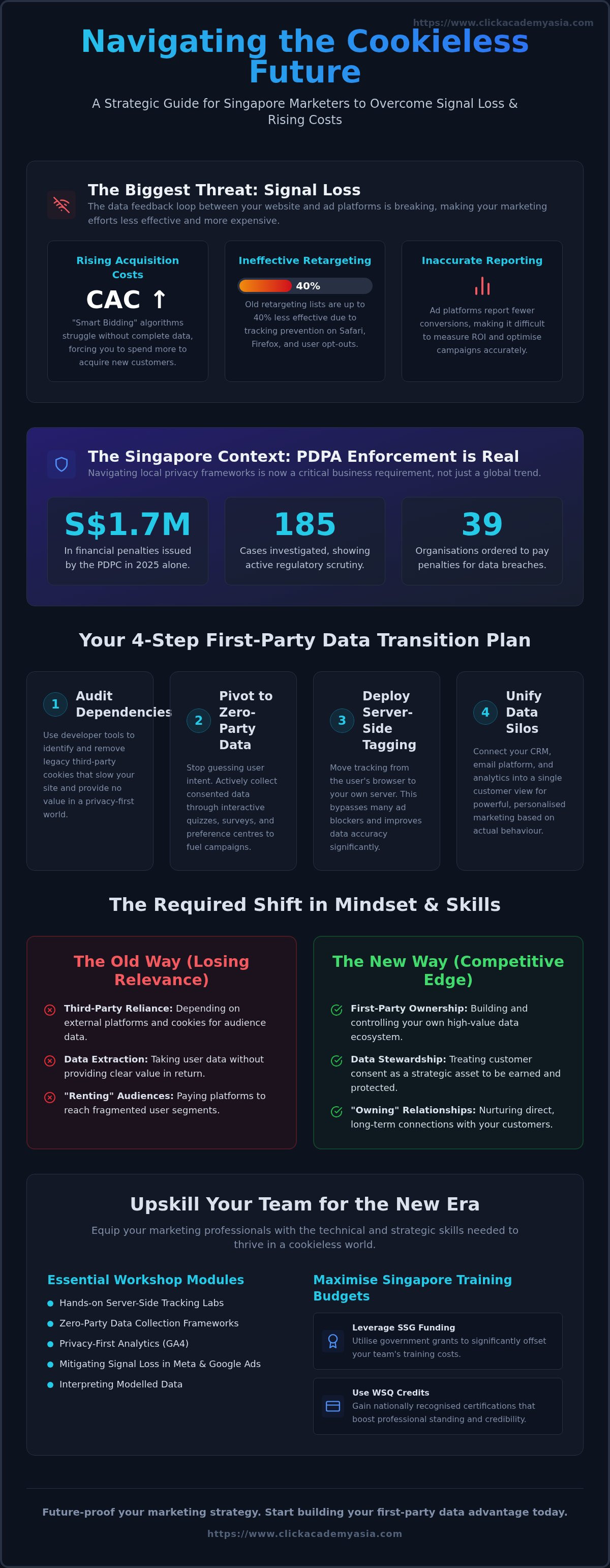
By August 2026, the digital landscape in Singapore has reached a critical tipping point. While Google Chrome hasn't enforced a total blackout, the combination of user-choice prompts and existing blocks on Safari and Firefox has made "signal loss" the primary threat to your marketing ROI. Understanding what third-party cookies are is crucial to realising that your old retargeting lists are likely 40% less effective than they were just a few years ago. This isn't a future problem; it's a present reality affecting every PMEB managing a digital budget.
To better understand how this shift affects your business-to-business efforts and overall strategy, watch this analysis:
Signal loss occurs when the data feedback loop between your website and platforms like Meta or Google is broken. You've likely noticed your ad platforms reporting fewer conversions or your "Smart Bidding" algorithms struggling to find the right audience. When you can't track a user from their first click to their final purchase, your acquisition costs skyrocket because you're essentially flying blind. This fragmentation makes the customer journey look like a series of unrelated events rather than a cohesive path to conversion.
The Paradigm Shift in APAC Data Privacy
Regional regulatory pressure has intensified significantly. In 2025, Singapore's PDPC investigated 185 cases and issued 58 decisions, with 39 organisations ordered to pay a combined S$1.7 million in financial penalties. It's no longer just about following global trends like GDPR; it's about navigating local frameworks like the PDPA. Traditional retargeting methods are failing because users are increasingly opting for privacy-first browser settings, forcing a complete redesign of how we reach potential customers in the APAC region.
The Capability Gap in Modern Marketing Teams
Most marketing teams in Singapore are still operating with a "data extraction" mindset. PMEBs must shift towards "data stewardship," where customer consent is treated as a strategic asset rather than a technical nuisance. This transition requires a new level of statistical literacy to interpret the modelled data provided by GA4. If you aren't already preparing for a cookieless world marketing workshop, your team is likely falling behind. Investing in WSQ-certified training ensures your leaders move from "renting" audiences on social platforms to "owning" high-value customer relationships through first-party data strategies.
First-Party Data Transition: Guide for Marketing Leaders
If you're currently preparing for a cookieless world marketing workshop, you already know that transitioning to a privacy-first model is about reclaiming your competitive edge. While the industry adjusts to Google's shifting timelines, leading Singaporean brands are already building their own data ecosystems. This journey starts with a systematic approach to data ownership that moves beyond the limitations of third-party tracking.
Step 1: Audit your dependencies. Use developer tools to identify every third-party cookie firing on your site. Many legacy tags are still draining your site speed while providing zero actionable data in a 2026 environment.
Step 2: Pivot to Zero-Party collection. Instead of guessing user intent, ask for it through interactive experiences. This provides clean, consented data that fuels high-performance campaigns.
Step 3: Deploy server-side tagging. Reclaim lost conversion data by moving your tracking from the user's browser to your own server. This bypasses many browser-level blocks and significantly improves data accuracy.
Step 4: Unify your data silos. Connect your CRM, email marketing platform, and website analytics to create a singular customer view. This allows you to personalise marketing based on actual purchase history rather than inferred browsing habits.
Step 5: Optimise your analytics. Master privacy-preserving measurement through Google Analytics (GA4) Training. This ensures you're using modelled data correctly to fill the gaps left by non-consenting users.
Mastering Zero-Party Data Strategy
Interactive content like quizzes, polls, and preference centres allows you to gain deep insights directly from your customers. The key is a fair value exchange; offer a personalised report, exclusive access, or a discount in return for their preferences. Zero-party data is the gold standard for 2026 because it is data that a customer intentionally and proactively shares with a brand. This approach builds long-term trust while providing the high-intent signals that Meta and Google Ads algorithms now lack.
Building the Architecture of Consent
Your consent banner shouldn't be a legal hurdle but a seamless part of your user experience. Optimise your banners for higher opt-in rates by using clear, brand-consistent language that explains the actual benefit of personalised content. Ensure your tech stack communicates seamlessly with your consent management platform (CMP) to prevent data leakage and ensure compliance with Singapore's PDPA. If you find these technical shifts daunting, attending a preparing for a cookieless world marketing workshop can provide the hands-on roadmap your team needs to stay ahead of the curve.
Evaluating the Best Preparing for a Cookieless World Marketing Workshop: Key Modules
Selecting the right professional development path requires more than just a cursory glance at a syllabus. A high-quality preparing for a cookieless world marketing workshop must bridge the gap between complex technical implementation and high-level business strategy. In Singapore's competitive landscape, PMEBs need actionable frameworks that go beyond theoretical slides to provide real-world utility. You should look for a curriculum that balances the "how" of technical setup with the "why" of strategic data ownership.
When evaluating potential programmes, ensure they meet these four critical criteria:
Practical Labs: The workshop should include hands-on sessions for Google Tag Manager (GTM) and server-side tagging. Theoretical knowledge won't help when you're facing a broken conversion API.
Regional Expertise: Instructors must be active practitioners within the APAC region. Understanding the nuances of local consumer behaviour and PDPA regulations is vital for any Singapore-based lead.
Recognised Certification: Ensure the programme is WSQ-certified. This guarantees a standard of excellence and allows you to leverage SSG funding to offset costs.
Integrated Curriculum: A siloed approach is no longer effective. Your training should connect SEO, SEM, and analytics into a unified privacy-first strategy.
Technical SEO and Privacy-Preserving Measurement
As paid tracking signals degrade, organic search becomes your most reliable channel for consistent growth. A top-tier workshop will integrate WSQ Search Engine Optimization (SEO) to help you build long-term organic resilience. You'll also need to explore Media Mix Modelling (MMM) as a sophisticated alternative to traditional attribution. Mastering WSQ Search Engine Marketing (SEM) in this environment means learning to use modelled data to fill the gaps left by non-consenting users without losing sight of your target ROI.
Strategic Planning and Leadership for PMEBs
For marketing leaders, the primary challenge is organisational transformation rather than just technical troubleshooting. You must develop a robust roadmap that guides your technical teams through cookieless requirements while maintaining brand trust. Effective training teaches you how to brief these teams accurately and communicate the long-term ROI of a first-party data strategy to stakeholders. By focusing on WSQ Digital Marketing Strategy & Planning, you position yourself as a strategic advisor capable of navigating technical complexity to deliver tangible business results.
Maximising SSG Funding and WSQ Credits for Your Marketing Team’s Upskilling
Technical shifts in the digital ecosystem shouldn't be a financial burden for Singaporean businesses. When preparing for a cookieless world marketing workshop, the cost of high-level training is significantly mitigated by the robust support of SkillsFuture Singapore (SSG). For HR decision-makers, the Workforce Skills Qualifications (WSQ) framework offers a reliable benchmark, ensuring that every training hour aligns with national industry standards. This makes certified programmes a much safer bet for corporate development compared to unverified online tutorials.
The financial incentives for upskilling in Singapore are substantial. Currently, Singapore Citizens and Permanent Residents can receive subsidies of up to 70% for WSQ-certified courses. For Singapore Citizens aged 40 and above, the Mid-Career Enhanced Subsidy can cover up to 90% of the course fees. Additionally, qualifying employers can utilise the one-time S$10,000 SkillsFuture Enterprise Credit (SFEC) to offset out-of-pocket expenses for workforce development. Individual PMEBs should also check their SkillsFuture Credit balance via the MySkillsFuture portal to see how much they can contribute towards their own professional advancement.
Navigating the SSG Application Process
Applying for training grants as an employer is a straightforward digital process through the Enterprise Portal for Jobs & Skills. You must first ensure your chosen preparing for a cookieless world marketing workshop is an SSG-approved course to qualify for funding. Once verified, you can submit your application before the course starts to secure the relevant subsidies. Investing in certified upskilling creates a "Trust Dividend" where both employees and external stakeholders gain confidence in your organisation’s data governance capabilities.
ROI of Continuous Learning for Singaporean Businesses
Developing internal expertise is far more cost-effective than relying on expensive external consultancies for every technical update. When your team understands how to manage server-side tagging and first-party data audits, you reduce long-term operational costs. Professional development pathways also act as a powerful retention tool, as PMEBs are more likely to stay with organisations that invest in their career progression. Workforce Singapore (WSG) continues to support this journey by providing resources that help professionals transition into high-growth digital roles. You can start future-proofing your department today by exploring WSQ Digital Marketing courses that focus on practical, privacy-first strategies.
Future-Proof Your Brand with ClickAcademy Asia’s WSQ-Certified Training
ClickAcademy Asia stands as the premier destination for Singaporean marketing leaders seeking to bridge the gap between digital theory and operational excellence. With over 3,000 5-star Google Reviews, our reputation is built on delivering high-impact, practical training that PMEBs can apply the very next day. Attending a preparing for a cookieless world marketing workshop with us means you aren't just listening to lectures; you're engaging in hands-on labs that simulate real-world data challenges. We seamlessly integrate official Google certifications with the local WSQ framework, providing a dual-layered credential that is respected both globally and regionally.
Our training environment thrives on a mentor-led approach. You'll gain access to an elite network of APAC practitioners and mentors who have navigated the same signal loss challenges you face. This community provides a vital support system for continuous learning, ensuring you stay at the forefront of the 2026 data economy. By grounding our curriculum in practical mastery rather than abstract concepts, we ensure your professional growth is tangible and immediate.
Equip Your Team for the 2026 Data Economy
We provide customised corporate bootcamps specifically designed to address the unique industry challenges your organisation faces. Whether you're in finance, retail, or B2B services, our role-specific training modules close the capability gap by empowering your staff with technical precision and strategic foresight. Booking a consultation for your team is the first step toward building a resilient, data-literate workforce that doesn't rely on third-party tracking. Our instructors help you map out a bespoke learning journey that aligns with your corporate KPIs and maximises your available training grants.
Join the Next Preparing for a Cookieless World Marketing Workshop
Secure your spot in our upcoming intake to ensure your brand remains competitive in an increasingly private digital space. Enrollment is open for Singaporean professionals looking to master the three pillars of modern data strategy: Audit, Upskill, and Optimise. You'll leave with a clear roadmap for auditing your current dependencies, upskilling your team on server-side tagging, and optimising your GA4 measurement for maximum accuracy. Don't wait for your ad performance to degrade further before taking action. Enrol in ClickAcademy Asia’s WSQ-certified marketing programmes today and lead your organisation into the post-cookie era with confidence.
Lead the Privacy-First Revolution in Singapore
The 2026 digital landscape doesn't reward those who wait for a perfect solution; it rewards those who own their customer data. You've seen how signal loss erodes ad performance and how PDPA regulations make compliance a non-negotiable board-level priority. By shifting from third-party reliance to a robust first-party data strategy, you transform a technical hurdle into a long-term competitive advantage for your Singaporean brand.
Taking the next step by preparing for a cookieless world marketing workshop ensures your team possesses the technical precision and strategic foresight required to thrive. With WSQ-certified and SSG-funded programmes, you can access elite training that is both high-impact and cost-effective. As an official Google Certification Partner, ClickAcademy Asia provides expert trainers with real-world APAC experience to guide your professional journey.
Now is the time to bridge the capability gap and future-proof your career. Upskill your team with ClickAcademy Asia’s WSQ-certified marketing workshops and secure your place at the forefront of the privacy-first era. You have the tools; let's build your roadmap together.
Frequently Asked Questions
What is the "cookieless future" and why is it critical for Singaporean businesses in 2026?
The cookieless future refers to the industry shift away from third-party tracking towards privacy-centric browsing. In 2026, it's critical because PDPA enforcement has intensified significantly. Singaporean firms must adapt to maintain targeting accuracy without violating strict data privacy laws, especially as the PDPC continues to increase scrutiny on how personal data is processed for marketing purposes.
How does third-party cookie deprecation affect my Google Ads and Meta campaigns?
Deprecation causes "signal loss," which breaks the link between ad clicks and website conversions. Your "Smart Bidding" algorithms lose the granular data they need to optimise effectively, leading to higher acquisition costs and smaller retargeting pools. Campaigns become less efficient as the feedback loop from the user's browser is severed, making your ad spend less predictable.
Can I use SkillsFuture credits for a cookieless marketing workshop?
Yes, Singapore Citizens can use their SkillsFuture Credits to offset out-of-pocket fees for WSQ-certified programmes. While the 2020 top-up expired in December 2025, your base credits remain available for use. This makes preparing for a cookieless world marketing workshop highly accessible for individual PMEBs looking to upskill without a heavy financial burden.
What is the difference between first-party and zero-party data?
First-party data is information you collect from user interactions on your own platforms, such as purchase history or website behaviour. Zero-party data is even more valuable; it's data a customer intentionally and proactively shares with you, often through quizzes or preference centres. Both are essential for building a resilient marketing strategy that doesn't rely on external tracking signals.
How much SSG funding is available for corporate digital marketing training?
Eligible Singapore Citizens and PRs can receive up to 70% subsidies for WSQ-certified programmes. For those aged 40 and above, the Mid-Career Enhanced Subsidy provides up to 90% funding. Qualifying companies can also apply the S$10,000 SkillsFuture Enterprise Credit (SFEC) to further reduce training costs for their teams, making high-level upskilling very affordable for local SMEs.
Is server-side tagging necessary for my business to track conversions?
It's becoming a technical necessity for any brand spending significantly on digital advertising. Server-side tagging moves tracking from the user's browser to your own server, bypassing browser-level blocks and improving data security. This reclamation of lost data is a core focus when preparing for a cookieless world marketing workshop, as it restores the accuracy of your conversion reporting.
What are the key modules I should look for in a marketing analytics course?
Look for modules that cover GA4 server-side setup, Media Mix Modelling (MMM), and PDPA compliance frameworks. A strong course should also include hands-on labs for Google Tag Manager and first-party data auditing. These technical skills allow PMEBs to move from basic reporting to advanced, privacy-first strategic measurement that survives the loss of traditional cookies.
How do I start building a first-party data strategy without a large IT team?
Start by auditing your existing website forms and CRM to ensure you're capturing consented data correctly. Use low-code tools for interactive content like polls or quizzes to gather zero-party insights directly from your audience. Focus on high-impact quick wins, such as optimising your email sign-up value exchange, before moving to more complex technical implementations like server-side tagging.


Comments