
Content Localization for Diverse Asian Audiences: A Singapore Professional’s Guide to APAC Scaling
- ClickAcademy Asia

- 4 days ago
- 11 min read
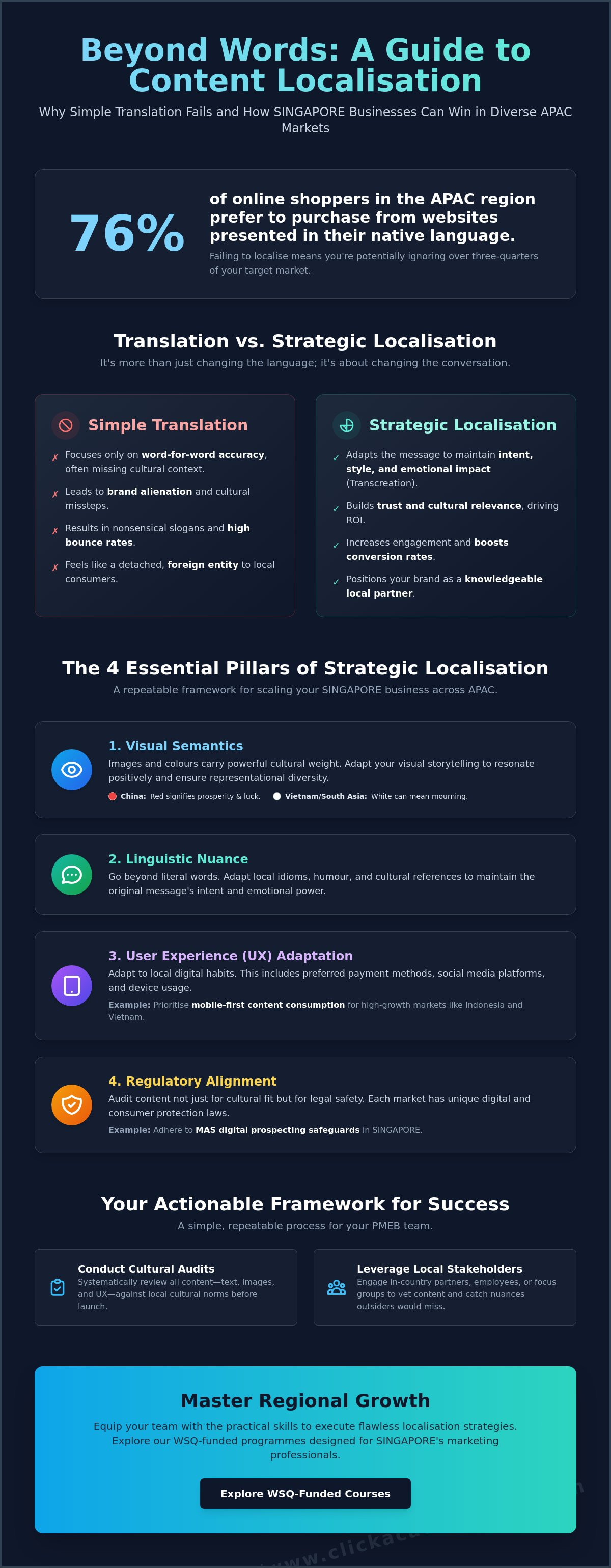
Did you know that 76% of online shoppers in the region prefer to purchase from websites in their native language? For many Singaporean PMEBs, the challenge of content localization for diverse asian audiences isn't just about language; it's about avoiding the cultural faux pas that can instantly damage a brand's reputation. You've likely noticed that even perfectly translated copy can suffer from high bounce rates if it doesn't align with local values and digital habits.
We understand the frustration of seeing regional campaigns stall despite your team's best efforts. This guide provides the strategic framework you need to bridge the gap between global standards and local expectations, turning localisation into your primary competitive advantage. We'll examine essential transcreation techniques, discuss how to utilise SSG funding for team training, and outline a repeatable workflow to drive conversion across the APAC region.
Key Takeaways
Distinguish between literal translation and the holistic adaptation required for content localization for diverse asian audiences to prevent brand alienation.
Identify critical visual and linguistic pillars, including colour palettes and local idioms, that resonate with specific regional sensitivities.
Gain actionable insights into high-growth markets like Indonesia and Vietnam, focusing on religious sensitivities and mobile-first content consumption.
Establish a repeatable strategic framework for your SINGAPORE business by conducting cultural audits and leveraging local stakeholders for vetting.
Learn how to upskill your marketing teams through WSQ-funded programmes to ensure your regional scaling efforts are grounded in practical mastery.
Table of Contents
Why Content Localization for Diverse Asian Audiences Trumps Simple Translation
Essential Pillars of Strategic Localisation in the APAC Region
Navigating Cultural Sensitivities Across Diverse Asian Markets
Implementing a Localisation Strategy Within Singaporean Business Frameworks
Master Regional Growth with WSQ-Funded Content Marketing Training
Why Content Localization for Diverse Asian Audiences Trumps Simple Translation
Many regional expansion plans fail because they treat language as a technical barrier rather than a strategic opportunity. Simply swapping English text for Bahasa Indonesia or Vietnamese often results in brand alienation. True content localization for diverse asian audiences requires a holistic approach that adapts messaging, imagery, and even core brand values to fit local contexts. It's the difference between being a guest who speaks the language and a guest who understands the house rules.
SINGAPORE holds a unique position as a regional hub for content strategy. Our multicultural background gives local PMEBs a distinct advantage in understanding the complexities of the APAC landscape. However, the cost of cultural blindness is high. In high-stakes markets like India or Indonesia, failing to account for religious sensitivities or social hierarchies can lead to immediate reputational damage and wasted marketing spend. Strategic localisation ensures your brand feels like a local partner rather than a detached foreign entity.
To better understand the depth of this process, watch this helpful video:
The Distinction Between Translating and Transcreating
Effective Language localisation involves a process called transcreation. While translation focuses on word-for-word accuracy, transcreation adapts a message to maintain its original intent, style, and emotional impact. A classic example is the marketing slogan that sounds inspiring in English but becomes nonsensical or offensive when translated literally. For SINGAPOREAN professionals, mastering transcreation is a critical skill. It allows you to preserve brand consistency while ensuring your call to action feels natural to a Thai or Filipino consumer. This level of nuance is exactly what we explore in our [Internal Link: ClickAcademy Asia Sales/Marketing courses].
Driving ROI Through Cultural Relevance
Investing in content localization for diverse asian audiences is a direct driver of ROI. When users feel a brand truly understands their lifestyle, trust increases and conversion rates follow. Research shows that 76% of online shoppers prefer to buy from websites in their native language [External Link: local statistic/industry study]. This cultural relevance significantly reduces customer acquisition costs (CAC) because your messaging cuts through the noise more effectively. By moving beyond simple translation, you build a foundation for sustainable growth in the fastest-growing region in the world.
Essential Pillars of Strategic Localisation in the APAC Region
Mastering content localization for diverse asian audiences requires moving beyond the text on a screen to address the psychological and cultural foundations of communication. Successful regional scaling from SINGAPORE depends on four essential pillars: visual semantics, linguistic nuance, user experience (UX) adaptation, and regulatory alignment. Each pillar serves as a bridge, ensuring your brand message doesn't just arrive in a new market but actually belongs there.
Regulatory compliance is a critical but often overlooked pillar. As of 2026, the Monetary Authority of SINGAPORE (MAS) has introduced stricter digital prospecting safeguards to protect consumers from misleading tactics. Similar shifts are happening elsewhere; the Philippines' Securities and Exchange Commission (SEC) recently implemented enhanced beneficial ownership disclosure rules. Content must be audited not only for cultural fit but for legal safety to avoid costly penalties.
Visual Storytelling for Diverse Markets
Images carry immense symbolic weight that varies wildly across APAC. While red signifies prosperity and luck in China, white is traditionally associated with mourning in parts of South Asia and Vietnam. A marketing campaign featuring the wrong palette can unintentionally trigger negative emotions. It's also vital to ensure representational diversity in your lifestyle photography; consumers in Jakarta or Manila want to see themselves reflected in your brand story.
Actionable Win: Conduct a visual audit of your current image library to ensure regional inclusivity and cultural accuracy.
Symbolic Check: Verify that icons and hand gestures used in your creatives don't carry offensive meanings in target territories.
Adapting Tone and Voice for Local Context
Communication styles in APAC often lean towards 'high-context', where the relationship and the setting are as important as the words spoken. This contrasts with the 'low-context', direct approach common in Western markets. Maintaining your brand's core authority while adopting a local persona requires a delicate balance. You must understand local humour and social cues to avoid sounding like an automated bot or, worse, an arrogant outsider.
Capturing these nuances is a sophisticated skill that requires practical training. If you're looking to refine your team's approach, you might want to explore our content marketing strategy modules to bridge these cultural gaps. Digital platforms in China, like WeChat and Douyin, demand a completely different engagement rhythm compared to LinkedIn in SINGAPORE. Adapting your tone ensures your brand remains agile and results-driven across every border.
Navigating Cultural Sensitivities Across Diverse Asian Markets
Scaling a brand from SINGAPORE requires more than a regional headquarters; it demands an intimate understanding of the cultural nuances that define each border. Success in content localization for diverse asian audiences hinges on your ability to pivot between the religious sensitivities of Indonesia and the high-energy, video-driven landscape of Vietnam. Each market possesses its own "house rules" that dictate how content is received and shared.
In Indonesia, navigating the world's largest archipelago means respecting deep-seated social observances. During Ramadan, for instance, marketing should shift towards community and reflection rather than aggressive sales. Conversely, Vietnam has seen a massive rise in mobile-first consumption. With over 98% of users accessing the internet via mobile devices, your content must be lightweight and visually striking to capture attention in a crowded digital space.
Thailand offers a different challenge. The power of emotional storytelling and unique "Thai-style" humour often outperforms traditional corporate messaging. Meanwhile, India presents a linguistic puzzle with dozens of official languages and distinct state cultures. A one-size-fits-all approach here is a recipe for failure. You must treat India not as a single country, but as a continent of diverse preferences.
The Importance of Local Religious and Social Observances
Aligning your marketing calendar with regional festivals like Lunar New Year, Ramadan, or Diwali is a quick win for engagement. However, it's not just about the dates. It's about understanding the psychological shift in consumer behaviour during these periods. Misstepping during sensitive times can lead to unintentional offence and lasting brand damage. We deep-dive into these cultural triggers in our [Internal Link: ClickAcademy Asia sales/marketing courses], helping you master the buyer psychology of each territory.
Mobile-First and Social-First Localisation
Localisation must also account for dominant local platforms. While SINGAPOREAN PMEBs are comfortable with LinkedIn and Instagram, your strategy in Vietnam should prioritise Zalo, and in Thailand, Line is essential. Content delivery must be optimised for local internet speeds and device types to ensure a seamless user experience. Video content, in particular, should be designed for sound-off environments in urban APAC hubs, as many users consume content during their daily commutes.
Data shows that the average SMS click-through rate in APAC is 32.4%, which is significantly higher than the global average [External Link: local statistic/industry study]. This highlights the importance of direct, mobile-first communication channels. By tailoring your delivery format to the specific digital habits of each market, you ensure your localisation efforts drive tangible regional growth.
Implementing a Localisation Strategy Within Singaporean Business Frameworks
Transitioning from a SINGAPORE-centric operation to a regional powerhouse requires a structured execution plan. You can't simply "wing it" when managing content localization for diverse asian audiences. Success depends on moving from ad-hoc translations to a repeatable strategic framework that integrates with your existing business processes. This ensures consistency while allowing for the necessary regional flexibility that drives conversion.
A successful implementation follows four strategic steps:
Step 1: Conduct a cultural audit. Review your current SINGAPORE-centric assets to identify idioms, visual cues, or references that won't translate well in other APAC markets.
Step 2: Identify local champions. Recruit regional stakeholders or partners who can provide ground-level vetting for your localized content before it goes live.
Step 3: Build in-house competency. Leverage WSQ-certified training to ensure your marketing team understands the technical and cultural nuances of regional scaling.
Step 4: Establish a feedback loop. Use analytics to track regional engagement and adjust your messaging based on what actually resonates with local consumers.
Building an In-House Localisation Team
To scale effectively, your team needs a specific mix of skills. You'll require Content Strategists who can design "Global-Ready Content", Cultural Consultants for nuance, and Multilingual SEO Specialists. Integrating localisation into the initial creation process saves time and prevents expensive re-works. To measure the success of these regional efforts, it's essential to master GA4 training to track specific regional performance metrics and user journeys.
Leveraging SSG Funding for Professional Development
Upskilling your workforce is highly accessible through SINGAPORE'S robust support ecosystem. As of June 2026, SSG subsidies remain a vital resource for companies looking to future-proof their teams. SINGAPORE Citizens and PRs can access up to 70% funding for WSQ-accredited programmes, while SMEs can benefit from up to 90% support. These frameworks provide a standardised approach to content strategy, making it easier for HR leaders to prioritise regional marketing competencies.
By utilising these subsidies, you can enrol your team in WSQ Content Marketing Strategy tracks to bridge the skills gap. This investment ensures your staff isn't just translating words but is strategically adapting your brand for the entire APAC region. Practical mastery of these frameworks turns localisation from a logistical hurdle into a core competitive advantage.
Master Regional Growth with WSQ-Funded Content Marketing Training
Localisation isn't a luxury; it's the strategic engine for regional growth. By 2026, the APAC region is projected to hold a 25.3% share of the global localisation market, making it the fastest-growing territory worldwide. For SINGAPOREAN businesses, success requires a shift from passive translation to active transcreation. This transition is only possible when your team possesses the practical skills to navigate complex cultural landscapes without losing brand integrity.
Continuous learning is the definitive competitive edge for modern PMEBs. While AI tools can assist in the process, human oversight remains vital for context, humour, and cultural nuance. ClickAcademy Asia bridges this gap by offering programmes grounded in real-world application rather than abstract theory. Our workshops empower you to lead regional expansion with the confidence of a supportive mentor invested in your tangible career growth.
Actionable Takeaways for Immediate Implementation
Update your brand style guide to include specific regional variations for colour symbolism, iconography, and tone of voice.
Pilot one localised campaign in a high-potential APAC market like Vietnam or Indonesia to test your cultural assumptions before a full-scale rollout.
Assess your team's current skills against the WSQ Content Marketing framework to identify critical knowledge gaps in regional strategy.
Equip Your Team for the APAC Century
We are committed to helping SINGAPOREAN businesses thrive in a globalised economy through expert-led workshops and certifying partnerships with major global platforms. Our curriculum is designed to provide tangible results and regional leadership. By leveraging SSG funding, you can significantly reduce the cost of upskilling while ensuring your team meets the highest industry standards.
Don't let cultural barriers limit your brand's potential in the region's most exciting markets. It's time to master content localization for diverse asian audiences and drive sustainable growth from your base in SINGAPORE. Explore our WSQ-funded courses today to equip your team with the cutting-edge skills needed for the APAC century.
Future-Proof Your Regional Strategy from SINGAPORE
Mastering content localization for diverse asian audiences is no longer just a marketing task; it's a core business competency for any PMEB in SINGAPORE looking to scale. We've seen how moving beyond simple translation to embrace transcreation and mobile-first UX can significantly reduce bounce rates and build regional trust. By implementing a structured cultural audit and leveraging local champions, you ensure your brand resonates across the vast diversity of the APAC landscape.
Practical mastery of these frameworks is within reach through our WSQ-certified training programmes. With SSG funding available for eligible individuals in SINGAPORE, upskilling your team in regional strategy is both accessible and impactful. We've already supported professionals from over 30 countries in achieving their growth objectives. Equip your team with regional marketing expertise by exploring our WSQ-funded content strategy tracks. You have the strategic roadmap to succeed; now take the decisive step to turn that regional potential into tangible business results.
Frequently Asked Questions
What is the difference between translation and content localisation?
Translation is the process of converting text from one language to another with linguistic accuracy. Localisation is a holistic strategy that adapts messaging, visual semantics, and cultural values to fit a specific market. It ensures your brand feels like a local entity by adjusting everything from colour palettes to social cues, rather than just swapping words.
Why is content localisation for diverse Asian audiences important for Singaporean businesses?
SINGAPORE serves as a regional gateway, but success in the content localization for diverse asian audiences is what drives actual conversion. Research indicates that 76% of regional shoppers prefer buying in their native language. Without localisation, you risk high bounce rates and brand alienation in high-growth markets like Indonesia, Vietnam, and Thailand.
Can I use AI tools for my APAC content localisation strategy?
You can utilise AI for "orchestration" to handle initial drafts and data analysis, but human oversight remains mandatory. AI often misses the subtle cultural nuances, humour, and religious sensitivities essential for the APAC region. A hybrid approach ensures efficiency while maintaining the high-context communication styles required to build trust with local consumers.
How do I measure the ROI of my localisation efforts?
ROI is measured by tracking regional-specific metrics such as conversion rates, bounce rates, and Customer Acquisition Cost (CAC). Compare the performance of localised campaigns against your baseline SINGAPORE assets. When content is culturally relevant, engagement typically increases, leading to a significant reduction in CAC over the long term as brand trust grows.
Are there government subsidies in Singapore for marketing localisation training?
Yes, SINGAPOREAN PMEBs can access substantial support through SSG funding for WSQ-accredited programmes. Eligible individuals and companies can receive between 70% and 90% subsidies for courses like WSQ Content Marketing Strategy. These frameworks are designed to help local professionals master the complexities of regional scaling while keeping training costs highly manageable.
What are the most common mistakes in regional content localisation?
The most frequent errors include literal translation of slogans and "cultural blindness" regarding local observances. Forgetting to align marketing calendars with events like Ramadan or Diwali can lead to missed opportunities or unintentional offence. Additionally, using non-representative imagery or ignoring local digital platforms like Zalo or Line often results in poor campaign engagement.
How do I maintain brand consistency across multiple Asian markets?
Maintain consistency by establishing a "Global-Ready" brand style guide that defines non-negotiable core values while allowing for regional modules. Use transcreation to adapt the delivery of your message without changing its original intent. Appointing local champions to vet content ensures that your brand voice remains stable while feeling authentic to each specific territory.
Which APAC markets should I prioritise for localisation first?
Prioritise markets based on your product-market fit and digital adoption rates. Vietnam is an excellent choice for mobile-first, video-driven content, while Indonesia offers massive scale for businesses that can navigate its religious and social sensitivities. Start with one high-potential market to pilot your strategy before scaling across the diverse digital ecosystems of the wider region.


Comments