
Connecting Marketing KPIs to Company Valuation: A Strategic Guide for SINGAPORE Leaders in 2026

What if your marketing budget wasn't viewed as a line item to be trimmed, but as a strategic lever that increases the total sale price of your business? Many leaders in SINGAPORE face constant pressure to justify spend, often finding it difficult to translate digital campaign data into the financial language the board demands. If you've felt that marketing is unfairly treated as a cost centre, you aren't alone in this struggle. By connecting marketing kpis to company valuation, you can shift the conversation from short-term ROI to long-term corporate worth in a volatile 2026 market.
This guide provides a clear framework to bridge the gap between marketing performance and financial value, helping you gain more influence within the C-suite. You'll learn how to align brand equity and customer lifetime value with the International Valuation Standards (IVS) recognised by ACRA. We'll explore the specific metrics that drive valuation multiples and show you how to present this data to secure a higher valuation for your next investment round or exit.
Table of Contents
The Strategic Shift: Why SINGAPORE Leaders Must Connect Marketing KPIs to Company Valuation
Beyond Vanity Metrics: Identifying the KPIs that Influence Corporate Valuation
The Valuation Bridge: Mapping Marketing Performance to Financial Multiples
Upskilling for Strategic Impact: The WSQ Pathway to Marketing Leadership
The Strategic Shift: Why SINGAPORE Leaders Must Connect Marketing KPIs to Company Valuation
Business leaders in SINGAPORE are facing a significant reckoning. The board no longer accepts simple return on ad spend (ROAS) or click-through rates as the final measure of success. In 2026, the focus has shifted decisively toward how marketing activity impacts the long-term balance sheet. A well-defined Key Performance Indicator (KPI) should do more than track a single campaign; it must signal the financial health and future potential of the entire enterprise.
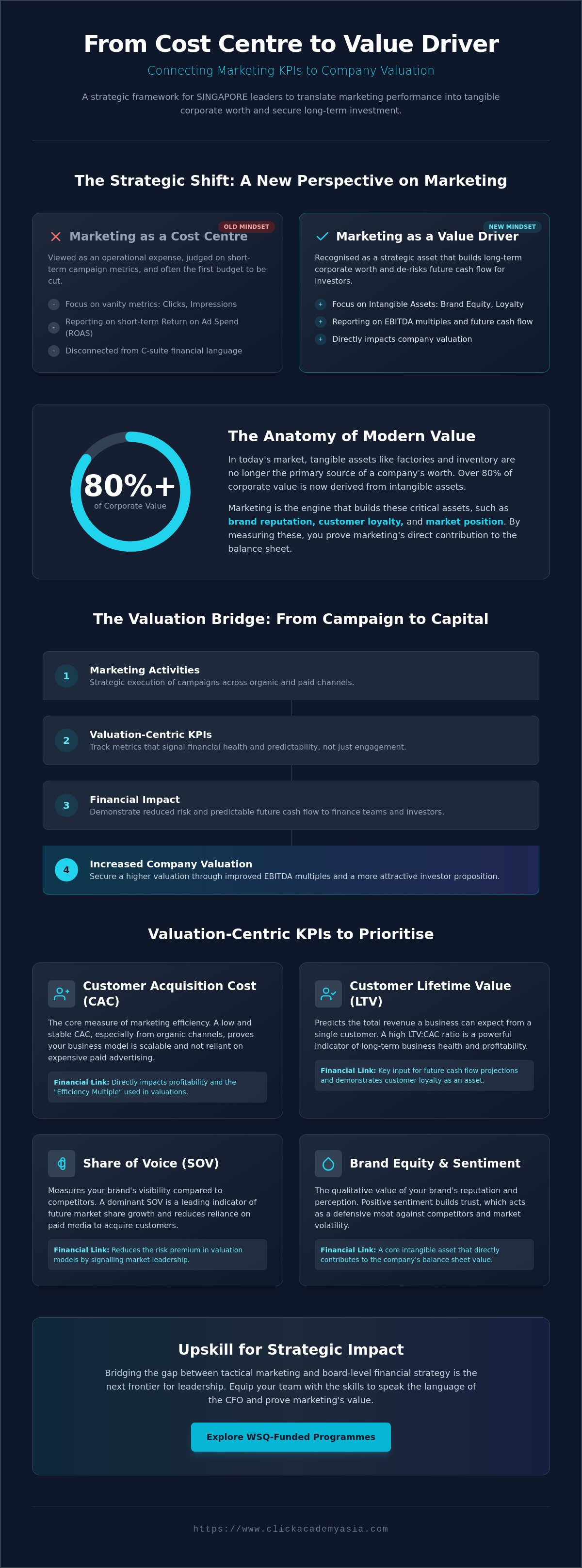
Investors across the APAC region are increasing their scrutiny of marketing efficiency due to ongoing market volatility. They aren't just looking for quick wins; they want to see how brand investments build "Intangible Assets." These assets, which include brand reputation and customer loyalty, now account for over 80% of corporate value globally [External Link: Ocean Tomo Intangible Asset Market Value Study]. By connecting marketing kpis to company valuation, you prove that your department is a high-yield growth engine rather than a drain on resources.
To better understand the relationship between metrics and business outcomes, watch this helpful video:
From Cost Centre to Value Driver
Historically, financial audits have struggled to quantify the value of a loyal customer base. This often leads to marketing being undervalued or, worse, being the first budget cut during a downturn. For a PMEB, the challenge is psychological as much as it is technical. You must bridge the communication gap by speaking the language of the CFO. This means translating engagement metrics into risk reduction and cash flow predictability. This shift is particularly vital for SINGAPORE startups aiming for Series B+ funding, where investors demand proof of a scalable, value-driven system that survives beyond the next quarter.
The 2026 Valuation Landscape
AI and real-time data transparency have stripped away the "black box" of marketing. Every dollar spent is now visible to investors, which raises the stakes for maintaining high Brand Equity. In a fragmented digital ecosystem, a recognisable and trusted brand acts as a defensive moat. The WSQ Digital Marketing Strategy & Planning framework at ClickAcademy Asia specifically addresses this evolution. It prioritises financial alignment and strategic foresight over mere tactical execution. This approach ensures your strategy is built for the 2026 valuation landscape, where connecting marketing kpis to company valuation is the only way to secure long-term corporate influence.
Beyond Vanity Metrics: Identifying the KPIs that Influence Corporate Valuation
While clicks and impressions populate spreadsheets, they rarely move the needle during a board review in SINGAPORE. To truly master the art of connecting marketing kpis to company valuation, you must distinguish between operational fluff and the essential marketing KPIs that impact your firm's market cap. Valuation-centric metrics provide a window into the future cash flow of the business, making them indispensable for any PMEB aiming for a leadership role.
Customer Acquisition Cost (CAC) acts as the primary driver for your "Efficiency Multiple." In 2026, the average CAC for B2B SaaS companies sits at $702, and investors look for teams that can lower this through organic Brand Sentiment and Share of Voice (SOV). A high SOV relative to your market share is a strong predictor of future growth, as it suggests your brand is "top of mind" without requiring massive paid injections. Focus on these core pillars to prove efficiency:
CAC Efficiency: Lowering acquisition costs through established organic channels.
SOV Dominance: Outpacing competitors in digital presence to capture future demand.
Brand Sentiment: Building a moat of trust that justifies premium pricing and higher margins.
The "Golden Ratio" of Valuation
The LTV:CAC ratio is the most scrutinised metric in a valuation audit. A healthy 3:1 benchmark proves that for every dollar spent, three dollars are generated in lifetime value. Optimising your payback period, ideally to under 12 months, improves corporate liquidity and reduces the need for external capital. In the eyes of an investor, Customer Lifetime Value (CLV) represents the present value of all future profits from a customer relationship, providing a predictable revenue floor for the enterprise.
Retention and Churn: The Valuation Silent Killers
Churn is the quickest way to erode a company's multiple. Research shows that increasing retention by just 5% can boost profit and valuation by 25% to 95%. A healthy annual churn rate for sustainable models should stay under 5% to maintain a stable valuation. By monitoring your Net Promoter Score (NPS), you treat customer loyalty as a leading indicator of reduced financial risk. High NPS scores correlate with lower price sensitivity, allowing you to maintain margins even in a volatile APAC market.
Mastering these data points requires more than just access to a dashboard. Using WSQ Marketing Analytics & Insights allows you to predict churn before it ever hits the balance sheet. This proactive approach transforms marketing data into a defensive asset. It ensures that your strategy focuses on high-value retention rather than just a constant, expensive hunt for new leads, ultimately securing your seat at the boardroom table.
The Valuation Bridge: Mapping Marketing Performance to Financial Multiples
Revenue is often a vanity metric if it lacks predictability. For SINGAPORE leaders, the real goal is connecting marketing kpis to company valuation by proving that your growth is a systematic result rather than a series of lucky breaks. When you demonstrate a consistent flow of high-quality leads and a low churn rate, you directly reduce the "Risk Premium" in Discounted Cash Flow (DCF) models. Investors are always willing to pay a higher premium for certainty than they are for raw, volatile numbers.
Mapping Customer Equity to the balance sheet allows you to treat your customer database as a quantifiable asset. In 2026, savvy APAC investors look past the profit and loss statement to evaluate the strength of your "Brand Moats." A strategic marketing pivot recently helped a SINGAPORE-based logistics firm increase its exit multiple from 4x to 8x EBITDA. They achieved this by proving that 65% of their new business was driven by organic, high-intent SEO traffic, which significantly lowered their long-term risk profile.
Marketing and the Cost of Capital
Established market leadership does more than just drive sales; it lowers your cost of capital. Lenders and financial institutions view prominent, well-regarded brands as lower-risk borrowers, which often results in more favourable interest rates for corporate debt. This financial advantage stems from the link between marketing consistency and reduced stock price volatility. Investors pay a premium for the stability created through long-term Content Marketing and SEO strategies that dominate search engine results and maintain a steady Share of Voice.
EBITDA Expansion Through Marketing Efficiency
Marketing efficiency is one of the fastest ways to expand your EBITDA multiples. By deploying advanced marketing automation, you reduce the manual operational costs typically associated with lead nurturing and customer service. High-intent SEM (Search Engine Marketing) also plays a critical role by accelerating the sales cycle. This turns prospects into revenue at a much faster rate, improving cash flow velocity and making the entire business more attractive to potential buyers.
Understanding these complex financial levers is what separates a tactical marketer from a true corporate leader. To master these high-level concepts, many PMEBs in the region enrol in Sales and Marketing courses that specifically bridge the gap between digital execution and financial strategy. This specialised training ensures you can enter a board meeting and explain exactly how your latest campaign is expanding the company's valuation multiple through improved efficiency and reduced risk.
Implementing a Valuation-First Marketing Strategy in 2026
Moving from tactical reporting to strategic value management requires a structured roadmap. For SINGAPORE leaders, the process of connecting marketing kpis to company valuation begins by auditing the current measurement stack for "Valuation Readiness." If your data cannot show a clear path from a lead to long-term equity, it's time to re-engineer your reporting. You must align your marketing cycles with SINGAPORE's financial quarterly reviews to ensure your insights are relevant during board-level discussions.
Technical integration is the next critical pillar. You need to integrate GA4 data with your CRM and financial accounting software to create a single source of truth. This allows you to track how specific brand investments impact the balance sheet over time. Finally, you must invest in "Financial Literacy for Marketers." Your team needs to understand how their daily optimisations influence the firm's cost of capital and overall market attractiveness.
Building the Valuation Dashboard
A valuation-first dashboard distinguishes between what you show the board and what you show the marketing team. While the team focuses on conversion rates, the board needs to see predictive analytics that forecast the valuation impact of proposed campaigns. Data hygiene is non-negotiable here. High-quality data ensures your projections are credible during investor due diligence. Many SINGAPORE firms utilise Google Analytics (GA4) Training to ensure their teams can maintain the rigorous standards required for financial-grade reporting.
Cross-Departmental Collaboration
Breaking down the silos between the CMO and CFO is essential for long-term success. By establishing shared KPIs, such as CAC payback periods and Brand Premium margins, both departments can work toward the same goal of equity growth. You should also consider structuring "Value-Linked" incentives for your marketing agencies. This ensures their goals are tied to your company's valuation rather than just reach or impressions. According to recent APAC industry reports, firms that align marketing spend with valuation metrics see a 15% higher efficiency in capital allocation [External Link: local statistic/industry study].
Developing a "Marketing Ledger" allows you to track brand investment as a long-term asset rather than a monthly expense. This shift in perspective is what transforms a standard marketing department into a strategic value driver. To equip your leadership team with the skills to lead this transformation, consider exploring the Digital Transformation for Leaders programme, which provides the strategic framework needed to navigate this complex financial landscape.
Upskilling for Strategic Impact: The WSQ Pathway to Marketing Leadership
The journey toward connecting marketing kpis to company valuation culminates in the quality of your human capital. To lead effectively in 2026, PMEBs must transcend the role of tactical operators and evolve into strategic value managers. While execution can often be automated or outsourced, the ability to interpret data through a financial lens remains a high-value human skill. In the SINGAPORE business ecosystem, corporate leaders now prioritise professionals who can demonstrate how their strategies reduce risk and expand multiples.
WSQ-certified programmes in SINGAPORE offer a structured and recognised pathway for this career progression. These courses are meticulously benchmarked against industry needs, ensuring that the skills acquired are immediately applicable to real-world business challenges. By leveraging SSG funding, local businesses can access this high-level training with significantly reduced out-of-pocket costs. Singaporeans and Permanent Residents can receive up to 70% in SSG funding, while those aged 40 and above may qualify for subsidies up to 90% through the SkillsFuture Mid-Career Enhanced Subsidy.
Mastering Strategy and Planning
ClickAcademy Asia plays a pivotal role in shaping future-ready leaders through its comprehensive suite of Sales and Marketing courses. The WSQ Digital Marketing Strategy & Planning module is particularly essential for those aiming to align their department with the board's financial objectives. This programme moves beyond simple campaign metrics to focus on the long-term equity impact of brand positioning and customer acquisition. A WSQ certification serves as a formal validation of a professional’s ability to translate complex marketing data into tangible business value that resonates with investors.
Your Next Steps to Boardroom Influence
Applying for SSG subsidies for your team is a straightforward process that yields a high return on investment. Most WSQ-certified tracks allow for direct fee offsetting, meaning your company only pays the net amount after subsidies. Investing in certified marketing analytics expertise provides the data-driven foundation needed to survive investor scrutiny during a volatile APAC market cycle. It ensures that your team isn't just spending a budget, but actively building a more valuable enterprise.
The transition from a cost centre to a value driver is not just a change in reporting; it is a change in mindset. By equipping your leadership team with the right certifications, you ensure that every marketing dollar spent is a step toward a higher company valuation. Take the decisive step today to future-proof your organisation. Equip your team with the skills to connect marketing to valuation by exploring our WSQ-funded training tracks at ClickAcademy Asia.
Future-Proofing Your Corporate Worth in SINGAPORE
Transitioning from tactical reporting to strategic value management is no longer optional for leaders who want to thrive. By aligning your team's metrics with financial multiples and EBITDA growth, you ensure that every campaign contributes to the firm's long-term exit or investment potential. Mastering the art of connecting marketing kpis to company valuation transforms your department into a respected driver of corporate strategy rather than a cost centre to be managed.
As an Official Google Certification Partner trusted by PMEBs in over 30 countries, ClickAcademy Asia provides the practical mastery your team needs to succeed. Our WSQ-certified and SSG-funded courses are specifically designed to bridge the gap between digital execution and boardroom influence. Empower your leadership team to drive real corporate value and secure your company's future in the APAC region. Explore our WSQ-certified Digital Marketing Strategy & Planning programmes today. Your journey toward strategic excellence starts here.
Frequently Asked Questions
How exactly does marketing impact company valuation?
Marketing impacts valuation by transforming discretionary spend into intangible assets like brand equity and proprietary customer data. These assets comprise a significant portion of modern corporate value. By building predictable and scalable revenue streams, marketing reduces the risk premium in financial models. This leads to higher multiples during an exit or investment round because the business is seen as more stable.
Which marketing KPIs do investors care about most?
Investors focus on metrics that signal long-term sustainability and capital efficiency rather than vanity numbers. Key KPIs include the LTV:CAC ratio, CAC payback period, and annual churn rate. They want to see that your acquisition engine is scalable without requiring exponential increases in spend. High Net Promoter Scores (NPS) also act as a leading indicator of reduced financial risk and customer loyalty.
Can brand awareness be quantified in financial terms?
Yes, brand awareness is quantified by measuring the "Brand Premium," which is the price difference customers are willing to pay over a generic competitor. You can also track Share of Voice (SOV) as a leading indicator of future market share growth. These metrics directly impact EBITDA margins, which are the primary foundation for most valuation multiples used by analysts in SINGAPORE.
How do I calculate the LTV to CAC ratio for my business?
To calculate this, divide the total gross profit a customer generates over their entire relationship by the total cost of sales and marketing used to acquire them. A ratio of 3:1 or higher is the industry standard for a valuable business model. If your ratio is lower, it signals to investors that your acquisition costs are too high relative to the long-term value created.
Is there government funding in SINGAPORE for marketing strategy training?
Absolutely. SINGAPORE offers extensive support through SkillsFuture Singapore (SSG) for WSQ-certified training. Eligible PMEBs can receive up to 70% funding for strategic courses like WSQ Digital Marketing Strategy & Planning. Singaporeans aged 40 and above enjoy even higher subsidies of up to 90% through the SkillsFuture Mid-Career Enhanced Subsidy programme, making upskilling highly accessible for local businesses.
What is the difference between marketing ROI and valuation impact?
Marketing ROI measures the immediate profit generated from a specific campaign's spend. Valuation impact goes much deeper by connecting marketing kpis to company valuation through long-term asset building and risk reduction. While ROI tells you if a campaign worked last month, valuation impact tells investors if your brand equity will make the business worth more three years from now.
How can small businesses in SINGAPORE use marketing to attract investors?
Small businesses should focus on proving "Customer Equity" through high retention and organic growth channels. Showing that your brand can attract customers through SEO and Content Marketing rather than just paid ads creates a defensive moat. Investors pay a premium for businesses that own their audience rather than renting it from expensive social media platforms through constant paid injections.
Why is GA4 essential for connecting marketing to financial outcomes?
GA4 is essential because it offers a unified, event-based view of the customer journey across multiple platforms. Its predictive analytics capabilities allow you to forecast churn and lifetime value with much higher accuracy. This level of data hygiene is vital for connecting marketing kpis to company valuation because it provides the verifiable evidence required during a rigorous financial due diligence process.



Comments