
Choosing the Best Regional Marketing Strategy Course in Singapore (2026)

Updated: Sep 14
Did you know that Singapore's digital advertising expenditure is projected to hit S$2.45 billion in 2026 [External Link: Singapore digital ad spend 2026], yet a staggering number of regional campaigns fail simply due to cultural misalignment? Many PMEBs in Singapore find that even the most polished strategies falter when they cross borders; what works in the local market often clashes with fragmented digital ecosystems in Indonesia or Vietnam. Selecting the right regional marketing strategy course is no longer a luxury for career growth; it's a strategic necessity to ensure your brand resonates across the continent without wasting budget on misaligned messaging.
It's frustrating to watch regional campaigns underperform while trying to navigate the complexities of SSG funding for your team's upskilling. We understand that you need practical, practitioner-led insights rather than abstract theory. This guide will help you discover how to master APAC market expansion and optimise your digital campaigns with the right professional certification and SSG-funded training [Internal Link: ClickAcademy Asia WSQ courses]. We'll explore the top-tier programmes available in Singapore, break down the latest 2026 SkillsFuture subsidies, and provide a clear framework for adapting your strategy to diverse regional markets.
Table of Contents
Why Singaporean PMEBs Need a Regional Marketing Strategy Course in 2026
Core Frameworks for Navigating Diverse Digital Environments in APAC
Evaluating Professional Training: WSQ Certification vs. Academic Seminars
Practical Strategies for Executing a Regional Marketing Strategy
Maximising Your Training Budget: Leveraging SSG Funding for Regional Marketing
Why Singaporean PMEBs Need a Regional Marketing Strategy Course in 2026
A regional marketing strategy course is a specialised professional programme designed to help you adapt brand messaging across the diverse APAC markets. For PMEBs in Singapore, this isn't just about theory; it's about mastering the execution of campaigns that respect local nuances while maintaining global brand integrity. Singapore continues to serve as the premier strategic hub for regional headquarters in 2026, making it the ideal location for marketing leads to sharpen their cross-border capabilities and lead multi-market teams.
The ROI of Cultural Competence for Regional Leads
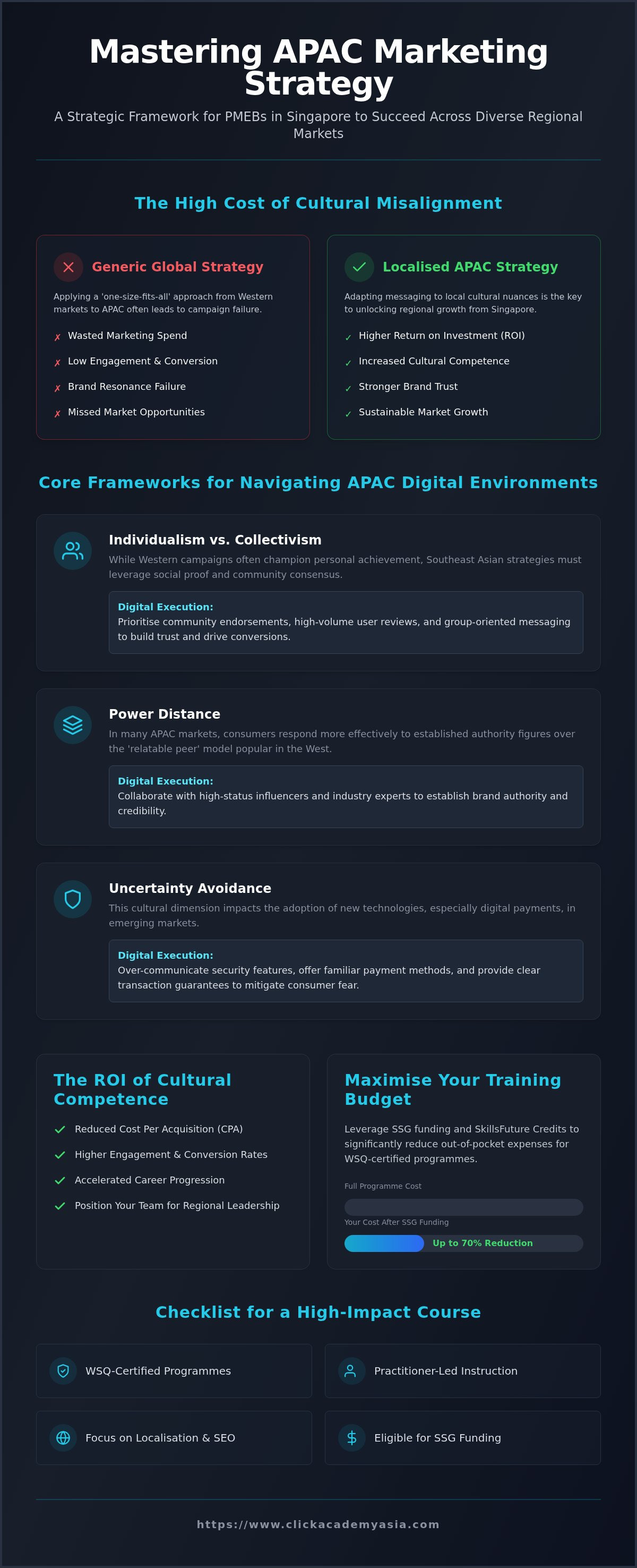
Aligning your creative with local cultural values directly reduces your Cost Per Acquisition (CPA). When a digital ad feels native rather than 'imported', engagement rates climb. In regional e-commerce, cultural trust signals, such as specific payment preferences or community-based social proof, are the primary drivers of conversion rates. Mastering these Core Frameworks for Regional Branding allows PMEBs to move from executing local tactics to leading regional growth, a shift that significantly accelerates career progression. It's about becoming a strategic advisor who understands how to bridge the gap between global headquarters and local market realities.
Navigating the 2026 APAC Consumer Landscape
The middle class in emerging markets like Thailand and Vietnam is expanding rapidly, creating a massive appetite for Singaporean exports and services. However, a 'one-size-fits-all' strategy is a recipe for wasted marketing spend in these diverse digital ecosystems where consumer expectations are now hyper-localised. Regional strategy is a technical requirement for 2026 marketing performance, demanding a sophisticated understanding of platform-specific behaviours across different territories. By choosing a practitioner-led regional marketing strategy course at ClickAcademy Asia, you'll gain the frameworks needed to capture this growth without the trial-and-error costs that plague uncertified teams.
Core Frameworks for Navigating Diverse Digital Environments in APAC
Success in regional expansion requires more than a standard business plan; it demands the translation of cultural theory into digital execution. A comprehensive regional marketing strategy course provides the bridge between academic frameworks like Hofstede’s Cultural Dimensions and the practical realities of user experience (UX) design. For instance, while Western campaigns often celebrate 'Individualism' with a focus on personal achievement, Southeast Asian strategies must leverage 'Collectivism' through robust social proof. In markets like Indonesia or Vietnam, your digital assets should prioritise community endorsements and high-volume review counts to build the necessary trust for conversion.
Understanding 'Power Distance' is equally vital when selecting your influencer mix or defining brand authority. In many APAC territories, consumers respond more effectively to established authority figures and high-status influencers compared to the 'relatable peer' model favoured in the West. Additionally, 'Uncertainty Avoidance' plays a critical role in the adoption of digital payment methods. When launching in emerging markets, your checkout interface must over-communicate security features and escrow guarantees to mitigate the inherent fear of transaction failure. These Core frameworks for APAC digital environments ensure that your strategy is built on data-driven cultural insights rather than assumptions.
High-Context vs. Low-Context Digital Messaging
Messaging that works in Singapore or Australia may fall flat in high-context markets like Thailand or Japan. In these regions, visual storytelling and emotive content carry more weight than direct, text-heavy copy. Conversely, lower-context environments like Hong Kong prefer direct, benefit-driven communication that respects the user's time. PMEBs should use this checklist to audit their regional ad copy:
Visual Hierarchy: Does the imagery convey the brand's 'vibe' before the user reads a single word?
Directness: Is the call-to-action appropriately polite or is it too aggressive for local etiquette?
Contextual Cues: Are you using local idioms and cultural references that resonate with the target demographic?
Psychological Triggers in APAC Digital Assets
Localising digital design goes beyond translation. It involves a deep dive into the psychological triggers that drive action in specific borders. This includes localising imagery to reflect local demographics and lifestyle aspirations, ensuring users see themselves in your brand story. Colour palettes also require careful selection; red might signify luck and prosperity in Vietnam, but other shades could inadvertently signal mourning or instability elsewhere. ClickAcademy Asia integrates these psychological triggers into their strategic programmes, helping you build assets that connect on a subconscious level. If you want to refine these skills, consider how a practitioner-led regional marketing strategy course can provide the hands-on experience needed to master these subtle yet powerful nuances.
Evaluating Professional Training: WSQ Certification vs. Academic Seminars
Not all professional development is created equal. Academic seminars often lean toward high-level theory that feels detached from the daily grind of campaign optimisation. Online-only bootcamps, while convenient, frequently lack the local context and accreditation weight required in the Singapore business ecosystem. A robust regional marketing strategy course should provide a middle ground; it pairs the prestige of a professional certification with the agility of modern digital tactics.
Practitioner-led training is where the real value lies. Trainers who have actively managed regional APAC brands bring a level of insight that textbooks simply cannot replicate. They understand the nuances of local regulations and consumer psychology across different borders. Additionally, the networking value of joining a cohort of Singapore-based regional marketing leads cannot be overstated. You aren't just gaining a certificate; you're gaining a community of peers who are navigating the same complex markets.
The Value of the WSQ Framework for Singaporean PMEBs
The WSQ framework ensures your skills remain industry-relevant and portable throughout your career in Singapore. It provides a standardised benchmark that validates your ability to handle complex regional portfolios and high-stakes digital budgets. For PMEBs, this certification is a powerful tool for career progression, signalling a mastery of both strategy and execution. To see how these modules align with your professional goals, check out our detailed breakdown of WSQ digital marketing courses in Singapore.
Practical Application: Beyond Classroom Theory
Practical Strategies for Executing a Regional Marketing Strategy
Regional Social Media Localisation in 2026
The 'Shoppertainment' trend on TikTok has redefined digital retail, but its execution must vary by border to be effective. In Singapore, consumers often respond to high-production value and clear utility in their feeds. In contrast, Indonesian audiences typically favour raw, authentic live-streaming sessions that feel like a community event rather than a corporate broadcast. Using local influencers who authentically represent the target culture is no longer optional; it's the only way to build genuine brand trust in 2026. ClickAcademy Asia helps managers master these regional social media trends by providing frameworks that go beyond platform basics to focus on cultural resonance.
Cross-Cultural SEO and Keyword Intelligence
Direct translation of keywords is a common pitfall that leads to wasted marketing spend and poor organic visibility. For example, searchers in Thailand or Vietnam often use local dialects, modern slang, or specific cultural references that generic translation tools miss. Understanding search intent requires a deep dive into how local populations actually speak and search in their daily lives. This is why mastering advanced keyword research strategies is critical for regional success. By localising your SEO intelligence, you ensure your brand appears exactly where your customers are looking, using the language they actually use.
Ready to lead your brand's expansion with confidence? Enrol in a regional marketing strategy course at ClickAcademy Asia today to gain the practical skills needed for APAC mastery.
Maximising Your Training Budget: Leveraging SSG Funding for Regional Marketing
Investing in a regional marketing strategy course shouldn't be a financial burden. In 2026, the Singapore government continues to provide robust support through SkillsFuture Singapore (SSG) to ensure our workforce remains globally competitive. Whether you're an individual PMEB looking to pivot into a regional role or an HR leader tasked with upskilling an entire department, the WSQ-accredited curriculum at ClickAcademy Asia offers a cost-effective pathway to mastery. By leveraging these grants, you can bridge the gap between local execution and regional leadership without exceeding your annual training budget.
Strategic Use of SSG Grants and Absentee Payroll
Singapore Citizens and Permanent Residents (PRs) benefit from a baseline subsidy of up to 50% for SSG-supported courses. If you're aged 40 and above, the Mid-Career Enhanced Subsidy (MCES) covers up to 90% of the programme fees. Employers can also tap into the SkillsFuture Enterprise Credit (SFEC) to offset up to 90% of out-of-pocket expenses. Additionally, companies can claim Absentee Payroll to help manage the manpower costs associated with staff being away for training. This co-payment model ensures that high-level regional training remains accessible to all levels of the organisation.
HR managers should strategically select WSQ modules that fill specific skill gaps within their regional marketing departments. For instance, pairing a module on digital advertising with one on marketing analytics ensures your team can both execute and measure cross-border campaigns effectively. This targeted approach to upskilling maximises the return on your training investment while building a more resilient, future-ready workforce.
Next Steps: Equipping Your Team for APAC Success
Before enrolling, we recommend conducting a thorough skill gap audit of your team's current regional communication abilities. Identify where your campaigns are stalling; is it a lack of cultural SEO intelligence or a misunderstanding of Southeast Asian social commerce trends? Once identified, you can build a modular learning roadmap that starts with foundational digital strategy and culminates in regional leadership. Our team at ClickAcademy Asia specialises in designing customised corporate group training that aligns your entire regional team with your specific business objectives. Reach out to us to explore how our WSQ-accredited tracks can future-proof your organisation's APAC strategy and ensure your brand remains a leader in the regional landscape.
Future-Proof Your Regional Leadership in Singapore
Mastering the APAC market requires a decisive shift from generic digital tactics to deep cultural intelligence. Enrolling in a regional marketing strategy course provides the technical frameworks needed to lead multi-market teams with confidence; it ensures your path to mastery is both high-impact and cost-effective through SSG-funded training.
Perform a cultural audit of your current digital assets to identify visual or tonal misalignment in specific territories.
Localise your SEO intelligence by replacing direct keyword translations with terms that reflect local dialects and search intent.
Map your platform strategy to match dominant regional apps like Zalo or Line rather than relying solely on global networks.
Maximise your budget by utilising the SkillsFuture Mid-Career Enhanced Subsidy to cover up to 90% of your programme fees.
[Internal Link: Equip your team with regional marketing expertise through ClickAcademy Asia's WSQ-funded courses today.]
It's time to bridge the gap between local execution and regional excellence. We're here to support your journey toward becoming a results-driven leader in the APAC landscape.
Frequently Asked Questions
What is a regional marketing strategy course?
A regional marketing strategy course is a professional programme designed to equip marketers with the technical frameworks needed to adapt brand messaging across diverse APAC territories. Unlike general marketing classes, these courses focus on cultural nuances, platform-specific behaviours, and multi-market execution. At ClickAcademy Asia, we bridge the gap between global brand theory and local digital performance, ensuring that Singaporean PMEBs can lead cross-border campaigns with the precision required for the 2026 digital economy.
Are these courses eligible for SkillsFuture Credit in Singapore?
Yes; most WSQ-certified programmes at ClickAcademy Asia are eligible for SkillsFuture Credit and SSG funding. Singapore Citizens and Permanent Residents can access baseline subsidies of up to 50%, while those aged 40 and above may qualify for the Mid-Career Enhanced Subsidy of up to 90%. Additionally, eligible individuals can use their S$4,000 SkillsFuture Credit mid-career top-up to offset out-of-pocket costs, making high-level upskilling for regional leadership roles highly accessible for Singaporean professionals.
How does cross-cultural communication affect digital marketing ROI?
Cross-cultural communication directly impacts your digital marketing ROI by reducing Cost Per Acquisition (CPA) and increasing conversion rates. When campaigns respect local cultural dimensions and trust signals, engagement levels rise because the content feels native rather than imported. Conversely, cultural misalignment leads to wasted marketing spend and brand distrust. Mastering these nuances through a regional marketing strategy course allows you to optimise your budget by ensuring every dollar spent resonates with the specific psychological triggers of your audience.
What is the difference between a WSQ course and a traditional university seminar?
The primary difference lies in practical application and government accreditation. WSQ courses are practitioner-led programmes that focus on hands-on skills and real-world APAC case studies, whereas university seminars often prioritise academic theory and high-level research. Additionally, WSQ certifications are specifically designed to meet Singapore's industry standards and are eligible for SSG funding. This makes them a more agile and cost-effective choice for PMEBs who need immediate, actionable insights to manage complex regional portfolios.
Can this training be customised for specific APAC markets like Indonesia or Vietnam?
Absolutely; ClickAcademy Asia provides customised corporate group training tailored to your organisation's specific regional objectives. We can focus the curriculum on particular markets like Indonesia, Vietnam, or Thailand, addressing unique digital ecosystems such as Zalo or social commerce trends. This bespoke approach ensures your team gains deep expertise in the territories most critical to your business growth, allowing for a more targeted and effective regional marketing strategy that aligns with your corporate goals.
Who should attend a regional marketing strategy course?
This training is ideal for PMEBs, marketing managers, and business leaders who are responsible for expanding brands across the APAC region. It's also highly beneficial for HR decision-makers looking to upskill their teams for regional roles. If you find your current campaigns underperforming due to cultural misalignment or struggle to navigate diverse digital platforms, a regional marketing strategy course will provide the strategic frameworks needed to improve your campaign performance and leadership capabilities.
How long does it take to complete a professional certification in regional marketing?
The duration varies depending on the specific programme, but most professional certifications at ClickAcademy Asia are designed for busy PMEBs. We offer intensive workshops and bootcamps that can be completed in a few days, as well as modular pathways that allow for long-term learning. This flexibility ensures you can balance upskilling with your professional responsibilities while still achieving a recognised WSQ certification that validates your expertise in regional marketing strategy and digital execution.
What are the most common mistakes brands make when expanding into Southeast Asia?
The most frequent error is adopting a 'one-size-fits-all' approach that ignores the vast cultural and digital diversity within Southeast Asia. Brands often rely on direct translations of Western campaigns, which fail to capture local search intent or emotional triggers. Other common mistakes include overlooking dominant local platforms and failing to adapt conversion journeys to local payment preferences. These oversights lead to poor ROI and can be avoided with the structured frameworks provided in a regional marketing strategy course.



Comments