
Building a Customer Loyalty Program That Increases Profit: A 2026 SINGAPORE Guide
- ClickAcademy Asia

- Jul 31
- 12 min read
Updated: Aug 9
What if your rewards programme is actually draining your margins instead of protecting them? Many corporate leaders and PMEBs in SINGAPORE are currently struggling with building a customer loyalty program that increases profit while facing record-high customer acquisition costs (CAC) across the APAC region. You likely feel that your current "points-only" schemes are simply giving away profit to customers who would have purchased anyway, leaving you without the hard data needed to prove ROI to your stakeholders.
It's time to shift your perspective from reactive discounting to strategic value creation. We'll show you how to move beyond basic rewards to design a sophisticated system that drives predictable revenue streams by focusing on long-term customer lifetime value (CLV) and referral loops. This guide provides the strategic framework for designing and optimising a programme that moves beyond simple rewards to drive measurable bottom-line growth.
By the end of this article, you'll understand how to apply data-driven marketing principles and WSQ-aligned strategies to your retention efforts. We'll examine how to leverage GA4 insights and local frameworks to ensure your loyalty initiatives are both measurable and sustainable in the competitive 2026 landscape. This approach ensures your marketing spend is an investment in growth rather than a drain on your resources.
Table of Contents
The Strategic Shift: Building a Customer Loyalty Program That Increases Profit in SINGAPORE
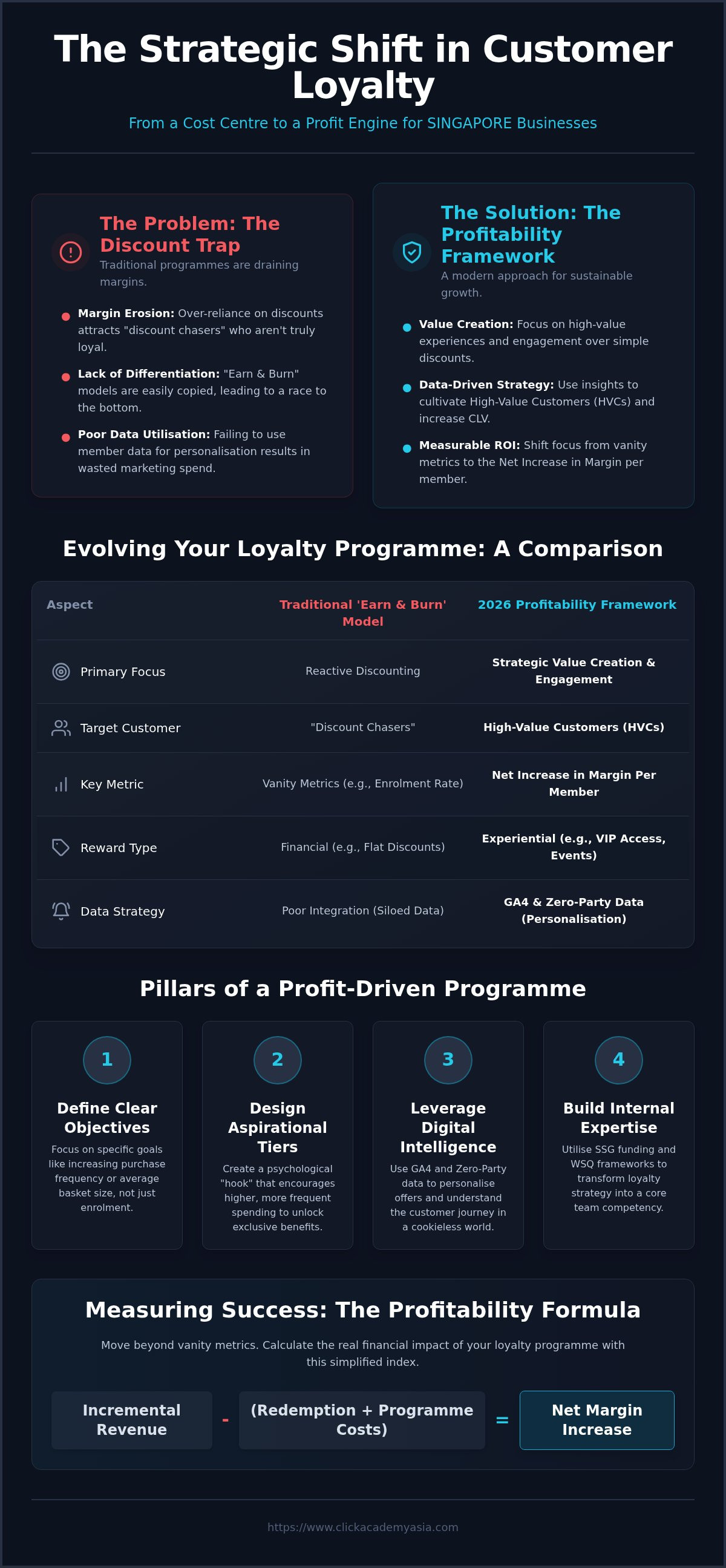
The SINGAPORE market in 2026 is increasingly unforgiving for businesses relying on old-school tactics. With digital ad costs across the APAC region reaching new peaks, the cost of acquiring a single new customer often exceeds the profit from their first transaction. This reality makes building a customer loyalty program that increases profit a strategic necessity rather than a marketing luxury. Traditional models often focus on "Earn and Burn" mechanics; customers simply hoard points to redeem for deep discounts that eventually erode your bottom line.
To stay competitive, you must move toward engagement-based loyalty. This means rewarding behaviours like social sharing, product reviews, or community participation, which build brand equity without immediate margin hits. A well-structured customer loyalty program prioritises high customer lifetime value (CLV) because retained customers typically spend more and cost less to serve. By focusing on net profit per member, you transform your marketing department from a cost centre into a genuine revenue engine.
Why Traditional Loyalty Programmes Often Fail
Most programmes fall into the "Discount Trap." When rewards are purely financial, you attract "Discount Chasers" who leave the moment a competitor offers a better coupon. This lack of differentiation is a major hurdle. If your rewards look exactly like your competitor's, you aren't building loyalty; you're participating in a race to the bottom. Friction is another silent killer. Complicated redemption processes or opaque terms lead to low active participation rates, leaving your database full of ghost accounts that provide zero value.
Margin Erosion: Over-reliance on discounts that cut directly into net profit.
Lack of Data: Failing to use member data to personalise offers and reduce waste.
Poor Integration: Loyalty systems that don't talk to your POS or CRM, creating a disjointed user experience.
The 2026 Profitability Framework for Retention
To succeed, PMEBs must calculate a "Loyalty Profit Index" that weighs redemption costs against incremental revenue. This allows you to identify your High-Value Customers (HVCs), the top segment who drive the majority of your profit, and tailor exclusive, non-monetary experiences for them. This might include early access to new launches or VIP service tiers that provide high perceived value at low operational cost. Developing these strategies requires a deep understanding of modern consumer behaviour; you can refine these leadership skills through the strategic modules found at ClickAcademy Asia.
When you focus on building a customer loyalty program that increases profit, you're essentially engineering a sustainable growth loop. You're no longer just giving away points; you're investing in data-driven relationships that pay dividends over time. Profit-driven loyalty is the intersection of data intelligence and customer reciprocity.
Step-by-Step: Structuring Your Programme for Maximum ROI
Execution is where most loyalty initiatives fail or succeed. To move from a cost centre to a profit engine, you must start with a singular business objective. Are you trying to increase purchase frequency, grow the average basket size, or drive brand advocacy? Without this clarity, you risk over-rewarding behaviours that don't actually move the needle on your net margin. When Building a Successful Loyalty Program, your design must prioritize high perceived value with low marginal cost.
Step 1: Financial Modelling and Margin Protection
You must set reward thresholds that protect your break-even point at all times. This involves rigorous financial modelling to ensure that the cost of the reward is always lower than the incremental profit generated by the increased activity. Incorporating "breakage"—the percentage of points or vouchers that are never redeemed—is a critical part of your liability management. If you don't account for breakage, you'll find your balance sheet weighed down by unfulfilled promises that drain your cash flow. Mastering these complex calculations is easier when you upskill your team in marketing analytics to ensure every decision is backed by hard data.
Step 2: Choosing the Right Loyalty Mechanics
The choice between a tiered system and a subscription-based "Prime" model depends on your customer's purchase cycle. Tiered systems work best for high-frequency retail, while subscriptions can provide a predictable revenue stream for services or luxury goods. Gamification also plays a major role in the 2026 landscape. Adding progress bars, badges, or "surprise and delight" milestones drives non-transactional engagement, keeping your brand top-of-mind between purchases.
In the SINGAPORE market, your programme must be mobile-first. PMEBs and corporate leaders expect seamless, one-tap access to their rewards via smartphones. Integrating feedback loops allows you to refine these mechanics based on real-time user behaviour. If a specific tier shows low participation, you can pivot quickly to adjust the value proposition. This agility is what separates profitable programmes from those that simply stagnate.
Leveraging Digital Intelligence and GA4 to Optimise Retention
Data is the fuel that powers modern retention strategies. In the SINGAPORE market of July 2026, relying on third-party cookies is a strategy of the past. To succeed, you must prioritise Zero-Party data. This is information that your customers proactively share with you, such as their preferences, interests, and purchase intentions. Collecting this data not only ensures compliance with the latest PDPA standards but also provides the granular insights necessary for building a customer loyalty program that increases profit. When you understand exactly what your members want, you stop wasting budget on irrelevant offers.
Google Analytics 4 (GA4) has evolved to become a central pillar of this intelligence. As of mid-2026, GA4 features advanced AI-powered insights that can track traffic even from AI assistants and chatbots. This allows you to see how your loyalists interact with your brand across multiple touchpoints before they ever reach a checkout page. By identifying patterns in this data, you can spot "at-risk" customers whose engagement levels are dipping. Predictive analytics then allows you to intervene with a targeted offer before they churn, protecting your long-term revenue streams.
A unified customer view is essential for this process. Your CRM, marketing automation, and loyalty platforms must communicate seamlessly to avoid fragmented experiences. For a PMEB or corporate leader, there is nothing more frustrating than receiving a generic promotion for a product they already purchased. Integrating these systems ensures that every interaction feels personal, relevant, and valuable. This level of sophistication is what transforms a simple points scheme into a high-performance profit engine.
Tracking Loyalty Events in GA4
You should define custom dimensions within GA4 to monitor specific loyalty behaviours. Tracking events like "tier_upgrade," "reward_redemption," and "points_expiry_warning" gives you a clear picture of how your programme impacts user behaviour. You can link this data to your broader marketing analytics and insights to see the direct correlation between loyalty membership and conversion rates. This evidence is vital when you need to prove the ROI of your retention efforts to stakeholders and board members.
Personalisation at Scale
Effective personalisation goes beyond just using a customer's name in an email. Use SEO and content interaction data to understand the specific topics your members are researching. If a group of users frequently engages with content about sales leadership, your programme should offer them exclusive access to advanced management workshops. Automating "Surprise and Delight" moments based on user milestones—such as a "brand anniversary"—creates emotional stickiness. AI now plays a critical role in optimising the timing of these rewards, ensuring they arrive when the customer is most likely to take action.
Measuring Success: Profitability Metrics for PMEBs
Vanity metrics are the silent killers of marketing budgets. While many brands celebrate high enrolment numbers, these figures rarely correlate with actual bottom-line growth. When building a customer loyalty program that increases profit, you must shift your focus toward the Active Participation Rate. This metric tracks the percentage of members who engage with your brand within a specific timeframe, such as 90 days. A database of a million inactive users is a liability; a community of ten thousand active spenders is a gold mine.
You should also closely analyse the Referral Value of your loyalists. In the SINGAPORE market, word-of-mouth remains a powerful driver of trust. Loyal customers who refer friends effectively reduce your overall customer acquisition cost (CAC), allowing you to reinvest those savings into high-margin rewards. By tracking the "Net Increase in Margin" per loyalty member, you can see the clear financial impact of your retention efforts. This involves subtracting the total cost of rewards and operational overheads from the incremental profit generated by member-only transactions.
Churn rate analysis is equally critical, especially within your top-tier segments. If your most valuable customers are leaving, it signals a fundamental flaw in your value proposition. Identifying these trends early through WSQ Marketing Analytics & Insights training allows you to pivot your strategy before the loss becomes significant. Profitability isn't just about making more; it's about keeping more of what you make.
Revenue vs. Profit Metrics
To truly understand your programme's performance, you must distinguish between gross revenue and net profit. Use the following table as a template for your internal reporting to ensure you aren't overvaluing low-margin sales.
Incremental Margin is the key KPI for 2026 loyalty leads; it measures the additional profit earned from a customer specifically because they are part of your programme.
Reporting to the C-Suite
When presenting to corporate leaders, frame your loyalty programme as a long-term asset rather than a marketing expense. Use data visualisation to show how customer lifetime value (CLV) grows over time, creating a predictable revenue stream that stabilises your business against market volatility. Referencing a [External Link: local industry study on Singapore consumer loyalty trends] can provide the necessary regional context to support your claims. Building a customer loyalty program that increases profit requires a mindset shift at the highest levels of leadership, moving from short-term wins to sustainable, data-driven growth.
Upskilling Your Team via WSQ Frameworks for Loyalty Excellence
Outsourcing your loyalty strategy often feels like a convenient shortcut, but it rarely provides the deep, data-driven integration required for building a customer loyalty program that increases profit. Your internal team possesses the institutional knowledge and brand passion that an external agency cannot replicate. By keeping these capabilities in-house, you ensure every retention tactic aligns perfectly with your specific business objectives and local SINGAPORE market nuances. It's about owning your data and the strategy that drives it, rather than renting it from a third party.
The national SkillsFuture movement and the WSQ framework provide a robust structure for this internal growth. These programmes aren't just about learning theory; they're about practical mastery in areas like advanced digital strategy and keyword research. WSQ-certified courses standardise excellence across your team, ensuring every member follows a proven, industry-recognised framework. This consistency is vital when managing multi-tier rewards or complex referral loops that require high-level coordination.
Leveraging SSG Funding for Professional Development
For SINGAPORE citizens and PRs, SSG funding significantly lowers the financial barrier to high-level training in 2026. PMEBs can access substantial subsidies for WSQ-accredited modules, making it feasible to upskill an entire department without straining the corporate budget. This investment reduces the long-term cost of digital transformation by creating a self-sufficient workforce capable of managing complex loyalty ecosystems. A team trained in these frameworks can navigate the evolving APAC landscape with confidence and technical precision.
Upskilling your staff also acts as a retention tool in itself, as employees feel valued and empowered by the investment in their career growth. When your marketing team understands how to use GA4 for predictive analytics or how to structure a tier-based system, they become strategic assets. This internal expertise allows your business to pivot quickly when market conditions change, ensuring your loyalty initiatives remain profitable and relevant. It transforms your workforce into a vital partner for future-proofing your brand's market position.
Next Steps: Enrolling in WSQ Digital Marketing Strategy
To begin this transformation, you should audit your current team's skills gap, specifically looking at data analytics and strategic planning. Key WSQ modules cover everything from consumer privacy laws to advanced customer database management. These skills are the building blocks for any modern retention strategy. Identifying where your team needs support is the first step toward building a more resilient and profitable business model.
Don't let your loyalty strategy stagnate with outdated "points-only" thinking. Equip your team with the skills to build a customer loyalty program that increases profit by exploring [Internal Link: ClickAcademy Asia WSQ courses]. By taking advantage of SSG funding and WSQ frameworks, you're not just buying a course; you're investing in a sustainable revenue engine for 2026 and beyond.
Future-Proof Your Retention Strategy for 2026
The path to sustainable growth in SINGAPORE requires moving beyond generic points systems. You've seen how shifting to value-added experiences and leveraging GA4 for predictive intelligence protects your margins while driving engagement. By focusing on net profit per member and referral loops, you effectively lower your CAC and build a resilient revenue stream. Successfully building a customer loyalty program that increases profit is ultimately a data-science and leadership challenge that requires a mindset shift from the C-suite down to the marketing floor.
Relying on internal expertise rather than outsourcing ensures your strategy remains agile and deeply integrated with your business goals. This transformation is highly accessible through local frameworks designed to support PMEBs in their professional journey. As a trusted partner to professionals across 30+ countries and an official Google and GA4 training partner, we are here to support your team's development. Empower your team to drive profitability through our WSQ-certified and SSG-funded Digital Marketing Strategy & Planning programmes.
Take the next step toward mastering the 2026 landscape. Your commitment to practical mastery will define your brand's leadership in the years to come.
Frequently Asked Questions
How much does it cost to build a loyalty program in SINGAPORE?
Implementation costs vary based on whether you utilise a pre-approved digital solution or a custom-built platform. Businesses in SINGAPORE often leverage the Productivity Solutions Grant (PSG) to offset up to 50% of the cost for CRM and loyalty software. Beyond the technology, you must budget for the internal staff time required to manage the programme and the marginal cost of the rewards themselves.
Can a loyalty program really increase profit margins?
A well-designed system increases margins by shifting focus from expensive acquisition to high-value retention. When building a customer loyalty program that increases profit, you reduce the reliance on broad discounts that erode your bottom line. By targeting your High-Value Customers (HVCs) with personalised offers, you ensure that your marketing spend generates a significantly higher return per transaction.
What are the best WSQ courses for learning loyalty strategy?
The WSQ Digital Marketing Strategy & Planning and WSQ Marketing Analytics & Insights courses are ideal for mastering retention. These programmes provide the structured framework needed to design, implement, and measure a profit-centric loyalty ecosystem. They cover critical areas like consumer privacy laws and data-driven decision-making which are essential for navigating the 2026 landscape.
How do I measure the ROI of my loyalty rewards?
Measuring ROI requires tracking the incremental profit generated by members versus non-members. You should calculate the 'Net Increase in Margin' per member after accounting for the cost of rewards and operational overheads. Moving beyond enrolment rates to monitor the Active Participation Rate ensures you are measuring genuine engagement that leads to predictable revenue streams rather than vanity metrics.
Is SSG funding available for corporate loyalty training?
Yes, SSG funding is available for eligible SINGAPORE citizens and Permanent Residents (PRs) attending WSQ-certified training. This support makes advanced professional development accessible for PMEBs looking to build internal capabilities. Corporate leaders can leverage these subsidies to upskill their entire marketing department, reducing the long-term reliance on expensive external digital marketing agencies.
What happens if my customers only join for the discounts?
If customers only join for discounts, your programme is likely lacking differentiation and emotional stickiness. You should introduce engagement-based rewards and aspirational tiers that provide exclusive access or VIP services. For example, offering premium wellness gifts can enhance member satisfaction; learn more about Royal Bird's Nest for a look at high-tier reward options. These non-monetary benefits have high perceived value but low marginal cost, helping your business move away from the "Discount Trap" that destroys profit margins.
How do I integrate GA4 with my existing loyalty platform?
Integrating GA4 involves setting up custom events and dimensions to track specific loyalty touchpoints like reward redemptions and tier upgrades. You can use Google Tag Manager (GTM) to pass loyalty member IDs and tier status into your GA4 reports. This setup allows you to analyse the correlation between loyalty membership and long-term conversion rates with high technical precision.
Can small businesses in SINGAPORE benefit from WSQ-funded marketing programmes?
Small businesses can certainly benefit from WSQ-funded marketing programmes to build a competitive edge. SMEs in SINGAPORE often have access to higher subsidy rates and can use government grants like the PSG to adopt digital tools. Upskilling your team through a WSQ framework ensures that your small business applies the same data-driven strategies used by global industry leaders.


Comments